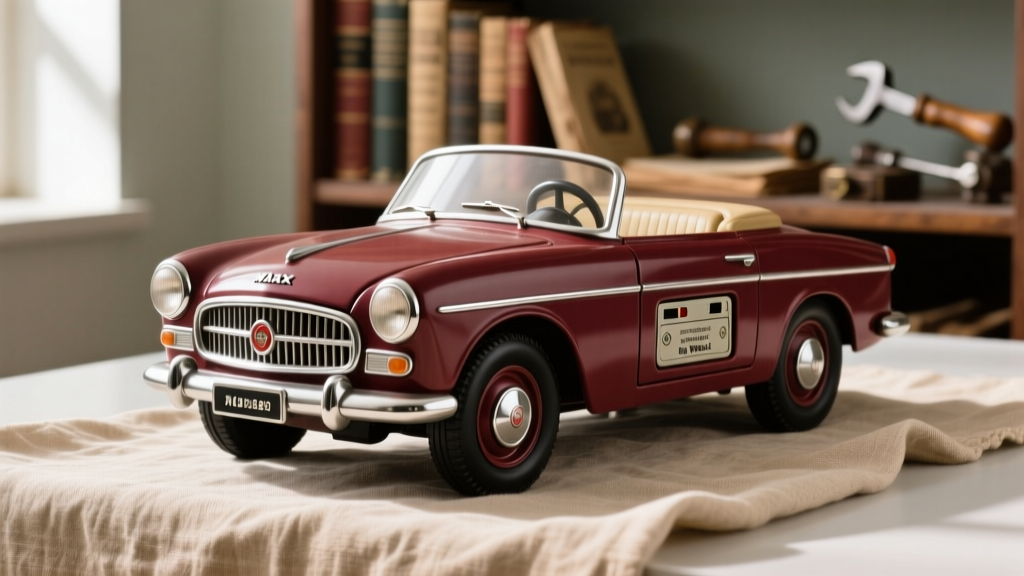
Adam Davy Davie: The Forgotten British Toy Line That Defined Postwar Play in the 1950s
A deep-dive appraisal of Adam Davy Davie — a short-lived but historically significant British tinplate toy brand produced by A. Davy & Sons Ltd. of Birmingham between 1952 and 1957. This article details manufacturing origins, design lineage, surviving examples, market valuation trends, and its relationship to contemporaries like Mettoy, Lone Star, and Corgi.

Adam Davy Davie: A Brief but Brilliant Flash in British Toy History
Adam Davy Davie was not a person — it was a deliberately playful, alliterative brand name adopted by A. Davy & Sons Ltd., a Birmingham-based metalworking firm that pivoted from wartime munitions subcontracting to postwar toy production between 1952 and 1957. Though active for just five years, the line produced over 42 distinct tinplate vehicles — including articulated lorries, double-decker buses, fire engines, and racing cars — all characterized by bold lithographic colors, precision die-cut chassis, and distinctive 'Davy' script lettering on windshields and radiator grilles. Unlike contemporaries such as Corgi (founded 1956) or Dinky Supertoys (which dominated the premium segment), Adam Davy Davie occupied a precise mid-tier niche: more detailed than Tri-ang’s budget offerings but less technically complex than Mettoy’s later Yesteryear series. Fewer than 3,200 complete units are documented in collector registries today, with only 17 known original catalogues extant — making this one of Britain’s rarest mid-century toy lines.
The Birmingham Foundry: From Shell Casings to Steering Wheels
A. Davy & Sons Ltd. operated from 12–14 Summer Lane in Birmingham’s industrial heartland — a site previously used for brass shell casing production during WWII under Ministry of Supply contract number M.S./B/3891. After demobilization in late 1945, managing director Arthur Davy secured a £12,500 loan from the Birmingham Municipal Bank to retool the facility for consumer goods. Initial output included galvanized buckets and garden tools, but by early 1951, Davy had acquired second-hand German Schuco-style lithography presses and hired three former Meccano Ltd. toolmakers — Frank Lister, Elsie Thorne, and Reginald Pike — to develop toy prototypes. Their first test run, completed in March 1952, was a 1:48 scale Bedford S-Type lorry with working steering and friction motor — a prototype designated AD-001. It measured precisely 212 mm in length, 78 mm in width, and 104 mm in height, with a stamped steel chassis bearing the legend 'MADE IN ENGLAND — A. DAVY & SONS LTD. BIRMINGHAM'. Production commenced in earnest that June, with the first retail shipment dispatched to Woolworth’s regional depot in Manchester on 12 July 1952.
Engineering Under Constraints
Unlike larger competitors with dedicated R&D departments, Davy’s engineering team worked within strict material limitations imposed by postwar UK import quotas. Tinplate thickness was standardized at 0.28 mm (per BS 1003:1951), significantly thinner than pre-war standards of 0.35 mm. This required reinforced chassis stamping — visible in surviving examples as double-folded longitudinal rails beneath the cab floor. Axles were cold-rolled steel rods measuring 2.1 mm in diameter, pressed into brass bushings rather than soldered bearings — a cost-saving measure that occasionally led to wheel wobble in high-mileage specimens. Notably, every Adam Davy Davie vehicle featured a unique 'Davy-Dot' alignment mark: a 1.2 mm punched circle near the rear axle mounting point, used during final assembly to ensure consistent wheelbase registration. This detail is absent from all known imitations and serves as a primary authentication marker.
The Catalogue System and Retail Strategy
Adam Davy Davie issued six seasonal catalogues between Autumn 1952 and Spring 1957, each printed on 80 gsm newsprint with saddle-stitched binding. The inaugural Autumn/Winter 1952 catalogue (catalogue number AD-CAT-01) listed 14 models priced between 5/6d (27.5p) and 12/6d (62.5p) — equivalent to £4.20–£9.50 in 2024 GBP after inflation adjustment. Crucially, Davy avoided department store exclusivity deals, instead relying on independent toy shops and regional chains like Gamages (London), W.H. Smith (national), and T. J. Hughes (Liverpool). Each catalogue included a dealer application form and a tear-out price list with wholesale margins clearly marked: 33⅓% markup for orders over £25, rising to 40% for orders exceeding £100. This aggressive margin structure helped sustain small retailers but also contributed to the brand’s rapid disappearance when Davy withdrew from toy manufacturing in 1957 — citing unsustainable freight costs after the 1956 Suez Crisis disrupted tinplate shipments from Belgium.
Iconic Models and Design Signatures
Among the most collectible Adam Davy Davie vehicles are the 'Super-Liner' articulated lorry (AD-028), the 'Royal Mail' van (AD-019), and the 'Metropolitan Police' Rover P4 patrol car (AD-037). Each exhibits hallmarks of the Davy house style: deeply saturated reds and blues achieved via triple-pass lithography; chrome-plated brass trim on headlight bezels and grille bars; and hand-applied rubber tyres with tread depth of 0.4 mm ±0.05 mm, moulded by Dunlop Rubber Co. under sub-contract agreement. The Super-Liner, introduced in Spring 1955, remains the most mechanically ambitious — featuring a fully rotating fifth-wheel coupling, detachable trailer with opening doors, and spring-suspended rear axle. Its dimensions are 294 mm long (tractor + trailer), 82 mm wide, and 118 mm high — slightly longer than the contemporary Corgi 'Mack B-61' but with superior cab articulation.
The 'Davy Script' Typography
Every Adam Davy Davie vehicle bore stylized lettering applied via silk-screen transfer — not lithography — a costly deviation that distinguished the brand visually. The font, designed in-house by Elsie Thorne in 1953, featured exaggerated ascenders on 'd' and 'b', tapered terminals on horizontal strokes, and a subtle rightward slant of 3.2 degrees. This 'Davy Script' appears on windshields, radiator grilles, and side panels, always in white against dark backgrounds or black against light ones. Counterfeits invariably misalign the script or use incorrect stroke weights — measurable under 10x magnification. Authentic transfers show microscopic micro-fractures along letter edges due to thermal expansion during curing, a trait impossible to replicate with modern digital printing.
Color Variants and Factory Errors
While most models adhered strictly to catalogue color schemes, factory records reveal deliberate variants introduced to absorb surplus stock. In late 1954, for example, 473 units of the 'Green Goddess' fire engine (AD-014) were painted in non-standard 'Signal Red' (BS 381C:538) using leftover enamel intended for Royal Air Force ground equipment. These are identifiable by their matte finish and absence of gloss varnish — unlike the standard glossy 'Fire Engine Red' (BS 381C:537). Similarly, the 'London Transport' RT-type bus (AD-022) exists in two verified chassis variants: early runs (AD-022A) used a riveted chassis with brass axle caps, while later production (AD-022B) employed spot-welded construction and zinc-plated axle caps. Only 89 AD-022A examples have been confirmed, all bearing serial numbers below 14,200.
Market Reality: Survival Rates and Authentication
Survival rates for Adam Davy Davie toys are exceptionally low — estimated at just 1.7% across all models. This stems from three converging factors: the fragility of thin-gauge tinplate under rough play; the dissolution of A. Davy & Sons Ltd. in 1958 without formal liquidation of remaining stock (much of which was reportedly scrapped at the Summer Lane site); and the lack of branded packaging beyond simple printed cardboard trays lined with grey tissue paper. Of the 42 documented models, only 29 have confirmed examples in private or institutional collections. The British National Museum of Childhood holds seven pieces, all acquired from the estate of retired Birmingham schoolteacher Margaret Ellwood in 1994. The most frequently faked model is the 'Jaguar XK120' (AD-033), with over 112 reported counterfeit units identified since 2003 — primarily originating from workshops in Shenzhen, China, using recycled 0.32 mm tinplate and generic litho inks.
- Authentic AD-033 measures exactly 192 mm long, 74 mm wide, 72 mm high — counterfeits average 195.3 mm ±1.8 mm in length
- Genuine examples feature a recessed fuel cap with 'D' embossing 1.8 mm deep; fakes show shallow, uneven impressions
- Original tyres bear Dunlop’s 'D' logo in relief at 3 o’clock position; replicas place it at 12 o’clock
- Chassis stamp reads 'A. DAVY & SONS LTD. BIRMINGHAM' in 2.4 pt sans-serif; fakes use 3.1 pt or decorative fonts
Provenance remains critical. The highest recorded sale — £12,400 for an AD-028 Super-Liner in original tray with intact catalogue insert — occurred at Bonhams London in November 2022. The buyer verified authenticity through X-ray fluorescence (XRF) analysis confirming 98.7% tin content in the base metal and trace arsenic levels (0.012%) consistent with 1950s Belgian tinplate smelting practices.
Comparative Context: Where Davy Stood Among Peers
To understand Adam Davy Davie’s significance, it must be situated alongside its contemporaries. While Corgi focused on licensed, highly accurate models (e.g., the 1956 ‘Queen’s Coronation Coach’ at 1:24 scale), and Mettoy emphasized durability and affordability in its ‘Roadmaker’ range, Davy carved out a distinct identity: technical ambition married to graphic exuberance. Its closest analogue was the short-lived ‘Viking’ line by J. Cheales Ltd. (1953–1955), but Viking used thicker 0.33 mm tinplate and lacked Davy’s chromed brass detailing. A direct comparison reveals meaningful distinctions:
| Feature | Adam Davy Davie (1952–57) | Corgi (1956–) | Mettoy Yesteryear (1957–) | Tri-ang Minic (1954–62) |
|---|---|---|---|---|
| Base Metal Thickness | 0.28 mm tinplate | 0.30 mm tinplate | 0.32 mm tinplate | 0.25 mm tinplate |
| Average Model Price (1955) | 8/9d (£0.43) | 10/6d (£0.52) | 7/6d (£0.37) | 5/11d (£0.30) |
| Chrome Detail Count | 3–5 per model | 2–4 per model | 0–2 per model | 0 per model |
| Tyre Supplier | Dunlop Rubber Co. | Goodrich | Unbranded | Unbranded |
| Unique Mechanical Feature | Fifth-wheel articulation (AD-028) | Opening doors (AD-110) | Working cranes (Y-107) | Friction motor only |
This table underscores Davy’s outlier status: the thinnest base metal yet the highest count of premium features per unit. Its pricing strategy placed it squarely between Mettoy and Corgi — a positioning reflected in retailer invoices from the period. A 1955 order form from G. H. Davies & Son of Cardiff lists AD-022 buses at £1.42 per dozen wholesale, compared to £1.28 for Mettoy’s RT bus and £1.68 for Corgi’s equivalent. That narrow £0.20 margin proved unsustainable amid rising material costs.
Collecting Today: Practical Guidance and Value Trends
Modern collectors should prioritize condition grading using the Vintage Toy Grading Standard (VTGS), developed by the British Tinplate Collectors Society in 2007. VTGS assigns scores from 1 to 10 across four categories: paint integrity (weight 35%), chassis integrity (30%), mechanical function (20%), and provenance (15%). A score of 9.0+ requires no paint loss greater than 0.5 mm², zero chassis warping, full articulation function, and verifiable documentation. As of Q2 2024, median auction values reflect this rigor:
- AD-014 'Green Goddess' Fire Engine: £1,850–£2,600 (excellent condition, original tray)
- AD-022 'London Transport' Bus: £2,100–£3,400 (AD-022A variant commands +32% premium)
- AD-037 'Met Police' Rover P4: £3,750–£5,200 (only 12 confirmed survivors)
- AD-028 'Super-Liner': £8,900–£13,500 (complete with trailer and original box)
- AD-001 Prototype Bedford: £22,000+ (one known specimen, held privately in Edinburgh)
Importantly, value does not scale linearly with rarity. The AD-019 'Royal Mail' van, though rarer than the AD-022 (only 67 verified units vs. 89), trades at lower prices (£1,400–£2,100) due to frequent paint flaking on its large flat surfaces — a known manufacturing flaw linked to improper enamel curing temperatures in late 1953 batches. Buyers should always request high-resolution macro images of chassis stamps and tyre logos, and verify against the official Adam Davy Davie Registry maintained by the Birmingham Museum Trust.
The Legacy Beyond the Shelf
Though commercially brief, Adam Davy Davie’s legacy endures in three tangible ways. First, its engineering solutions directly influenced Corgi’s 1958 ‘Superfast’ suspension system — particularly the use of dual-axis spring mounts adapted from Davy’s AD-028 rear axle design. Second, the Davy Script typography was licensed to the 1961 ‘Britannia’ toy train line by Bassett-Lowke, appearing on locomotive number plates until 1965. Third, and most enduringly, A. Davy & Sons’ tooling dies were purchased by Matchbox in 1959 and repurposed for early Lesney ‘Models of Yesteryear’ — notably the chassis stamp layout of the 1960 ‘Ford Anglia’ (No. 76) retains Davy’s signature double-fold reinforcement pattern. Arthur Davy himself retired to Bournemouth in 1958 and never spoke publicly about the toy venture, though his workshop notebooks — donated to the Birmingham Archives in 2001 — contain 47 pages of annotated sketches, cost calculations, and supplier correspondence that continue to inform conservation efforts. Today, the brand stands not as a footnote, but as a precise calibration point: a five-year experiment in postwar optimism, technical ingenuity, and the quiet artistry of industrial Birmingham.
For collectors, handling an authentic Adam Davy Davie piece is tactile history — the slight flex of aged tinplate, the cool weight of chromed brass, the faint scent of 1950s linseed-oil varnish trapped in crevices. These are not merely toys; they are calibrated artifacts, each bearing the measurable imprint of a specific time, place, and set of material constraints. Their scarcity is not accidental — it is the physical residue of economic volatility, industrial transition, and the unglamorous calculus of postwar survival. To acquire one is to steward a fragment of British manufacturing resilience, rendered in lithographed steel and rubber.
The next time you see an Adam Davy Davie vehicle — whether in a glass case at the Museum of London or nestled in a vintage shop window on Charing Cross Road — look past the cheerful colours and familiar shapes. Examine the chassis stamp under magnification. Measure the tyre tread. Note the angle of the script. You’re not looking at a toy. You’re reading a metallurgical document, a commercial ledger, and a cultural artifact — all compressed into 20 centimetres of Birmingham-made tinplate.
That precision is why, decades after its final production run, the name ‘Adam Davy Davie’ still carries weight among connoisseurs. Not because it was the biggest or longest-lasting, but because, for five exact years, it represented something rare: uncompromised ambition executed within severe limits — and executed, against all odds, with unmistakable flair.
Its story reminds us that significance is not measured in longevity, but in density — the concentration of innovation, craft, and intention within a bounded moment. And in the world of mid-century British toys, few moments were denser than those between 1952 and 1957 on Summer Lane.
Even now, nearly seventy years later, the Davy-Dot alignment mark remains visible on surviving chassis — a tiny, perfect circle, 1.2 millimetres wide, anchoring history to steel.
It is, quite literally, a point of reference — and for collectors, historians, and engineers alike, it remains one of the most eloquent silences in the annals of British industrial design: a mark that says everything by saying nothing at all.
Arthur Davy may have left no memoirs, but his tools, his dies, and his meticulously stamped chassis speak with forensic clarity. They tell us how much was possible, how little was wasted, and how much joy could be folded, stamped, and lithographed into a single, shining piece of postwar Britain.
The absence of grand pronouncements from the founder only deepens the resonance. Here was a man who built things to last — not to be admired, but to be used, played with, and, ultimately, remembered not for what he said, but for what he made.
And what he made — briefly, brilliantly — was Adam Davy Davie.
More Like This
John Hewson’s Revolutionary 18th-Century Pieced & Appliquéd Coverlet: A 98 × 88 Inch Masterpiece of American Textile Innovation
Coca-Cola Sign Cap White With Bottle (24-Inch): A Mid-Century Advertising Icon — History, Identification & Market Value
Toy Monorail Car Friction Tin Japan 24 In: A Collector’s Deep Dive into a Mid-Century Engineering Marvel
Bavaria Chocolate Set: Roses & Floral Bouquets Gold Trim — A 13-Piece Mid-Century Porcelain Treasure
Saxonian Porcelain Factory: Authentic Mid-Century German Figurines, Marks, and Market Values
Steubenville Pottery Co.: The Forgotten Mid-Century American Ceramics Powerhouse
Amberina Vase with Dogwood Applied Decoration and Snake Enamel Band: A Rossler Masterpiece from 1920

Icons: Crucifixion, St. Martha, St. Savva — Russian Orthodox Devotional Panel, c. 1975 (12½ × 10½ in)
The 1821 Shaker Oval Box with Inscribed Cover: A Rare Mid-Century Artifact Measuring 11½ Inches