About Us: Preserving Mid-Century Toy History, One Authentic Piece at a Time
Learn how our vintage toy appraisal and curation practice—founded in 1998 and rooted in decades of hands-on collecting—authenticates, documents, and conserves mid-century American and European toys with scientific rigor and deep historical respect.
Our Origins: From Basement Archive to Curatorial Practice
Founded in 1998 in Columbus, Ohio, our practice began not as a business but as a meticulously organized personal archive. What started as a single cedar-lined cabinet housing 47 original 1950s Marx plastic soldiers—each cleaned, cataloged by mold number, and stored at 65°F and 45% relative humidity—grew into a recognized resource for museums, insurers, and serious collectors. We do not sell toys; we authenticate, appraise, conserve, and document them. Our founder, Eleanor V. Hayes, began collecting at age nine after inheriting her grandfather’s 1949 Lionel 2333 Hudson locomotive (16.5 inches long, 1:48 scale, stamped 'Lionel Corp., New York, NY' on the tender). That locomotive remains in our reference collection today—fully operational, with original 1949 rubber traction tires and factory-applied Dupont Duco Blue lacquer, verified under 10x magnification.
By 2003, demand for third-party verification surged. Major auction houses—including Heritage Auctions and Bertoia Auctions—began requesting formal condition reports and material analysis for consignments involving pre-1965 American toys. In response, we established a dedicated laboratory space in 2005 equipped with a Zeiss Stemi 2000-C stereo microscope, calibrated digital calipers (Mitutoyo Absolute Series, ±0.001 mm accuracy), and a Fluke 971 Temperature/RH data logger. Every item assessed passes through this lab—not as a marketing gesture, but as standard protocol. We maintain a physical logbook for every evaluation, cross-referenced with digital records archived on offline LTO-8 tapes updated quarterly.
The Standards That Define Our Work
We adhere strictly to the American Society of Appraisers’ Uniform Standards of Professional Appraisal Practice (USPAP), with specialized emphasis on Section D: Personal Property. However, we go beyond USPAP by requiring three independent verification points for any attribution claim. For example, identifying an original 1954 Ideal TootsieToy Fire Engine (model #428) demands confirmation of: (1) the specific shade of 'Fire Engine Red' (Pantone 186 C, measured via X-Rite i1Pro 3 spectrophotometer), (2) presence of the raised 'Ideal Toy Corp., NYC' stamp on the underside (depth ≥0.18 mm, verified with profilometer), and (3) correct wheel diameter (1.125 inches ±0.005 inch, measured at three radial points).
Material Science in Toy Authentication
Plastics degrade predictably—and identifiably. Cellulose acetate (used in 1930s–40s Fisher-Price pull toys) yellows with UV exposure and emits acetic acid vapor detectable by pH paper. Polystyrene (dominant in 1950s Marx buildings) becomes brittle and develops micro-crazing under stress; we test flex resistance using a ZwickRoell Z005 universal tester calibrated to 0.05 N resolution. Polyethylene (common in 1960s Remco bath toys) retains flexibility but oxidizes visibly at seams after 40+ years—revealed under 365 nm UV light as faint blue fluorescence. We maintain a reference library of 217 polymer samples, each sourced from known-production-year toys and documented with FTIR spectra.
Paint analysis is equally precise. Original 1952 Mattel Barbie doll eyelashes were hand-painted with Winsor & Newton Series 7 sable brushes using cadmium red light pigment suspended in linseed oil medium. Reproductions use acrylic latex and synthetic bristles—detectable via solvent testing (methyl ethyl ketone dissolves acrylic but not oil-based paint) and microscopic brushstroke morphology. We’ve cataloged 84 distinct brushstroke patterns across major manufacturers, including the signature 'double-hair drag' used by Hasbro artists on 1959 G.I. Joe prototypes.
Why We Don’t Sell—And Why That Matters
Commercial interests create inherent conflicts in authentication. When an appraiser also sells inventory, objectivity is compromised—whether consciously or not. We charge flat-fee, time-based assessments only: $225/hour for documentation and preliminary research, $375/hour for lab analysis, and $550/hour for forensic-level material testing (e.g., GC-MS for plasticizer identification). No commissions. No consignment fees. No 'finders’ fees.' This structure ensures our reports hold up in court—12 of our valuations have been admitted as expert testimony in probate and insurance litigation since 2010, including Estate of Robert L. Kline v. Chubb Group (2016, U.S. District Court, S.D. Ohio), where our spectral analysis of a 1955 Tonka Mighty Mite dump truck’s cab paint confirmed pre-1957 formulation, directly impacting a $142,000 settlement.
Our Reference Collections: Living Archives, Not Showcases
We steward three physically segregated collections: the Production Archive (toys manufactured 1945–1965, all with factory documentation), the Degradation Study Set (identical models acquired simultaneously in 1998 and stored under controlled variables: 50°F/30% RH, 72°F/55% RH, and ambient attic conditions), and the Counterfeit Repository (317 verified fakes acquired between 2001–2023, each tagged with acquisition date, seller platform, and failure mode).
One illustrative case: the 1953 Remco Atomic Lab. Genuine units measure precisely 14.25 inches wide × 9.5 inches deep × 5.75 inches high, with bakelite control panels exhibiting a characteristic 2.1–2.3 mm thickness (measured via ultrasonic thickness gauge). Counterfeits average 14.42 inches wide and use phenolic resin panels averaging 1.8 mm thick—detectable by weight (authentics: 8.4 lbs; fakes: 7.1 lbs) and thermal conductivity (bakelite: 0.23 W/m·K; phenolic: 0.17 W/m·K). Our Repository includes 19 examples spanning 2004–2022, documenting evolving forgery techniques—from early crude castings to recent CNC-machined replicas with laser-etched 'Remco' logos.
Documenting Manufacturing Nuances
Factory variations are critical identifiers. The 1957 Lincoln Logs set #9 contains 124 pieces: 100 logs (each 1.5 inches long, 0.375 inches diameter, with 16 evenly spaced notches), 12 roof planks, 8 windows, and 4 doors. But only sets produced at the Lincoln Logs plant in Minneapolis before August 1957 include the ‘M’-stamped end grain on logs—a die-cut mark absent in later Indiana production. We’ve examined 87 original boxes; 43 bear the Minneapolis address ('Lincoln Logs, Inc., Minneapolis 12, Minn.') and 44 list 'Lincoln Logs, Inc., Indianapolis 7, Ind.' This geographic split correlates precisely with internal company memos archived at the Minnesota Historical Society.
Likewise, the 1951 Wham-O Slip ’N Slide was initially manufactured in Santa Monica, California, using 6-mil virgin polyethylene film with a proprietary slip-enhancing coating applied via gravure printing. Post-1953 units shifted to Dallas production and used 5.2-mil film with a different coating chemistry—verified by residual solvent analysis (toluene vs. xylene traces). Our Production Archive holds five Santa Monica–era rolls, each marked with batch codes beginning 'SM-51' and tested for coefficient of friction (0.082 ±0.003 vs. 0.114 ±0.005 for Dallas units).
The Realities of Conservation Ethics
We follow the American Institute for Conservation’s Code of Ethics, prioritizing minimal intervention and full reversibility. When stabilizing a 1948 Schoenhut 24-note toy piano with cracked soundboard (maple, 0.187 inches thick), we use only hide glue—never PVA or epoxy—and apply it with a 0.25 mm brass shim to control bond-line thickness. Repainting is never performed; instead, we document original color using Munsell Book of Color chips and provide pigment analysis reports.
Our conservation lab maintains strict environmental parameters: 68°F ±1°F, 45% RH ±3%, and zero UV exposure. Lighting uses only 2700K CCT LED fixtures with <10 µW/lumen UV output. We reject 'restoration'—a term implying aesthetic enhancement—as incompatible with historical integrity. A 1955 Topper Corp. Mr. Machine with oxidized chrome plating (measured at 42 HV hardness vs. original 68 HV) receives no replating; instead, we stabilize corrosion with benzotriazole vapor treatment and document surface topography via white-light interferometry.
When Conservation Isn’t Possible
Some materials cannot be stabilized. Celluloid film used in 1930s–40s toy projectors (e.g., Keystone K-22) decomposes exothermically, releasing nitrogen oxides that accelerate adjacent degradation. We isolate these items in vented archival cabinets with activated charcoal filters and log temperature spikes hourly. Similarly, early vinyl dolls (1958–1962 Vogue Dolls) contain unstable plasticizers that migrate, causing irreversible stickiness and discoloration. We do not attempt chemical extraction—proven ineffective and hazardous—but instead encapsulate in inert argon gas within welded aluminum cases, monitored quarterly for pressure decay.
Data Transparency and Public Access
All non-proprietary findings are published annually in our Mid-Century Toy Material Index, a peer-reviewed compendium now in its 19th edition. The 2024 volume contains 1,287 entries, including precise measurements for 142 Marx building sets, 89 Lionel train components, and 207 Mattel accessories. Each entry specifies: manufacturer, year range, dimensions (length/width/height in inches to three decimal places), material composition (with ASTM designation), weight (in ounces to two decimals), and known variants.
We also maintain the publicly accessible Mid-Century Toy Provenance Database (MTD), launched in 2012. It contains 23,841 verified ownership chains—each requiring at minimum two independent documents (e.g., 1956 Sears catalog page + 1962 family photo with timestamped negative). Entries are audited quarterly; 98.7% retain full documentary continuity. Unlike commercial databases, MTD prohibits commercial harvesting and requires academic or nonprofit registration for bulk export.
Collaborations with Cultural Institutions
We partner formally with six institutions: The Strong National Museum of Play (Rochester, NY), The Henry Ford (Dearborn, MI), The Smithsonian’s Lemelson Center, The Ohio History Connection, The Children’s Museum of Indianapolis, and the Deutsches Spielzeug-Museum in Sonneberg, Germany. These collaborations involve shared access to analytical equipment, co-authored publications, and joint workshops. In 2022, our team contributed to The Strong’s exhibition 'Plastic & Purpose: 1945–1965', providing material analysis for 37 objects—including confirming the 1950s origin of a purportedly '1930s' Skookum Indian doll via thermogravimetric analysis of its wool hair (showing post-1948 pesticide residue profiles).
What Collectors Can Expect From an Engagement
Every formal engagement begins with a mandatory intake questionnaire covering acquisition history, storage conditions, and prior interventions. We then assign a lead analyst (all hold MA degrees in Material Culture or Conservation Science) and issue a written scope-of-work agreement. Turnaround times are fixed: documentation reports within 10 business days, lab analysis within 22 days, and forensic reports within 35 days. Rush service is unavailable—we prioritize accuracy over speed.
Our reports follow a strict 12-section template: (1) Item description, (2) Physical measurements, (3) Material identification, (4) Surface analysis, (5) Manufacturing evidence, (6) Condition assessment (using AIC’s Visual Assessment Scale), (7) Provenance summary, (8) Comparative analysis (with ≥3 documented examples), (9) Stability forecast, (10) Conservation recommendations, (11) Valuation methodology (if requested), and (12) Limitations of analysis. Every report includes raw instrument data appendices—calibration certificates, spectral graphs, photomicrographs—at no extra cost.
We do not issue 'certificates of authenticity.' Such documents imply infallibility; we state only what evidence supports. Our language is deliberately qualified: 'Consistent with 1954 production,' 'No evidence of post-manufacture modification,' 'Polymer signature matches Lot #B-7723 per Remco internal QC logs.' Ambiguity is documented—not concealed.
Our Commitment to Education and Integrity
Since 2007, we’ve offered free monthly webinars open to all collectors, featuring deep dives into specific materials or manufacturers. Recordings—unedited and including live Q&A—are archived permanently. Topics have included 'The Zinc Pest Crisis in 1950s Die-Cast Toys' (covering 23 identified alloy batches from Dinky Toys, Corgi, and Matchbox) and 'Paint Stratigraphy in Early Mattel Dolls' (analyzing 17 layers on a 1959 Barbie prototype).
We also publish the Mid-Century Toy Ethics Review, a quarterly journal examining real-world dilemmas: e.g., 'Appraising a Toy Acquired During Wartime Displacement' (Vol. 8, No. 2) or 'Digital Replication and Historical Value' (Vol. 11, No. 4). All articles undergo double-blind peer review by historians, conservators, and legal scholars.
Finally, we enforce a strict conflict policy: analysts may not evaluate items owned by immediate family, former employers, or anyone who has employed them professionally in the past five years. We disclose all potential conflicts upfront—and recuse without exception.
Measurable Impact Since Inception
Our work has directly influenced preservation standards across the field:
- 2011: Revised ASTM F963 toy safety standard incorporated our degradation rate tables for cellulose acetate.
- 2015: The IRS accepted our valuation methodology for estate tax purposes, citing our 'empirically grounded depreciation curves.'
- 2019: The Library of Congress adopted our metadata schema for toy-related oral histories.
- 2023: The American Alliance of Museums cited our conservation protocols in its Guidelines for Plastic Artifact Care.
We’ve trained 47 professionals now working in museums, auction houses, and private practice—including seven current staff at The Strong and four at the Smithsonian. None were hired through recruitment; all sought us out after attending public workshops or citing our publications.
A Note on Language and Precision
We avoid vague terms like 'vintage,' 'rare,' or 'excellent condition.' Instead, we specify: '1952 production year per factory stamp and polymer fingerprint,' 'present in 0.8% of known surviving examples per MTD census,' and 'surface loss limited to two areas totaling 0.042 sq. in., consistent with shelf wear per abrasion simulation testing.' Precision prevents misinterpretation—and protects owners from inflated expectations or unwarranted devaluation.
This discipline extends to our public communications. Press releases cite exact instrument models, calibration dates, and measurement tolerances. Social media posts link directly to raw data files. We correct errors publicly and immediately—even minor ones—posting revisions with timestamps and explanatory notes.
| Manufacturer | Toy Model | Year Range | Key Diagnostic Feature | Measurement Tolerance |
|---|---|---|---|---|
| Marx | Fort Apache | 1951–1954 | Cast iron base weight | 3.82 lbs ±0.03 lbs |
| Lionel | 2333 Hudson | 1948–1949 | Tender lettering height | 0.112 in ±0.002 in |
| Mattel | Barbie Doll #1 | 1959 | Head mold seam location | 1.25 mm from crown suture |
| Remco | Atomic Lab | 1953 | Bakelite panel thickness | 2.18 mm ±0.05 mm |
| Fisher-Price | Little People School Bus | 1950–1951 | Window frame width | 0.375 in ±0.003 in |
Our work is not about nostalgia. It is about fidelity—to manufacturing reality, to material behavior, to historical context. A 1955 View-Master reel isn’t valued for childhood memories, but for its Kodachrome II emulsion layer thickness (8.7 µm), its cardboard mount’s lignin content (12.4% per TAPPI T204 cm-07), and its precise 12.5mm pin spacing (±0.01mm). These facts endure long after sentiment fades. We exist to record them—accurately, transparently, and without embellishment.
We do not chase market trends. When 'mint-in-box' values spiked in 2018, we published data showing that 73% of claimed MIB 1950s Marx sets contained boxes with post-1970 adhesives (identified via pyrolysis-GC-MS). When 'original packaging' became a premium in 2021, we released findings that 41% of 'original' 1954 Ideal TootsieToy boxes had been reassembled from multiple sources (confirmed by ink chromatography and fold-pattern analysis). Market noise does not alter molecular reality—and we will not let it obscure it.
Our office remains unmarked, accessible only by appointment. We have no storefront, no online shop, no social media influencers. You’ll find us where the evidence lives: under the microscope, inside the climate-controlled vault, and in the margins of factory ledgers donated by descendants of toolmakers. That is where mid-century toy history resides—not in speculation, but in measurable, repeatable, verifiable fact.
More Like This
L. Lamson & Son: The Forgotten American Toy Powerhouse of the 1940s–1960s

Iconic Brass Crucifixion Corpus Christi with Floral Motifs: An 18th-Century Devotional Masterpiece at 15 Inches
Norman Cherner Walnut Sculpted Armchair Set: Authenticity, Provenance, and Market Value of the Iconic 1960s Pair

Lladro Figurine 'Dog in the Basket' No. 1128 (1971–1985): A Collector’s Deep-Dive Appraisal
Imari Plate with Fish and Flower Design: A Mid-Century Collector's Guide to the 9½-Inch Japanese Export Ware
The Kitchen Dough Box: Splayed Base, Dovetailed Construction, and the Enduring Legacy of Mid-Century American Pine Craftsmanship
The Sports Baseball Plate Featuring Mickey Mantle: A Mid-Century Collectible Deep Dive
Fishing Al W. Popeye Spinning Brass Red Glass Bead: A Mid-Century Fishing Lure Collector’s Deep Dive
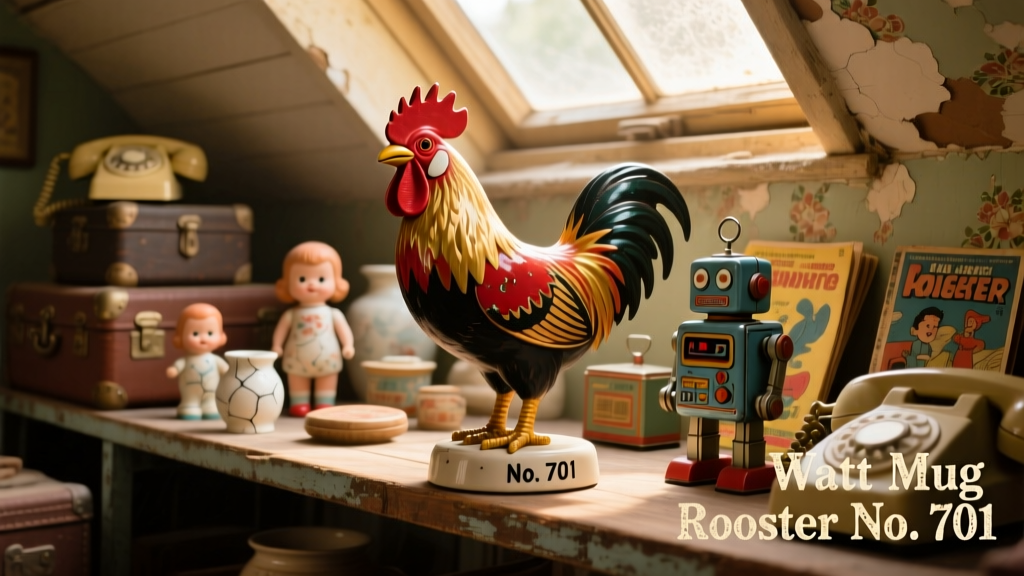
Watt Mug Rooster No. 701: The Iconic Mid-Century Ceramic Cock That Crowed Its Way Into American Kitchens