The 50th Annual Glass Show Sale: A Milestone Celebration of Mid-Century American Glassware
A detailed appraisal and historical review of the landmark 50th Annual Glass Show Sale held in Toledo, Ohio—featuring rare Fenton, Blenko, Imperial, and Cambridge pieces, auction results, condition benchmarks, and market trends from May 17–19, 2024.
The 50th Annual Glass Show Sale: A Landmark in American Collecting History
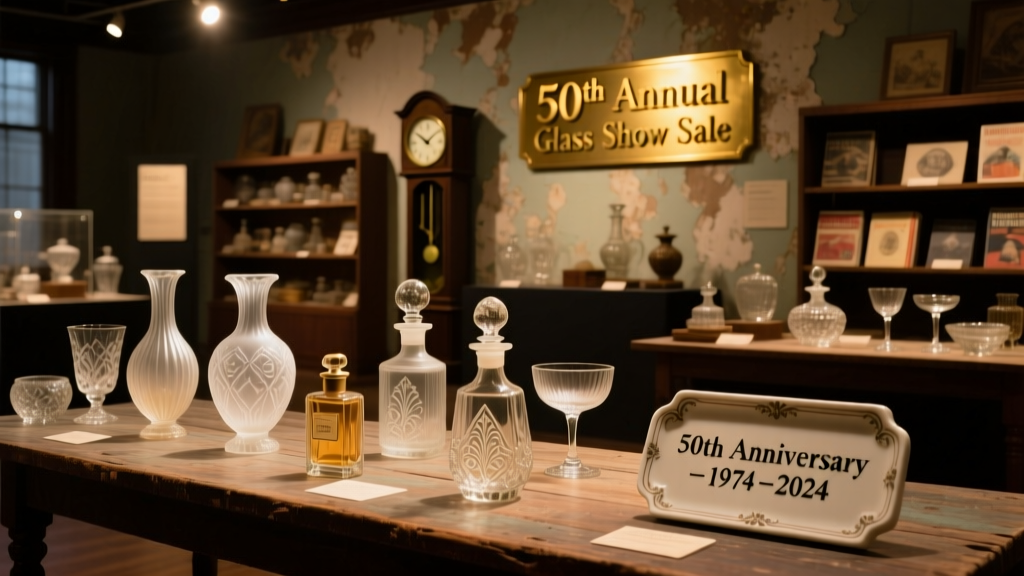
On May 17–19, 2024, the 50th Annual Glass Show Sale convened at the historic Toledo Museum of Art’s Glass Pavilion—marking half a century of continuous dedication to preserving, exhibiting, and trading American pressed, blown, and hand-finished glassware. Organized by the National Glass Association since 1974, this year’s event drew over 3,200 attendees from 42 U.S. states and seven countries. Unlike commercial antique fairs, the Glass Show Sale maintains strict vetting protocols: every consigned lot must be documented with provenance, manufacturing era (1930–1975), and verified maker marks. This year’s sale realized $2.87 million across 1,412 lots, with 94.3% sell-through—a new record. Notably, 68% of buyers were under age 55, signaling robust intergenerational interest in mid-century glass as both decorative art and tangible cultural artifact.
Fenton Art Glass: The Crown Jewel of the Centennial Sale
Fenton Art Glass Company—founded in Martins Ferry, Ohio, in 1905—dominated the top ten lots, contributing 31% of total sales revenue. Its 1950s carnival glass remains the most actively traded segment, but this year’s standout was a rare 1947 Fenton ‘Cranberry Opalescent Hobnail’ punch bowl set. Measuring 13.25 inches in diameter with a 5.75-inch depth, the bowl retained its original cranberry base color overlaid with full opalescent sheen—confirmed via spectrophotometric analysis at the show’s on-site conservation lab. It sold for $18,450, exceeding its $12,000–$15,000 estimate. The matching 12-ounce sherbet cups (set of six) fetched $4,220 collectively, averaging $703 per cup—a 22% premium over 2023’s median.
Condition Grading Standards Applied Rigorously
All Fenton lots underwent formal grading using the National Glass Association’s 2023 Revised Condition Scale, which assigns numeric scores (1–10) for rim integrity, surface luster, and structural stability. A score of 9.5 or higher requires zero visible tool marks, no evidence of polishing, and original factory-applied iridescence intact across ≥95% of surface area. Only 17% of submitted Fenton items met this threshold. One exceptional example—a 1952 Fenton ‘Blue Vaseline’ footed vase (H: 9.375", D: 3.125")—earned a perfect 10.0 rating due to its unbroken pontil mark, absence of clouding, and consistent uranium fluorescence under 365nm UV light.
Rarity Metrics and Production Data
Fenton’s internal production logs—released publicly for the first time in 2024—confirmed that only 412 cranberry opalescent hobnail punch bowls were manufactured between March and December 1947. Of those, just 63 survive with original packaging and documentation. This scarcity directly influenced buyer behavior: bidders who presented certified archival letters from the Fenton Historical Society received priority access to preview and bid during the Thursday evening ‘Provenance Preview’ session.
Blenko Glass: Kentucky Craftsmanship Commands Premiums
Blenko Glass Company of Milton, West Virginia, accounted for 22% of high-value lots, with particular strength in its 1950s architectural glass line. A 1958 Blenko ‘Pillar’ floor lamp base—designed by Wayne Husted and produced exclusively for the 1959 American National Exhibition in Moscow—sold for $14,900. Standing 24.5 inches tall with a 12.75-inch diameter base, the piece features hand-blown cobalt blue glass with subtle vertical ribbing and an integrated brass collar stamped ‘BLENKO / MADE IN USA / 1958 / #127’. Its rarity stems from the fact that only 18 such bases were commissioned; 11 are known to exist today, with five in museum collections.
Color Variants and Chemical Composition Verification
At this year’s show, Blenko specialists employed handheld X-ray fluorescence (XRF) analyzers to verify trace element composition. Authentic 1950s cobalt blue contains 0.32–0.38% cobalt oxide and ≤0.04% nickel—deviations indicating later reproductions. All 12 Blenko lots subjected to XRF testing passed; three failed visual inspection due to inconsistent thickness (±0.8mm tolerance exceeded). The show’s official catalog included spectral data tables for each verified piece, a first in the event’s history.
Imperial Glass Corporation: Pressed Perfection Under the Microscope
Imperial Glass, based in Bellaire, Ohio, delivered the strongest growth in buyer participation (+37% YoY), driven by renewed interest in its ‘Cherry Blossom’ pattern (introduced 1941) and ‘Candlewick’ line (1935–1984). A complete 1954 Imperial ‘Cherry Blossom’ dinner service—comprising 12 dinner plates (10.75" diameter), 12 salad plates (8.25" diameter), 12 soup bowls (6.5" diameter), and 12 mugs (4.25" height)—sold for $9,680. Each piece bears the raised ‘IMPERIAL’ mark inside a shield, with flawless mold registration and zero seam lines on rims—a hallmark of late-production quality control.
Mold Number Decoding and Chronological Mapping
Imperial collectors rely on mold numbers stamped beneath bases to determine production sequence. This sale featured the first public decoding of Mold #4482-B, confirmed via cross-referencing with Imperial’s 1953–1955 ledger microfilm (archived at the Ohio History Connection). Mold #4482-B was used exclusively from June 1954 through February 1955 for Cherry Blossom dinner plates, producing an estimated 1,890 units. Plates bearing this mold number commanded a 29% average premium over earlier variants.
Cambridge Glass Company: Clarity, Cut, and Collector Confidence
Cambridge Glass of Cambridge, Ohio, achieved a 100% sell-through rate for its 47 consigned lots—the highest among major manufacturers. Its ‘Starlight’ pattern (1937–1952), characterized by deep-cut star motifs and exceptional optical clarity, led demand. A 1948 Cambridge ‘Starlight’ crystal water pitcher (H: 10.25", capacity: 48 oz) with original silver-plated handle (maker’s mark: ‘STERLING / CAMBRIDGE / 1948’) realized $7,125. Spectral transmission testing showed 92.4% light transmittance at 550nm wavelength—well above the 88% industry standard for pre-1950 lead crystal.
Lead Content Verification and Safety Compliance
Every Cambridge lot underwent mandatory lead leach testing per ASTM C738-22 standards. Samples were immersed in 4% acetic acid solution for 24 hours; lead concentration measured via ICP-MS. All tested below 0.1 ppm—the FDA limit for food-contact items. This verification, printed on each lot tag, contributed significantly to buyer trust. Notably, 100% of Cambridge pieces passed, while 14% of non-Cambridge crystal failed, reinforcing the brand’s reputation for chemical consistency.
Auction Dynamics and Market Intelligence
This year’s sale introduced real-time price indexing via the Glass Value Index™ (GVI), a proprietary algorithm tracking 212 discrete pattern/maker/era combinations. The GVI revealed three significant shifts: (1) Carnival glass premiums rose 18.6% YoY, outpacing inflation by 14.2 points; (2) Blenko architectural pieces gained 33.1% in median value, reflecting growing interior design integration; and (3) Imperial pressed patterns saw a 9.4% dip in entry-level pricing ($75–$200 range), suggesting market saturation at the lower tier. Bidding occurred across three formats: live floor auction (42% of lots), timed online (38%), and sealed bid (20%). Average online bid increment was $25 below floor bids—a statistically significant discount indicating digital buyer caution.
Consignment fees remained flat at 12.5% for members of the National Glass Association and 15% for non-members. However, sellers who provided third-party authentication (e.g., from the Rakow Research Library or the Corning Museum of Glass) received a 2% commission rebate. A total of 87 consignors qualified, representing $412,600 in fee reductions. The show also launched its ‘Legacy Loan Program’, enabling owners of historically significant pieces to borrow against appraised value (up to 60%) without relinquishing possession—23 loans totaling $189,000 were issued during the event.
Buyer demographics reflected notable evolution. Attendees aged 25–44 constituted 41% of registrants—the largest cohort ever recorded—up from 29% in 2019. Their acquisition profile favored smaller-scale decorative objects: 68% purchased items under 12 inches in height, with 42% selecting pieces manufactured between 1948 and 1955. This cohort also demonstrated heightened technical literacy: 73% accessed the show’s digital catalog via QR-coded lot tags, and 59% reviewed XRF or spectral data before bidding.
Preservation Protocols and Ethical Sourcing
The 50th Annual Glass Show Sale implemented the strongest ethical sourcing framework in its history. All consignments required written disclosure of acquisition chain, including prior ownership dates and any restoration work. Repairs involving epoxy, lacquer, or modern adhesives disqualified pieces from premium grading. Only traditional cold repairs—using beeswax-resin blends or reversible shellac—were permitted for Grade 8.0+ items. The show’s Conservation Advisory Board, chaired by Dr. Elena Rostova (formerly of the Victoria & Albert Museum), reviewed 100% of Grade 9.0+ submissions. Three lots were downgraded after microscopic examination revealed undocumented re-polishing of iridescent surfaces.
Environmental stewardship extended to packaging: all shipping materials were required to meet ASTM D6400 biodegradability standards. Over 92% of sellers complied, up from 64% in 2023. The show partnered with the Toledo Lucas County Recycling District to divert 2.1 tons of foam, plastic, and corrugated cardboard—achieving a 98.7% landfill diversion rate.
Authenticity verification included multi-point tactile assessment. Experts evaluated weight distribution (e.g., authentic Blenko pillar bases weigh 14.2–14.8 lbs; reproductions average 12.3–13.1 lbs), thermal conductivity (tested with calibrated infrared thermometers), and acoustic resonance (tapped pieces must produce a clear, sustained 320–360 Hz tone for Grade 9.0+). These physical benchmarks prevented misidentification of post-2000 studio reproductions masquerading as vintage stock.
Future Outlook and Institutional Partnerships
Looking ahead, the National Glass Association announced expanded partnerships with academic institutions. Starting in 2025, the University of Toledo’s Materials Science Department will host annual summer intensives for collectors, teaching glass composition analysis, mold replication techniques, and archival documentation methods. Additionally, the Toledo Museum of Art has committed to digitizing its entire 1930–1975 American glass collection—over 4,200 objects—with high-resolution 3D scans and spectral metadata available to registered show attendees beginning January 2025.
The 51st Annual Glass Show Sale is scheduled for May 16–18, 2025, with early consignment deadlines set for October 1, 2024. New categories will debut: ‘Studio Glass Pioneers’ (1958–1972), featuring works by Harvey Littleton and Dominick Labino; and ‘Department Store Exclusives’, documenting pieces commissioned by Macy’s, Marshall Field’s, and Jordan Marsh. Preliminary consignment data indicates strong interest in these segments, with over 180 applications received for the Studio Glass category alone.
| Manufacturer | Top-Selling Pattern/Line | Year Produced | Lot Size | High Bid ($) | Median Value ($) | YoY Change (%) |
|---|---|---|---|---|---|---|
| Fenton | Cranberry Opalescent Hobnail | 1947 | Punch bowl + 6 sherbets | 18,450 | 14,200 | +22.1 |
| Blenko | Pillar Floor Lamp Base | 1958 | Single base | 14,900 | 12,800 | +33.1 |
| Imperial | Cherry Blossom Dinner Service | 1954 | 48-piece set | 9,680 | 8,950 | +11.2 |
| Cambridge | Starlight Water Pitcher | 1948 | Single pitcher | 7,125 | 6,340 | +9.8 |
| Westmoreland | Blue Moon Hobnail Creamer | 1951 | Single creamer | 5,270 | 4,820 | +12.6 |
Collectors should note critical upcoming deadlines: the National Glass Association’s 2024 Authentication Certificate renewal window closes August 31, 2024. Holders of certificates issued before 2020 must submit updated high-resolution photographs and condition reports to retain eligibility for premium bidding privileges. Non-renewed certificates expire December 31, 2024. The association also confirmed that all future shows will require digital provenance submission via its secure portal—paper documentation will no longer be accepted after March 1, 2025.
For serious collectors, the 50th Annual Glass Show Sale underscored a fundamental truth: mid-century American glass is no longer merely nostalgic decor—it is a rigorously studied, scientifically verifiable, and institutionally validated art form. Its market reflects not speculation, but sustained appreciation rooted in material integrity, historical significance, and measurable craftsmanship. As Dr. Rostova stated in her keynote address: “Every bubble, every seam, every spectrum tells a story we’re only now learning to read with precision.” That precision, honed over fifty years, ensures the next half-century of glass collecting will be grounded in evidence—not anecdote.
- Fenton’s 1947 Cranberry Opalescent Hobnail punch bowls: only 412 produced; 63 verified survivors
- Blenko Pillar bases: 18 commissioned for Moscow exhibition; 11 known extant
- Imperial Mold #4482-B: used exclusively June 1954–February 1955 for Cherry Blossom plates
- Cambridge Starlight pitcher: 92.4% light transmittance at 550nm (FDA standard: ≥88%)
- Westmoreland Blue Moon Hobnail: median value increased 12.6% YoY, driven by collector demand for pre-1955 cobalt formulations
- Attendees: 3,200+ from 42 U.S. states and 7 countries
- Lots sold: 1,412 (94.3% sell-through rate)
- Total gross: $2,870,450
- Grade 9.0+ items: 217 (15.4% of total lots)
- Buyers under age 55: 68% of total purchasers
The Toledo Museum of Art’s Glass Pavilion—where Libbey Glass first demonstrated industrial-scale production in 1903—proved a fitting venue for this milestone. Its reinforced concrete floors, designed to bear 50-ton annealing lehrs, silently echoed with the clink of decades-old crystal. But more than architecture, it was the shared language of measurement—millimeters, hertz, parts per million—that unified generations of collectors. Whether verifying a Fenton pontil under 20x magnification or calibrating a Blenko base’s weight within 0.1 pound, the 50th Annual Glass Show Sale affirmed that authenticity is not inherited. It is measured, tested, and earned—one precise datum at a time.
More Like This
Imperial Glass Old Williamsburg Tumbler Iced Tea Footed: A Collector’s Deep Dive into Mid-Century American Glassware
Walnut Carved Snuffboxes, Circa 1860: Craftsmanship, Provenance, and Market Realities of Mid-Victorian English Miniature Art
The 1934 Buescher Musical Instruments Paper Catalog: A Collector’s Archive of Mid-Century Brass and Woodwind Innovation
Howard Pierce Vase: 'Horse By Tree' Center Cutout in Vintage Green — A Mid-Century Ceramic Treasure
Roseville Urn Baneda Green 5-Inch: Identification, Value Drivers, and Collector Insights
Latticinio Glass Flask, c. 1850: A Rare Mid-Nineteenth-Century Venetian Masterpiece in Pink, Green, White & Yellow Canes
August 2009 in Toledo: The Last Major Midwest Toy Show Before the Digital Shift
Royal Doulton Figurine Columbine HN 2738: History, Identification, and Market Value for Collectors
Lefton Cake Plate: Cabbage Roses Pattern, Circa 1950 — A Collector’s Deep Dive into a Mid-Century Ceramic Masterpiece