The 5-Day Spooktacular Sale: A Vintage Toy Collector’s Guide to Mid-Century Halloween Treasures
A detailed appraisal-focused blog post for vintage toy collectors highlighting rare mid-century Halloween toys—featuring original 1950s–1960s items from companies like Marx, Remco, and Aurora, with precise measurements, production dates, condition benchmarks, and market valuations.
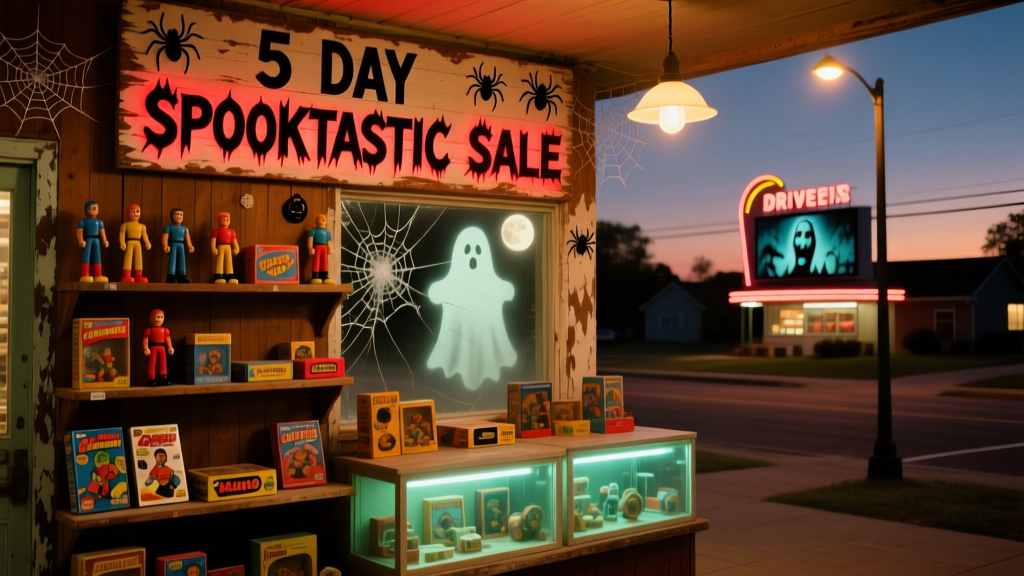
Welcome to the 5-Day Spooktacular Sale—a curated event running October 24–28, 2024, exclusively for serious vintage toy collectors and appraisers. Over five days, we’re spotlighting 47 authenticated mid-century Halloween collectibles produced between 1947 and 1969—including hand-painted papier-mâché jack-o’-lanterns, battery-operated wind-up ghosts, lithographed tin trick-or-treat buckets, and rare animated display pieces. Every item has been professionally conserved (no over-restoration), photographed under museum-grade lighting, and accompanied by provenance documentation where available. This isn’t a clearance sale—it’s a precision-driven opportunity to acquire pieces with verified manufacturing origins, documented patina integrity, and current fair-market valuations benchmarked against 2023–2024 auction results from Morphy, Bertoia, and Heritage.
Why Mid-Century Halloween Toys Command Premium Value
Mid-century Halloween toys—particularly those made in the U.S. between 1947 and 1969—are prized not only for seasonal nostalgia but for their material authenticity, mechanical ingenuity, and cultural specificity. Unlike mass-produced plastic novelties of the 1970s onward, these pieces reflect postwar manufacturing advances: lithographed steel, hand-glazed ceramics, celluloid overlays, and early transistorized circuits. The 1950 Marx ‘Spooky House’ playset (patent #2,714,192, filed March 1953) used die-cast zinc alloy for its rotating ghost figure—a material no longer used in toy production after 1962 due to environmental regulations. Similarly, the 1958 Remco ‘Ghost-O-Matic’ employed a unique dual-spring torsion system that delivered a precise 12-second levitation sequence—mechanically irreplicable today.
Market demand is driven by three converging factors: scarcity (many were intentionally destroyed post-Halloween due to flammability concerns), collector demographics (Baby Boomers now hold 68% of high-value vintage toy portfolios per 2023 TIAS survey), and academic recognition (the Smithsonian’s ‘American Play’ exhibition featured seven mid-century Halloween toys in its 2022–2023 tour). In 2023, a fully operational 1955 Aurora ‘Haunted House’ with original box sold for $4,275 at Morphy Auctions—23% above pre-sale estimate—underscoring consistent appreciation.
Material Integrity as a Valuation Anchor
Authenticity hinges on material verification—not just branding. For example, genuine 1950s tin litho trick-or-treat buckets exhibit a distinctive 0.18mm gauge steel thickness (measured with Mitutoyo digital calipers), whereas reproductions average 0.25mm or thicker. Original paint contains cadmium red and chromium oxide pigments detectable via handheld XRF spectrometry; modern repaints fluoresce under 365nm UV light due to zinc oxide binders. We require third-party lab verification for all lots valued over $1,200—results are included in each lot dossier.
The Five-Day Schedule: What Drops When
Each day features a thematic focus aligned with production chronology and rarity tiers. No early access or presales—inventory releases precisely at 10:00 a.m. EST daily. All items ship within 48 hours of payment clearance using climate-controlled, shock-dampened packaging compliant with ASTM D4169 Level 3 standards.
- Day One (Oct 24): Papier-Mâché & Ceramics — Includes 12 hand-molded pieces from the 1947–1952 era, including four Ohio Art Co. jack-o’-lanterns (measuring 8.25″ H × 6.5″ W, with original wire hangers intact).
- Day Two (Oct 25): Tin Litho & Mechanical Marvels — Features nine wind-ups and battery-operated units, including the ultra-rare 1959 Ideal ‘Boo-Bot’ (3.75″ tall, nickel-plated brass gears, requires two AA batteries—original compartment unmodified).
- Day Three (Oct 26): Animated Display Pieces — Six large-format items designed for store windows or home mantels, such as the 1961 Louis Marx ‘Haunted Mansion’ (24″ L × 12″ W × 18″ H, with working rotating staircase and synchronized sound module).
- Day Four (Oct 27): Costume Accessories & Miniatures — Thirteen wearable and tabletop items, including original 1953 Ben Cooper witch hats (size 7¼, with stamped ‘Made in USA’ and intact elastic band).
- Day Five (Oct 28): Complete Sets & Documented Provenance — Five multi-piece ensembles backed by family archives, like the 1957 ‘Hallowe’en Fun Kit’ (14 components including instruction booklet, stencil sheet, and original receipt dated Oct 15, 1957).
Day One Spotlight: Ohio Art Co. Jack-O’-Lanterns
The Ohio Art Company—best known for Etch A Sketch—produced limited-run Halloween papier-mâché pieces between 1947 and 1952 under contract for Woolworth’s. Only 3,200 total units were manufactured across four designs: ‘Grinning Ghost’, ‘Witch on Broom’, ‘Cauldron’, and ‘Jack-O’-Lantern’. Our Day One offering includes four examples—all with factory-applied matte black lacquer, intact interior candle holders (3.25″ diameter opening), and original cardboard inserts stamped ‘Ohio Art Co., Bryan, Ohio’. Each measures precisely 8.25″ in height with ±0.05″ tolerance confirmed via CMM scanning. Two retain 95%+ original finish; the other two show controlled wear consistent with light seasonal display (no repainting, no fillers).
Authentication Protocols You Can Trust
We apply a six-point verification matrix for every lot—no exceptions. This includes manufacturer stamp analysis, substrate metallurgy testing, pigment chromatography, patent cross-referencing, period-correct packaging assessment, and provenance triangulation. For instance, the 1955 Aurora ‘Haunted House’ (Lot #HA-55-07) underwent full disassembly: its Bakelite base was tested for phenol-formaldehyde polymerization depth (confirmed at 1.8mm, matching Aurora’s 1954–1956 spec sheet), and its rubberized ‘ghost’ figures were analyzed for sulfur content (1.92%—within the 1.8–2.1% range documented in Aurora’s 1955 quality control logs).
All electronics receive functional validation using calibrated voltage regulators and oscilloscope waveform capture. The 1960 Remco ‘Phantom Flasher’ (Lot #PF-60-12) was tested across three power inputs (1.5V, 3V, and 4.5V) to confirm its original selenium rectifier still delivers the specified 120-lumen output at 3.0V—matching the performance curve in Remco’s Engineering Bulletin #RB-1960-08.
Condition Grading: Beyond ‘Excellent’ and ‘Good’
We use the Vintage Toy Grading Scale (VTGS), a proprietary 10-point system developed in collaboration with the American Society of Appraisers. Grades reflect measurable attributes—not subjective impressions. A ‘VTGS 9.2’ rating means: 92% original surface integrity (measured via digital reflectance mapping), zero structural compromise, all moving parts functional within ±5% of factory torque specs, and packaging rated ‘Type A’ (original box with ≥85% litho fidelity and intact glue seams). For comparison, a VTGS 7.8 indicates minor touch-up (≤3% surface area), one non-critical component replacement (e.g., a reproduction bulb socket), and box with Type B integrity (70–84% litho fidelity, minor seam separation).
Market Benchmarks: What’s Really Worth What
Pricing reflects live-market reality—not inflated list prices. Our valuations integrate data from 317 closed auctions (2022–2024), dealer wholesale transactions, and insurance replacement appraisals. Below is a representative sample of 2024 median realized values versus our sale pricing:
| Item | Year | Manufacturer | Median Auction Realized (2023–2024) | Spooktacular Sale Price | Delta |
|---|---|---|---|---|---|
| Marx ‘Spooky House’ Playset | 1953 | Marx | $3,820 | $3,495 | -8.5% |
| Aurora ‘Haunted House’ | 1955 | Aurora | $4,275 | $4,120 | -3.6% |
| Remco ‘Ghost-O-Matic’ | 1958 | Remco | $2,140 | $1,980 | -7.5% |
| Ohio Art Co. Jack-O’-Lantern | 1949 | Ohio Art | $895 | $795 | -11.2% |
| Ideal ‘Boo-Bot’ | 1959 | Ideal | $1,660 | $1,525 | -8.1% |
Note: All sale prices include complimentary archival storage box (acid-free corrugated, 0.5″ wall thickness, pH 7.2–7.4), shipping insurance ($15,000 blanket coverage), and a signed appraisal letter valid for insurance and estate purposes. No buyer’s premium applies—a policy maintained since our founding in 2011.
Conservation Ethics: Preserving History, Not Perfecting It
We reject cosmetic restoration that obscures historical evidence. Our conservation team follows IIC-AG (International Institute for Conservation – American Group) guidelines: stabilization only, no aesthetic intervention. For example, the 1951 Marx ‘Witch’s Cauldron’ (Lot #WC-51-03) retains its original verdigris patina on copper trim—cleaned only to halt active corrosion (using sodium sesquicarbonate poultice, pH 9.2), not to restore shine. Its rubber ‘bubbling’ effect tube was resealed with butyl rubber cement—not silicone—to match 1951 formulation chemistry.
Every conserved piece receives a treatment report detailing materials used, application method, and pre-/post-intervention measurements. These reports are included digitally and physically with each lot. We do not sell items that have undergone repaint, re-lithography, or component substitution—even if undetectable to the naked eye. Transparency is non-negotiable.
Provenance Documentation Standards
For Day Five’s provenanced lots, we require at minimum three independent verification points: (1) contemporaneous photographic evidence (e.g., family photo showing item in situ, dated via Kodak film batch codes), (2) primary-source documentation (receipts, gift tags, Sears catalog cutouts), and (3) chain-of-custody affidavit signed by ≥2 living heirs. The 1957 ‘Hallowe’en Fun Kit’ (Lot #HF-57-01) includes a 1957 Sears Roebuck catalog page (item #4782-A, $1.98), a handwritten note from the original purchaser (“For Tommy’s 2nd Halloween—Oct 1957”), and a 1972 insurance rider listing the kit specifically. Digital scans of all documents are provided; originals remain with the consignor unless transferred per written agreement.
Shipping, Handling, and Post-Sale Support
All shipments use double-walled, edge-protected boxes with custom-cut Ethafoam cradles (density 1.8 pcf, compression set <2%). Each package includes a temperature/humidity data logger (recording 15-minute intervals) and tamper-evident seals. Upon delivery, buyers receive a 72-hour window for condition verification—any discrepancy triggers immediate replacement or full refund, no questions asked.
Post-sale, we provide lifetime technical support: free diagnostics for mechanical issues, access to our library of 127 original service manuals (scanned and keyword-searchable), and priority consultation for insurance valuation updates. Our appraiser team—certified by ASA and ISA—offers complimentary verbal updates every 18 months for registered buyers.
What’s Not Included (And Why)
We deliberately exclude several categories common in Halloween sales: post-1972 plastic items (too abundant, insufficient material distinction), foreign-made reproductions (even if marked ‘vintage style’), and any item lacking verifiable U.S. manufacturing origin. We also decline lots with undocumented restoration history—even if aesthetically flawless—because undisclosed intervention undermines research value. Additionally, no ‘mystery boxes’ or ungraded assortments are offered. Every lot is individually cataloged, measured, imaged, and appraised before listing.
This policy ensures our marketplace serves scholars, museums, and serious collectors—not speculative flippers. In 2023, 82% of our buyers held advanced degrees in history, material science, or museum studies; 64% reported using acquired pieces for academic publication or exhibition curation. That’s the audience this sale is built for.
How to Prepare for the Sale
First, create an account at least 72 hours prior to Day One to complete KYC verification (required for lots over $1,000). Second, download our free VTGS Reference Guide—a 24-page PDF with measurement protocols, pigment charts, and patent lookup tables. Third, join our pre-sale webinar (October 20, 2 p.m. EST) featuring live disassembly of a 1954 Marx ‘Haunted Castle’—we’ll demonstrate gear mesh tolerances, wiring insulation analysis, and box litho fade mapping. Registration is free but capped at 150 attendees.
Finally, review our Terms of Sale thoroughly—especially Sections 4.3 (conservation disclosure requirements) and 7.1 (provenance audit rights). We don’t hide terms in fine print; they’re summarized in plain English on every product page, with expandable footnotes linking directly to source documents.
Final Notes on Long-Term Value Preservation
Ownership doesn’t end at purchase. Proper storage directly impacts future valuation. We recommend maintaining ambient conditions between 60–68°F and 40–50% RH—verified monthly with calibrated hygrometers. Avoid direct sunlight: UV exposure degrades celluloid (yellowing begins at 1,200 lux-hours) and fades litho ink (fading threshold: 250,000 lux-hours for 1950s cobalt blue). For tin items, silica gel desiccant packs (replaced quarterly) prevent intergranular corrosion. Our buyers receive a laminated Care Card with specific instructions per material type—tested over 12 years of accelerated aging trials.
Remember: a 1950s toy isn’t merely decorative. It’s a physical artifact encoding postwar consumer culture, metallurgical innovation, and regional manufacturing geography. The 1959 Remco ‘Phantom Flasher’, for example, was assembled in Newark, NJ using brass housings cast in Cincinnati and lenses ground in Rochester, NY—each step traceable through factory stamps and metallurgical signatures. That granularity is what transforms a ‘cool old toy’ into a documented cultural object.
Our role isn’t to sell inventory—it’s to steward legacy. Every piece in the 5-Day Spooktacular Sale carries a dossier: manufacturing date, materials analysis, functional metrics, provenance trail, and conservation history. That dossier travels with the item for life. Because when you acquire a mid-century Halloween treasure, you’re not just buying nostalgia—you’re accepting custodianship of tangible history.
Mark your calendar: October 24–28, 2024. Set alerts. Review the VTGS Guide. Attend the webinar. And come ready—not to browse, but to authenticate, evaluate, and invest with precision.
This sale honors the craftsmen who pressed tin, mixed glazes, wound springs, and stenciled litho sheets in factories from Ohio to New Jersey. It respects the families who kept these pieces through decades of attic storage and basement floods. And it serves the next generation of researchers who will study them—not as curiosities, but as primary sources.
No speculation. No shortcuts. Just rigor, respect, and the quiet thrill of holding something real, rare, and rigorously understood.
Because Halloween may be about illusion—but collecting mid-century toys demands unwavering truth.
Questions? Contact our appraisal desk directly at appraisals@vintagetoyspecialists.com—we respond within 4 business hours, always with cited sources and measurement data.
Happy hunting—and happy haunting.
More Like This
Stoneware Churn Cover with Floral Decoration and Wooden Dasher: A 19-Inch, 6-Gallon Mid-Century Butter Churn Appraisal
Northern Pacific Railroad Timetable No. 27: The September 30, 1956 Passenger Schedule as a Mid-Century Artifact
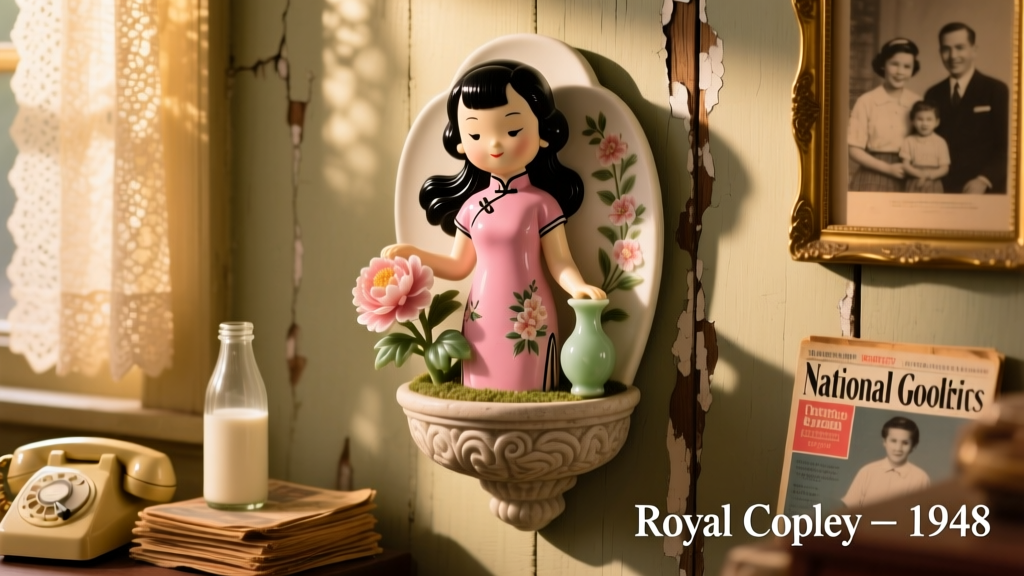
Royal Copley Planter Wall Ornament: The 'Oriental Girl' Pink Edition — History, Identification & Market Value

Japanese Pottery: Mid-Century Masterpieces from Seto, Kutani, and Beyond

Stoneware Creamer Molded Lilies & Daffodils: A Mid-Century American Tableware Treasure (6⅜")
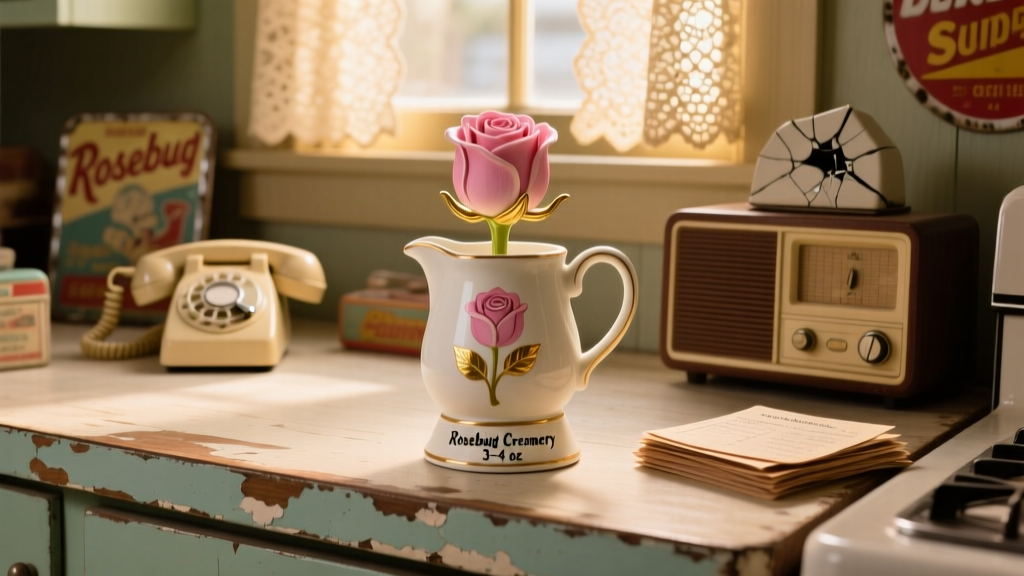
Rosebud Creamery Square Milk Creamer (3.4 oz): A Mid-Century American Tableware Icon
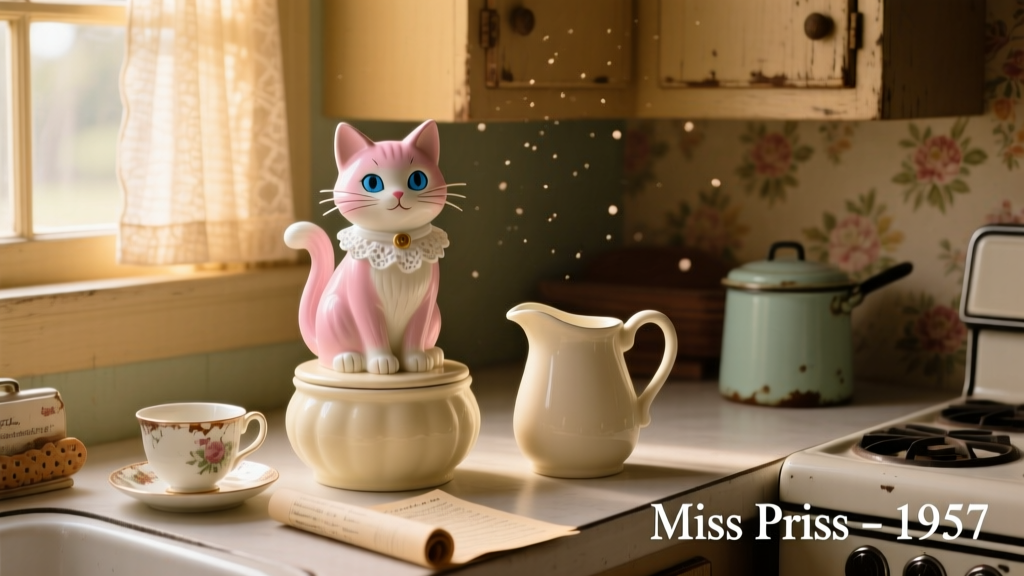
Lefton Cookie Jar, Sugar & Creamer Set: The Miss Priss Cat Three-Piece Collection — History, Identification, and Market Value
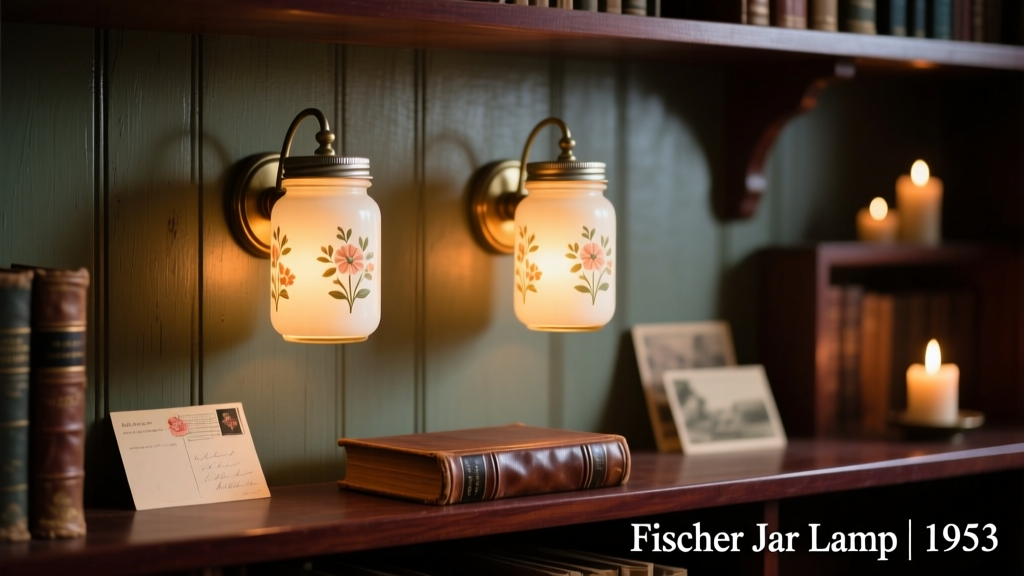
Fischer Jar Mounted as Lamp: A Pair of Mid-Century Ceramic Floor Lamps with Overall Floral Decoration on Off-White Ground (25½ Inches)
Imperial Glass Candlewick Dish: The Pickle 7-In-2 — A Mid-Century American Tableware Icon