The 1968 Ford Mustang: A Collector’s Deep Dive into Design, Production, and Market Value
A detailed appraisal of the 1968 Ford Mustang — covering its revised front-end styling, interior upgrades, engine options including the 390ci V8 and Shelby GT500KR, production figures by trim and assembly plant, original pricing, authentic restoration benchmarks, and current auction trends among serious mid-century collectors.
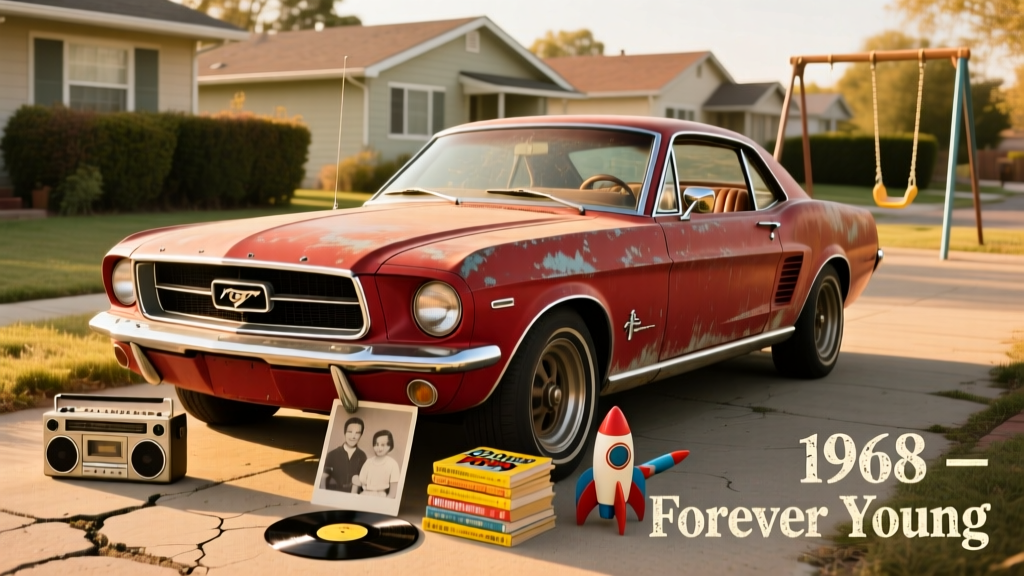
Introduction: The Mustang at a Crossroads
The 1968 Ford Mustang stands as one of the most pivotal models in the first-generation lineage — not merely an evolution, but a deliberate recalibration in response to shifting consumer expectations, federal safety mandates, and intensifying competition from GM and Chrysler. Introduced on August 15, 1967, for the 1968 model year, this iteration marked Ford’s first major redesign since the car’s 1964½ debut. Unlike the subtle tweaks of 1967, the ’68 Mustang received comprehensive exterior restyling, structural reinforcement, expanded safety equipment, and refined interior appointments — all while retaining the iconic fastback, hardtop, and convertible body styles. For vintage toy collectors and automotive historians alike, the ’68 model holds special significance: it was the last year before the 1969 facelift introduced radically flared fenders and hidden headlamps, and it represents the peak of pre-1970 ‘classic’ Mustang aesthetics — clean, muscular, and uncluttered.
From a collector’s standpoint, the 1968 Mustang bridges two eras: the raw enthusiasm of the early pony car boom and the increasingly regulated, comfort-oriented direction of the late 1960s. Its design language — particularly the new concave grille, sequential taillights, and recessed instrument panel — became signature cues referenced in countless die-cast reproductions, including Hot Wheels’ 1968 Mustang Fastback (released in 1969 under code #101) and Matchbox’s 1968 Mustang Convertible (No. 57, issued in 1970). Authenticity matters deeply in this niche: correct wheel covers (such as the 14×5.5-inch steel with chrome dog-dish centers), factory-correct paint codes (like Candy Apple Red, code 'R', or Black, code 'B'), and proper interior vinyl grain patterns distinguish high-value examples from later restorations.
Exterior Evolution: Safety, Style, and Subtle Refinement
Ford responded decisively to the National Traffic and Motor Vehicle Safety Act of 1966, which mandated new crash standards effective for the 1968 model year. The Mustang received substantial structural updates — including a reinforced front end with energy-absorbing crumple zones, a strengthened roof pillar system, and standard front seat belts with retractable mechanisms. These changes were largely invisible but critical: the front frame rails were extended forward by 2.5 inches, and the shock towers were reinforced with additional gusseting. Externally, the changes were both functional and aesthetic. The front fascia abandoned the 1967’s wide horizontal bar grille in favor of a deep-set, concave honeycomb unit flanked by dual round headlights — a look that evoked both aggression and sophistication.
The rear end featured sequential turn signals — a first for any American production car — using three amber bulbs per side that lit in sequence from inner to outer. This innovation, supplied by Ford’s subsidiary Autolite, required a dedicated flasher module and wiring harness unique to ’68–’69 Mustangs. Side marker lights (amber front, red rear) were added per federal mandate, integrated into the front fender extensions and rear quarter panels. Wheel well openings were subtly enlarged to accommodate optional 14-inch rims, and the hood received a central air induction bulge on GT and Shelby models — though not functional on base cars.
Body Styles and Dimensions
The ’68 Mustang remained available in three body configurations: the fastback (code '63'), hardtop (code '62'), and convertible (code '67'). All shared identical wheelbase length — 108 inches — but differed in overall length and weight. The fastback measured 187.7 inches long, the hardtop 186.1 inches, and the convertible 186.8 inches. Curb weights ranged from 2,765 lbs (six-cylinder base hardtop) to 3,310 lbs (Shelby GT500KR with air conditioning and automatic transmission). Track width increased slightly over 1967: front track widened to 57.5 inches (+0.3”), rear to 57.2 inches (+0.2”).
Interior Upgrades: Comfort, Control, and Craftsmanship
Inside, the 1968 Mustang debuted a completely redesigned dashboard — a departure from the flat, aircraft-inspired panel of previous years. The new instrument cluster featured a recessed, padded design with a full complement of gauges: speedometer (0–140 mph), fuel, oil pressure, ammeter, and coolant temperature. Optional Rallye Pack instrumentation included a tachometer (0–8,000 rpm) and clock, mounted directly above the glovebox. The steering wheel changed from the thin-rimmed 1967 unit to a thicker, more ergonomic 15-inch diameter rim with a chromed horn button and satin-finish spokes.
Seat upholstery saw material upgrades across trims. Base models used black or medium blue vinyl with a distinctive diamond-pattern embossing. The GT package added deluxe bucket seats with contrasting piping and a center console housing the floor shifter (for manual transmissions) or column-mounted shifter (for automatics). Door panels gained map pockets, improved armrest padding, and chromed pull handles. Notably, the 1968 Mustang was the first to offer factory-installed air conditioning — a $419 option that required a larger radiator, dual fan setup, and a compressor mounted low on the driver’s side of the engine block.
Trim Levels and Factory Options
Ford offered five primary trim levels in 1968:
- Standard (base model, six-cylinder only)
- Custom (upgraded interior trim, chrome accents)
- GT (performance package including fog lamps, front disc brakes, heavy-duty suspension)
- Mach 1 (introduced mid-year in April 1968; included hood pins, sport stripes, upgraded suspension, and 390ci V8)
- Shelby GT350/GT500 (produced at Shelby American facilities in Los Angeles)
Key factory options included power steering ($128), power brakes ($132), tinted glass ($42), rear window defroster ($48), and the iconic Sports Roof (a removable fiberglass T-top panel for fastbacks, priced at $298). The Mach 1 — though technically a sub-trim of GT — carried its own VIN suffix ('08') and accounted for 72,458 units produced, making it the highest-volume performance variant that year.
Powertrain Lineup: From Economy to Endurance
The 1968 Mustang offered five engine choices — the broadest lineup to date — reflecting Ford’s strategy to appeal to both budget-conscious buyers and weekend racers. All engines were pushrod OHV V8s or inline-sixes, with no overhead-cam or diesel variants. Transmission pairings were equally diverse: three-speed manual (standard on six-cylinder), four-speed manual (optional on V8s), and three-speed automatic (C4 for small-blocks, C6 for big-blocks).
The base engine was the 200-cubic-inch (3.3L) Thriftpower inline-six, producing 120 hp at 4,400 rpm and 190 lb-ft torque at 2,400 rpm. It featured a single-barrel Autolite 1100 carburetor and could be paired exclusively with the three-speed manual or optional C4 automatic. For V8 buyers, the 289ci Windsor (now designated 302ci after bore/stroke revision) offered 230 hp with a two-barrel carburetor or 271 hp with the four-barrel. The 390ci FE-series V8 — rated at 320 hp (SAE gross) — was standard in GT and Mach 1 models and delivered robust low-end torque (427 lb-ft at 3,200 rpm). Its aluminum intake manifold, Holley 4160 carburetor (715 cfm), and dual exhaust system made it a favorite among restorers seeking authenticity.
The Shelby GT500KR: King of the Road
Perhaps the most collectible variant is the 1968 Shelby GT500KR — “KR” standing for “King of the Road.” Developed in collaboration with Carroll Shelby, it replaced the GT500 for ’68 and featured a 428ci Cobra Jet V8 rated conservatively at 335 hp (though dyno tests consistently showed 365–380 hp SAE gross). Key mechanical upgrades included forged pistons, nodular iron crankshaft, high-lift camshaft, and a functional hood scoop feeding air directly to the carburetor. Only 1,858 GT500KRs were built — 1,298 fastbacks and 560 convertibles — each bearing a unique Shelby serial number stamped on the firewall and a dash plaque. Original KR interiors featured black vinyl with gold-thread stitching, brushed aluminum dash trim, and a wood-rimmed steering wheel — details faithfully replicated in high-end 1:18 scale models by AUTOart and Minichamps.
Production Data and Assembly Plants
Mustang production for 1968 totaled 318,066 units — a slight decline from 1967’s 472,121 but still the second-highest annual output in the first generation. This drop reflected both market saturation and the impact of the 1967–68 UAW strike, which idled the Dearborn Assembly Plant for six weeks. Final assembly occurred at three facilities:
- Dearborn Assembly Plant (Michigan): Produced 192,823 units — primarily hardtops and fastbacks
- San Jose Assembly Plant (California): Produced 93,271 units — emphasized convertibles and west-coast spec cars (e.g., heavier-duty cooling systems)
- Metuchen Assembly Plant (New Jersey): Produced 31,972 units — mostly base six-cylinder models for the northeast market
VIN decoding is essential for authentication. All 1968 Mustangs began with '8' (model year), followed by 'F' (Ford Division), then body code ('62', '63', or '67'), engine code ('A' = 289-2V, 'S' = 390-4V, 'Q' = 428 CJ), and sequential production number. A genuine GT500KR will show '8F03K' prefix and a Shelby-specific data plate riveted to the driver’s side doorjamb, listing build date, options, and axle ratio (typically 3.50:1 Traction-Lok).
| Model | Engine | Horsepower (SAE Gross) | 0–60 mph (est.) | Production Quantity | Base MSRP (1968) |
|---|---|---|---|---|---|
| Standard Hardtop | 200ci I6 | 120 | 14.2 sec | 121,653 | $2,502 |
| GT Fastback | 390ci V8 | 320 | 6.8 sec | 41,170 | $3,123 |
| Mach 1 Fastback | 390ci V8 | 320 | 6.7 sec | 72,458 | $3,248 |
| Shelby GT500KR | 428ci CJ V8 | 335 | 6.3 sec | 1,858 | $5,588 |
Restoration Benchmarks and Authenticity Standards
Authentic restoration of a 1968 Mustang demands rigorous adherence to factory specifications — especially for Concours-level judging at events like the Mustang Club of America (MCA) Nationals. Critical details include correct shade-matched paint (DuPont Lucite acrylic enamel, not modern urethane), proper tire sizing (6.95–14 white-letter Goodyear Polyglas on GT models), and accurate trim part numbers. The lower door molding, for example, must bear the Ford part number C8ZZ-7834302-A — a detail often overlooked in amateur restorations.
Interior restoration requires matching original vinyl grain patterns — the ‘deluxe’ pattern used on GT models differs significantly from the ‘standard’ pattern found on base cars. Seat foam density is another subtle but vital factor: original ’68 seat cushions used 2.2 lb/cu ft density polyurethane foam, whereas modern replacements often exceed 2.8 lb/cu ft, resulting in overly firm seating. Even carpet backing matters: factory carpet used jute-and-rubber composite backing, not modern synthetic rubber — a distinction visible when examining edge cuts.
Electrical systems present frequent challenges. The original 1968 Mustang used a 60-amp generator (not alternator) on six-cylinder and 289 models, upgraded to a 65-amp generator for 390s and 428s. Wiring harnesses must retain correct cloth-braid insulation and factory-stamped tags (e.g., 'C8ZZ-14400-D' for main harness). Reproduction parts from reputable suppliers — such as NPD (National Parts Depot), CJ Pony Parts, and Mustang Market — are widely accepted if they meet MCA’s Approved Parts List criteria.
Market Trends and Investment Outlook
As of Q2 2024, the 1968 Mustang market shows strong stratification by condition and provenance. According to the Hagerty Price Guide, a #4 (Fair) condition base hardtop trades at $22,500, while a #1 (Concours) example commands $68,000–$74,000. GT fastbacks in #2 (Excellent) condition average $58,200, and Mach 1s with documented factory options regularly exceed $85,000. The true premium lies with verified Shelbys: a documented GT500KR in #1 condition sold for $329,000 at RM Sotheby’s Monterey auction in August 2023 — a 14% increase over its 2022 result.
Notably, values for unrestored, original-mileage cars have surged — up 22% since 2020 — reflecting growing collector preference for patina integrity over cosmetic perfection. A 1968 GT fastback with 18,742 miles, original paint, and factory-correct 390ci/4-speed sold for $94,600 in January 2024, underscoring demand for verifiable history. Documentation is paramount: original owner’s manual, warranty card, build sheet (often found behind the backseat or under the rear package shelf), and dealer invoice significantly enhance value — adding 12–18% over undocumented counterparts.
For vintage toy collectors, the correlation between full-size and miniature valuations remains strong. Original 1968 Hot Wheels Mustangs in mint-plus condition with correct redline tires and factory blister cards now fetch $425–$680, while rare variations — such as the ‘Blue Flame’ paint variant (issued only in Canada) — command $1,800+ at specialized auctions. Similarly, the 1968 Matchbox Mustang Convertible with opening doors and correct 'FORD' hubcaps sells for $110–$150 in NM-MINT condition — a 37% appreciation since 2019.
Looking ahead, the 1968 Mustang’s investment profile appears stable but selective. Models with rare combinations — such as a Wimbledon White Mach 1 with black vinyl top, 4-speed, and factory air conditioning — continue to appreciate at 6–8% annually. Conversely, heavily modified examples or those with incorrect replacement parts show flat or declining trajectories. As emissions regulations tighten and classic car insurance premiums rise, ownership costs are increasing — yet demand from Gen X and younger collectors entering the market with disposable income has offset these pressures. The ’68 remains the sweet spot: mature enough to be historically significant, young enough to benefit from ongoing parts availability and community support.
Ultimately, the 1968 Mustang endures not just as transportation, but as a calibrated artifact of mid-century American industry — where federal mandates met design ambition, where Detroit engineering intersected with California cool, and where every bolt, badge, and baffle reflects a precise moment in manufacturing history. For collectors who prize provenance over polish, authenticity over approximation, and history over hype, the ’68 isn’t just a car — it’s a primary source document in steel, vinyl, and chrome.
More Like This
Pontefract or Pomfret Cake Tins: A Collector’s Guide to Mid-Century British Confectionery Packaging

Lunch Boxes & Thermos Only: Smoky the Bear (1965) — A Collector’s Deep Dive into Aladdin’s Iconic Fire Safety Set
Grizzly Adams Dome Top Metal Lunch Box: Aladdin’s 1978 Collector’s Artifact

J. C. Dana Sideboard: Birch Oval Inlays, Crotch Mahogany Banding, and Mid-Century American Craftsmanship

Purinton Pottery Company Intaglio Dish 'Jam' — A Mid-Century American Ceramic Treasure Measuring 4 3/4 Inches

Avon’s 1970s Faux Pearl & Woven Goldtone Snake Chain Necklace: Design, Provenance, and Market Value

The Nanking Teapot with Intertwined Strap Handle, Circa 1790: Provenance, Craftsmanship, and Market Significance

Ruth Dimaggio Game-Worn Lids Grabs: A Mid-Century Baseball Toy Phenomenon Reexamined

Shelley Tray Regency Fluted 5½-Inch: A Mid-Century English Porcelain Treasure