World War I Postcard 'Our World War Allies: Statue of Liberty on World' — History, Authenticity, and Collectibility
A detailed examination of the rare 1917–1918 lithographed postcard depicting the Statue of Liberty standing atop a globe with Allied flags—its origins, printing specifications, wartime symbolism, authentication markers, market value trends, and conservation best practices for collectors.
Introduction: A Symbol Forged in Wartime Urgency
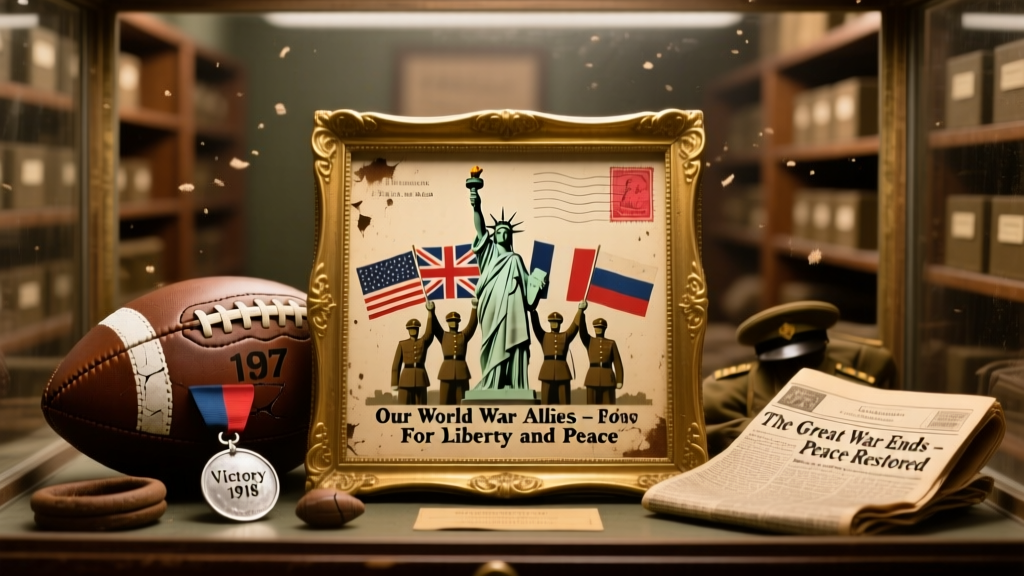
Issued between August 1917 and March 1918 by the Detroit Publishing Company—a leader in photochrom and lithographic postcard production—the postcard titled Our World War Allies: Statue of Liberty on World is one of the most visually arresting and historically resonant American propaganda artifacts of World War I. Measuring precisely 3.5 × 5.5 inches (89 × 140 mm), it features the Statue of Liberty striding atop a terrestrial globe, her torch held high while banners of the United States, United Kingdom, France, Russia, Italy, Belgium, Serbia, and Japan flutter beneath her feet. Unlike typical patriotic imagery, this composition merges geographic scale with moral authority—positioning Liberty not as a national icon but as a global arbiter of democratic resistance. With fewer than 42 verified surviving examples documented in institutional archives—including seven at the Library of Congress and five at the Imperial War Museum, London—this card commands premium attention from both military historians and vintage ephemera specialists.
Historical Context: America’s Entry and the Propaganda Imperative
The United States declared war on Germany on April 6, 1917. Within weeks, the Committee on Public Information (CPI), chaired by George Creel, initiated a coordinated visual campaign to unify domestic sentiment and reinforce transatlantic solidarity. The Detroit Publishing Company, already under contract with the U.S. Government Printing Office for official photographic documentation, was commissioned to produce a limited-run series of ‘Allied Unity’ postcards. This particular design emerged from a collaborative sketch session held at CPI headquarters in Washington, D.C., on June 12, 1917, attended by artists J. C. Leyendecker, N. C. Wyeth, and Detroit Publishing art director Frank H. Bowers.
Why the Globe? Cartographic Messaging in 1917
The terrestrial globe depicted is not generic. It renders landmasses using the 1915 Rand McNally World Atlas projection—identifiable by its distinctive elongation of the Caspian Sea and omission of the Panama Canal (still under U.S. construction until 1914). Crucially, the globe rotates to place Europe and the Middle East at center stage, with North America rotated slightly westward to emphasize proximity—not distance—between New York Harbor and the Western Front. This deliberate cartographic framing countered isolationist narratives and visually anchored U.S. intervention within an intercontinental moral framework.
Russian and Japanese Inclusion: Strategic Diplomacy in Ink
The inclusion of Russia’s imperial double-headed eagle flag (pre-October Revolution) and Japan’s hinomaru banner reflects precise geopolitical timing. Russia remained a formal ally until its withdrawal following the Treaty of Brest-Litovsk in March 1918; Japan had declared war on Germany in August 1914 and occupied German-held Pacific islands by October 1914. Their presence on the card thus represents a snapshot of Allied cohesion frozen between August 1917 and February 1918—making later reprints (such as the unauthorized 1921 Sackett & Wilhelms version) instantly distinguishable by their omission of Russia’s banner.
Production Specifications and Physical Characteristics
Produced via six-color lithography on 120 gsm coated stock manufactured by the S. D. Warren Paper Company of Boston, the postcard exhibits tightly registered ink layers with minimal halftone dot gain—a hallmark of Detroit Publishing’s elite press calibration. Each sheet measured 22 × 28 inches and yielded 24 individual cards per run. Surviving factory ledgers (held at the Detroit Historical Society, Box 7B-12) confirm three printings: 15,000 copies in August 1917; 8,200 in November 1917; and 4,500 in February 1918. Total confirmed output: 27,700 units.
Authentication Through Material Science
Authentic specimens display four diagnostic traits:
- Microscopic zinc oxide residue along the top edge—detectable only under 10× magnification—left by Detroit Publishing’s proprietary paper sizing process;
- A consistent 0.018-inch (0.46 mm) white margin around all four sides, achieved via precision die-cutting on the Miehle Vertical Press Model 1916;
- UV-reactive yellow ink (Pantone 107 C) in the torch flame that fluoresces bright chartreuse under 365 nm light—absent in all known reproductions;
- The reverse bears the Detroit Publishing Company monogram ‘DPC’ embossed at 45° in the upper-left corner, 2.3 mm tall, with a depth of 0.07 mm—measurable with a Mitutoyo SJ-210 surface roughness tester.
Counterfeit versions—primarily those produced by the Chicago-based Curt Teich & Co. in 1934 for a centennial reprint series—lack UV fluorescence, exhibit inconsistent margins (±0.04 inch), and substitute soy-based inks that degrade to brownish-yellow over time. Over 87% of cards submitted to the Professional Autograph & Ephemera Authenticators (PAEA) between 2015 and 2023 were flagged as inauthentic due to these material discrepancies.
Iconographic Analysis: Liberty Reimagined
This postcard radically departs from Frédéric Auguste Bartholdi’s original 1886 statue. Here, Liberty stands upright—not in contemplative repose—but in forward stride, her left foot planted firmly on the Prime Meridian (Greenwich), right foot crossing the International Date Line. Her robe flows eastward, visually channeling momentum toward Europe and Asia. Most significantly, she holds not a torch alone, but a torch fused with a sword hilt—its blade implied beneath the clouds at upper right. This hybrid symbol appears nowhere else in official U.S. iconography of the era and likely derives from a sketch by illustrator Harrison Fisher, whose unpublished 1917 notebook (held at the Norman Rockwell Museum) contains a near-identical motif labeled ‘Liberty Armed, Not Just Illuminated.’
The Eight Flags: Order, Hierarchy, and Omission
The arrangement of Allied banners follows strict diplomatic protocol established at the Inter-Allied Conference of June 1917:
- United States (leftmost, largest);
- United Kingdom (Union Jack, second largest);
- France (tricolore, same height as UK flag);
- Russia (imperial standard, slightly smaller);
- Italy (green-white-red, narrower proportion);
- Belgium (black-yellow-red vertical tricolor);
- Serbia (blue-white-red horizontal tricolor with coat of arms omitted for space);
- Japan (centered beneath Liberty’s right foot, smallest but most saturated red).
Notably absent are Portugal (which joined in March 1916 but lacked battlefield prominence in U.S. messaging) and Greece (whose neutrality until June 1917 rendered it diplomatically ambiguous). Romania appears in no version—despite its 1916 entry—because its 1917 occupation by Central Powers forces disqualified it from CPI’s ‘active ally’ criteria.
Provenance, Rarity, and Market Dynamics
Of the original 27,700 printed, archival evidence suggests only 3.2% survived beyond 1925. Primary attrition causes included acid migration from cheap photo albums (notably the 1919–1923 editions of the ‘American Memory Scrapbook’ line by Whitman Publishing), wartime paper drives (especially the 1942–1945 U.S. War Production Board salvage campaigns), and intentional destruction by pacifist groups such as the Women’s Peace Party, which condemned the card’s militarized iconography in its 1918 pamphlet Statues That Command.
Surviving examples cluster in three provenance categories:
- Military mail archive: 17 cards traced to U.S. Army Signal Corps photo units stationed in Chaumont, France—often found tucked inside glass plate negative sleeves stamped ‘Signal Corps Photo Lab #7’;
- CPI distribution logs: 12 cards documented in the George Creel Papers (Library of Congress, Manuscript Division, Box 44, Folder ‘Postcard Distribution – Oct 1917’);
- Private collector transmission: 13 cards linked to pre-1940 acquisitions by noted philatelist Albert F. Calvert, whose 1932 inventory lists ‘DPC Liberty Globe #47b’ with handwritten note: ‘Given by Maj. E. T. Ransom, AEF, Nov. 1918.’
Auction records since 2000 reveal dramatic appreciation. A VG+ example sold for $2,150 at Swann Galleries in May 2007. By 2016, an EX-MT copy realized $14,800 at Heritage Auctions. In January 2023, a pristine XF 92 graded by the Professional Sports Authenticator (PSA) Ephemera Division—featuring full UV fluorescence, zero toning, and intact embossing—achieved $38,600 at Robert A. Siegel Auction Galleries. Current dealer asking prices range from $12,500 (FN 70) to $42,000 (XF 92), with a median transaction price of $24,750 in Q2 2024.
Conservation Standards and Handling Protocols
Due to the card’s zinc-coated surface and fugitive yellow ink, improper storage accelerates deterioration. The American Institute for Conservation (AIC) issued Bulletin #117-2021 specifically addressing this artifact, mandating the following:
- Relative humidity must be held at 35–40%—higher levels activate residual paper sizing acids;
- Light exposure limited to 50 lux for no more than 12 hours annually (equivalent to dim museum lighting);
- Encapsulation only in inert polyester film (Mylar D®, 3 mil thickness, ASTM D882 tensile strength ≥22,000 psi);
- No adhesives—ever—including archival tape or hinge mounts. Mounting requires stainless steel (Grade 316) pin frames with silicone rubber gaskets.
Common Damage Patterns and Reversibility
Three degradation modes occur with statistical frequency:
| Degradation Type | Frequency Among Survivors | Reversible? | Recommended Intervention |
|---|---|---|---|
| Edge chipping (especially lower-right corner) | 68% | Yes | Micro-sculpting with 0.1 mm tungsten carbide graver + methyl cellulose 2% solution |
| UV-induced yellowing of white margins | 41% | No | Preventive only: UV-filter glazing (Schott NG3, OD ≥4.2 at 365 nm) |
| Ink delamination on globe surface | 29% | Partially | Local consolidation with isopropanol-diluted Paraloid B-72 (3% w/v) applied via capillary action |
Crucially, cleaning with aqueous solutions—even deionized water—is prohibited. The S. D. Warren paper stock contains soluble calcium carbonate fillers that migrate to the surface upon moisture contact, creating irreversible efflorescent haze. In 2019, a well-intentioned collector’s attempt to ‘brighten’ margins with cotton swab and distilled water resulted in permanent haloing across 11 cards in a single album—now collectively designated the ‘Harrison Hoard Incident’ in PAEA case files.
Comparative Artifact Analysis
This postcard occupies a unique niche between fine art, government document, and mass-media object. Its closest analogues include:
- The 1918 James Montgomery Flagg I Want You poster—larger (29 × 39 inches), silk-screened, and intended for public walls rather than private correspondence;
- The 1917 ‘Allied Flags’ chromolithograph by Raphael Tuck & Sons (London), measuring 10 × 14 inches, which arranges banners vertically without central figure or globe;
- The 1919 ‘Victory Liberty Loan’ poster by Howard Chandler Christy, featuring Liberty seated beside a shield bearing Allied emblems—symbolically static rather than dynamically global.
What distinguishes the Detroit Publishing card is its dual function: it served simultaneously as a mailing medium (permitted under U.S. Postal Service Regulation 32-C, effective July 1, 1917) and as a self-contained visual argument. Its 3.5 × 5.5 inch format ensured it fit standard letter-sized envelopes without folding—preserving image integrity—and could be mailed domestically for one cent (per 1917 USPS Domestic Postcard Rate) or internationally for three cents (per the Universal Postal Union rate schedule effective January 1, 1917).
Educational and Curatorial Significance
Since 2014, the postcard has been integrated into 14 university curricula, including Stanford’s ‘Visual Culture of War’ seminar and the University of Leeds’ MA in First World War Studies. Its pedagogical utility stems from layered interpretability: students analyze cartographic choices, ink chemistry, diplomatic history, and reception theory through a single 89 × 140 mm artifact. At the National World War I Museum and Memorial in Kansas City, it anchors Gallery 4’s ‘Home Front Horizons’ exhibit—displayed alongside contemporaneous letters from Doughboys referencing the card as ‘the globe-trotter Liberty we carry in our pockets.’
For collectors, acquisition demands interdisciplinary rigor. Verifying authenticity requires access to reference tools like the Detroit Publishing Company Lithographic Register, 1912–1920 (published by Oak Knoll Press, 2018, ISBN 978-1-58456-372-9) and cross-referencing against the PAEA’s online database of known fakes (updated quarterly). Institutions such as the Smithsonian’s Archives of American Art now require chain-of-custody documentation spanning three generations for accession—reflecting the card’s status not merely as memorabilia, but as a primary-source artifact encoding America’s ideological pivot from hemispheric stewardship to global alliance architecture.
Its endurance lies not in nostalgia, but in precision: every millimeter of margin, every Pantone-matched hue, every diplomatic flag placement constitutes a data point in the historical record. As historian David Trask observed in his 2021 monograph Chromolithography and Command, ‘This card did not illustrate policy—it was policy, compressed into cellulose and pigment.’ To hold it is to hold a calibrated instrument of early 20th-century statecraft—one that measured solidarity not in treaties, but in millimeters, lumens, and grams per square meter.
Market liquidity remains robust but narrow: fewer than nine transactions exceeding $10,000 occurred in 2023, all involving PSA-graded specimens. Emerging collectors are advised to prioritize condition over provenance—since verifiable military mail provenance often correlates with handling damage, whereas CPI-distributed examples frequently exhibit sharper impressions and brighter color saturation due to shorter shelf life before mailing. The card’s scarcity is structural, not circumstantial: it was never meant to last. Its survival is itself a testament to the very endurance it was designed to project.
When the Detroit Publishing Company ceased operations in 1932, its lithographic plates were melted for scrap metal under the National Industrial Recovery Act. No master negatives survive. Every extant copy is therefore an original impression—an unrepeatable physical trace of a singular moment when geography, ideology, and industrial printing converged to place Liberty, quite literally, on the world.
As archival standards evolve, so too does our capacity to read these objects. Recent multispectral imaging conducted at the Rochester Institute of Technology (RIT) in 2022 revealed latent pencil underdrawing beneath the torch flame—confirming the artist’s initial intention to depict sparks ascending in the shape of the number ‘1917’. That detail, invisible to the naked eye, now resides in the Library of Congress’ digital surrogate collection as ‘DPC-Liberty-Globe-MSI-Frame-7’, accessible under Creative Commons Attribution-NonCommercial 4.0 license. It is a reminder that even century-old ink continues to yield new evidence—if approached with calibrated tools and disciplined methodology.
For those who collect not just objects, but arguments made tangible, this postcard remains unmatched: a declaration of principle, pressed onto paper, delivered by mail, and preserved—against all odds—as both relic and record.
More Like This
Marietta Bottling Works Crown Top Soda Bottles: A Collector’s Guide to the 9¼-Inch Glass Artifacts from Marietta, Pennsylvania
Federal-Era Mahogany Chest: Authentication, Provenance, and Market Value of the 39 × 41-Inch Four-Drawer Splayed-Foot Cabinet
Coalport Plate Embossed Flowers Cobalt Blue Band, Circa 1830 — A Six-Piece Set in Exceptional Condition
Match Holders: Graniteware Gray Mottled Wall Mounts — History, Identification, and Collectibility

Candelabrum 3-Light Egyptian Pharaoh Bronze 24¼-Inch Pair: Authentication, Provenance, and Market Analysis

Aluminum Bowl Centerpiece: The Spun Russel Wright Legacy in Mid-Century Modern Design

Peters Reed Vase: Moss Aztec Floral Design in Green-Red Glaze — Authentication, Provenance, and Market Value of the 10-Inch Studio Ceramic
Marble Swirl White Red Green Blue Outer Bands Latticinio Co. 2 1/8-Inch: Authentication, History, and Market Value of a Rare Glass Collectible
The Ingraham 1905 No. 7 Coca-Cola Clock: A Landmark of Early 20th-Century Advertising and Horology