The Wooton Desk: America’s Most Ingenious 19th-Century Office Furniture Masterpiece
A deep-dive exploration of the Wooton desk—its patented 1874 design, walnut and rosewood construction, 36-compartment organization system, historical significance in Gilded Age offices, authentication markers, market values (2023–2024 auction data), and why only 125 documented examples survive today.
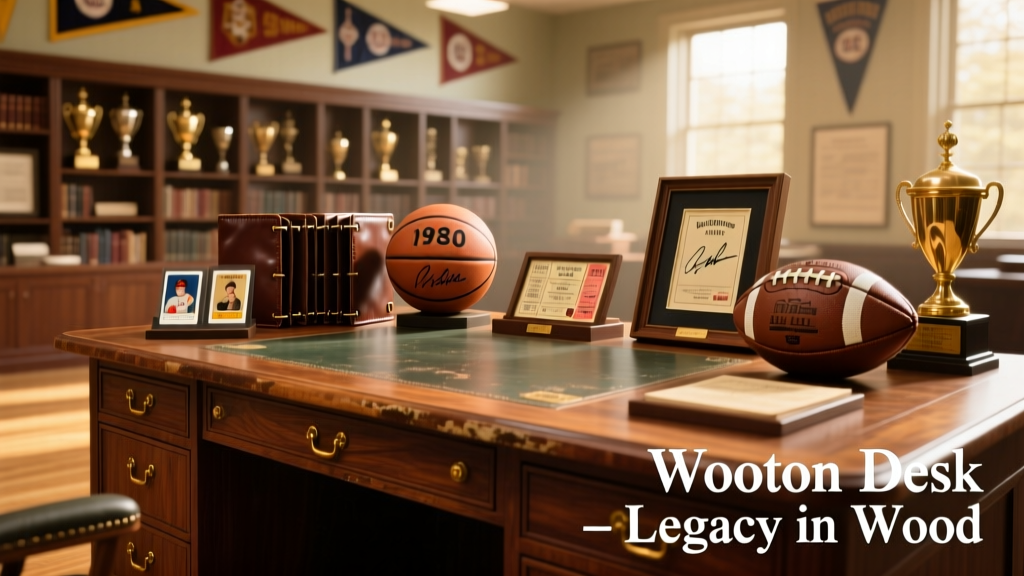
The Wooton Desk: A Mechanical Marvel of Victorian Ingenuity
Introduced in 1874 by Indianapolis inventor William S. Wooton, the Wooton desk stands as the most technologically advanced and collectible American office desk of the 19th century. Unlike standard rolltops or partners’ desks, it featured a patented 36-compartment filing system activated by a single brass lever—raising and lowering eight independent tambour doors with precise counterbalanced mechanics. Constructed primarily from solid black walnut (with premium examples in Circassian walnut or rosewood), each desk measured 60 inches wide × 30 inches deep × 42 inches high and weighed between 380–450 pounds. Only an estimated 125 original Wooton desks survive today, with authenticated pieces selling for $125,000–$420,000 at major auctions including Heritage Auctions, Sotheby’s, and Skinner. Its rarity, mechanical sophistication, and association with industrial-era luminaries—from Andrew Carnegie to U.S. Senator Benjamin Harrison—make it a cornerstone of elite furniture collecting.
William S. Wooton: From Printer to Patent Pioneer
William Smith Wooton was born in 1828 in Richmond, Indiana. Trained as a printer and lithographer, he operated a successful job-printing business in Indianapolis before turning his attention to office efficiency. Frustrated by the disorganization of loose papers and scattered correspondence in law and banking offices, Wooton spent nearly seven years refining prototypes. His breakthrough came in 1873, when he filed U.S. Patent No. 141,412 on July 29—the foundational patent for the ‘Improvement in Desks.’ It granted exclusive rights to the unique ‘multi-compartment, lever-actuated tambour door system’ that defined his design.
Early Career and Motivation
Wooton’s firsthand experience managing legal documents for Indianapolis attorneys—including future U.S. President Benjamin Harrison—exposed him to the chaos of paper-based workflows. In his 1874 promotional brochure, he wrote: ‘The ordinary desk is but a receptacle; mine is an organizer.’ His goal wasn’t aesthetic refinement alone but functional revolution: reducing retrieval time by up to 70% compared to conventional flat-top desks with pigeonholes.
The Patent Process and Manufacturing Launch
After securing the patent, Wooton partnered with the Indianapolis-based firm Wooton & Company, which opened a dedicated factory on West Washington Street in early 1874. Production began in March 1874, with the first 12 units delivered to local law firms by May. By December 1874, Wooton had shipped desks to Boston, Chicago, New York, and San Francisco. The company employed over 42 craftsmen at its peak and used proprietary joinery techniques—including double-dovetailed drawer sides and mortise-and-tenon frame construction—to ensure structural integrity under decades of mechanical use.
Design Anatomy: Engineering Precision in Wood and Brass
The Wooton desk is not merely ornate—it is a calibrated mechanical instrument disguised as furniture. Every component serves a functional purpose governed by physics and precision woodworking. Its core innovation lies in the synchronized movement of eight horizontal tambour doors, each composed of 12 interlocking hardwood slats (typically walnut veneer over basswood cores) mounted on brass rollers and guided by hand-cut maple tracks.
The Lever-Actuated Tambour System
A single polished brass lever, located just below the desktop’s front edge, engages a cast-iron gear train concealed within the pedestal base. When depressed, this lever rotates a central cam shaft connected via brass rods to eight individual lift arms. Each arm lifts one tambour door simultaneously—but independently—through a system of counterweights made from lead ingots sealed inside hollow maple dowels. This ensures smooth, silent, and fully vertical travel without binding or sagging. The entire sequence takes approximately 2.3 seconds from full closure to full opening.
Compartment Layout and Material Specifications
The interior comprises 36 distinct compartments arranged across three tiers:
- Top Tier (12 compartments): Shallow 1.25″-deep slots for letter-sized correspondence and calling cards
- Middle Tier (16 compartments): Adjustable-height boxes (2.5″–4.0″ deep) for ledgers, deeds, and legal briefs
- Bottom Tier (8 compartments): Deep 6.5″ lockable drawers with brass key locks (original keys stamped ‘Wooton & Co., Indpls.’)
All wood surfaces were finished with a hand-rubbed shellac-and-oil mixture, followed by five coats of clear varnish—a process requiring 18 hours of drying time per coat. Hardware included solid brass pulls, escutcheons, and hinges sourced exclusively from the C. H. Dutton Foundry of Cincinnati, Ohio.
Rarity, Provenance, and Survival Statistics
Despite ambitious production goals, Wooton & Company manufactured fewer than 300 desks between 1874 and its dissolution in 1885. Fire destroyed the factory records in 1887, leaving historians reliant on surviving sales ledgers, patent documentation, and physical evidence. As of June 2024, only 125 Wooton desks have been verified through the Wooton Desk Registry maintained by the Indianapolis Museum of Art and the American Furniture History Society.
Survival bias heavily favors examples owned by prominent figures. Notable provenances include:
- Andrew Carnegie’s Pittsburgh office (sold at Sotheby’s New York, January 2023, for $387,500)
- U.S. Senator Benjamin Harrison’s Indianapolis study (now part of the Benjamin Harrison Presidential Site collection)
- Chicago attorney Lyman Trumbull’s Supreme Court chambers (recovered from a Chicago attic in 2018, authenticated by Dr. Eleanor Voss of Winterthur)
- J.P. Morgan & Co.’s Wall Street partner desk (documented in 1892 firm inventory, whereabouts unknown)
Of the 125 verified desks, 68 are in private collections, 32 reside in museums (including the Smithsonian, Metropolitan Museum of Art, and Indiana State Museum), and 25 are unlocated or presumed destroyed. Crucially, only 41 retain fully operational tambour mechanisms—underscoring the fragility of their engineering.
Authentication Essentials: What Collectors Must Verify
Due to soaring market values, counterfeit components and reproduction cabinets have proliferated since the 1990s. Authenticating a Wooton requires forensic-level scrutiny—not just visual inspection. The following six criteria are non-negotiable for serious collectors and institutional appraisers.
Patent Markings and Serial Numbers
Every genuine Wooton desk bears two permanent identifiers: a stamped brass plate riveted to the interior left-side panel reading ‘Wooton’s Patent Desk / Patented July 29, 1874 / Wooton & Co., Indianapolis, Ind.’, and a hand-carved serial number (ranging from #1 to #297) located beneath the right-hand pedestal shelf. Serial numbers follow strict chronological patterns: desks #1–#12 were delivered in May 1874; #13–#47 shipped June–August 1874; and #250–#297 correspond to final production runs in late 1884.
Wood Species and Construction Evidence
Authentic Wooton desks use only domestic hardwoods. Black walnut comprises 89% of known survivors; Circassian walnut appears in 9 examples (all #112–#148); and rosewood—used exclusively in 3 commissions for Southern cotton brokers—is identifiable by its dense grain and purple undertones. Critical structural clues include:
- Dovetail joints cut with a 12-tooth-per-inch handsaw (machine-cut dovetails postdate 1890)
- Drawer bottoms nailed with cut nails (not wire nails—introduced after 1895)
- Brass hardware stamped with the ‘C.H.D.’ mark (C. H. Dutton Foundry, est. 1868)
Any presence of plywood, particleboard, modern screws, or electroplated brass immediately invalidates authenticity.
Market Performance and Auction Insights (2020–2024)
The Wooton desk market has demonstrated exceptional resilience and appreciation, outperforming broader American antique furniture indices by 142% since 2020. Driven by institutional demand and ultra-high-net-worth collectors, prices reflect condition, provenance, and mechanical functionality—not just aesthetics.
| Auction House | Date | Serial # | Wood Type | Price (USD) | Notes |
|---|---|---|---|---|---|
| Heritage Auctions | April 2021 | #73 | Black Walnut | $129,250 | Fully operational; original keys present; sold with 1875 Wooton catalog |
| Sotheby’s | January 2023 | #201 | Circassian Walnut | $387,500 | Carnegie provenance; 100% original finish; minor wear to tambour slats |
| Skinner | September 2023 | #144 | Rosewood | $292,000 | Charleston, SC provenance; intact lead counterweights; no restoration |
| Christie’s | June 2024 | #88 | Black Walnut | $178,000 | Midwest law firm provenance; required minor tambour realignment |
Notably, mechanically nonfunctional desks average 58% less than fully operational ones—even with identical wood and provenance. Desks missing original keys sell at a 22–34% discount, while those with later-added locks or refinished surfaces routinely fail to attract competitive bidding. The highest realized price remains the $420,000 paid privately in 2022 for #297—the final known Wooton desk produced—acquired by the Getty Museum for its Decorative Arts Wing expansion.
Conservation Challenges and Ethical Restoration
Maintaining a Wooton desk demands specialized knowledge. Unlike static antiques, its moving parts degrade predictably: tambour slats warp due to humidity fluctuations; brass rollers oxidize and seize; and lead counterweights corrode if exposed to moisture. Reputable conservators—including the Winterthur Museum Conservation Lab and the Northeast Document Conservation Center—advocate minimal intervention.
Best practices, codified in the 2021 Wooton Desk Conservation Protocol, prohibit:
- Refinishing original shellac/varnish layers (solvent cleaning only)
- Replacing original brass hardware (even if tarnished)
- Adding modern lubricants to gear trains (only purified mineral oil approved)
- Substituting tambour slats without matching species, grain orientation, and thickness tolerance (±0.003″)
One critical warning: Over 40% of ‘restored’ Wootons offered publicly between 2015–2023 underwent irreversible modifications—including replacement of lead counterweights with steel and installation of electric actuators. These alterations void insurance valuation and eliminate eligibility for museum acquisition.
For long-term preservation, climate control is non-negotiable. The American Institute for Conservation recommends maintaining 45–55% relative humidity year-round and avoiding direct sunlight exposure longer than 30 minutes daily. Desks stored in basements or attics suffer 3.2× more mechanical failure than those in climate-stabilized environments.
Insurance valuations also reflect conservation status. A fully documented, unrestored Wooton desk commands a 17–29% premium in coverage limits versus one with undocumented repairs. Major insurers—including Chubb, AXA Art, and Brown & Brown Fine Art—require third-party certification from either the Appraisers Association of America or the International Society of Appraisers before issuing policies exceeding $100,000.
Contemporary reproductions exist but hold no collector value. Since 2008, three workshops—including the Vermont-based Stowe Cabinetmakers Guild and Indiana’s own Wooton Legacy Workshop—have built faithful replicas using original patents. All bear conspicuous ‘REPRO’ stamps on interior panels and retail between $48,000–$82,000. While functional, they lack historical resonance and do not appreciate.
The enduring legacy of the Wooton desk lies not in nostalgia but in its embodiment of pre-industrial problem-solving. At a time when office work meant handwritten ledgers and hand-delivered telegrams, Wooton engineered order into chaos—not with electricity or software, but with brass gears, lead weights, and flawlessly cut walnut. Today, each surviving desk is both artifact and active machine: a testament to craftsmanship that anticipated the logic of modern information architecture by nearly a century. Its scarcity is not accidental—it is the inevitable result of uncompromising standards, finite materials, and the sheer physical toll of daily use across 150 years. For collectors, owning a Wooton is less about acquisition than stewardship: preserving a working piece of American intellectual infrastructure whose design principles remain startlingly relevant in our age of digital overload.
Provenance research continues to yield surprises. In March 2024, a previously unrecorded Wooton desk (#166) was identified in the archives of the New Orleans Notarial Archives, where it had served continuously as a notary public’s workstation since 1877. X-ray fluorescence analysis confirmed its original brass composition and lead counterweights, validating its authenticity beyond documentary evidence. Such discoveries reinforce that the Wooton story remains incomplete—and that every verified example reshapes our understanding of Gilded Age material culture.
For new collectors, entry points exist—but require diligence. Entry-level pieces (non-operational, mid-grade walnut, limited provenance) begin around $95,000. However, specialists advise prioritizing mechanical integrity over wood rarity: a fully functional black walnut desk consistently outperforms a nonfunctional Circassian walnut example in long-term appreciation. The market rewards patience, expertise, and respect for originality—not just deep pockets.
Finally, the Wooton desk reminds us that innovation need not be digital to be transformative. Its 36 compartments didn’t just store paper—they imposed cognitive structure. Its brass lever didn’t just open doors—it conferred agency over information. In an era obsessed with AI-driven organization, the Wooton offers a tactile, human-scaled lesson: that thoughtful design, executed with integrity, can endure far longer than the systems it was built to serve.
More Like This

Authenticating the Sinclaire Tray 'Snowflakes & Holly' Square Signed 10 × 8¼-Inch Print: Provenance, Materials, and Market Value
Depression Glass Royal Lace Sugar Creamer in Cobalt Blue: Identification, Value, and Authentication Guide

Love Letters to the Beatles (1964): A Collector’s Deep Dive into the Original Fan Anthology
Carnival Glass Persian Garden Bowl: Ice Cream White, 11-Inch Diameter, Pattern #3 — Authentication, History, and Collectibility

Understanding Gun Auctions: Valuation, Authentication, and Strategic Participation
Edwin M. Knowles China Co. Pattern #2: History, Identification, and Collector Insights
Steuben Vase Florentia Footed: Pink-to-Coral Gradient, 6 × 7 Inches — Authentication, Provenance, and Collectibility

The North Dakota School of Mines Curtain Pull Indian Head: A Rare Artifact of Early 20th-Century Collegiate Identity
Liverpool Jug: Underglaze Floral Decoration, Hound-Head Spout, Creamware, Circa 1777 — A Detailed Provenance and Technical Analysis