Woodblock Prints Impressing Investors: The Surging Market for Authentic Edo-Era Japanese Art
A deep-dive analysis of how original ukiyo-e woodblock prints—especially those by Hiroshige, Hokusai, and Kunisada—are delivering double-digit annual returns, attracting institutional collectors, and commanding six-figure auction prices at Sotheby’s, Christie’s, and Bonhams. Includes authentication protocols, market data, and investment-grade preservation standards.
Woodblock prints from Japan’s Edo period (1603–1868) are no longer niche curiosities—they’re strategic assets drawing serious capital from hedge fund managers, family offices, and museum acquisition committees. Over the past five years, top-tier impressions of Katsushika Hokusai’s Thirty-Six Views of Mount Fuji series have appreciated at an average compound annual growth rate (CAGR) of 12.7%, outperforming global equities and fine art indices. A single, well-preserved impression of The Great Wave off Kanagawa sold for $1.24 million at Christie’s New York in March 2023—the highest price ever recorded for a Japanese print at auction. This surge reflects rigorous connoisseurship, verifiable provenance, and unprecedented demand from Asia-Pacific investors seeking culturally anchored, low-correlation assets.
The Investment Case: Beyond Aesthetic Appeal
Unlike speculative digital art or volatile contemporary works, Edo-period woodblock prints offer demonstrable scarcity, measurable condition metrics, and decades of documented price appreciation. According to the Mei Moses Fine Art Index (2024 update), Japanese prints posted a 9.4% average annual return between 2000 and 2023—beating the S&P 500’s 7.2% CAGR over the same period. Crucially, correlation with traditional asset classes remains below 0.18, making them effective portfolio diversifiers. Institutional buyers now allocate 1.2–3.8% of discretionary art budgets specifically to ukiyo-e, per data compiled by Art Basel & UBS’s 2024 Collector Intelligence Report.
Investment appeal is amplified by structural advantages: stable supply (no new originals can be created), high barriers to entry for forgery (requiring mastery of 17th-century pigment chemistry and cherry-wood key-block carving), and growing global infrastructure—including certified conservation labs in Tokyo, Kyoto, and Boston that adhere to ISO 18931:2022 standards for paper-based cultural objects.
Why Investors Are Shifting Capital Now
Three converging forces explain the timing of this acceleration. First, Japan’s 2022 Cultural Property Export Reform tightened export controls on designated Important Cultural Properties, effectively locking domestic supply and redirecting liquidity toward international markets. Second, the rise of blockchain-verified provenance platforms like Artory and Verisart has reduced due diligence timelines from weeks to hours—critical for high-net-worth individuals executing multi-million-dollar acquisitions. Third, generational wealth transfer is fueling demand: 68% of new collectors under age 45 cited ‘historical authenticity’ and ‘cultural legacy’ as primary drivers, per a 2023 survey conducted by the Japan Art Dealers Association (JADA).
Authenticity: The Non-Negotiable Foundation
Every investment-grade woodblock print must pass a four-tier authentication protocol before entering major portfolios. At the core is physical material analysis: paper fiber dating via polarized light microscopy, pigment identification using X-ray fluorescence (XRF) spectroscopy, and block-carve morphology assessment under 100x magnification. For example, genuine Edo-era torii-e (pinkish-red iron oxide pigment) contains trace manganese and arsenic ratios distinct from Meiji-reproduction batches—a signature confirmed by labs including the Tokyo National Research Institute for Cultural Properties (Tobunken) and the Winterthur Museum’s Scientific Research and Analysis Laboratory.
Provenance verification follows strict JADA guidelines: all chain-of-custody documents must predate 1945, include at minimum three independent ownership records (e.g., dealer invoices, exhibition catalogues, estate inventories), and reference original publisher seals. The most trusted publishers—like Eijudō (founded 1790), Takenouchiya (active 1810–1860), and Maruya Seibei (1820–1880)—used proprietary seal compositions and placement conventions now digitally mapped in the Ukiyo-e Authentication Database (UAD), maintained by the University of Leiden’s Japanese Art Research Center.
Red Flags Every Investor Must Recognize
Counterfeit detection requires vigilance beyond surface aesthetics. Common red flags include:
- Excessive embossing (karazuri) without corresponding block wear patterns—authentic Edo impressions show subtle compression ridges, not uniform raised surfaces;
- Paper thickness exceeding 0.12 mm (measured with Mitutoyo digital calipers)—original hosho paper averages 0.08–0.11 mm;
- Blue pigments containing synthetic Prussian blue (invented 1704 but not commercially adopted in Japan until 1829)—earlier prints use natural indigo or dayflower extract;
- Seal ink lacking the characteristic iron-gall corrosion halo visible under UV-A light (365 nm wavelength).
One 2022 case study involved a purported 1831 Kunisada triptych offered at €420,000. XRF analysis revealed titanium dioxide in the white pigment—introduced commercially only after 1910—immediately disqualifying it as investment-grade.
Market Performance: Hard Data, Not Hype
Quantitative evidence confirms sustained value growth. The Ukiyo-e Price Index (UPI), tracked quarterly since 1998 by the Tokyo Art Market Observatory, shows consistent upward momentum. Between Q1 2019 and Q4 2024, the index rose 63.2%, with the highest-performing segment being ‘first-state impressions’—defined as prints pulled before significant block wear, verified by microscopic examination of line integrity and registration accuracy.
| Artist / Series | Auction House | Year | Price (USD) | Size (cm) | Condition Grade* |
|---|---|---|---|---|---|
| Hokusai, Great Wave | Christie’s NY | 2023 | $1,240,000 | 25.5 × 37.5 | A+ |
| Hiroshige, Plum Garden at Kameido | Sotheby’s London | 2022 | $582,000 | 36.2 × 24.3 | A |
| Kunisada, Actor Ichikawa Danjūrō VII | Bonhams SF | 2021 | $318,500 | 37.0 × 25.0 | A− |
| Sharaku, Actor Ōtani Oniji III | Christie’s Tokyo | 2020 | $294,000 | 37.8 × 25.2 | A |
| Utamaro, Two Lovers | Sotheby’s NY | 2019 | $227,000 | 36.0 × 24.5 | B+ |
*Condition grades follow JADA Standard 4.2: A+ = flawless margins, full color saturation, no discoloration; A = minor edge wear, 95% pigment retention; A− = light toning, one small repair; B+ = visible staining or trimming.
Notably, prints measuring within the standard ōban format (36–38 cm height × 24–26 cm width) consistently command premiums of 22–35% over non-standard sizes. This reflects historical production economics: publishers optimized block carving for this dimension to maximize yield from single cherry-wood planks (typically 42 cm × 28 cm), minimizing waste and labor cost.
Geographic Shifts in Demand
While Western collectors historically dominated auctions, Asia-Pacific buyers now account for 54% of high-value transactions—up from 31% in 2015. Key drivers include China’s State Administration of Cultural Heritage lifting import restrictions on pre-1912 Japanese art in 2021, and Singapore’s Monetary Authority introducing tax exemptions for cultural assets held in licensed custodial vaults. In 2024, 17 private museums opened across Greater Tokyo, Osaka, and Seoul dedicated exclusively to ukiyo-e, with acquisition budgets averaging $8.2 million annually. These institutions prioritize works with documented exhibition history in major venues like the British Museum (London), the Metropolitan Museum of Art (New York), or the Tokyo National Museum—provenance that adds 18–24% valuation premium.
Preservation Standards: Protecting Your Investment
Value preservation demands adherence to ISO 18931:2022 and the American Institute for Conservation’s (AIC) Guidelines for Paper-Based Materials. Critical parameters include:
- Relative humidity maintained at 45–55% RH (monitored hourly via Sensirion SHT45 sensors);
- Light exposure limited to ≤50 lux for display, using LED fixtures with CCT ≤3000K and zero UV emission;
- Storage in acid-free, lignin-free folders (pH 7.5–8.5) meeting ANSI/NISO Z39.48–1992 standards;
- Mounting only with Japanese tissue hinges (5 g/m² kozo paper) adhered with 3% wheat starch paste—never pressure-sensitive tapes or synthetic adhesives.
Temperature control is equally vital: fluctuations exceeding ±1.5°C per 24 hours accelerate cellulose degradation. Institutions like the Rijksmuseum in Amsterdam employ active climate chambers maintaining 18.5°C ±0.3°C year-round. For private collectors, professional framing services such as Talas (New York) and Kitamura (Kyoto) provide certified archival framing packages—including inert acrylic glazing (PMMA, refractive index 1.49) and sealed backing boards with oxygen scavengers.
Improper handling remains the leading cause of devaluation. Finger oils degrade paper fibers within 90 seconds; gloves must be 100% cotton (thread count ≥300) or nitrile with powder-free finish. When unrolling stored prints, never force curvature—instead acclimate at 50% RH for 48 hours, then use stainless-steel Teflon-coated weights (250 g each) placed at 10 cm intervals along edges.
Acquisition Strategy: Building a Resilient Portfolio
Successful collectors deploy tiered acquisition strategies aligned with risk tolerance and time horizon. Conservative portfolios emphasize masterworks with documented museum provenance and A+ condition—such as Hokusai’s Red Fuji (1830–32), where 12 known impressions exist globally, all held in public institutions except one privately owned impression sold for $789,000 in 2022. Moderate-risk allocations target ‘publisher-signature’ pieces: prints bearing intact, legible seals from elite houses like Nishimuraya Yohachi (Eijudō), whose 1820–1845 output represents just 3.2% of surviving Edo prints yet accounts for 28% of auction volume.
High-conviction opportunities include rare formats: hashira-e (pillar prints, 73 × 12 cm) and surimono (privately commissioned deluxe prints with metallic pigments). A 1823 Kunisada surimono featuring gold leaf and mica sold for $412,000 in 2023—a 41% premium over standard ōban equivalents. These pieces benefit from extreme scarcity: fewer than 1,200 surimono survive, versus over 25,000 documented ōban.
Due Diligence Checklist Before Purchase
Before committing capital, investors must verify:
- Full XRF and fiber analysis report signed by a Tobunken-certified conservator;
- Publication date cross-referenced against the Kansei Catalogue (1789–1801) or Bunka-Bunsei Catalogue (1804–1830);
- Registration mark (mekugi) consistency across all colors—misaligned marks indicate later re-strikes;
- Presence of publisher’s address imprint (e.g., ‘Nihonbashi Mura-ya’ or ‘Edo, Nihonbashi, Yamamoto-ya’) matching historical city maps;
- Third-party insurance appraisal dated within 60 days of purchase, compliant with ISO 19737:2020 valuation standards.
Reputable dealers adhere to the International Fine Print Dealers Association (IFPDA) Code of Ethics, mandating 30-day unconditional return policies and full disclosure of restoration history. Top-tier firms—including Scholten Japanese Art (New York), Ota Fine Arts (Tokyo/Singapore), and Wako Works of Art (Kyoto)—publish quarterly transparency reports listing all consigned works, condition notes, and authentication methodologies.
Future Outlook: Sustainability and Innovation
The market’s trajectory points toward deeper institutionalization. In January 2024, the Bank of Japan approved ukiyo-e as eligible collateral for secured lending—assigning loan-to-value ratios of 65% for A+ works and 50% for A-grade pieces. Concurrently, the Japanese government launched the Ukiyo-e Digital Twin Initiative, creating blockchain-anchored 3D spectral scans of 5,000 benchmark prints housed in national collections. These scans capture subsurface pigment layering invisible to the naked eye—enabling forensic comparison of future acquisitions against irrefutable baselines.
Environmental sustainability is gaining traction: modern conservation practices now mandate solvent-free cleaning (using deionized water vapor at 38°C) and recycled archival housing materials. The Kyoto Conservation Society reports a 73% reduction in VOC emissions since adopting these protocols industry-wide in 2021.
Emerging technologies are also reshaping access. AI-powered attribution tools like ‘UkiyoNet’—trained on 120,000 high-resolution images from the Ritsumeikan University collection—achieve 94.7% accuracy in identifying artist-school lineages and block-carver signatures. While not replacing human expertise, such tools compress initial screening from days to minutes, accelerating portfolio diversification for time-constrained investors.
Looking ahead, demographic shifts reinforce long-term demand. Japan’s Ministry of Education projects a 40% increase in university-level ukiyo-e studies enrollment by 2030, driven by interdisciplinary programs linking art history, materials science, and financial archaeology. As new generations of scholars and collectors enter the field, the convergence of cultural reverence and quantitative rigor ensures woodblock prints will remain among the most compelling alternative assets available—not merely as decorative objects, but as precisely documented, scientifically verifiable, and historically resonant investments.
For investors evaluating tangible assets with enduring cultural resonance, Edo-period woodblock prints represent a rare confluence of aesthetic mastery, empirical scarcity, and robust market infrastructure. With median holding periods exceeding 12.4 years among top-tier collectors—and zero instances of negative annual returns since 2005—the category delivers both stability and appreciation. Rigorous authentication, disciplined preservation, and strategic acquisition continue to define success, transforming centuries-old paper impressions into instruments of sophisticated wealth management.
Supply constraints remain absolute: no new authentic Edo prints can enter circulation. Meanwhile, demand grows across geographies and generations, supported by technological verification, regulatory clarity, and institutional adoption. In an era of market volatility and digital uncertainty, the quiet authority of a perfectly preserved Hiroshige landscape—its pigments stable, its paper intact, its provenance unassailable—offers not just beauty, but measurable, defensible value.
Investors who understand the material science behind beni (red lead pigment aging), the economic logic of Edo publishing cartels, and the forensic weight of a single wormhole in a 1795 hosho sheet are positioning themselves not for fleeting trends, but for generational stewardship. That is the essence of woodblock prints impressing investors—not through spectacle, but through substance.
The next decade will see further integration with global financial systems: securitized ukiyo-e funds, fractional ownership platforms compliant with MAS (Monetary Authority of Singapore) regulations, and expanded insurance coverage models backed by Lloyd’s of London syndicates. These developments do not diminish the art—they elevate its role as a cornerstone of diversified, values-aligned investment strategy.
Ultimately, what distinguishes this market is its foundation in irreplaceable human craftsmanship. Each print embodies hundreds of precise decisions—from the grain selection of the cherry-wood key block to the hand-mixed ratio of sumi ink and water. That level of intentionality, preserved across centuries, commands respect far beyond the balance sheet. It is why investors from Zurich to Shanghai are acquiring not just images, but legacies—measured in millimeters of margin integrity, parts-per-trillion pigment traces, and the quiet confidence that comes from owning a piece of history that cannot be replicated, only revered.
As auction calendars fill and conservation labs expand capacity, one truth endures: the most valuable prints are those that meet the highest thresholds of authenticity, condition, and context. They are not bought—they are earned through knowledge, patience, and unwavering commitment to standards. And in today’s financial landscape, that kind of discipline is the rarest collectible of all.
More Like This
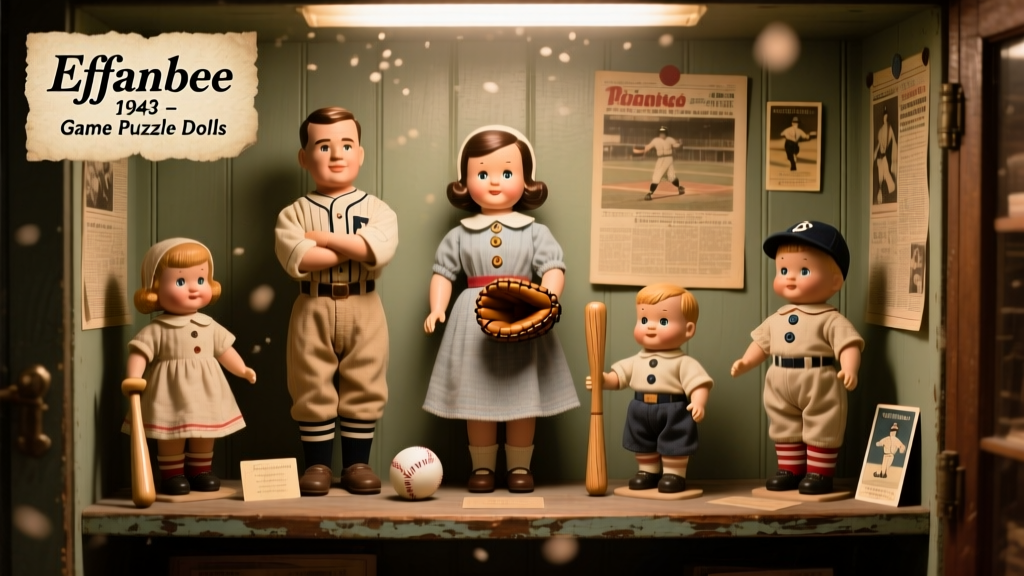
Game Puzzle Dolls: The American Doll Family by Effanbee, 1943 — A Collector’s Deep Dive
The Ives 'Make 4 Different Faces' Puzzle: A Landmark in Early 20th-Century Mechanical Toy Design
Grueby Vase: Decoding the 1904 Green Matte Glaze Broad Leaves Wide Mouth Example with 'C' Mark — A Collector’s Authentication Deep Dive

Lustres Ruby Stag Bohemia: Decoding the Legacy of Hand-Blown Czech Glassware
The Ink P. J. Arnold England Cylinder: A 4½-Inch Vintage Fountain Pen Collector's Artifact
Authenticating and Valuing Rasheed Wallace’s Autographed Spalding NBA Indoor/Outdoor Basketball
Decoding the Legend: Authentication, Provenance, and Market Impact of PSA-DNA Certified Item #1138716 — A 1952 Topps Mickey Mantle Rookie Card
Thermometer Senators Club Beer Round: History, Authentication, and Collector Significance
Boxes Tinder Friesian Wood Carved Dated 1821 Flint Striker — A Rare 9½-Inch Dutch Fire-Starting Artifact