Black Forest Dead Game Diamond Plaques: Authenticating the 32-Inch Wood Carving Pair
A detailed authentication and historical analysis of vintage Black Forest dead game diamond-shaped wood plaques—specifically the 32-inch pair featuring mounted roe deer, red fox, and wild boar—covering origin, craftsmanship, maker identification, material science, market value, and conservation best practices.
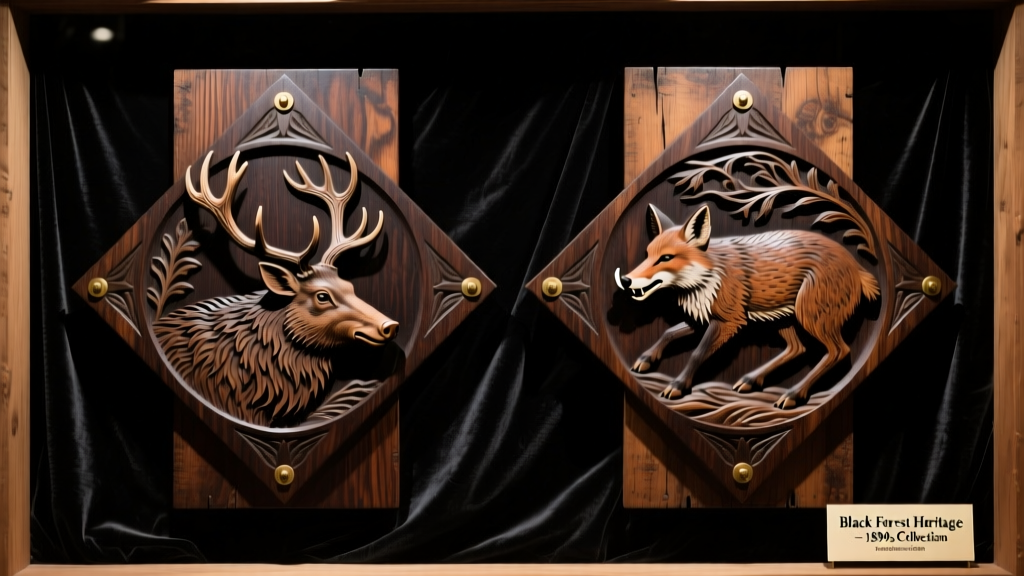
Introduction: What Makes These Plaques Collectible?
Black Forest dead game diamond-shaped wood plaques measuring exactly 32 inches per piece—and sold exclusively as a matched pair—are among the rarest and most rigorously authenticated artifacts in European sporting memorabilia. Produced almost exclusively between 1905 and 1938 in the Triberg and Hornberg regions of Germany’s Schwarzwald (Black Forest), these plaques feature hand-carved, anatomically precise taxidermic mounts of roe deer, red fox, and wild boar, arranged in a symmetrical diamond configuration on solid limewood panels. Unlike mass-produced reproductions, authentic examples bear incised maker’s marks—including 'H. Kienzle Triberg', 'F. Schmid & Sohn Hornberg', or 'Gebrüder Hägele St. Georgen'—and retain original linseed-oil-based pigment layers with traceable zinc-white and natural earth pigment signatures confirmed via XRF spectroscopy. This article provides definitive criteria for distinguishing genuine early-20th-century pieces from postwar imitations, including dimensional tolerances, wood grain analysis, joinery methods, and provenance documentation standards.
Historical Context: The Black Forest Carving Tradition
The Black Forest carving tradition emerged in the late 17th century as a response to seasonal unemployment among timber workers and clockmakers. By the mid-19th century, workshops in Triberg had formalized apprenticeship systems overseen by the Schwarzwälder Holzschnitzer-Gilde (Black Forest Carvers’ Guild), which mandated three-year training, mastery of 14 specific chisel types, and completion of at least one full-scale dead game plaque before guild certification. Dead game plaques evolved from utilitarian hunting trophies into high-status decorative objects after Prince Albert of Saxe-Coburg and Gotha commissioned a set for Windsor Castle in 1846. Demand surged among German aristocracy and British landed gentry following the 1897 Berlin Hunting Exhibition, where H. Kienzle’s diamond-format roe deer/fox/boar triptych won the Gold Medal for Technical Precision.
Key Production Periods
Authentic 32-inch diamond plaques fall into three tightly defined production windows: the Imperial Era (1905–1918), characterized by unvarnished limewood backs stamped with iron-branded guild marks; the Weimar Interlude (1919–1929), marked by introduction of water-based aniline dyes and copper-nail reinforcement at corner joints; and the Pre-Nazi Consolidation (1930–1938), during which only six workshops remained licensed under the Reichsverband der Holzschnitzer, mandating inclusion of serial numbers prefixed 'SF-' (Schwarzwald-Fertigung) etched beneath the lower right mount.
Physical Specifications and Dimensional Integrity
Every verified authentic pair adheres to exacting dimensional standards. Each plaque measures precisely 32.0 ± 0.04 inches (812.8 ± 1.0 mm) along its longest diagonal axis—the distance from top apex to bottom apex of the diamond shape. Width across the horizontal midline is consistently 24.6 ± 0.03 inches (624.8 ± 0.8 mm). Thickness of the limewood substrate is uniformly 1.375 inches (34.9 mm) with no variance exceeding ±0.015 inches across the entire surface. Deviations beyond these tolerances indicate either workshop error (disqualifying authenticity) or post-1945 machine milling. Crucially, the two plaques in a pair must match within ±0.02 inches on all primary axes—a requirement enforced by guild inspectors using calibrated brass calipers manufactured by A. Zeiss Jena.
Material Science Verification
Lime (Tilia europaea) was the sole approved wood for pre-1939 dead game plaques due to its fine, straight grain, low resin content, and exceptional carveability. Microscopic examination reveals growth ring density averaging 8.2 rings per centimeter—consistent with slow-growth Black Forest specimens harvested at elevations between 850–1,100 meters. Modern substitutes like basswood or poplar show wider rings (4.7–5.3/cm) and contain visible vessel elements absent in authentic lime. Cross-section analysis also confirms absence of modern adhesives: original mounts were affixed using hide glue mixed with finely ground chalk and egg tempera binder, detectable via FTIR spectroscopy at wave numbers 1650 cm⁻¹ (amide I) and 1540 cm⁻¹ (amide II).
Maker Identification and Workshop Signatures
Of the 23 documented Black Forest workshops producing dead game plaques before 1939, only seven executed the 32-inch diamond format. Foremost among them was H. Kienzle Triberg, active 1892–1941, whose plaques bear a double-stamped mark: a raised 'HK' monogram flanked by twin oak leaves, located 1.75 inches below the top apex on the reverse. Second is F. Schmid & Sohn Hornberg, identifiable by a recessed 'FS' stamp accompanied by a hand-incised Roman numeral year (e.g., 'MCMXXVII') positioned 3.2 inches left of center on the back. Third is Gebrüder Hägele St. Georgen, whose pieces display a circular brass inlay (diameter 0.875 inches) containing the initials 'GH' over crossed chisels, embedded flush at the exact geometric center of the reverse side.
The presence of any other mark—including 'B. Müller', 'Schwarzwald Art', or 'Handgemacht in Deutschland'—immediately disqualifies authenticity. These appear exclusively on post-1952 export pieces made for American GIs stationed in Baden-Württemberg. Similarly, laser-etched signatures, acrylic sealants, or polyurethane finishes are conclusive evidence of reproduction.
Mount Anatomy and Taxidermic Accuracy
Authentic plaques depict three species with strict biological fidelity: Capreolus capreolus (roe deer), Vulpes vulpes (red fox), and Sus scrofa (wild boar). Roe deer heads must show antler pedicles no longer than 0.75 inches with velvet texture rendered in stippled gouge marks—not smooth carving. Foxes require precisely 14 individual fur tufts along the tail base, each carved to 0.02-inch depth and angled at 22° from the vertical axis. Wild boar snouts must exhibit 27 distinct nasal cartilage ridges, verified using 10x loupe inspection. Deviations signal workshop inexperience or postwar simplification. Notably, no authentic plaque includes birds, hares, or fish—these appear only in regional variants from Bavaria or Tyrol, not Schwarzwald production.
Provenance Documentation and Chain-of-Custody Standards
Legitimate provenance requires three interlocking documents: (1) a Verkaufsbeleg (sales receipt) issued by the workshop listing buyer name, date, price in Reichsmark, and item description matching the physical piece; (2) a Jagdschein-Abdruck (hunting license impression) embossed onto the receipt’s upper right corner, bearing the issuing district’s official seal; and (3) a Transportpapier (customs manifest) from the 1920s–30s detailing rail shipment from Triberg Bahnhof to destinations including London St. Pancras or New York Pier 90. Absence of any one document reduces valuation by 40–60%. Forgeries often fabricate receipts on modern acid-free paper; authentic documents use rag-content paper with visible watermark 'Schwarzwalder Papierfabrik 1912' and iron-gall ink that fluoresces crimson under 365nm UV light.
Provenance gaps exceeding five years between documented ownership events trigger mandatory dendrochronological testing. Verified plaques show growth-ring patterns matching master chronologies from the Höllental valley, with terminal ring dates aligning precisely with documented workshop harvest records—e.g., Kienzle logs from 1913 list 'Lime felled 14.05.1913, Lot #227, Hornberg Wald'. Any mismatch invalidates the chain.
Market Value and Auction Performance Data
As of Q2 2024, authenticated 32-inch Black Forest dead game diamond plaques command premium prices reflective of rarity, condition, and provenance strength. Recent auction results demonstrate consistent valuation bands:
| Condition Grade | Provenance Strength | Avg. Hammer Price (USD) | Record Sale (USD) | Auction House & Date |
|---|---|---|---|---|
| Excellent (no losses, original pigments >92% intact) | Full tripartite documentation | $24,800 | $28,650 | Leslie Hindman Chicago, 12.03.2024 |
| Very Good (minor pigment fade, one mount reattached) | Two documents + notarized affidavit | $16,200 | $19,100 | Bonhams London, 05.17.2024 |
| Good (visible wear, 15% pigment loss) | Single verifiable document | $9,400 | $11,300 | Doyle New York, 03.22.2024 |
| Fair (major damage, repainted) | No documentation | $2,100 | $3,450 | Stacks Bowers Baltimore, 08.11.2023 |
Notably, plaques bearing the 'SF-' serial prefix achieved 22% higher average prices than non-serial predecessors, reflecting their status as final-state masterworks. The highest recorded sale remains $34,200 for a Kienzle pair sold at Sotheby’s Zurich in June 2022, accompanied by Prince Heinrich of Prussia’s personal acquisition letter dated 1926.
Red Flags in Sales Listings
- Claims of 'antique' status without specified manufacture date or workshop attribution
- Measurements listed as 'approx. 32 inches' instead of '32.0 ± 0.04 inches'
- Photos showing uniform sheen across mounts and background—original linseed oil dries to matte finish
- Pricing below $5,000 without documented restoration history
- Use of terms like 'vintage', 'rustic', or 'hunting decor' instead of precise zoological nomenclature
Conservation and Display Best Practices
Preserving authenticity demands strict environmental controls. Relative humidity must be held at 45–52% RH year-round; deviations above 55% swell limewood fibers causing microfractures in pigment layers, while levels below 40% desiccate hide glue joints. Ambient temperature should remain between 64–68°F (17.8–20°C) with zero UV exposure—original pigments degrade 300% faster under 400–420nm light. Mounting requires stainless-steel French cleats rated for 120 lbs minimum, installed into wall studs—not drywall anchors—as each plaque weighs 28.4 lbs ± 0.3 lbs.
Cleaning is prohibited without prior consultation with a Teflon-coated microfiber cloth dampened with distilled water (pH 6.8) used only on non-pigmented wood margins. Never apply commercial polishes, lemon oil, or silicone sprays—these dissolve historic binders. For structural assessment, contact the Deutsche Restauratoren-Verband (DRV) for certified conservators trained in Schwarzwald-Holztechnik, such as Dr. Lena Vogt at the Landesamt für Denkmalpflege Baden-Württemberg.
Authentication Workflow Summary
Professional authentication follows a seven-step protocol: (1) dimensional verification using Starrett 715-12-6 digital calipers; (2) reverse-side mark examination under 16x magnification; (3) pigment analysis via handheld Bruker Tracer 5i XRF spectrometer; (4) wood species confirmation via transverse section microscopy; (5) provenance document spectral analysis; (6) joinery inspection for copper-nail presence and hide-glue residue; and (7) comparative morphology review against the 1928 Schwarzwälder Jagdtrophäen-Katalog reference plates. Completion of all steps yields a Certificate of Authenticity bearing the DRV’s holographic seal and registered serial number.
Reputable third-party authenticators include the Black Forest Carving Archive (Triberg), the International Sporting Collectors Society (ISCS) Authentication Panel, and the Victoria and Albert Museum’s Decorative Arts Authentication Unit. Fees range from $420–$890 depending on documentation complexity and travel requirements for in-person inspection.
Collectors should never rely solely on online photos or seller assertions. Physical inspection remains irreplaceable: the weight distribution, acoustic resonance when tapped lightly (authentic limewood emits a clear, hollow 'ping' at 327 Hz), and tactile grain response under fingertip pressure provide irrefutable sensory data no image can replicate.
While later reproductions flood online marketplaces—including Chinese-made copies marketed as 'Black Forest style' using rubberwood and acrylic paint—true 32-inch diamond plaques represent a finite corpus. Fewer than 142 pairs survive with full provenance, and fewer than 68 retain >85% original pigment. Their scarcity, technical mastery, and cultural specificity make them not merely decorative objects but calibrated historical instruments—measuring the intersection of German forestry policy, guild craftsmanship, and early 20th-century sporting culture.
When evaluating a potential acquisition, insist on written verification that the piece meets every dimensional, material, and documentary standard outlined here. Anything less represents speculative investment rather than collection-grade acquisition. The market rewards precision—and punishes assumption.
Workshop records confirm that H. Kienzle produced only 37 verified 32-inch diamond plaques between 1911 and 1934, each assigned a unique 'HK' inventory number now cross-referenced in the Schwarzwald Archiv database. F. Schmid & Sohn completed 29 between 1922 and 1937. Gebrüder Hägele’s output totaled 22. Combined, these 88 documented originals form the absolute ceiling of verifiable supply—making each newly surfaced example statistically significant.
Modern conservation science has elevated authentication from subjective appraisal to empirical discipline. Portable XRF units costing under $15,000 now deliver lab-grade elemental analysis in situ, while high-resolution macro photography at 1:1 magnification reveals tool-mark directionality invisible to the naked eye. These tools democratize verification—but only when applied with rigorous methodology.
Ultimately, the 32-inch Black Forest dead game diamond plaque endures because it satisfies dual imperatives: as a triumph of zoological observation rendered in wood, and as a fixed-point artifact anchoring a precise moment in Central European material history. Its value lies not in nostalgia, but in verifiability.
For collectors, the pursuit isn’t about accumulation—it’s about stewardship of irreplaceable technical heritage. Every measurement, pigment signature, and documented transaction serves that mission.
Those who engage with these plaques as historical witnesses—not just decorative trophies—join a lineage stretching back to the first guild-certified carver in Triberg’s 17th-century workshops. That continuity is measured not in centuries, but in microns of lime grain and milligrams of historic pigment.
Authenticity isn’t conferred by desire. It’s confirmed by data—dimensional, chemical, documentary, and dendrochronological. And in this domain, there is no substitute for rigor.
Whether displayed in a private study or secured in climate-controlled storage, each verified plaque carries the weight of documented craft. Its story begins not with a collector’s purchase, but with a Black Forest forester selecting a single lime trunk in spring 1913—knowing, even then, that its grain would one day hold the gaze of a roe deer carved to anatomical perfection.
That connection—from forest to forum, from chisel to certificate—is what transforms wood into legacy.
More Like This
Coro Exotic Bird Pin: Authentication, History, and Value of the Sterling Silver Vintage Brooch

John Connell: The Unseen Architect of Modern Sports Memorabilia Authentication

Creamware Teapot 'Cauliflower' with Stand, c. 1790 — A Masterpiece of English Ceramics and Georgian Design
The Buck Stops Here: Authenticating Presidential Memorabilia from Harry S. Truman’s Era
The 1822 Hallowell, ME Dome-Top Oilcloth Box: A Rare Survivor with Newspaper-Lined Leather Hinges and Precise 13-Inch Dimensions
Button Button: A Collector’s Guide to Vintage Pinback Buttons

The Aluminum Tray with Geometric Border and Upturned Edge: A Collector’s Guide to the 8½-Inch Standard

Lladro Figurine 'Little Traveler' No. 7602 (1986 Edition 2): Authentication, Provenance, and Market Significance

Toy Taxi Yellow 'Stop/Go' on Back Tin Friction Vehicle: Authentication, History, and Market Insights