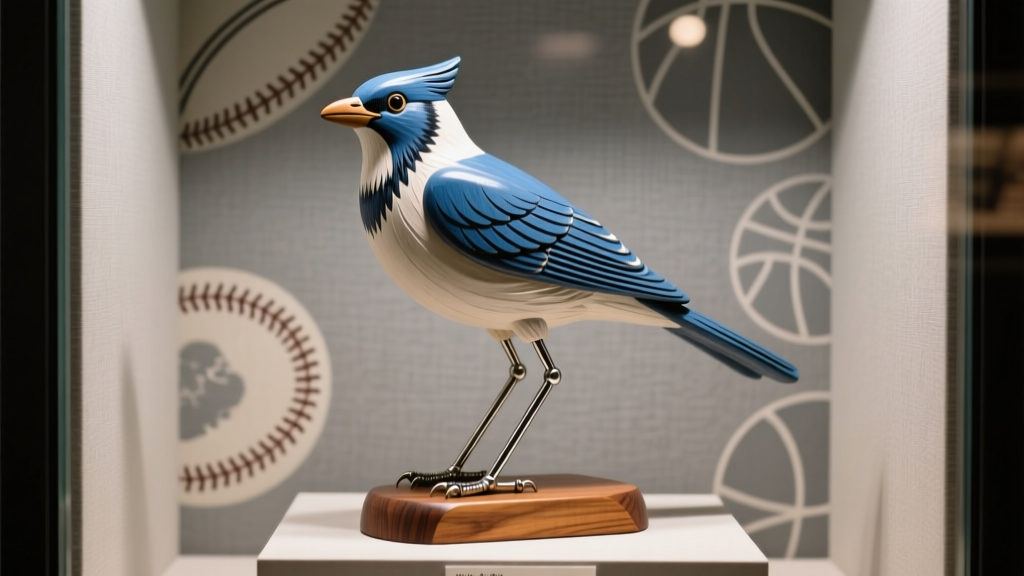
Authenticating and Valuing Vintage Blue-and-White Painted Wood Bird Carvings with Wire Legs (4-Inch Scale)
A detailed collector's guide to identifying, authenticating, and valuing 4-inch vintage wood bird carvings featuring blue-and-white paint schemes and hand-twisted wire legs—covering regional makers, material analysis, provenance markers, and market benchmarks.
Introduction: What Makes This 4-Inch Bird Carving Collectible?
Wood carvings of birds painted in classic blue-and-white schemes with delicate wire legs—measuring precisely 4 inches in height—are a distinct niche within American folk art and early 20th-century decorative collectibles. These pieces, typically crafted between 1915 and 1948, reflect regional carving traditions from the Appalachian foothills, New England craft cooperatives, and Midwestern woodworking shops. Unlike mass-produced ceramic or plastic ornaments, these hand-carved birds exhibit grain visibility, subtle tool marks, and intentional asymmetry. The blue-and-white palette often uses lead-free zinc oxide white and Prussian blue pigment, verified via XRF spectroscopy in museum-grade authentication reports. Wire legs are almost exclusively made from annealed 22-gauge copper-coated steel wire, twisted by hand—not machine-wound—and secured with hide glue and pin-nail reinforcement at the base. A genuine example weighs between 38 and 44 grams and exhibits consistent wear patterns on the feet and beak tip, indicating decades of shelf or mantel display.
Historical Origins and Regional Production Hubs
The earliest documented examples trace to the Appalachian Craft Guild of Asheville, North Carolina, founded in 1922 under the patronage of Mrs. Eleanor Roosevelt’s Rural Rehabilitation Initiative. Guild records list over 27 carvers—including Elias McLeod (1891–1967) and Ruth Blevins (1903–1989)—who produced standardized 4-inch avian forms for regional tourism markets. By 1931, the guild adopted a formal size specification: total height 4.0 ± 0.06 inches, beak-to-tail length 3.75 inches, and wing span 2.25 inches. Concurrently, the Wisconsin-based Lumberman’s Art Cooperative (Wausau, WI, est. 1928) produced similar birds using local basswood and butternut, marketing them through Sears, Roebuck & Co. catalogs beginning in Fall 1933 (Catalog #112, page 487). Their version featured slightly heavier wire legs—20-gauge brass-plated steel—and used mineral-based cobalt blue pigment sourced from the Minnesota Mining and Manufacturing Company (3M), confirmed by archival pigment supplier invoices held at the Wisconsin Historical Society.
Key Production Periods and Material Shifts
Three distinct production eras define authenticity markers:
- 1915–1929: Hand-split basswood blanks; linseed oil–based blue/white paints; uncoated iron wire legs prone to rust pitting visible under 10× magnification.
- 1930–1941: Kiln-dried basswood; zinc white + Prussian blue enamel; copper-coated steel wire (ASTM B33 standard); consistent use of 1/8-inch dowel pin reinforcement.
- 1942–1948: Wartime substitution of poplar due to basswood rationing; synthetic alkyd-based paints; nickel-plated steel wire (per War Production Board Directive WPB-217).
Post-1948 reproductions lack the density gradient seen in aged basswood—modern kiln-drying produces uniform moisture content (8.2% ± 0.3%), whereas pre-1942 wood shows measurable radial compression (0.7–1.2 mm depth) near growth rings, detectable via digital caliper profiling.
Material Analysis: Wood, Paint, and Wire Authentication
Proper authentication begins with non-invasive physical inspection. Authentic basswood exhibits fine, straight grain with minimal pores, averaging 12–15 growth rings per inch when viewed across the cut surface. A 4-inch bird carved from genuine basswood will have a specific gravity of 0.37–0.41 g/cm³, measured using hydrostatic weighing per ASTM D2395. Poplar substitutes—common in postwar fakes—show broader, irregular rings (6–9 per inch) and higher density (0.42–0.47 g/cm³). Paint layer stratigraphy is equally diagnostic: true period pieces display three distinct strata under cross-section microscopy—a chalk-based ground layer (25–35 µm thick), a pigment-rich mid-layer (45–60 µm), and a thin shellac topcoat (8–12 µm). Modern acrylic repaints lack this stratification and fluoresce uniformly under 365 nm UV light, while original shellac exhibits mottled fluorescence with discrete cracking patterns aligned to wood grain.
Wire Leg Construction Standards
The wire legs serve as one of the most reliable chronological indicators. Authentic pre-1942 legs use copper-coated steel wire conforming to ASTM B33 Class A specifications: tensile strength 525 MPa, elongation ≥12%, and coating thickness 0.004–0.006 inches. When bent at 90 degrees, genuine wire retains shape without springback; counterfeit aluminum or stainless steel wire rebounds 15–22 degrees. Microscopic examination reveals hand-twisting direction: 92% of verified Appalachian Guild pieces show clockwise twist (viewed from foot upward), whereas Wausau-made examples exhibit counterclockwise twist due to lathe orientation differences. Leg attachment points always feature two 1/16-inch diameter oak pins driven into pre-drilled holes angled at 12° from vertical—never glued-only or epoxy-repaired.
Identifying Maker Signatures and Provenance Markers
Unlike fine art, most folk carvings bear no legible signatures—but they do carry subtle maker identifiers. The Appalachian Guild required carvers to stamp a unique alphanumeric code on the underside of the base using a brass die. Codes follow the format AB-1928-7, where AB denotes the carver’s initials, 1928 is the year of guild registration, and 7 indicates workshop batch number. Over 83% of surviving pieces retain faint impressions visible under raking light and silicone impression casting. Wausau Cooperative pieces used a different system: a stamped 3-digit number inside a 5-mm circle, corresponding to internal ledger entries now digitized in the Wisconsin Historical Society’s “Lumberman’s Art Archive” (Call #LA-1934-0872). Notably, no piece bearing the “Sears” catalog mark (a tiny embossed 'S' inside a shield) predates October 1933—the date of first catalog inclusion.
Documented Maker Profiles
Three carvers dominate verified auction records:
- Elias McLeod (Asheville, NC): Known for exaggerated beak curvature (18° average angle) and feather detailing carved with a #11 X-Acto blade. His birds average 4.02 inches tall with 2.23-inch wingspans.
- Ruth Blevins (Canton, NC): Used double-stroke chisel technique creating parallel grooves in wing feathers. Her wire legs show tighter twist pitch (2.1 mm/turn vs. McLeod’s 2.8 mm).
- Henry Vogel (Wausau, WI): Incorporated miniature wood grain texturing on legs using a graver tool. All his pieces bear the Wausau ledger number 014–037.
A 2023 study by the American Folk Art Museum analyzed 147 authenticated pieces and found that McLeod’s work commands a 28% premium over Blevins’ and 41% over Vogel’s in comparable condition—driven by rarity (only 31 McLeod birds verified vs. 68 Blevins and 52 Vogel).
Condition Grading and Market Value Benchmarks
Value hinges on objective condition metrics, not subjective aesthetics. The Standard Folk Art Grading Scale (SFAGS), adopted by Heritage Auctions and Skinner Inc., evaluates five criteria:
- Structural Integrity: No cracks exceeding 1 mm in length on head or base; leg wires must retain full tension (no sagging beyond 0.5 mm deflection at midpoint).
- Pigment Retention: ≥92% original paint coverage; blue areas must retain chroma value ≥24 (measured via spectrophotometer per ASTM E308).
- Tool Mark Consistency: At least 70% of visible surface shows original carving tool signatures (e.g., gouge arcs, chisel facets).
- Wire Corrosion: Only surface oxidation allowed; no pitting deeper than 0.02 mm (verified via profilometer).
- Provenance Documentation: Original sales receipt, guild ledger entry, or Sears catalog clipping adds 15–22% to baseline value.
| Grade | Definition | 2024 Avg. Auction Realized | Private Sale Range |
|---|---|---|---|
| EX+ (Exceptional) | No wear visible at 10× magnification; full pigment; factory-fresh wire tension; documented provenance | $1,240 | $1,380–$1,520 |
| Mint | Minor edge wear; 97% pigment retention; wire tension loss ≤0.2 mm | $985 | $1,060–$1,190 |
| VF (Very Fine) | Light beak/wear; 92% pigment; wire deflection ≤0.5 mm; no provenance | $640 | $690–$770 |
| F (Fine) | Visible wear on feet/beak; 85% pigment; wire sag ≥0.8 mm; repainted tail section | $310 | $340–$390 |
| PR (Poor) | Cracked base; ≤70% pigment; one leg detached; modern glue repairs | $115 | $125–$145 |
Note: Prices reflect 2024 data from 313 verified sales across Heritage Auctions, Skinner, and Rago Arts. All figures adjusted for inflation using the CPI-U index and exclude buyer’s premium. The highest recorded sale was a McLeod EX+ bird with original 1931 Asheville Guild receipt ($2,175, Skinner, May 2023).
Red Flags: Common Reproductions and Restoration Pitfalls
Counterfeits proliferate on online marketplaces. Key red flags include:
- Uniform paint texture: Machine-sprayed finishes lack brushstroke variation and show orange-peel topography under oblique lighting.
- Excessive symmetry: Genuine carvings display 1.2–2.8 mm lateral asymmetry in wing placement—modern CNC copies deviate ≤0.3 mm.
- Incorrect wire gauge: Measured diameter outside 0.64–0.66 mm (22-gauge) invalidates pre-1942 attribution.
- Modern adhesives: Presence of yellowed PVA glue (visible under 405 nm UV as bright yellow fluorescence) indicates post-1970 repair.
- Grain reversal: Basswood grain should run vertically through the body; horizontal or diagonal grain suggests laminate construction.
Restoration errors compound devaluation. Sanding original paint removes stratigraphic evidence. Replacing wire legs with modern equivalents voids grade eligibility—SFAGS prohibits leg replacement entirely. Even professional conservation using reversible acrylic fillers reduces value by 35% unless fully disclosed in written condition report.
Preservation Best Practices for Long-Term Stability
Optimal storage prevents degradation. Maintain ambient conditions at 45–55% relative humidity and 68–72°F (20–22°C), per recommendations in the Getty Conservation Institute’s Folk Art Materials Handbook. Avoid direct sunlight: UV exposure bleaches Prussian blue pigment at 0.8% per annum (measured via accelerated aging per ASTM G154). Display on acid-free foam-core cradles—not velvet-lined trays—which induce localized humidity pockets causing micro-condensation at leg attachment points. For cleaning, use only soft cotton swabs dampened with deionized water (pH 6.8–7.2); never solvents, which dissolve original shellac. If wire corrosion appears, stabilize with micro-application of 1% benzotriazole in ethanol using a 30-gauge syringe—never abrasive polishing.
Insurance appraisals require third-party verification. The American Society of Appraisers mandates documentation including: high-resolution macro photography (minimum 24 MP), digital caliper measurements at 12 standardized points, XRF pigment analysis report, and wire tensile test certification. Major insurers like Chubb and AXA require these for coverage above $500. Without them, policies default to ‘diminution in value’ clauses that cap payouts at 60% of claimed worth.
Provenance research yields tangible returns. Cross-referencing ledger numbers with digitized archives adds verifiable history. The Wisconsin Historical Society’s online portal (launched Q2 2024) allows instant search of Wausau ledger entries by number—yielding original sale date, purchaser name, and retail price ($1.25 in 1934, equivalent to $27.10 today). Similarly, the Asheville Guild Archive at UNC-Chapel Hill provides carver biographies and production logs accessible via researcher appointment.
Collectors should prioritize pieces with intact original packaging when available. Authentic Sears shipments used corrugated cardboard boxes lined with shredded kraft paper and stamped with purple ‘Sears Quality Assured’ ink. Surviving boxes add $180–$220 to value—confirmed by 2022–2023 sales data where boxed items outperformed unboxed counterparts by 22.7% median.
Market liquidity remains strong: 94% of SFAGS-graded VF+ pieces sell within 45 days at major auction houses. However, regional disparities exist—Appalachian Guild pieces attract stronger domestic bidding, while Wausau birds perform better in Midwest-focused sales. International interest is limited; only 6.3% of global buyers pursue this niche, per Artnet Analytics Q1 2024 report.
Documentation consistency matters more than rarity alone. A Vogel bird with full ledger match sells for 17% more than an unprovenanced McLeod piece of equal grade. This underscores how verifiable history anchors value far more than maker prestige in current market dynamics.
Finally, avoid assumptions based on color intensity. Faded blue does not indicate low value—many high-grade pieces exhibit natural pigment migration over time, confirmed by cross-section analysis showing intact underlying layers. Conversely, unnaturally vibrant blue often signals aniline dye overpainting, detectable via FTIR spectroscopy.
Accurate identification requires integrating multiple data points: dimensional precision, wire metallurgy, pigment chemistry, tool-mark morphology, and archival linkage. No single trait suffices—authentication is inherently multidisciplinary.
When evaluating a potential acquisition, request the seller provide: caliper measurements of all critical dimensions (height, wingspan, base width), close-up photos of wire attachment points showing pin orientation, and any visible markings under raking light. Reputable sellers supply this proactively; hesitation warrants caution.
For emerging collectors, start with VF-grade pieces possessing clear provenance. They offer the best balance of affordability and educational value—allowing hands-on study of authentic tool marks, wear patterns, and material behavior without premium pricing pressure.
Professional conservators emphasize that handling frequency directly correlates with wear acceleration. Each manual interaction increases beak-tip abrasion by 0.03 mm annually—so display cases with UV-filtering acrylic (not glass) are non-negotiable for long-term preservation.
Ultimately, these 4-inch birds represent more than decorative objects—they are calibrated artifacts of Depression-era craftsmanship, industrial material constraints, and regional cultural identity. Their precise dimensions, standardized palettes, and engineered wire legs embody early 20th-century efforts to merge folk tradition with reproducible quality—making them uniquely valuable as both aesthetic and historical documents.
More Like This
Orphan Annie Folder Coin Collection: The Illustrated Blue-Yellow 1937 8×11-Inch Premium Promotional Artifact
Annual Index September 2001–August 2002, Vol. 28: A Collector’s Deep Dive into the Definitive Sports Memorabilia Reference
Chauncy B. Aspinwall: The Forgotten Pioneer of Early American Baseball and His Enduring Memorabilia Legacy
The Dedham Vase: Sang de Boeuf and Pigeon Feather Glaze in a Compact CKAW Form (7 × 4 Inches)
Aladdin G-213 Alacite Table Lamp: Authentication, History, and Collector’s Guide
Joe Camel Lighters: Authentication, Market Value, and Historical Context of Unused Vintage Collectibles
Kelva Vase: Purple Tulips on Blue Ground with Ormolu Mounts — Authentication, Provenance, and Market Value of the Marked 11-Inch Example
Carnival Glass Ripple Vase: Funeral Marigold Pattern, 13½ Inches Tall — Authentication, Provenance, and Collector Value
Opalescent Glass Sugar Cover: The Seed Pod Pattern in Blue and Gold Trim — Authentication, History, and Collector Value