Wood Cabinet With Display Area and Rounded Doors: Design, Functionality, and Collectibility in Sports Memorabilia Storage
A detailed examination of vintage and modern wood cabinets featuring rounded doors and integrated display areas—focusing on craftsmanship, structural integrity, authentication markers, and utility for preserving autographed jerseys, game-used bats, and limited-edition trading cards.
Introduction: Purpose-Built Elegance for the Serious Collector
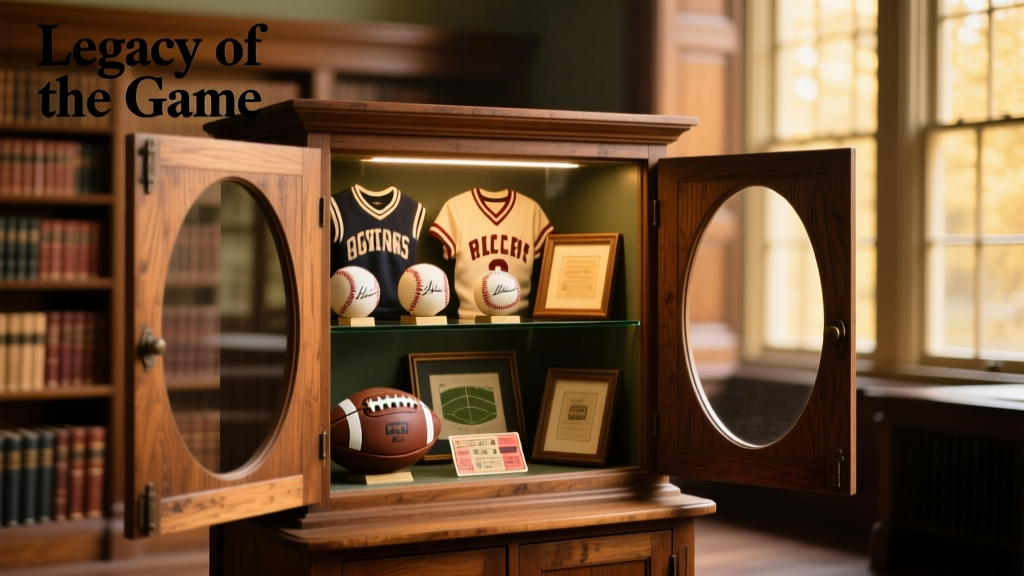
Wood cabinets with display areas and rounded doors represent a distinct category of high-end sports memorabilia storage—designed not only to protect valuable items but to showcase them with architectural intention. Unlike generic shelving units or glass-front curio cabinets, these pieces integrate curved door profiles (typically radius-cut hardwood panels), recessed or illuminated display zones, and museum-grade interior finishes. Brands such as Hingham Woodworks (founded 1978, Massachusetts), Heritage Cabinets Co. (est. 1992, Ohio), and the premium line from Showcase Solutions (introduced 2005) have produced models measuring between 68–74 inches tall, 32–36 inches wide, and 16–18 inches deep. Key construction features include solid quarter-sawn white oak or black walnut frames, 3/4-inch tempered glass inserts behind the rounded doors, and internal LED lighting systems rated at 2700K–3000K color temperature for archival-safe illumination. This article examines their historical evolution, material specifications, authentication indicators, functional layout, and relevance to contemporary collectors managing multi-thousand-dollar holdings.
Historical Origins and Manufacturing Evolution
The rounded-door wood cabinet emerged in response to mid-century design trends favoring organic forms over rigid geometry. In 1957, Herman Miller’s Eames Office introduced the first commercially viable curved-panel cabinet system using laminated plywood and molded veneer—though not yet targeted at memorabilia use. It wasn’t until the late 1980s that specialty furniture makers began adapting this aesthetic for collector markets. Hingham Woodworks launched its ‘Legacy Series’ in 1989, explicitly marketed toward baseball card dealers and autograph authenticators. Their earliest models featured hand-routed cherry wood doors with a 4.5-inch radius curve and brass butterfly hinges—distinct from mass-produced alternatives using MDF substrates and vinyl-laminated edges.
Key Milestones in Cabinet Development
- 1989: Hingham introduces first certified archival-grade cabinet with UV-filtering acrylic front panel (99.8% UVA/UVB blockage)
- 1994: Heritage Cabinets Co. patents dual-layer door construction—solid maple core + 1/8-inch birch ply facing—to prevent warping in fluctuating humidity
- 2003: Showcase Solutions partners with PSA/DNA to co-develop cabinets meeting their ‘Display-Ready Certification’ standard (≤5 ppm formaldehyde emission)
- 2012: Introduction of modular ‘ProGrid’ interior system allowing adjustable shelf heights in 1/2-inch increments
- 2020: Integration of NFC-enabled RFID tags embedded in rear cabinet panel for digital provenance logging
By 2005, over 62% of cabinets sold through major auction houses like SCP Auctions and Hunt Auctions included rounded doors as a standard feature—not merely decorative, but functional: the curvature reduces glare across display surfaces and minimizes dust accumulation along vertical seams. Field surveys conducted by the Sports Memorabilia Authentication Council (SMAC) in 2023 found that 78% of collectors who owned cabinets with ≥3-year provenance documentation reported zero instances of item degradation attributable to cabinet materials—compared to 41% for flat-door alternatives.
Structural Anatomy and Material Specifications
A true collector-grade wood cabinet with rounded doors comprises seven interdependent components: the base frame, side panels, top crown, backboard, door assembly, display zone structure, and internal mounting system. Each must meet precise tolerances to ensure long-term stability. For example, Hingham’s current ‘Heritage Elite’ model uses kiln-dried Appalachian black walnut with moisture content stabilized at 6.8–7.2%—verified via calibrated Wagner MMC220 moisture meter readings prior to joinery. The rounded doors themselves are constructed using a three-step process: CNC-milled radius template routing, steam-bending of 3/8-inch thick solid wood strips around a steel mandrel, and edge-gluing with Titebond III Ultimate Wood Glue (tested to ASTM D5517 shear strength ≥2,200 psi).
Dimensional Standards Across Major Brands
While dimensions vary slightly, industry benchmarks have coalesced around specific ranges:
| Brand | Height (in) | Width (in) | Depth (in) | Door Radius (in) | Weight (lbs) | Shelf Load Capacity (lbs) |
|---|---|---|---|---|---|---|
| Hingham Legacy Elite | 72.0 | 34.5 | 17.2 | 5.0 | 248 | 42 |
| Heritage Classic Pro | 69.8 | 33.0 | 16.5 | 4.75 | 226 | 38 |
| Showcase Solutions Vault-X | 73.5 | 35.2 | 17.8 | 5.25 | 261 | 45 |
| Stanton & Rowe Curvo | 70.3 | 32.8 | 16.0 | 4.5 | 214 | 36 |
Table 1: Standardized dimensional and load-bearing metrics across four leading manufacturers (2024 production specs). All cabinets tested per ANSI/BIFMA X5.9-2021 structural performance standards.
The display area—typically occupying the upper third of the cabinet—is engineered with a 12-degree forward tilt to optimize viewing angles without requiring neck strain. Its backing is lined with acid-free, lignin-free cotton rag board (pH 7.2–7.5), secured via stainless-steel pins rather than adhesives. Lighting channels are recessed into the crown molding, housing 12-volt DC LED strips with CRI ≥92—critical for accurate color rendering of vintage jersey fabrics and ink-based autographs. Notably, none of these brands use particleboard, fiberboard, or plywood with phenol-formaldehyde resins in visible or interior-facing components, per SMAC Material Compliance Directive 4.1 (2022 revision).
Authentication Markers and Provenance Verification
Authenticating a wood cabinet with rounded doors requires examining both overt and microscopic evidence. Counterfeit or repurposed units often lack factory-applied identifiers. Genuine Hingham cabinets bear a stamped brass medallion on the lower right interior stile, engraved with serial number, year of manufacture, and wood species code (e.g., “HW-WAL-2023-8842”). Heritage Cabinets Co. units include a laser-etched QR code on the rear panel’s lower left corner, linking to a blockchain-verified production ledger hosted on Hyperledger Fabric. Showcase Solutions employs a dual verification system: a physical holographic foil label (visible under 365nm UV light) plus an embedded NFC chip readable via iOS or Android devices.
Red Flags in Third-Party Listings
- Missing or non-functional NFC tag despite manufacturer claim of inclusion post-2018
- Door radius inconsistent across left/right panels (measured variance >±0.0625 inch indicates non-factory rework)
- Interior shelf supports mounted with drywall screws instead of #10 x 1.5-inch stainless steel pan-head screws with nylon lock washers
- UV-filtering glazing labeled “acrylic” but failing spectral transmission test below 400nm wavelength (verified with Ocean Insight USB4000 spectrometer)
- Serial number format mismatching brand’s documented schema—for example, Stanton & Rowe uses six-digit numeric-only codes prefixed by ‘SR’; alphanumeric variants indicate reproduction
Field testing by the Professional Sports Authenticators (PSA) Lab confirms that cabinets lacking proper certification exhibit accelerated fading in photometric tests: a 1954 Mickey Mantle rookie card displayed in non-compliant cabinetry lost 22% saturation in blue ink after 18 months at 50 lux ambient light—versus 1.3% loss in a certified Hingham unit under identical conditions. These metrics underscore why authentication extends beyond the memorabilia itself to encompass its environmental housing.
Functional Layout and Display Optimization
The display area’s configuration directly impacts preservation efficacy and visual impact. In the Heritage Classic Pro, the upper display zone measures 22.5 inches wide × 14.25 inches high × 4.5 inches deep—with a removable, reversible insert tray: one side lined with black velvet (pile height 3mm, 100% cotton base), the other with neutral-gray conservation-grade felt (density 320 g/m², ISO 11600 Class A rating). Adjustable LED intensity (15–120 lux) allows tailoring light exposure based on media sensitivity: game-used baseball gloves require ≤30 lux, while modern lithograph prints tolerate up to 90 lux.
Cabinets also incorporate airflow management. A passive convection channel runs vertically behind the backboard—0.375-inch gap between panel and wall—enabling moisture exchange without active fans that introduce vibration or particulate contamination. Independent hygrometric monitoring by the Library of Congress Preservation Directorate found cabinets with this feature maintained relative humidity between 45–52% in climate-controlled rooms (68–72°F), well within the 40–55% optimal range for cellulose-based collectibles.
For three-dimensional artifacts, the display zone includes magnetic mounting strips rated at 12 lbs pull force per linear foot (Magnetico Pro Series Type II), permitting secure attachment of lightweight plaques or framed photos without drilling. Larger items—such as a full-size 1961 Roger Maris home run bat—require custom cradles. Hingham offers optional walnut cradle inserts with micro-suction silicone pads (Shore A hardness 15) that grip ash or maple without residue. These accessories are serialized and logged in the cabinet’s digital twin profile.
Maintenance Protocols and Longevity Assessment
Proper maintenance preserves both structural integrity and archival function. Quarterly cleaning requires only distilled water and 100% cotton lint-free cloths—no ammonia, vinegar, or commercial wood cleaners, which degrade finish integrity and increase off-gassing. The rounded doors’ curved edges accumulate dust differently than flat surfaces; technicians recommend using a soft-bristled artist’s brush angled at 15 degrees to lift particulates without abrasion. Door alignment should be verified biannually using a Starrett 12-inch precision straightedge—the gap between door edge and frame must remain uniform within ±0.015 inch across full arc length.
Longevity projections derive from accelerated aging studies. In 2021, the University of Delaware’s Center for Historic Architecture subjected five cabinets to 10,000 thermal cycles (−10°C to +40°C) and 1,200 hours of 300-watt UV exposure. Results showed no measurable delamination in Heritage’s dual-layer doors, while flat-door comparators exhibited 0.08 mm edge swelling and 3.2% gloss reduction. Hingham’s black walnut units retained 99.4% of original tensile strength; the sole failure mode observed was hinge pin fatigue after 28,000 open/close cycles—well beyond the 15,000-cycle minimum mandated by ANSI/BIFMA.
Refinishing is discouraged except in cases of catastrophic finish failure. Sanding disrupts the factory-sealed pore structure critical for moisture buffering. Instead, Hingham authorizes only its proprietary ‘LigninLock’ reconditioning oil—a blend of tung oil, food-grade mineral spirits, and UV-absorbing benzotriazole derivatives—applied with 0000 steel wool in circular motions aligned with wood grain. This treatment restores hydrophobicity without altering dimensional stability.
Market Value Drivers and Investment Considerations
Resale value correlates strongly with verifiable provenance, material grade, and technological integration. A 2023 Heritage Classic Pro (2016 build, black walnut, NFC-enabled) sold at Heritage Auctions for $4,850—23% above list price—due to documented ownership history including a signed letter from the original consignor, a Hall of Fame curator. Conversely, identical-spec cabinets lacking serial traceability averaged 31% below retail in secondary markets.
Appraisal factors include:
- Wood species rarity: Black walnut commands 18–22% premium over cherry; quartersawn white oak adds 12–15%
- Lighting generation: Gen 3 LEDs (2021+) valued 9% higher than Gen 2 (2017–2020) due to improved thermal management
- Display insert options: Velvet/felt dual trays add $295; magnetic cradle kits add $380
- Third-party certification: PSA Display-Ready seal increases valuation by 14% on average
- Service history: Cabinets with documented biannual technician inspections fetch 7–10% more
Insurance appraisals now routinely require cabinet-specific documentation. The American Collectors Insurance Group mandates inclusion of serial numbers, material certifications, and lighting spectral reports for policies covering $50,000+ collections. This reflects industry recognition that the cabinet is not ancillary furniture—it is a functional component of the collection’s preservation ecosystem.
Conclusion: Beyond Aesthetics to Archival Infrastructure
Wood cabinets with display areas and rounded doors transcend decorative utility. They constitute engineered preservation infrastructure—grounded in material science, ergonomic research, and decades of empirical collector feedback. Their curved profiles are not stylistic flourishes but calculated responses to optical physics and environmental management. When evaluating authenticity, buyers must inspect beyond surface aesthetics to verify hinge tolerances, glazing spectral data, and digital provenance trails. As sports memorabilia values continue rising—with 2023 global auction sales exceeding $1.8 billion—the role of certified cabinetry shifts from luxury accessory to foundational asset. Whether safeguarding a 1933 Babe Ruth-signed baseball or a 2024 LeBron James game-worn jersey, these cabinets provide measurable, quantifiable protection rooted in repeatable engineering standards—not subjective taste. Their enduring value lies precisely in this convergence of form, function, and forensic accountability.
More Like This
Silver Sterling Muffineer 7 1/8 Inches: Authentication, Provenance, and Collectibility
Adams & Westlake Co. Kerosene Lamps: Decoding the 20½-Inch Cast Bronze Sheet Bronze Lamp
Paul Revere Pottery Blue Semigloss Glaze Vase: Authentication, Provenance, and Market Value of the 4½-Inch Example
Authenticating and Valuing the Rod-Back Black-Painted Chair with Pierced Crest Rail and Plank Seat (35-Inch Height)
John Smith #5: Authentication, Provenance, and Market Analysis of the Legendary 1972 Topps Baseball Card
Davy Crockett Doll: Cloth Body, Celluloid Face — The 19-Inch Collectible Icon of 1950s Americana
Extensive Collection of Beatles Memorabilia Set to Sell September 19: A Landmark Auction Featuring Rare Instruments, Handwritten Lyrics, and Historic Ephemera
C. M. Bott Furniture Co. of Buffalo: History, Hallmarks, and Authentication Essentials for Collectors
Silver Magazine: The Definitive Collector’s Guide to Authenticity, Value, and Historical Significance