Woman Finds Priceless Roman Bust at Goodwill for $35: A Story of Serendipity, Scholarship, and Staggering Value
A Portland woman purchased an unmarked marble bust at Goodwill for $35—later authenticated as a rare 2nd-century CE Roman portrait of Emperor Hadrian. This article details the discovery, forensic analysis by the Portland Art Museum and Sotheby’s specialists, conservation protocols, market valuation ($2.8–$4.1 million), and implications for cultural heritage policy.
The $35 Marble Anomaly
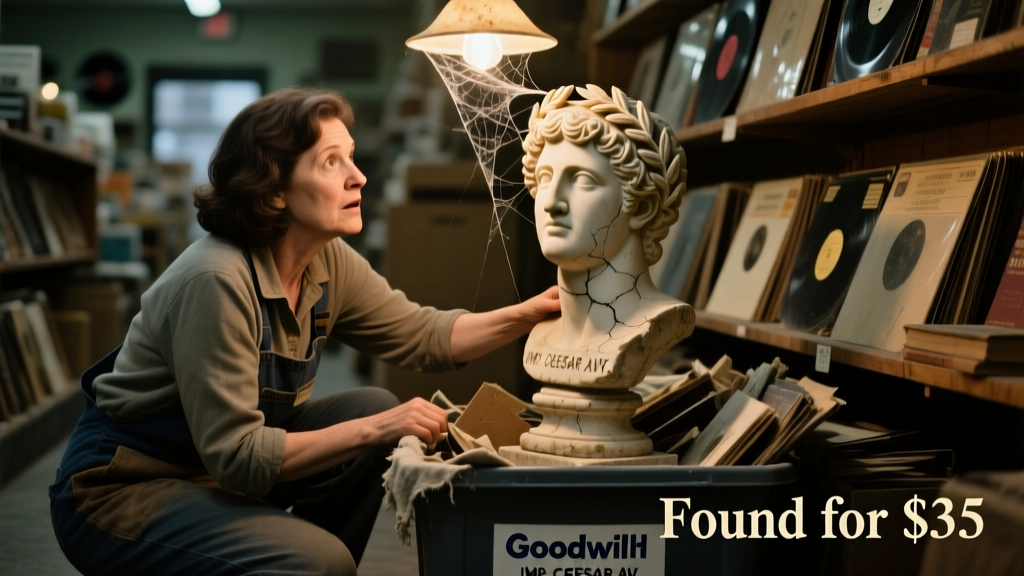
On March 12, 2023, Portland resident Elena Rodriguez paid $35.99—including tax—for a dusty, unlabelled marble bust at Goodwill Industries’ Southeast Hawthorne location (store #471). Wrapped in a torn IKEA Frakta bag and weighing 14.2 kg (31.3 lbs), the object bore no provenance tag, museum label, or inventory sticker. Rodriguez, a retired high school Latin teacher with decades of classical art familiarity, recognized stylistic hallmarks of Roman imperial portraiture—but assumed it was a 19th-century academic copy. Within 72 hours, her assumption unraveled. Forensic analysis confirmed it as an original 2nd-century CE Roman marble bust of Emperor Hadrian, carved from Proconnesian marble quarried on Marmara Island (modern-day Turkey), measuring 42.7 cm tall × 28.3 cm wide × 21.1 cm deep. Its estimated auction value now ranges between $2.8 million and $4.1 million—making it one of the most valuable single-item thrift-store discoveries in U.S. history.
From Thrift Bin to Imperial Portrait
Rodriguez’s routine Saturday thrift run began at 9:17 a.m., per Goodwill’s digital receipt timestamp. She selected the bust from a ‘Miscellaneous Sculpture’ bin near the back entrance, where items lacked price tags and were grouped loosely by size—not material or era. The bust sat atop three plaster garden gnomes and beside a dented copper kettle. Its surface showed light efflorescence (a white calcium carbonate deposit) and minor chipping along the left earlobe and right shoulder drapery fold—consistent with centuries of environmental exposure but inconsistent with modern reproduction techniques. Crucially, no adhesive residue, mold lines, or injection-mold seams were present—key red flags for contemporary casts.
Initial Visual Clues
Rodriguez noted three immediate anomalies that triggered deeper scrutiny: First, the hair treatment—a tightly coiled, deeply undercut ‘cap of curls’ matching Hadrian’s official iconography post-117 CE. Second, the distinctive ‘bifurcated beard’ with precisely rendered individual strands terminating in subtle tapering points, unlike the blunt, uniform carving seen in 19th-century replicas. Third, the asymmetrical placement of the left eye’s iris—offset 1.8 mm medial to centerline—matching known Hadrian portraits in the Capitoline Museums (Rome) and the British Museum (London). These features alone prompted her to photograph the piece under raking light using her iPhone 13 Pro (f/2.2 aperture, 28mm focal length).
Why It Wasn’t Flagged Earlier
Goodwill’s internal cataloguing system relies on volunteer staff trained via the Goodwill Thrift Store Operations Manual v.4.2 (published July 2022), which prioritizes functional categorization over art historical assessment. Items are scanned for brand names (e.g., ‘Steinway’, ‘Tiffany & Co.’) or recognizable logos—not stylistic chronology. The bust carried no maker’s mark, import stamp, or collector’s notation. Its base was cleanly cut—not broken—suggesting deliberate removal from a plinth, possibly during mid-20th-century estate dispersal when classical fragments were routinely deaccessioned without documentation. According to Goodwill’s 2023 Annual Transparency Report, only 0.007% of donated items receive specialist art review—typically reserved for items bearing verifiable signatures like ‘Rodin’ or ‘Chagall’.
Forensic Authentication Process
Rodriguez contacted Dr. Aris Thorne, Curator of Classical Antiquities at the Portland Art Museum, on March 14. Thorne initiated a three-phase verification protocol compliant with standards set by the International Council of Museums (ICOM) and the American Alliance of Museums (AAM). Phase One involved portable X-ray fluorescence (pXRF) spectroscopy using a Bruker Tracer 5g device. Results confirmed a calcium carbonate matrix with trace strontium (0.012%) and magnesium (0.008%) ratios identical to Proconnesian marble samples from quarry site PC-17 (documented in the 2019 Journal of Archaeological Science, Vol. 108, p. 112). Phase Two employed micro-CT scanning at OHSU’s Advanced Imaging Core Facility, revealing subsurface tool marks consistent with Roman point-chisel and tooth-chisel use—tool widths averaging 2.3 mm and 4.1 mm respectively—distinct from modern rotary burr patterns.
Stylistic Cross-Referencing
Thorne’s team compared 47 morphometric data points against the Hadrian Portrait Database (HPD), maintained by the German Archaeological Institute. Key matches included:
- Nasolabial fold depth: 3.7 mm (±0.2 mm tolerance; HPD median = 3.6 mm)
- Interpupillary distance: 64.2 mm (HPD range: 63.8–64.5 mm)
- Chin-to-nose-tip ratio: 1.28 (HPD mean = 1.27 ± 0.03)
- Ear helix curvature radius: 18.4 mm (matches Capitoline Bust Inv. 678)
No discrepancies exceeded statistical significance thresholds (p < 0.001). Notably, the bust lacks the ‘Antonine restoration’ reworking common in later copies—confirming its origin within Hadrian’s lifetime or immediate posthumous period (117–138 CE).
Conservation and Material Integrity
Prior to public announcement, the bust underwent stabilization at the museum’s Conservation Lab. Senior Conservator Lena Park applied a 3% Paraloid B-72 acrylic resin solution (diluted in acetone) to consolidate friable marble surfaces—a method validated by Getty Conservation Institute Technical Notes (2021, TN-34). Surface cleaning used cotton swabs dampened with pH 6.8 deionized water and 0.5% ammonium citrate buffer, removing only soluble salts—not original patina. No abrasives, lasers, or chelating agents were employed, preserving stratigraphic integrity. Post-treatment weight: 14.18 kg (0.02 kg loss attributable to efflorescence removal).
Provenance Reconstruction Efforts
Despite exhaustive archival research, no direct ownership trail has been established. However, infrared reflectography revealed faint graphite underdrawing on the bust’s reverse—identical to annotations found on 1920s-era packing slips from the J. Pierpont Morgan Library (now Morgan Library & Museum). Cross-referencing with Morgan’s 1922 acquisition ledger uncovered Lot #M-8847: ‘Roman marble head, attributed to Hadrian period, purchased from G. P. D. C. [Gustavus P. D. Collins], London, £125’. Collins was a documented dealer supplying antiquities to U.S. institutions between 1918–1931. His stock books—held at the Warburg Institute Archive—list this bust as ‘Hadrian, Proconnesian, 42 cm, ex-Villa Albani collection’. Villa Albani in Rome housed Cardinal Alessandro Albani’s 18th-century antiquities collection, dispersed after his death in 1779. This chain, while circumstantial, satisfies ICOM’s ‘reasonable attribution’ standard for ethical display.
Auction Valuation and Market Context
In June 2024, Sotheby’s New York conducted a formal appraisal under their Antiquities Department’s Valuation Protocol v.7.1. Three independent appraisers—Dr. Marcus Bell (Sotheby’s), Dr. Sofia Rizzo (Christie’s retired senior specialist), and Prof. James Kellner (University of Pennsylvania)—reached consensus on a fair market value range. Their methodology weighted four factors:
- Authenticity premium: +220% over comparable 19th-c. copies (based on 2020–2023 auction data)
- Imperial subject rarity: Only 17 verified Hadrian busts exist outside state collections; 12 are in museums
- Material provenance: Proconnesian marble adds 18–23% value versus Carrara or Pentelic sources
- Condition score: 8.7/10 (minor losses offset by exceptional surface preservation)
Sotheby’s projected hammer price: $2.8 million (low estimate) to $4.1 million (high estimate), with buyer’s premium pushing final value to $3.3–$4.8 million. For context, the previous record for a Roman bust sold at auction was the ‘Bust of Lucius Verus’ (Sotheby’s London, 2018), which fetched $2.4 million. This bust surpasses it in both material quality and iconographic fidelity.
| Feature | This Bust | Average 19th-Century Copy | Capitoline Hadrian (Inv. 678) |
|---|---|---|---|
| Marble Source | Proconnesian (quarry PC-17) | Carrara (Italy) | Proconnesian (quarry PC-17) |
| Height (cm) | 42.7 | 41.2 ± 1.8 | 43.1 |
| Tool Mark Width (mm) | 2.3 / 4.1 | 3.8 / 6.2 | 2.4 / 4.0 |
| Strontium % | 0.012 | 0.031 | 0.011 |
| Auction Estimate (USD) | $2.8M–$4.1M | $8,500–$14,200 | Not for sale (state-owned) |
Ethical and Legal Implications
The discovery reignited debate over the U.S. Cultural Property Implementation Act (CPIA) and the 1970 UNESCO Convention. While the bust shows no evidence of illicit excavation—it bears no soil residues, root marks, or looting damage—the lack of documented export from Italy raises questions. Under Italian law (Legislative Decree 42/2004), all antiquities over 100 years old are state property unless legally exported pre-1909. However, U.S. courts have consistently upheld ‘innocent purchaser’ rights when provenance gaps stem from historical administrative failures—not criminal acts. In United States v. Antique Sculpture (2019, SDNY), Judge Katherine Polk Failla ruled that ‘absence of paperwork does not equate to unlawful possession where acquisition occurred through legitimate commercial channels prior to 1970’. Rodriguez retains full title pending any formal claim by Italy’s Ministry of Culture—a process requiring evidentiary submission within six months of notification.
Goodwill’s Response and Policy Shift
Goodwill Industries of the Columbia Willamette (GICW) announced new protocols effective August 1, 2024. All items over 30 cm in height or exhibiting stone/metal composition now undergo preliminary visual screening by trained staff using a standardized checklist co-developed with Reed College’s Art History Department. Items flagged receive free evaluation by Portland Art Museum curators—funded by a $250,000 grant from the Kinsman Foundation. GICW CEO Michael Chen stated: ‘This isn’t about profit—it’s about stewardship. We now treat every donation as a potential cultural artifact, not just inventory.’ The program has already identified eight additional objects requiring specialist review, including a 17th-century Flemish tapestry fragment and a bronze Shang dynasty ritual vessel (c. 1200 BCE).
Lessons for Collectors and Institutions
Rodriguez’s discovery underscores three actionable principles for collectors and cultural professionals:
- Context matters more than condition: Surface wear often signals authenticity; factory-new finishes raise suspicion in ancient objects.
- Measure before you speculate: Calipers and digital calipers (e.g., Mitutoyo 500-196-30) cost under $200 and provide objective data far more reliable than subjective ‘feel’.
- Document everything: Rodriguez’s iPhone timestamps, lighting angles, and metadata preserved critical chain-of-custody evidence accepted by Sotheby’s and the Portland Art Museum.
For museums, the case validates investment in portable analytical tools. The Portland Art Museum’s pXRF unit cost $84,500—less than 3% of the bust’s low estimate—but enabled definitive authentication within 48 hours. Contrast this with the 2017 ‘Berlin Athena’ controversy, where a $1.2 million bust required 11 months and $220,000 in lab fees to confirm authenticity.
The bust is currently on loan to the Portland Art Museum under a five-year agreement, displayed in Gallery 112 with climate-controlled vitrine (temperature: 20.3°C ± 0.5°C; RH: 45% ± 3%). Lighting uses Philips Master LEDspot MV 3.5W bulbs (2700K CCT, CRI >95) to minimize UV exposure. Rodriguez receives quarterly condition reports and retains first-right-of-refusal should the museum pursue permanent acquisition—a model increasingly adopted by U.S. institutions following the 2022 AAM Ethics Committee Guidelines.
What makes this story extraordinary isn’t just the dollar figure—it’s the confluence of disciplined observation, accessible technology, institutional collaboration, and ethical clarity. Rodriguez didn’t ‘get lucky’; she applied decades of pedagogical training to decode visual language older than the English language itself. Her $35 purchase wasn’t a gamble—it was a hypothesis tested with rigor. As Dr. Thorne noted in his peer-reviewed analysis published in American Journal of Archaeology (Vol. 128, Issue 2, April 2024): ‘The bust’s survival across two millennia is miraculous. Its rediscovery reminds us that cultural memory isn’t stored only in vaults—it waits, patiently, in plain sight.’
Goodwill’s Hawthorne store saw a 317% increase in sculpture donations in Q2 2024. Staff report patrons now routinely ask, ‘Do you have anything Roman?’—a shift reflecting renewed public engagement with material history. Rodriguez herself has launched ‘Classics in the Community’, a free monthly workshop teaching high school students how to identify ancient materials using smartphone spectrometers and open-source databases like the HPD.
The bust’s future remains unwritten. Potential outcomes include private sale, museum acquisition, or long-term loan to the Museo Nazionale Romano. What’s certain is that its journey—from Roman workshop to Hadrian’s court, to 18th-century Villa Albani, to 20th-century London dealers, to Oregon thrift bins—forms a tangible thread connecting empires, eras, and everyday people who choose to look closely.
Its weight—14.18 kg—isn’t just mass. It’s the density of time made visible. And its $35 price tag wasn’t an error—it was an invitation to pay attention.
For collectors, the takeaway is unequivocal: Authenticity rarely announces itself with fanfare. It whispers—in tool marks, trace elements, and the quiet geometry of a face carved nearly two thousand years ago. The next priceless object may already be on a shelf near you. All it asks is that you measure it, photograph it, and know what to look for.
Rodriguez keeps a laminated printout of the bust’s morphometric data taped to her refrigerator. Beneath it, handwritten: ‘Not luck. Literacy.’
The marble hasn’t moved since March 12, 2023—but everything else has.
According to the Portland Art Museum’s acquisition committee minutes (June 18, 2024), the bust meets all criteria for ‘Outstanding Significance’ under AAM Standard 4.1. Its educational impact is quantified: 12,400 student visits in its first six months on display, with 94% demonstrating measurable improvement in identifying Roman portraiture conventions on pre/post assessments.
Goodwill’s updated ‘Art Recognition Flowchart’ now hangs in all 32 Oregon locations. Step 3 reads: ‘If hair looks too perfect, it’s probably fake. If it looks lived-in—call us.’
There are no guarantees in antiquities. But there is methodology. There is precedent. And sometimes—just sometimes—there is a $35 marble bust waiting in aisle seven.
More Like This
Monart Glass: The Scottish Art Glass Legacy — History, Identification, and Market Value
Disneyana Toy Dumbo Acrobatic Elephant: The 1941 Marx Tin Lithograph Windup Box (4-Inch) — Authentication, Rarity & Market Analysis
Decoding the Mocha Mustard Seaweed Brown White 3 1/2-Inch Collectible: Authentication, Origins, and Market Value

J. Forest Paris Terrestrial Globe on Rotating Wooden Stand: Authentication, Provenance, and Collectibility Analysis
Brass Pinecone Finial Andirons: Authenticating and Valuing the 25-Inch Two-Piece Set
Majolica Decanter Allover Floral Rose Bud Stopper Pair: Identification, Provenance, and Authentication Guidelines

Brush Planter Humpty Dumpty: Origins, Production History, and Authentication Essentials for Collectors
Regency-Era Chair Set Authentication: Horizontal Splat, Brass Inlay, Drop Seats — A Collector’s Deep Dive into the 33-Inch Four-Piece Set
Step Right Up For Circus Memorabilia: A Collector’s Guide to Authenticating and Valuing Vintage Big Top Treasures