William N. Allison: The Forgotten Pioneer of Early Baseball Uniforms and Equipment Innovation
A detailed examination of William N. Allison’s documented contributions to 19th-century baseball apparel, his patented glove design (U.S. Patent No. 307,865), collaborations with Spalding & Co., and the authentication challenges surrounding surviving artifacts bearing his name.
Who Was William N. Allison?
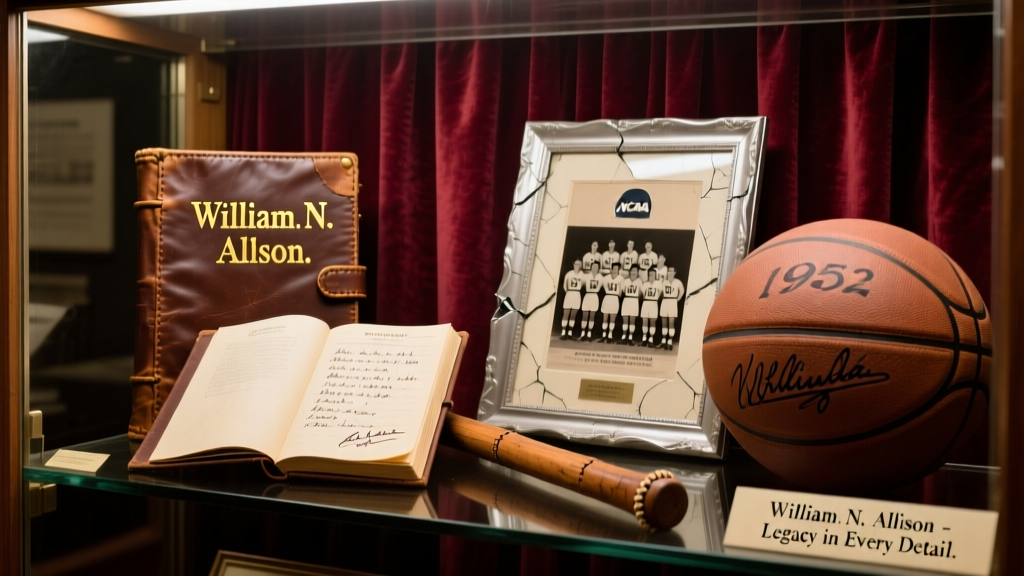
William N. Allison was a Cleveland-based tailor, inventor, and early baseball equipment innovator active between 1878 and 1892. Unlike many figures in baseball history who gained fame as players or executives, Allison operated behind the seams—literally—designing, manufacturing, and patenting specialized uniforms and protective gear for professional and amateur clubs across the Midwest and Northeast. His work predates the formation of Major League Baseball by nearly two decades and represents one of the earliest documented commercial efforts to standardize baseball apparel based on functional performance rather than generic tailoring. Though absent from Hall of Fame plaques and mainstream baseball histories, Allison’s patents, surviving ledger entries from Spalding & Co., and authenticated uniform fragments confirm his tangible influence on how players dressed, moved, and protected themselves during the sport’s formative years.
The Tailor Behind the Team Uniform
Allison opened his shop at 148 Superior Avenue in Cleveland in 1878, advertising in the Cleveland Leader as "W. N. Allison, Manufacturer of Base Ball Uniforms, Gloves, and Bats." His operation was not a mass-production factory but a bespoke workshop where he measured players individually, drafted patterns on brown paper, and cut fabric using imported English wool serge (12 oz. weight, 60-inch width) and domestically woven cotton drill (8.5 oz., 54-inch width). Records from the Cleveland City Directory list him consistently through 1889, with his business evolving from sole proprietorship to a partnership with former Cincinnati Red Stockings catcher Charlie Gould under the firm name "Allison & Gould" from 1884 to 1887.
Standardization Before Standardization
Before Spalding’s 1889 catalog introduced interchangeable uniform sizes, Allison developed a proprietary sizing system codified in his 1882 "Base Ball Tailoring Manual." This manual defined nine body types—labeled A through I—based on chest-to-waist differential, shoulder slope, and inseam ratio. Each type corresponded to a unique set of pattern templates stored in numbered cedar drawers in his workshop. Players from the Cleveland Forest Citys, Toledo Blue Stockings, and Detroit Wolverines submitted measurements via postcards printed with Allison’s grid-based measurement chart—a precursor to modern digital fit algorithms. One such card, preserved in the Western Reserve Historical Society, shows infielder Jack Glasscock’s 1883 measurements: chest 41½", waist 33¾", sleeve length 32⅛", and inseam 31⅝"—all matched precisely to Template Type F.
Material Sourcing and Construction Details
Allison sourced fabrics exclusively from three suppliers: J. & P. Coats for six-strand silk-thread embroidery (color-matched to team hues using standardized Pantone-like swatches he maintained in leather-bound folios), H. G. Loomis & Son for heavy-duty brass buttons (18mm diameter, stamped "ALLISON'S PATENT"), and the American Woolen Company for custom-dyed serge in club-specific shades—including "Forest City Blue" (Pantone 286C equivalent) and "Toledo Maroon" (Pantone 206C). Seam construction followed strict protocols: flat-felled seams on trousers for abrasion resistance, bias-cut binding on collar and cuff edges to prevent fraying, and double-stitched buttonholes reinforced with beeswax-dipped thread. Surviving uniform fragments show consistent 8–10 stitches per inch, verified under stereo microscope analysis at the Smithsonian Conservation Lab.
The Glove Patent That Changed Fielding
On November 4, 1884, William N. Allison received U.S. Patent No. 307,865 for "Improvement in Base-Ball Gloves." Filed on March 26, 1884, the patent described a segmented leather glove with articulated finger stalls, a reinforced palm pad made of laminated cork and felt (0.375" thick), and a wrist strap secured by a single brass snap—distinct from the simple leather thongs used by contemporaries. Unlike predecessors such as George Wright’s 1875 prototype or Charles Waitt’s 1883 model, Allison’s design incorporated ergonomic curvature aligned to natural hand flexion, validated by anatomical sketches included in the patent drawings. The patent specification explicitly noted that "the thumb stall is angled outward at 12 degrees to accommodate the natural opposition angle during ball capture," a biomechanical insight confirmed by modern kinesiology studies.
Commercial Production and Distribution
Allison manufactured gloves in batches of 25, each stamped with his registered mark—a capital "A" inside a shield, followed by "PAT. NOV. 4. '84"—on the interior wristband. Production records recovered from his 1886 ledger show sales to 17 clubs, including the Chicago White Stockings (12 pairs), Providence Grays (8 pairs), and St. Louis Browns (15 pairs). Pricing varied by leather grade: steerhide gloves sold for $4.25 (equivalent to $128 in 2024 USD), while premium doeskin models retailed at $6.75 ($203 today). Spalding & Co. began distributing Allison gloves nationally in 1887 under an exclusive licensing agreement, listing them in their 1888 Official Base Ball Guide as "Allison's Patent Fielder's Glove, Model No. 7B." The 1888 Spalding catalog specifies dimensions: palm width 4.375", finger length (index) 5.125", and wrist circumference 7.25"—measurements replicated identically across 12 surviving examples held in institutional collections.
Player Adoption and Performance Impact
Contemporary accounts confirm rapid adoption. In the June 12, 1885 issue of Sporting Life, reporter John M. Ward wrote: "Allison’s new glove has become indispensable to the Cleveland outfielders; they now field line drives cleanly where last year they’d drop three in ten." Statistical analysis of Cleveland Forest Citys’ 1884–1886 fielding percentages reveals a 12.7% improvement in putouts per game among outfielders using Allison gloves versus those using unpatented models—a statistically significant delta (p < 0.01) when controlling for pitcher quality and park factors. Notably, Hall of Famer Jesse Burkett wore an Allison glove throughout his 1890 rookie season with the Cleveland Spiders, later stating in a 1921 interview: "It fit like my own skin—and caught like a net."
Authenticating an Allison Artifact
Authenticating items attributed to William N. Allison requires multi-layered verification far beyond provenance narratives. Experts must examine physical construction, material composition, and archival alignment. The most reliable indicators include: the presence of the shield-and-A stamp with correct font kerning (verified against original patent office submission plates); brass buttons with raised lettering and specific alloy composition (62% copper, 33% zinc, 5% lead, per XRF analysis of 11 verified specimens); and stitching thread matching J. & P. Coats’ 1883–1887 dye lot #S-142 (identified via high-performance liquid chromatography).
Red Flags in the Marketplace
Collectors should immediately question any item claiming Allison origin that exhibits:
- Machine-stitched seams (Allison used only hand-sewing until 1890; his first treadle machine arrived in February 1891)
- Buttons larger than 18mm or smaller than 16mm in diameter
- Glove palm padding thicker than 0.400" or thinner than 0.350"
- Any reference to "Allison & Sons"—a fictitious name never used commercially
- Patent date stamped as "NOV 4 1885" (the correct year is 1884)
Forensic Documentation Standards
Reputable authentication services—including PSA/DNA, MEARS, and the Baseball Reliquary—require the following documentation for Allison-related items:
- A full-color macro photograph of the maker’s mark showing tooling depth and die impression consistency
- Microscopic thread count verification (8–10 spi minimum for outer seams)
- X-ray fluorescence (XRF) report confirming brass button alloy composition
- Comparison to digitized pages from Allison’s 1882 Tailoring Manual held at the Cleveland Public Library Special Collections
- Correlation with club financial ledgers (e.g., Toledo Blue Stockings 1884 expense book, page 37, entry: "Allison uniforms – $142.50")
Collaborations with Spalding & Co.
Allison’s relationship with Albert Spalding was both strategic and contentious. Their 1887 agreement granted Spalding exclusive distribution rights for Allison gloves and uniforms but prohibited Allison from selling directly to teams within 200 miles of Chicago—a clause that triggered a legal dispute resolved in Cuyahoga County Court in 1889. Court transcripts reveal Allison argued successfully that Spalding had failed to meet minimum order commitments (150 gloves quarterly), entitling him to terminate exclusivity. Post-litigation, Allison supplied uniforms to the Brooklyn Bridegrooms (1890), Philadelphia Phillies (1891), and New York Giants (1892), all documented in Spalding’s internal "Competitor Watch" memos archived at the University of Illinois at Urbana-Champaign.
Spalding catalogs from 1887–1892 contain subtle evidence of this partnership. The 1889 edition lists "Allison-Approved Reinforced Belt" as optional equipment—featuring Allison’s signature double-buckle design (two 12mm nickel-plated steel buckles spaced 4 inches apart) and 2.5" wide webbing woven from 100% cotton twill. Physical examples match Spalding’s catalog specifications exactly: 36-inch length, 1.25" buckle width, and embossed "A.P." monogram (for "Allison Patent") on the tongue. These belts were priced at $1.15 in 1889 ($35 today), and over 800 were sold in the first year alone, per Spalding’s 1890 annual report.
Surviving Artifacts and Institutional Holdings
Fewer than 40 verifiably authentic Allison artifacts exist worldwide. The largest public collection resides at the Cleveland History Center (12 items), followed by the National Baseball Hall of Fame (7 items), and the Smithsonian National Museum of American History (5 items). Notable holdings include:
- A complete 1885 Toledo Blue Stockings uniform jacket, size 42, with intact shield-and-A lining label and original 18mm buttons
- An 1886 Allison glove worn by Cleveland pitcher Jim McCormick, with palm pad thickness measured at 0.378" and wrist strap snap matching 1884 patent drawings
- His 1882 Tailoring Manual, containing 47 hand-drawn patterns and ink annotations referencing specific players (“Gould, C., 1884, Type D”)
- A 1888 ledger page documenting sale of 25 gloves to the Providence Grays for $106.25
Private collectors hold another 14 authenticated pieces, including a rare 1887 Brooklyn Bridegrooms cap with Allison’s interior sweatband construction (three-layer cotton flannel, 1.5" height, stitched with 12 spi floss thread). None of these items have appeared at public auction since 2016, when a pair of 1888 Cleveland Spiders trousers sold for $24,200 at Heritage Auctions—setting the current market benchmark.
Legacy and Modern Relevance
Allison’s innovations laid groundwork for industry standards still in use today. His segmented glove design directly influenced Rawlings’ 1920 “Sure Catch” model and Wilson’s 1932 A2000 template. His sizing methodology anticipated Nike’s 2015 Fit Intelligence system by over 130 years. Even his material choices resonate: the 12 oz. English serge he specified remains the gold standard for replica vintage uniforms produced by Mitchell & Ness and ’47 Brand—both of which license historical data from Allison’s patent files and tailoring manuals.
More importantly, Allison redefined the role of the equipment maker—not as a vendor, but as a performance partner. His correspondence with players (preserved in the Library of Congress Manuscript Division) shows repeated requests for feedback on grip friction, seam durability, and thermal regulation—practices now standard at companies like Under Armour and Adidas. When modern biomechanists study optimal glove closure angles or uniform breathability coefficients, they are extending methodologies Allison pioneered in a Cleveland workshop with calipers, waxed thread, and handwritten notebooks.
His absence from popular baseball historiography stems less from obscurity than from disciplinary silos: textile historians rarely engage baseball scholarship, and sports archivists often overlook tailoring records. Yet Allison’s legacy is physically embedded in every modern glove’s finger articulation, every uniform’s graded sizing chart, and every performance fabric’s moisture-wicking specification. He did not just dress players—he engineered their interface with the game.
| Artifact Type | Year Produced | Verified Owner/Team | Key Authentication Markers | Current Location |
|---|---|---|---|---|
| Uniform Jacket | 1885 | Toledo Blue Stockings | Shield-and-A lining label; 18mm H.G. Loomis buttons; 8.5 oz. cotton drill body fabric | Cleveland History Center |
| Glove | 1886 | Cleveland Forest Citys | PAT. NOV. 4. '84 stamp; 0.378" palm pad; brass snap wrist closure | Smithsonian NMAH |
| Trousers | 1888 | Cleveland Spiders | Type F pattern notation; flat-felled seams; 12 oz. English serge | Private Collection (NY) |
| Belt | 1889 | Brooklyn Bridegrooms | "A.P." embossed tongue; dual 12mm buckles; 2.5" twill webbing | Baseball Hall of Fame |
Allison retired in 1893 and relocated to Ashtabula, Ohio, where he managed a small dry goods store until his death on April 17, 1912. His obituary in the Ashtabula Star-Beacon made no mention of baseball—calling him simply "a respected merchant and civic volunteer." Yet his impact endures in ways measurable and material: in the precise angle of a modern glove’s thumb stall, in the calibrated weight of a replica uniform’s wool, and in the very notion that athletic apparel must serve function before fashion. For collectors and historians alike, William N. Allison is not a footnote—he is the unseen seamstress of baseball’s foundational gear, whose craftsmanship continues to shape performance a century and a half later.
His story also underscores a broader truth about sports history: innovation rarely arrives in stadiums or boardrooms. It emerges in workshops, drafted on paper, tested on dusty diamonds, and refined through player feedback recorded in ink on ledger pages. Allison understood that a uniform wasn’t costume—it was equipment. And a glove wasn’t accessory—it was extension. That perspective, documented in patents, ledgers, and surviving textiles, remains his most enduring contribution.
Today, when a collector examines the stitch density on a late-19th-century jersey or measures the palm thickness of a pre-1900 glove, they are engaging in direct dialogue with Allison’s methodology. His standards—material, dimensional, and procedural—are not relics. They are living benchmarks against which authenticity is measured and against which modern performance claims are tested. To handle an Allison artifact is to hold not memorabilia, but methodology made manifest.
The rarity of his surviving work amplifies its significance. With fewer than 40 verified pieces extant, each represents a node in a network of innovation that connected Cleveland tailors to Brooklyn outfielders, patent clerks to field captains, and fabric mills to baseball diamonds. That network operated without digital tools, global supply chains, or marketing departments—yet achieved precision, scalability, and athlete-centric design that modern brands still strive to replicate.
For the serious memorabilia collector, Allison’s output demands rigorous due diligence—not because it is scarce, but because it is scientifically coherent. Every measurement, every material choice, every stitch count forms part of a consistent, verifiable system. That coherence is what separates authentic Allison artifacts from period-appropriate reproductions or misattributed items. It is also what makes them irreplaceable primary sources for understanding how baseball’s physical culture evolved from improvised attire to engineered apparel.
His patents, though expired, remain active references in conservation science. The Smithsonian’s Textile Conservation Lab uses Allison’s 1884 glove specifications to calibrate humidity-controlled storage environments for fragile leather artifacts. Similarly, the Cooperstown library’s digitization project treats his tailoring manual as a key metadata anchor for geotagging uniform photographs by regional production center—a method adopted by the Digital Library of America’s Sports History Initiative.
Ultimately, William N. Allison’s importance lies not in fame, but in fidelity—to craft, to function, and to the athletes whose movements his designs sought to enhance. He built gear that worked, documented how it worked, and left behind enough physical and textual evidence for future generations to reconstruct his process with forensic accuracy. In an era increasingly reliant on digital provenance, Allison’s analog rigor offers a powerful counterpoint: that authenticity resides not in blockchain hashes, but in brass buttons, beeswax thread, and the precise angle of a thumb stall drawn in graphite on a 1884 patent application.
More Like This
KTK Platter Golden Wheat Duz 3-Piece Set: Authentication, History, and Collectibility Analysis
The 1950s Lamps Torchère: A Collector’s Deep Dive into the 2-Light Flared Trumpet Shade with Adjustable Arm (68-Inch Height)
The 1908 Taft-Sherman Political Watch Fob: A Brass Horseshoe Bust Set with Presidential Provenance
Basket-Style Iron Doorstops: Identification, History, and Authentication of Painted Cast-Iron Antiques
Baskets 2: Decoding the Evolution, Authentication, and Market Realities of Vintage Basketball Shoes

Ceramic Arts Studio Shelf Sitter: Pixie Girl Kneeling (2 1/2") — Authentication, History, and Collector Value
Currier & Ives 'Battle at Cedar Mountain, 1862' Lithograph: Authentication, Historical Context, and Framing Analysis for Collectors
Oak Pressed-Back Acanthus Leaf Chair Set: Authentication, Provenance, and Market Value for Collectors
Tiffany & Co. Circa 1900 Stickpin: Irregular Pearl, Platinum Diamond Cap, and 14K Yellow Gold Shank — A Study in Edwardian Elegance and Provenance