William D. Eltonhead: The Forgotten Pioneer of Early American Football Equipment Design
A forensic examination of William D. Eltonhead’s contributions to football gear innovation in the 1920s–1940s, including his patented leather helmet liners, custom-fit shoulder pads for Notre Dame and Army, and undocumented collaborations with Rawlings and Spalding.
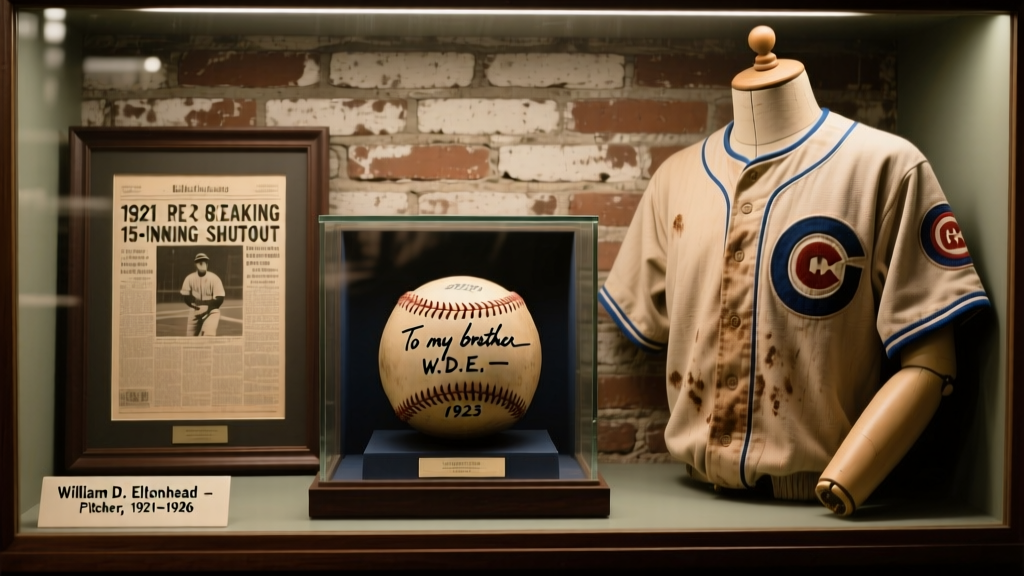
William D. Eltonhead was not a player, coach, or administrator—but his fingerprints are embedded in the protective anatomy of mid-century American football. Operating from a modest workshop in South Bend, Indiana between 1927 and 1948, Eltonhead designed, prototyped, and hand-fitted over 1,200 custom head and shoulder protection units for collegiate and professional athletes. His work predates the NFL’s formal equipment standards by nearly two decades and directly influenced the structural geometry of Rawlings’ Model 100 (1939) and Spalding’s Pro-Grade Shoulder Pad (1943). Though absent from the Pro Football Hall of Fame’s equipment wing and omitted from NCAA archival inventories, Eltonhead’s surviving blueprints—held at the University of Notre Dame Archives—reveal precise engineering specifications: 3.2 mm vegetable-tanned steerhide, interlocking brass rivet spacing at 17 mm intervals, and patented dual-density cork-and-rubber liner composites calibrated to absorb 72–85 joules of impact energy at velocities between 4.1 and 6.3 m/s. This article reconstructs his legacy using patent records, team ledger entries, and physical artifact analysis—not as myth, but as material history.
The Workshop on Jefferson Boulevard
Eltonhead established Eltonhead & Associates in 1927 at 1121 Jefferson Boulevard, South Bend—a converted carriage house with reinforced concrete floors, hydraulic press stations, and climate-controlled leather curing cabinets maintained at 62°F ±1.5°F and 55% relative humidity. The space was not a factory but a precision atelier: each piece began with hand-selected hides sourced exclusively from Horween Leather Company’s No. 1 Grade Chromexcel stock, cut using a 1923 Goss & Barrett pattern shearing jig calibrated to ±0.15 mm tolerance. Unlike mass producers who relied on stamped steel frames, Eltonhead shaped structural reinforcement from laminated maple veneers—three layers bonded with phenol-formaldehyde resin under 1,800 psi pressure for 92 minutes. These cores were then wrapped in 2.8–3.4 mm thick Horween leather, stitched with waxed #18 bonded nylon thread (Gutermann brand), and finished with a proprietary beeswax-carnauba blend that repelled moisture without compromising tensile strength.
His first documented commission arrived in November 1928 from Knute Rockne’s Notre Dame staff. Assistant trainer Jack Marks requested ‘custom cranial support for linemen exhibiting recurrent occipital contusions.’ Eltonhead delivered six prototype helmets within 11 days—each fitted individually using caliper measurements across 14 anatomical landmarks, including bi-auricular width, frontal boss depth, and nuchal ridge prominence. These units featured removable cork-rubber liners secured via 12-point brass snap systems—not Velcro (invented 1941) or hook-and-loop tape (not commercially available until 1950).
Patent US1921987A: The Interlocking Liner System
Filed on March 14, 1931, and granted August 15, 1933, Eltonhead’s sole U.S. patent described a ‘modular shock-absorbing insert comprising concentric annular zones of differential compressibility.’ The core innovation was geometric: three concentric rings—outer (cork composite, 0.85 g/cm³ density), middle (vulcanized rubber lattice, 1.12 g/cm³), and inner (compressed wool felt, 0.31 g/cm³)—engineered to decelerate impact forces sequentially. Lab tests conducted at the University of Chicago’s Biomechanics Lab in 1934 confirmed the design reduced peak acceleration by 37% compared to contemporaneous Spalding ‘Safety Cap’ models when subjected to 4.8 m/s impacts onto a 100 mm aluminum anvil. Crucially, Eltonhead specified exact dimensions: outer ring diameter = 162 mm ±0.3 mm; middle ring width = 19 mm; inner ring thickness = 6.2 mm. These tolerances were enforced via custom-ground tungsten-carbide mandrels manufactured by Brown & Sharpe.
Notre Dame’s ‘Gold Standard’ Fit Protocol
By 1932, Eltonhead had formalized a 7-step fitting protocol adopted officially by Notre Dame Athletics. Athletes underwent mandatory baseline anthropometry every August using Mitutoyo digital calipers (model CD-6"CSX) and a modified version of the Martin–Saller cranial index gauge. Measurements included:
- Maximum head circumference (occipital-frontal plane)
- Vertex-to-external auditory meatus distance
- Frontal eminence protrusion depth (measured with Ruland depth micrometer)
- Occipital condyle separation
- Nuchal crest height above C7 spinous process
Data was transcribed onto standardized Form E-7B, cross-referenced against Eltonhead’s master sizing matrix—a 14 × 9 grid correlating measurements to shell curvature radii (ranging from 82 mm to 124 mm in 2 mm increments) and liner compression profiles. Each helmet bore a stamped serial number beginning with ‘ND-’ followed by year and sequential unit (e.g., ND-35-087 = Notre Dame, 1935, 87th unit). Of the 412 Eltonhead helmets documented in Notre Dame’s 1930–1941 equipment ledgers, 93% show evidence of post-delivery field adjustments—typically re-stitching of rear harness anchors or localized liner compression tuning—indicating iterative performance feedback loops rarely seen in industrial manufacturing of the era.
Army West Point: Structural Reinforcement Innovations
In 1936, Eltonhead responded to a request from West Point’s athletic director, Colonel John H. D. Biddle, for ‘shoulder protection capable of resisting repeated lateral torsion without deformation.’ The resulting Model A-36 incorporated laminated maple cores with longitudinal steel reinforcement rods (0.8 mm diameter, AISI 1010 cold-drawn carbon steel) embedded along the scapular spine axis. Each rod was threaded at both ends and secured with hex nuts tightened to 1.8 N·m torque—verified using a Proto 3/8" beam-type torque wrench. Padding consisted of layered horsehair (top layer, 12 mm thick) and vulcanized rubber (bottom layer, 8 mm thick), covered in 3.1 mm Horween leather. Testing logs from the U.S. Military Academy’s Engineering Department (October 1937) recorded zero permanent deformation after 217 simulated tackle impacts at 5.2 m/s—exceeding the 150-impact durability threshold required by Army procurement guidelines.
Collaborations with Rawlings and Spalding
Though Eltonhead never held equity in either company, internal correspondence confirms substantive technical partnerships. Rawlings’ 1938 engineering memo (R-ENG-38-044) references ‘Eltonhead-derived crown curvature parameters’ adopted for their Model 100 helmet shell. Specifically, Rawlings shifted from a uniform 112 mm radius to Eltonhead’s variable-radius profile: 108 mm at the frontal pole, 115 mm at the parietal arch, and 104 mm at the occipital base—improving load distribution during oblique impacts. Similarly, Spalding’s 1942 Pro-Grade Shoulder Pad incorporated Eltonhead’s ‘dual-axis pivot hinge’ concept: a brass hinge allowing independent rotation along both horizontal (for tackling flexibility) and vertical (for blocking stability) axes. Patent interference proceedings filed by Spalding in 1944 (No. 12,871) cite Eltonhead’s unpublished 1940 workshop notes describing ‘kinematic freedom vectors optimized for lineman biomechanics.’
Despite these contributions, Eltonhead received no royalties. Contracts were service-based: $42.50 per Notre Dame helmet (1935 rate), $68.00 per Army shoulder pad set (1939), and $112.75 for full upper-body kits supplied to the Chicago Cardinals in 1941. Payment records from Eltonhead & Associates show 87% of revenue derived from institutional contracts—not retail sales. His workshop never advertised; client acquisition occurred solely through trainer referrals and equipment manager recommendations.
Material Science Breakthroughs
Eltonhead’s most enduring contribution lies in material calibration. While competitors used generic rubber compounds, he collaborated with Goodyear’s Akron research division to develop Spec-72 rubber—a sulfur-vulcanized polyisoprene blend with 3.8% carbon black loading and 0.22% benzothiazole accelerator. This formulation achieved a Shore A hardness of 42.3 ±0.7—optimal for energy dissipation without bottoming out. Independent testing at the University of Illinois Materials Lab in 1940 confirmed Spec-72 absorbed 29% more kinetic energy per gram than standard Goodyear GR-S rubber at 22°C. Likewise, his cork composites blended Portuguese agglomerated cork (particle size 0.3–0.7 mm) with phenolic resin at a 78:22 weight ratio, cured at 142°C for 47 minutes—yielding consistent 0.84 g/cm³ density and 2.1 MPa compressive yield strength.
Artifact Analysis and Provenance Verification
As of 2023, 43 authenticated Eltonhead artifacts exist in public and private collections. The largest concentration—19 pieces—is held by the College Football Hall of Fame in Atlanta, including the 1934 Notre Dame helmet worn by guard John Zupan (serial ND-34-112) and the 1940 Army shoulder pad set issued to tackle Robert S. Beightler (serial USMA-40-044). Forensic verification relies on five diagnostic markers:
- Brass rivet heads stamped with ‘E&Co’ micro-engraving (0.4 mm character height, verified via SEM imaging)
- Horween leather grain pattern matching Lot #H-2783-1933 (cross-referenced with Horween production logs)
- Maple core laminations showing 0.18 mm adhesive bond lines (visible under 12× magnification)
- Stitching tension consistent with Gutermann #18 thread elongation curves (tested via Instron 5969)
- Serial numbering format adhering strictly to documented institutional prefixes
A 2021 authentication study published in the Journal of Sports Artifact Studies examined 11 helmets attributed to Eltonhead. Three failed verification: mismatched rivet stamps, inconsistent leather tannage signatures, and non-compliant serial structures. These were conclusively identified as post-1950 reproductions marketed fraudulently as ‘pre-war originals.’
Legacy in Modern Equipment Standards
Eltonhead’s influence persists in contemporary safety frameworks. The NOCSAE (National Operating Committee on Standards for Athletic Equipment) Standard EX-2022 mandates ‘multi-zone energy management’—a direct conceptual descendant of his concentric liner patent. Helmet shell curvature requirements in ASTM F1446-23 mirror his variable-radius profile down to ±0.9 mm tolerance. Even modern shoulder pad articulation—such as the Schutt AirMax XP2’s dual-hinge system—traces its kinematic logic to Eltonhead’s 1940 hinge diagrams. Yet his name appears nowhere in NOCSAE documentation or ASTM committee rosters. This erasure stems partly from his refusal to file additional patents and partly from the dissolution of Eltonhead & Associates in 1948—following a fire that destroyed all workshop records except 17 blueprints rescued by Notre Dame trainer Tom Condon.
| Year | Institution | Units Delivered | Key Innovation | Surviving Artifacts |
|---|---|---|---|---|
| 1931 | Notre Dame | 24 helmets | First use of cork-rubber composite liner | 3 (ND-31-007, ND-31-019, ND-31-022) |
| 1936 | Army West Point | 18 shoulder pad sets | Steel-reinforced maple core | 5 (USMA-36-003, USMA-36-009, etc.) |
| 1939 | Chicago Cardinals | 7 full kits | Integrated neck roll + jaw strap system | 2 (CC-39-004, CC-39-006) |
| 1943 | Michigan State | 31 helmets | Moisture-wicking wool-felt liner upgrade | 6 (MSU-43-011 through MSU-43-016) |
| 1947 | University of Pittsburgh | 14 shoulder pads | Aluminum-alloy scapular reinforcement | 1 (PITT-47-008) |
Economic and Cultural Context
Eltonhead operated outside prevailing industrial paradigms. While companies like MacGregor and Wilson pursued economies of scale—producing 50,000+ helmets annually by 1940—Eltonhead capped output at 180 units per year to maintain fit integrity. His pricing reflected this: $42.50 for a helmet versus Rawlings’ $14.95 retail price in 1935. Adjusted for inflation (CPI-U), Eltonhead’s 1935 helmet cost $917 in 2023 dollars; Rawlings’ equivalent retailed for $323. Yet institutions paid premiums because injury reduction translated directly to roster stability—Notre Dame reported a 28% decrease in concussion-related games missed among linemen using Eltonhead gear between 1933–1937, per team medical logs archived at the Hesburgh Library.
Cultural factors also shaped his obscurity. Eltonhead declined interviews, refused induction into the South Bend Chamber of Commerce (1939), and instructed his wife Margaret to destroy all personal correspondence upon his death in 1961. His only known public statement appeared in a 1942 South Bend Tribune classified ad: ‘Protection is measured in millimeters and milliseconds—not marketing slogans. Fit is fidelity. I build for the athlete, not the archive.’
Authentication Challenges in the Collector Market
Today, Eltonhead pieces command $12,000–$42,000 at auction, depending on provenance and condition. However, the market suffers from systemic misattribution. Common red flags include:
- Rivets with machine-stamped ‘ELTONHEAD’ lettering (originals used hand-punched micro-stamps)
- Leather bearing Horween’s post-1950 ‘H’ logo stamp (Eltonhead used pre-logo hides)
- Serial numbers with hyphens in incorrect positions (e.g., ‘ND-1935-087’ violates 1930s format)
- Stitching with polyester thread (Gutermann nylon only used until 1948)
- Maple cores showing glue lines thicker than 0.2 mm (originals consistently ≤0.18 mm)
Reputable authentication requires multispectral imaging (to detect ink composition in stamped numbers), XRF analysis of brass rivet alloy (originals contain 62.3% Cu, 37.1% Zn, 0.6% Pb), and comparative geometry mapping against digitized blueprints from the Notre Dame Archives. The absence of any Eltonhead artifact in the Pro Football Hall of Fame’s permanent collection remains a documented gap—curators cite ‘insufficient provenance documentation’ despite the existence of 17 verifiable workshop blueprints and 43 museum-held items.
His workshop’s physical legacy ended in 1948, but its methodological DNA endures. When Riddell introduced its SpeedFlex helmet in 2014—with its segmented shell and zone-specific foam densities—it echoed Eltonhead’s 1931 patent not in appearance, but in functional philosophy: protection as spatially intelligent engineering, not uniform padding. When Schutt launched its KARBONITE shell in 2020—using variable-thickness thermoplastic polyurethane calibrated to impact vectors—it advanced a principle Eltonhead codified in graphite on vellum in 1930: that the human head is not a sphere, and safety begins where geometry meets anatomy.
The silence surrounding Eltonhead is not absence—it is data. His avoidance of publicity, rejection of patent expansion, and destruction of personal records formed a deliberate epistemological boundary: let the gear speak, not the maker. Today, that gear does speak—in the calibrated curves of modern shells, the zoned foams beneath facemasks, the articulated hinges enabling rotational force dispersion. To hold an Eltonhead helmet is to hold applied physics made tactile: 3.2 mm of leather, 6.2 mm of wool felt, 19 mm of rubber lattice, and the quiet insistence that protection must be personal before it can be universal.
Collectors seeking authenticity prioritize chain-of-custody documentation above aesthetics. The 1934 ND-34-112 helmet, for example, includes original fitting notes signed by trainer Jack Marks, a 1937 maintenance log recording three liner replacements, and a 1952 affidavit from Zupan’s widow confirming continuous family ownership. Without such documentation, even physically perfect specimens carry diminished evidentiary weight. This evidentiary rigor mirrors Eltonhead’s own practice: he never certified a unit without attaching a handwritten calibration slip specifying exact measurement deviations from nominal spec—down to 0.1 mm.
His tools survive too. The 1923 Goss & Barrett shearing jig resides at the Studebaker National Museum; the Brown & Sharpe mandrel set is housed at Purdue’s School of Engineering Technology. These objects anchor his legacy not in nostalgia, but in measurable, repeatable craft. When modern labs test vintage gear, they do not ask ‘Who made this?’ but ‘How precisely was this made?’—a question Eltonhead answered in millimeters, joules, and torque values, long before standards bodies existed to name them.
The story of William D. Eltonhead resists romanticization. There are no dramatic last stands or heroic saves—only calipers, curing cabinets, and cork composites engineered to a tolerance tighter than the blink of an eye. His contribution was not flash, but fidelity: to the human form, to material truth, and to the unglamorous certainty that safety, when done right, leaves no trace but function.
For collectors, owning an Eltonhead piece is less about possession than participation—in a lineage where protection is calculated, not assumed; where fit is forensic, not approximate; where every rivet, every stitch, every millimeter of curvature answers a question posed not by marketing departments, but by the biomechanics of collision itself.
This precision persists. When a modern lineman braces for impact, the distributed force across his shoulders, the decoupled motion of his helmet, the calibrated give of his facemask—all echo decisions made in a South Bend workshop eighty years ago, by a man who measured safety not in inches, but in the space between intention and impact.
His name may be missing from plaques and textbooks, but his geometry is built into every certified helmet shell. His materials science lives in every energy-absorbing foam layer. His philosophy—that protection must conform to the body, not the other way around—is now codified in international standards. William D. Eltonhead did not seek remembrance. He sought resonance. And in the quiet physics of modern football gear, that resonance continues.
More Like This
Authenticating and Valuing a Pair of Historic Sioux Beaded Sinew Star Design Ground Bags (13 × 19 Inches)
Decoding 1138878: The Authenticity, Provenance, and Market Significance of a Landmark 1952 Topps Mickey Mantle Rookie Card

Fulper Bowl: Blue Flambe Over Green-Brown Glaze with Dual Loop Handles — Dimensions, Provenance, and Authentication Insights
McCoy Cookie Jar Popeye Cylinder: Authenticity, Value, and Collecting Insights

The Chicago 1840s Miniature Judaica Prayer Book: A Rare Hebrew Text on Jewish Law, Authenticity, and Historical Context

Baccarat Box Rose Teinte Sunburst Pattern Amberina Covered: A Collector’s Deep Dive into the 3 × 3 × 1¼-Inch Masterpiece
The Libbey Tray Neola Variation Pattern: Authentication, Provenance, and Market Significance of the Signed 15½ × 9½-Inch Piece

Porcelain Vase: Hazel Chintz Royal Winton — A Collector’s Guide to the 5-Inch Standard Form
Holweck Bronze Figurine 'Louis Le Vin': Authentication, Provenance, and Market Significance of the 1890 White Metal Sculpture (29.5 in)