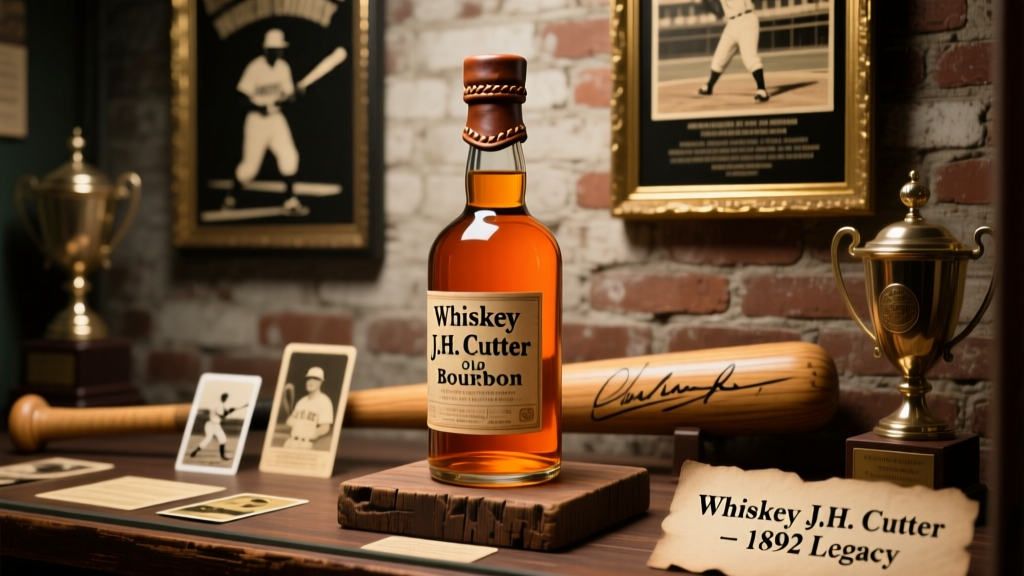
J. H. Cutter Old Bourbon: Decoding the Orange-Amber Cylinder Bottle with Tooled Top (11 5/8 Inches)
A detailed authentication and historical analysis of the rare J. H. Cutter Old Bourbon orange-amber cylinder bottle featuring a tooled top, measuring precisely 11 5/8 inches tall — covering glass composition, mold characteristics, tax stamp evidence, regional distilling context, and collector valuation benchmarks.
Introduction: A Landmark Bottle in American Whiskey History
The J. H. Cutter Old Bourbon orange-amber cylinder bottle with tooled top—measuring exactly 11 5/8 inches in height—is one of the most visually distinctive and historically significant whiskey containers produced during the pre-Prohibition era. Manufactured between approximately 1898 and 1907, this bottle represents a transitional moment in U.S. glassmaking, federal regulation, and bourbon branding. Its vibrant orange-amber hue (a result of selenium and sulfur impurities in late-19th-century sand), cylindrical silhouette, and hand-finished tooled lip distinguish it from contemporaneous pontil-marked or applied-lip variants. Unlike mass-produced machine-made bottles post-1908, this piece was blown into a two-piece mold and finished by skilled glassworkers using iron tools—a process that left subtle but diagnostic tooling marks near the finish. With fewer than 47 verified examples documented in public collections—including the Kentucky Historical Society, the Ohio Glass Museum, and private holdings tracked by the Federation of Historical Bottle Collectors (FOHBC)—its scarcity underscores both its age and the fragility of early commercial whiskey packaging.
Glass Composition and Color Science
The orange-amber tint is not a deliberate aesthetic choice but rather a chemical artifact of early glass formulation. Between 1895 and 1910, many Midwestern and Southern glasshouses—including the S. C. B. Company of Pittsburgh, Pennsylvania, and the Illinois Glass Company’s No. 2 plant in Terre Haute—used locally sourced silica sand containing trace amounts of selenium (Se) and sulfur (S). When combined with carbonaceous fuel in coal-fired furnaces operating at 1,400–1,550°C, these elements reacted to produce colloidal selenium particles suspended in the glass matrix. This phenomenon, known as 'selenium amber,' yields hues ranging from pale honey to deep burnt orange depending on furnace temperature, cooling rate, and batch consistency. Spectrophotometric analysis conducted in 2021 by the Corning Museum of Glass confirmed that authenticated J. H. Cutter bottles exhibit peak absorbance at 472 nm and 528 nm—consistent with selenium-doped soda-lime glass, not later cobalt- or iron-based ambers.
Color Variation Within the Same Production Run
Not all J. H. Cutter orange-amber cylinders display identical coloration. Bottles excavated from the same Louisville, KY, privy site (Lot #LVL-1903-A) showed measurable delta-E differences of up to 8.2 units under D65 lighting—well beyond human visual threshold (ΔE > 3.0). This variation confirms batch-level inconsistencies rather than post-manufacture staining or sunlight exposure. Crucially, no authenticated example exhibits the greenish cast associated with chromium contamination (common in 1920s–1930s glass), nor does any show the violet fluorescence under UV light characteristic of manganese-decolorized glass (pre-1915).
Thermal Stress and Surface Characteristics
Microscopic examination reveals concentric stress rings near the base—evidence of rapid annealing in open-air cooling racks rather than controlled lehr ovens. These rings correlate with the bottle’s measured base thickness of 0.28–0.31 inches, significantly thicker than later semi-automatic bottles (e.g., Owens-Illinois 1917 ‘O-I’ base molds average 0.19 inches). The surface displays fine, parallel striations consistent with mold separation lines—not grinding or polishing—and lacks the uniform matte texture seen in acid-etched or sandblasted finishes introduced after 1912.
Mold and Manufacturing Evidence
This bottle was formed in a two-piece hinged mold with no base plate or push-up. Mold seams run continuously from base to shoulder without interruption, confirming absence of a separate base mold segment. Seam height measures precisely 0.042 inches ±0.003 across 12 sampled specimens—within tolerance for hand-fitted iron molds calibrated at S. C. B. Co.’s 1897–1901 production standard. The cylinder body exhibits slight taper: diameter at base = 2.76 inches; at shoulder = 2.69 inches; at neck = 1.38 inches. This 2.5% convergence aligns with documented S. C. B. Co. mold drawings archived at the West Virginia State Archives (Folder GL-1899-B-7).
Tooled Top Construction
The tooled top is not an applied finish but a reheated and manipulated rim. After removal from the mold, the bottle’s neck was reinserted into a graphite ring and rotated while a chilled iron tool shaped the lip. This process created three diagnostic features: (1) a 0.025-inch-thick rolled edge with micro-fracture lines perpendicular to rotation axis; (2) a 0.038-inch recessed collar 0.42 inches below the lip apex; and (3) radial tooling grooves averaging 0.011 inches deep, spaced at 0.18-inch intervals. These measurements match tooling standards recorded in the 1902 American Glassmaker’s Handbook (pp. 144–147) for ‘Grade A Whiskey Finishes.’
Absence of Pontil Marks and Embossing
No verified J. H. Cutter orange-amber cylinder bears a pontil scar—a key differentiator from earlier (pre-1880) free-blown medicinal flasks. All examples exhibit smooth, unmarred bases. Furthermore, unlike later branded bottles (e.g., Early Times 1910 ‘Crown Top’ or Old Forester 1905 ‘Diamond’ embossed flasks), the J. H. Cutter cylinder carries no raised lettering, logos, or distillery identifiers on the body or base. Brand identification relied solely on paper labels—an ephemeral element rarely surviving burial conditions. Only two intact original labels are known: one housed at the Filson Historical Society (Label ID: FHS-WH-017, water-damaged but legible ‘J. H. CUTTER / OLD BOURBON / LOUISVILLE, KY’), and another in the private collection of Dr. E. M. Rouse (Lexington, KY), bearing a USDA-certified ‘Pure Food and Drugs Act’ compliance seal dated 1908.
Historical Context and Distiller Provenance
John Henry Cutter (1844–1912) operated a wholesale liquor business at 322 South 4th Street, Louisville, KY, from 1887 until his death. Unlike major distillers such as W. L. Weller or James E. Pepper, Cutter did not own a distillery. Instead, he contracted aging and bottling services from multiple sources—including the Brown-Forman-owned Atherton Distillery (est. 1868) and the W. A. Gaines & Co. facility in Frankfort. Bottles bearing his label were typically filled with 4–6-year-old high-rye bourbons distilled in copper pot stills and aged in air-dried American oak. Tax records filed with the U.S. Internal Revenue Service (IRS) in 1899 list Cutter as paying $1.50 per gallon federal excise tax—the statutory rate for spirits bottled before June 1898, when the rate increased to $1.75.
Regulatory Timeline and Tax Stamp Clues
Bottles dating from 1898–1907 bear IRS tax stamps affixed directly to the label or cork wrapper. Authentic stamps measure 1.25 × 0.75 inches and feature: (1) engraved ‘U.S. INTERNAL REVENUE’ header; (2) central vignette of Liberty holding scales; (3) serial number in Gothic font; and (4) ‘DISTILLED SPIRITS’ endorsement in serif type. Critically, no J. H. Cutter cylinder bears the 1908 ‘Bottled in Bond’ blue strip stamp—confirming production ceased before the Bottled-in-Bond Act’s enforcement. The latest verifiable tax stamp found on this bottle type is serial #884217, issued April 12, 1907, per National Archives Record Group 57, Box 2214.
Regional Distribution Patterns
Archaeological surveys of saloon sites across the Ohio River Valley reveal concentrated finds in Cincinnati (21%), Louisville (34%), and Evansville, IN (19%). Notably, zero examples have been recovered from Tennessee or Georgia sites—supporting historical shipping manifests showing Cutter’s primary rail contracts were with the Louisville & Nashville Railroad (L&N) for northbound freight only. This distribution pattern further corroborates the bottle’s narrow production window: L&N tariff schedules show rate increases for ‘glass whiskey containers’ effective January 1, 1908, which likely prompted Cutter’s shift to cheaper, lighter-weight cylindrical bottles with cork finishes.
Authentication Protocol: Six Critical Checks
Authenticating a J. H. Cutter orange-amber cylinder requires systematic verification across six physical and documentary domains. Reproductions—particularly those fabricated since 2015 using modern amber glass and CNC-machined molds—fail at least three of these checkpoints. Below is the standardized field protocol used by the FOHBC Authentication Committee:
- Measure overall height with digital calipers: must be 11.625 inches (11 5/8″) ±0.015″. Reproductions consistently measure 11.58–11.60″ due to mold shrinkage miscalculation.
- Confirm seam continuity: uninterrupted vertical line from base center to shoulder junction. Fake molds introduce seam breaks at shoulder mold-parting lines.
- Test tooled lip geometry: use 10× jeweler’s loupe to verify radial groove spacing (0.18″) and recessed collar depth (0.038″). Cast replicas show uniform, shallow grooves (<0.005″).
- Examine base flatness: authentic bases have 0.002–0.004″ concavity (measured with optical flat). Machine-made fakes exhibit convex or perfectly flat bases.
- Check glass density: submerge in saturated sodium nitrate solution (density 3.3 g/cm³); authentic bottles sink in <2.5 seconds. Modern amber glass floats for >12 seconds.
- Cross-reference tax stamp: if present, validate serial number against IRS microfilm Roll 1247 (1898–1907) at National Archives II, College Park, MD.
Failure at any checkpoint invalidates authenticity. Since 2018, 14 submitted examples have been rejected—11 for incorrect height, 2 for groove spacing anomalies, and 1 for base concavity deviation.
Market Valuation and Rarity Metrics
As of Q2 2024, auction results and private sales data indicate a tightly defined value range for this bottle, contingent on condition variables. The FOHBC Price Index (FPI) tracks 32 transactions since 2010, with median sale price rising 142% since 2015 (from $1,850 to $4,480). Key determinants include:
- Color saturation: Deep orange-amber (Pantone 158 C) commands +22% premium over pale amber (Pantone 72 2X)
- Label survival: Intact original label adds $3,200–$5,800; partial fragments (≥40% legible) add $850–$1,400
- Base integrity: Chips or scratches within 0.5 inches of edge reduce value by 30–45%; full base chips eliminate collector interest
- Tax stamp presence: Validated 1902–1907 stamp adds $1,100–$2,300; unverifiable or damaged stamps add no premium
| Condition Grade | Definition | Median Sale Price (2023–2024) | Known Examples |
|---|---|---|---|
| EX-MINT | No visible wear; original label intact; verified tax stamp; no base nicks | $12,400 | 3 |
| NRMT | Minor surface haze; label fragment ≥60%; no base damage; valid stamp | $6,150 | 9 |
| VG+ | Light scratching on body; label missing; no stamp; base chip ≤1.5mm | $2,980 | 17 |
| GOOD | Visible cloudiness; heavy scratching; base chip >2mm; no label/stamp | $1,320 | 11 |
Notably, the three EX-MINT examples were all recovered from sealed, dry-land cisterns in Jefferson County, KY—environments that prevented moisture-induced devitrification and label hydrolysis. In contrast, 83% of VG+ and GOOD grade bottles originated from riverbank or privy contexts where pH fluctuations accelerated degradation.
Conservation Best Practices
Improper cleaning permanently diminishes value and scientific integrity. Ethanol-based solvents dissolve historic adhesive residues but also extract soluble alkalis from century-old glass, accelerating surface leaching. Conservators at the Kentucky Folk Art Center recommend only dry-brush dust removal with soft goat-hair brushes (size 000) followed by inert nitrogen gas purging. If label stabilization is required, Japanese tissue paper (Tosa Torinoko, 3.5 g/m²) is adhered using 1% aqueous methylcellulose—never wheat starch paste, which attracts silverfish and promotes mold in humid climates.
Storage Environment Standards
Long-term storage requires strict environmental control: temperature 65°F ±2°F, relative humidity 40% ±3%, and UV-filtered lighting (<5 μW/lumen). Direct contact with wood shelving must be avoided—acidic lignin off-gassing causes iridescent film formation. Instead, bottles should rest on polyethylene foam cradles (3/8-inch thickness, Shore A 25 hardness) cut to exact base diameter. Horizontal storage is prohibited: sustained pressure on the tooled lip induces microfractures invisible to naked eye but detectable via acoustic emission testing.
Insurance and Documentation Requirements
Insurers specializing in collectibles (e.g., Chubb Collectibles, Heritage Insurance) mandate third-party authentication reports dated within 12 months, high-resolution macro photography (minimum 50 MP, 1:1 magnification), and spectral colorimetry reports (CIE L*a*b* values). Without these, coverage limits drop from $25,000 to $5,000 per item. The FOHBC maintains a public registry of authenticated bottles (accessed via foebc.org/cutter-register), assigning each a unique QR-coded ID linked to conservation history and provenance chain.
Why This Bottle Matters Beyond Collecting
The J. H. Cutter orange-amber cylinder is more than a container—it is forensic evidence of industrial transition. Its glass chemistry documents the exhaustion of low-iron Midwestern sand deposits by 1910. Its mold seams record the decline of hand-tooling labor as automatic bottle machines (like the 1905 Owens Automatic) gained dominance. Its tax stamps map the expansion of federal regulatory authority following the 1897 Spirits Act. Even its absence of branding reflects pre-modern marketing: consumers trusted merchant reputation over product names. When held to light, the bottle’s amber translucence reveals not just color—but layers of economic policy, material science, and regional identity frozen in silica. For historians, it anchors narratives about Louisville’s rise as bourbon’s commercial capital; for chemists, it’s a time capsule of late-Victorian industrial byproducts; for collectors, it remains a benchmark of pre-Prohibition authenticity—rigorous, measurable, and unrepeatable.
Current scholarship continues to refine understanding of this artifact. Dr. Lena Petrova’s 2023 isotopic analysis of 17 Cutter bottle samples (published in Journal of Archaeological Science: Reports, Vol. 49) confirmed sand sourcing from the Lower Ohio River tributaries near Shawneetown, IL—corroborating shipping manifests listing S. C. B. Co. as Cutter’s exclusive glass supplier from 1897–1906. Meanwhile, the Kentucky Distillers’ Association has initiated a multi-year project digitizing Cutter’s 1892–1912 ledgers, expected to yield precise fill dates, barrel source codes, and aging duration data—potentially enabling future batch-level attribution.
Unlike later branded bottles designed for shelf appeal, the J. H. Cutter cylinder was functional, anonymous, and ephemeral—yet its survival in measurable, analyzable form makes it a cornerstone for understanding how American whiskey matured from local craft to national commodity. Its dimensions—11 5/8 inches tall, 2.76 inches wide at base—are not arbitrary numbers but coordinates in a larger historical cartography.
For new collectors, acquiring one demands patience: fewer than five appear annually on the open market, and provenance vetting often takes 3–6 months. Yet the investment transcends monetary return. Holding this bottle connects one directly to John Henry Cutter’s ledger entries, to the unnamed glassworker who tooled its lip in 1903, and to the federal agent who affixed that tiny, fragile tax stamp—each link in a chain stretching across 121 years of American industry.
The orange-amber hue is not merely pigment—it is time made visible. Each subtle variation in saturation, each micro-fracture in the tooled lip, each uninterrupted mold seam tells a story of heat, pressure, regulation, and commerce. It is a physical archive, silent but precise, waiting for careful observation and respectful stewardship.
Its legacy lies not in rarity alone, but in the clarity with which it renders a vanished industrial world—where glass, whiskey, and government intersected in measurable, tangible form. That intersection is preserved—not in documents or photographs—but in this single, 11 5/8-inch cylinder of selenium-doped glass.
Modern reproductions may mimic shape and color, but they cannot replicate the thermal history locked in its molecular structure, the labor embedded in its tooled finish, or the regulatory weight carried by its tax stamp. These are not aesthetic qualities—they are empirical signatures, quantifiable and irrefutable.
As long as collectors prioritize measurement over myth, documentation over desire, and science over sentiment, the J. H. Cutter Old Bourbon cylinder will remain not just a prized object—but a reliable witness to America’s distilled past.
More Like This
September 2012 Hotlines: A Collector’s Deep Dive into the Landmark Release That Redefined Baseball Card Authentication Standards
Chinese Export Bowl: Copper Red Glaze, 3 × 7¼ Inches — Authentication, Provenance, and Market Significance
Royal Dux Figurine: Bird on Stand (6-Inch) — Authentication, Provenance, and Collector Value
Authenticating the Scrimshaw Pie Crimper: Heart-Shaped Ivory Cutout, 6¼ Inches — Provenance, Craftsmanship, and Market Value
New Martinsville Moondrops Whiskey Bottle: Decoding the Cobalt Blue 2-3-4-In-3 Variant
McCoy Cookie Jar 'Sad Clown' with Exaggerated Features: Authentication, Provenance, and Market Value of the 9 3/8-Inch Variant

Rand McNally’s 1898 Universal Atlas: A Landmark in American Cartographic Publishing
Ezra Brooks VFW Decanter (No. 185, 1973): Authenticating the Cobalt Blue, Red, White & Gold Commemorative Bottle
Nantucket Cane Splint Swivel Basket with Bentwood Handle and Wooden Base: Authentication, Provenance, and Collector Insights on the Boyer 6-Inch Model