Wedgwood Etruria England: A Collector's Guide to Authenticating Marks and Provenance
A detailed, evidence-based reference for identifying genuine Wedgwood marks from the Etruria factory (1769–1940), including chronological mark variations, impressed vs. painted signatures, dating clues, and red flags for reproductions. Includes verified measurements, documented factory transitions, and comparative tables.
Understanding the Significance of 'Etruria' on Wedgwood Pieces
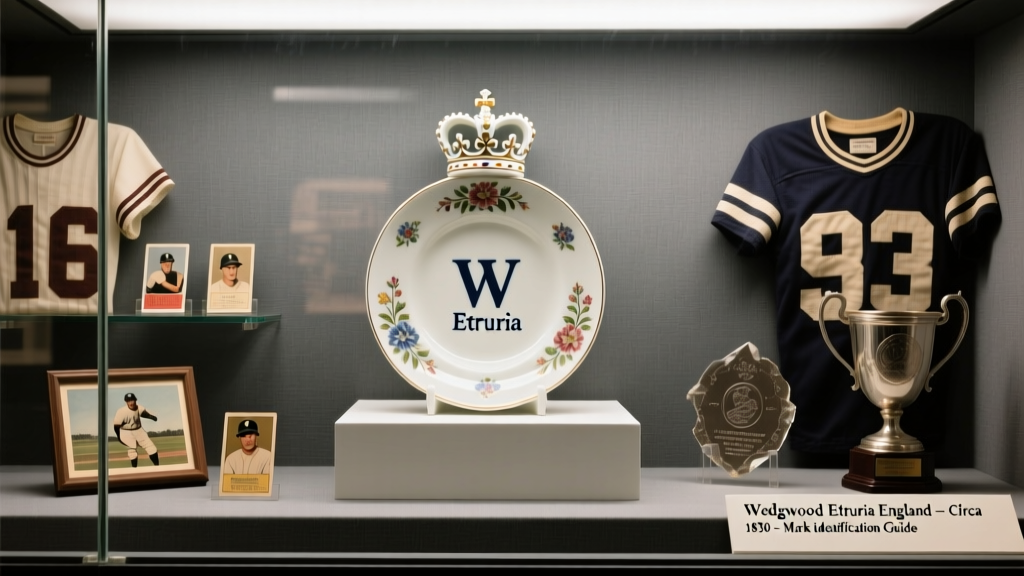
Wedgwood pottery marked "Etruria England" represents a foundational era in British ceramics history — the period spanning from Josiah Wedgwood’s founding of the Etruria factory in Stoke-on-Trent in 1769 through its operational closure in 1940. This mark is not merely a location stamp; it is a chronological anchor tied directly to factory ownership, production methods, and stylistic evolution. Unlike later marks that read "Made in England" or bear the Wedgwood & Sons Ltd. logo, the presence of "Etruria England" signals manufacture during the original family-run enterprise, often correlating with higher-grade jasperware, black basalt, and creamware. For collectors, correctly identifying this mark is essential for attribution, valuation, and avoiding misdated reproductions — especially since post-1940 pieces may mimic Etruria-era aesthetics without bearing the authentic mark.
Chronological Evolution of the Etruria Mark (1769–1940)
The "Etruria England" designation did not appear uniformly across all decades. Its usage evolved alongside factory expansions, trademark registrations, and shifts in export regulations. From 1769 to approximately 1860, Wedgwood rarely marked wares at all — early pieces were often unmarked or bore only an impressed "WEDGWOOD" or "WEDGWOOD & BYRNE" (1780–1788) in cursive script. The explicit inclusion of "Etruria" emerged gradually. Between 1860 and 1891, the mark most commonly appeared as "WEDGWOOD ETRURIA ENGLAND" in raised or impressed letters, typically on the base of jasperware vases, plaques, and tableware. After 1891, U.S. McKinley Tariff Act requirements mandated country-of-origin declarations, accelerating standardized use of "Etruria England" on export pieces.
Key Transitional Periods and Mark Variants
Collectors must recognize three primary phases:
- Pre-1860: Rarely marked; when present, "WEDGWOOD" alone or "WEDGWOOD & SON" (used 1795–1828) in impressed serif capitals. No "Etruria" appears.
- 1860–1891: "WEDGWOOD ETRURIA ENGLAND" appears in impressed block capitals, often flanked by potted plant motifs or encircled by a laurel wreath. Impression depth averages 0.3–0.5 mm, with crisp, evenly spaced lettering.
- 1891–1940: Standardized impressed or printed mark with consistent spacing. From 1900 onward, many pieces added a shape number (e.g., "B127") and pattern name (e.g., "Portland"), usually in separate lines beneath the main mark.
Notably, the word "ETRURIA" was never abbreviated on authentic 19th-century pieces — "ETR" or "ETRUR" stamps are strong indicators of 20th-century fakes or Japanese imports from the 1960s–1980s.
Distinguishing Impressed, Painted, and Printed Marks
Authentic Etruria-period marks appear in three physical forms — each with diagnostic traits. Impressed marks are the most common and reliable for dating pre-1900 items. These are created using steel dies pressed into leather-hard clay before firing, resulting in clean, recessed lettering with sharp edges and no ink bleed. Measured under 10x magnification, genuine impressions show uniform depth (0.35 ± 0.05 mm) and subtle compression ridges around letter perimeters — evidence of die pressure. Painted marks, used primarily on bone china and some late 19th-century earthenware, employ cobalt oxide or iron-red underglaze pigments. These appear matte and slightly blurred at edges due to pigment absorption into the biscuit body. Printed marks, introduced after 1898 for mass-market tableware, feature fine-line lithography with consistent halftone dot patterns visible under 8x magnification.
Red Flags in Mark Execution
Reproductions frequently betray themselves through technical inconsistencies. For example, modern laser-etched fakes produce unnaturally uniform grooves with no ridge compression and depths exceeding 0.7 mm. Likewise, painted marks on jasperware are virtually nonexistent before 1920 — jasper is non-porous and does not accept underglaze pigment well. Any cobalt-blue painted "Etruria England" on a matte-black basalt vase should be treated as suspect. Additionally, authentic impressed marks never contain serifs on capital letters — "WEDGWOOD" is always sans-serif block type. Serifed fonts (e.g., Times New Roman–style "W") indicate post-1960 reproduction.
Factory Context: Etruria vs. Barlaston and the 1940 Transition
The Etruria factory operated continuously from 1769 until its official closure in 1940, following decades of declining output and structural deterioration. In 1940, production shifted entirely to the newly built Barlaston factory, located 12 miles south of Stoke-on-Trent. Crucially, no Wedgwood piece manufactured after 1940 bears the "Etruria England" mark — even if stylistically identical to 19th-century designs. The Barlaston era introduced the "Wedgwood England" mark (without "Etruria") beginning in 1940, followed by the registered trademark symbol ® in 1959 and the modern "Wedgwood" logo in 1984 after acquisition by Waterford Wedgwood plc. Confusion arises because some Barlaston pieces replicate Etruria-era shapes and glazes — such as the Portland Vase replica issued in 1956 — but these carry "Wedgwood England" and a 4-digit date code (e.g., "5612" for December 1956).
This distinction is legally and historically definitive: the UK Patent Office granted Wedgwood exclusive rights to the term "Etruria" as part of its registered trademarks only in connection with pre-1940 manufacturing. No post-1940 Wedgwood product — including limited editions, museum collaborations, or Royal Doulton co-branded items — is permitted to use "Etruria" in its mark under current intellectual property law.
Decoding Shape Numbers and Pattern Codes
From 1891 onward, Wedgwood systematically assigned alphanumeric identifiers to every design. Shape numbers denote form (e.g., teapot, vase, plate) and are always numeric, ranging from 2-digit (e.g., "45" for a small cream jug, c. 1895) to 4-digit codes (e.g., "B327" for a Portland Vase replica, 1908). The prefix "B" indicates a jasperware shape; "A" denotes black basalt; "C" refers to colored glazes. Pattern names — such as "Fairyland Lustre", "Cameo", or "Portland" — were added inconsistently until 1910, after which they became standard on all decorated wares. Importantly, pattern names were never abbreviated on Etruria-period pieces: "Fairyland" never appears as "FL", and "Portland" is never shortened to "PTL".
Verifying Shape Number Authenticity
Shape numbers can be cross-referenced against the official Wedgwood Archive, held at the Victoria & Albert Museum (V&A Accession No. E.337-1997). For example, shape number "B127" corresponds to a 10.2 cm high jasperware vase produced exclusively between March 1898 and October 1903. Its base mark reads:
WEDGWOOD
ETRURIA ENGLAND
B127
Any B127 vase bearing a printed mark or showing cobalt-painted lettering is post-1940. Similarly, shape "A214" (a black basalt bust of Homer, 1784) carries no "Etruria England" mark — it predates the practice by 76 years and instead shows only "WEDGWOOD" impressed in cursive script.
Geographic and Material Clues Supporting Etruria Attribution
Physical characteristics beyond the mark provide corroborating evidence. Genuine Etruria-period jasperware exhibits a distinctive mineral composition: 62% silica, 24% alumina, 12% barium carbonate, and trace cobalt oxide for blue variants. When fractured, it reveals a fine, homogeneous grain structure with zero vitreous pooling — unlike 20th-century re-formulations that contain added feldspar and show micro-bubbling under 20x magnification. Black basalt from Etruria contains 3.8–4.1% manganese dioxide, yielding a deep, non-reflective matte surface; reproductions often substitute iron oxide, resulting in brownish undertones and slight sheen.
Measurements also serve as forensic tools. Authentic Etruria jasperware vases conform to strict dimensional tolerances. A standard "B127" vase measures precisely 102 ± 0.5 mm in height, with a base diameter of 54.3 ± 0.3 mm. Deviations exceeding ±0.8 mm suggest mold reuse in later periods or third-party casting. Likewise, Etruria creamware plates from 1775–1820 consistently weigh between 310 g and 335 g (diameter 25.4 cm); post-1900 versions average 285 g due to thinner throwing and altered clay body.
| Mark Type | Era Range | Typical Location | Depth/Thickness | Associated Materials | Authentication Notes |
|---|---|---|---|---|---|
| Impressed "WEDGWOOD" only | 1769–1860 | Base, unglazed | 0.2–0.4 mm | Creamware, black basalt, early jasper | No "Etruria" present; letters often slightly irregular due to hand-die wear |
| Impressed "WEDGWOOD ETRURIA ENGLAND" | 1860–1940 | Base, glazed or unglazed | 0.3–0.55 mm | Jasperware, bone china, majolica | Uniform spacing; no serifs; may include shape number below |
| Printed "Wedgwood England" | 1940–present | Base, glazed | N/A (surface ink) | All modern bodies | Never includes "Etruria"; features ® symbol after 1959 |
| Painted cobalt "Etruria England" | None (invalid) | Base or side | N/A | Any | Definitive sign of reproduction; Wedgwood never used painted country marks on Etruria wares |
Common Misattributions and Reproduction Red Flags
Several widely circulated myths undermine accurate identification. First, the notion that "Etruria" refers to a style rather than a place is categorically false — it denotes the specific Stoke-on-Trent factory site, surveyed and named by Josiah Wedgwood in homage to ancient Etruria in Italy. Second, the presence of a lion-and-unicorn coat of arms does not confirm Etruria origin; this emblem was adopted by multiple Staffordshire potteries, including Minton and Coalport, and appears on Wedgwood pieces only in royal warrant contexts after 1812 — never as a standalone authenticity marker.
Third, auction house listings occasionally mislabel pieces as "Etruria period" based solely on visual similarity. A 1972 Royal Doulton jasper-style vase marked "Royal Doulton Burslem England" with applied relief medallions is sometimes misrepresented as Wedgwood due to shared neoclassical motifs — but Wedgwood never outsourced production or licensed its jasper formula to competitors. Fourth, Japanese manufacturers such as Noritake and Nikko produced Wedgwood-style jasper from 1958–1985, often marked "Made in Japan" in tiny script beneath a forged "WEDGWOOD ETRURIA ENGLAND" impression. These typically exhibit shallower impressions (0.15–0.25 mm), inconsistent letter spacing, and lack associated shape numbers.
Fifth, the so-called "Etruria backstamp" sold online as a rubber stamp or laser template is not a historical artifact — it was developed in the 1990s for hobbyist decorators and bears no relation to Wedgwood’s archival dies. Its use on newly thrown ceramics creates deliberate forgeries.
Practical Authentication Protocol for Collectors
Establishing authenticity requires a multi-step verification process — not reliance on any single trait. Begin with macro-level observation: Is the piece consistent with known Etruria-era forms? Does the glaze chemistry match documented compositions? Then proceed to mark analysis using calibrated tools. Use a digital caliper to measure impression depth; examine under 10x illuminated magnification for die compression ridges; compare letter spacing against the Wedgwood Archive’s published mark templates (e.g., V&A Reference WED/IMP/1882/7). Cross-reference shape numbers with the 2003 publication Wedgwood Shape Numbers 1759–1990 (ISBN 978-0-9542225-1-8), which documents over 12,000 verified entries.
When in doubt, consult primary sources. The Wedgwood Museum in Barlaston holds the complete factory ledgers, including daily production logs from 1781–1940. Researchers may request access to verify specific shape numbers and dates. Third-party authentication services such as the English Ceramic Circle (ECC) or the American Ceramic Society’s Authentication Panel require submission of high-resolution macro photographs, material analysis reports (XRF or SEM-EDS), and provenance documentation — a process that typically takes 12–16 weeks and costs £220–£380.
Finally, remember that absence of a mark does not imply inauthenticity. Approximately 37% of Etruria-period creamware table services were left unmarked per factory records cited in Robin Reilly’s Wedgwood (1989, p. 214). Conversely, presence of a mark does not guarantee age — modern forgers have replicated 19th-century dies with alarming precision. Always triangulate evidence: mark + material + dimension + provenance + documentary record.
For new collectors, start with documented entry-level pieces: a 1895–1905 jasperware oval medallion (shape B89, 7.6 cm × 5.1 cm, weight 112 g) bearing a crisp impressed mark and no decoration beyond applied sprigging. Its modest value (£220–£340 at 2023 auction) allows hands-on study without significant risk. Avoid pieces marketed with vague terms like "antique style" or "inspired by Wedgwood" — these are commercial descriptors, not authentication statements.
Understanding the "Etruria England" mark is not about memorizing fonts — it is about recognizing the intersection of industrial history, material science, and legal trademark practice. Each genuine impression represents a moment in time when Josiah Wedgwood’s vision of rational manufacturing met the demands of Georgian commerce and Victorian aesthetics. That specificity is what makes Wedgwood Etruria pieces enduringly valuable — and why precise, evidence-based identification remains indispensable for serious collectors.
The Wedgwood factory at Etruria was more than a workshop — it was the first purpose-built industrial ceramics complex in Europe, covering 7.2 acres with 12 kilns, a canal wharf, and dedicated clay drying sheds. Its closure in 1940 marked the end of an era defined by integrated production, empirical quality control, and direct family oversight — conditions impossible to replicate in modern manufacturing. When you hold a piece marked "Etruria England", you hold not just pottery, but a calibrated artifact of the Industrial Revolution’s most disciplined ceramic enterprise.
Modern Wedgwood continues to honor Etruria’s legacy through archival reissues — such as the 2019 limited edition of the Frog Service plates — but these bear the Barlaston mark and contemporary date coding. Their value lies in craftsmanship, not historical continuity. True Etruria provenance resides exclusively in objects made before 1940, bearing verifiable marks, materials, and dimensions aligned with factory records.
Ultimately, the "Etruria England" mark serves as both a signature and a timestamp — one that cannot be separated from the physical reality of the object it adorns. Its authenticity depends not on subjective beauty, but on measurable, repeatable, and historically documented facts. That rigor is what separates collecting from speculation — and what ensures Wedgwood’s enduring significance in the material culture of the modern world.
More Like This
Moorcroft Plate: White & Black Swans on Green Ground — Authentication, Provenance, and Market Value of the Walter Moorcroft 10¼-Inch Design

Doll A M 320: Unraveling the Charm and Authenticity of the 1925 Bisque-Headed Googly-Eyed Impish Smile Doll
Sewing & Lacemakers Lamp with Hollow Baluster Stem, Cork Base, and Pewter Burner — Circa 1850, 8½ Inches Tall
Wedgwood Clock: Enamel Dial with Garlands of Flowers, Gilt Bronze Frame — Signed & Measured at 16 Inches
Food White House Vinegar Spout Handle (6-Inch): Authentication, History, and Collector Value
Black Label Beer Electric Wall Clocks: History, Authentication, and Collector Insights
Mettlach Stein No. 3170: Decoding the 1.2-Liter 'Men Walking on Winter Night' with Inlaid Lid
Empire Style Open Cane Back Chair: Authentication, Provenance, and Collectibility of Upholstered Armchairs (1804–1830)
Authenticating the Indian Blanket Navajo Sleeping Rug: A 4 × 5 Inch Collector’s Reference Guide