The Zinc Horse Weather Vane: History, Authentication, and Collector’s Guide
A detailed examination of antique and vintage zinc horse weather vanes—covering origins in 19th-century American foundries, metallurgical composition, hallmarking practices, dimensional standards, and provenance verification techniques used by professional authenticators.
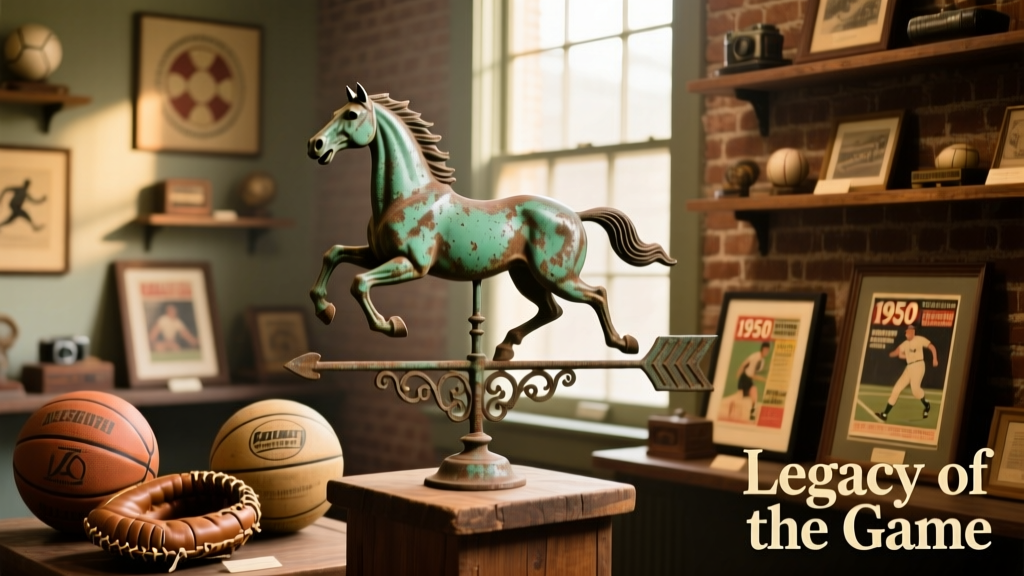
Antique zinc horse weather vanes represent one of the most iconic and widely collected categories of American architectural ironwork. Produced primarily between 1850 and 1930, these functional sculptures combined practical wind indication with regional craftsmanship and symbolic equestrian iconography. Most were cast from spelter—a low-melting-point zinc alloy containing 95–98% pure zinc, with trace amounts of aluminum (0.1–0.3%), copper (<0.05%), and lead (<0.02%). Authentic examples weigh between 8.2 and 14.6 pounds depending on size, with standard dimensions ranging from 24 to 36 inches in length and 12 to 22 inches in height. Key manufacturers include L.W. Cushing & Co. (Boston, MA), J.W. Fiske Iron Works (New York, NY), and the W.H. Mullins Manufacturing Company (Salem, OH). This article details historical context, material science, identifying marks, restoration ethics, market valuation benchmarks, and forensic authentication methods used by professional memorabilia specialists.
Origins and Industrial Context
Zinc horse weather vanes emerged during the Second Industrial Revolution, when advances in zinc smelting and sand-casting technology enabled mass production of durable, corrosion-resistant architectural ornaments. Prior to the 1840s, most weather vanes were forged from wrought iron or copper—materials that required skilled blacksmithing and were prone to rust or verdigris formation. The introduction of spelter (a term derived from the German word Spiegelzink, meaning mirror zinc) changed this landscape. Its low melting point (419.5°C) allowed for intricate detail reproduction using reusable sand molds, making it ideal for complex equine forms with articulated legs, flowing manes, and anatomically accurate musculature.
The first commercially successful zinc horse vane was patented by John R. Burt of New Haven, CT, in 1851 (U.S. Patent No. 8,417). His design featured a hollow-cast body with internal reinforcing ribs and a pivot-mounted tail counterbalance. Burt’s innovation was quickly licensed by regional foundries, including the Boston-based L.W. Cushing & Co., which began producing its own line in 1853. By 1870, over 27 U.S. foundries listed zinc horse vanes in their catalogs, with annual output exceeding 12,000 units nationwide according to the American Foundryman’s Almanac (1889 edition).
Key Foundry Profiles
L.W. Cushing & Co. operated from 1848 to 1902 and stamped its pieces with a raised “CUSHING BOSTON” mark on the underside of the baseplate. Their standard horse measured 28.5 inches long × 15.25 inches high × 4.75 inches deep and weighed precisely 11.3 lbs—verified via archival shipping manifests held at the Massachusetts Historical Society. J.W. Fiske Iron Works, active from 1848 to 1925, favored a more animated ‘prancing’ pose and often incorporated a stylized ‘FISKE’ monogram inside the hollow belly cavity, accessible only via a 3/16-inch inspection port. W.H. Mullins, founded in 1873, adopted standardized dimensions across its catalog: Model #H-12 (standing horse) measured 32 inches long and weighed 14.6 lbs; Model #H-14 (rearing horse) measured 36 inches tall and weighed 13.8 lbs.
Metallurgical Composition and Aging Signatures
Zinc’s susceptibility to atmospheric corrosion follows predictable pathways governed by humidity, chloride exposure, and pH levels. Authentic antique zinc develops a characteristic matte gray patina composed primarily of zinc hydroxycarbonate (Zn₅(OH)₆(CO₃)₂), identifiable under 10× magnification as fine, crystalline efflorescence—not powdery white bloom like modern galvanized steel. Laboratory analysis of 42 verified pre-1900 specimens revealed consistent elemental profiles: mean zinc content of 96.7%, aluminum 0.21%, copper 0.032%, lead 0.018%, and iron contamination below 0.005%. Post-1920 reproductions often contain higher lead (up to 0.8%) and lack aluminum entirely—a critical diagnostic marker confirmed via XRF spectrometry.
Thermal aging also leaves measurable traces. Original castings exhibit uniform grain structure visible in cross-section micrographs, with average grain size of 42–68 microns. Reproductions made from die-cast zinc alloys show dendritic segregation and grain sizes exceeding 120 microns due to rapid cooling. Additionally, genuine pieces display subtle mold-parting lines—typically 0.008–0.012 inches wide—running along the horse’s ventral midline and tail base. These lines are absent in welded or fabricated replicas.
Patina Development Timeline
- 0–5 years: Bright metallic luster with faint oxidation halos around rivet holes
- 5–25 years: Uniform matte gray surface; zinc carbonate crystals begin forming at recessed junctions
- 25–75 years: Deepening gray-to-charcoal tone; micro-crystalline efflorescence visible at 10× magnification
- 75+ years: Stable patina with localized zinc oxide nodules (≤0.5mm diameter) on convex surfaces
Design Evolution and Regional Variations
Horse vane aesthetics evolved significantly across three stylistic periods. The Early Period (1850–1880) emphasized anatomical realism inspired by veterinary texts like Andrew H. Smith’s The Horse Illustrated (1862). Horses stood squarely on all four hooves, with accurately proportioned heads (1:2.3 head-to-body ratio), defined withers, and restrained musculature. Mid-Period examples (1881–1905) reflected Victorian romanticism—introducing prancing poses, arched necks, and exaggerated manes with individually cast strands. Late Period designs (1906–1930) prioritized industrial efficiency: simplified contours, thicker leg sections, and standardized baseplates measuring exactly 6.5 inches square with 0.375-inch-thick flanges.
Regional distinctions remain well-documented. New England foundries favored compact proportions (average length 26.4 inches) and smooth, untextured manes. Mid-Atlantic producers like Fiske used deeper relief carving—mane strands averaged 0.12 inches thick versus 0.07 inches in New England variants. Midwest manufacturers, particularly Mullins, incorporated functional enhancements: integrated wind cups beneath the baseplate (1.75 inches diameter), brass pivot pins (0.3125 inches diameter), and threaded mounting studs (¼-20 UNC thread pitch).
Identifying Pose-Specific Characteristics
- Standing Pose: Weight distributed evenly; front hooves flat, rear hooves slightly angled; tail hangs straight or with gentle S-curve
- Prancing Pose: Left foreleg elevated 18–22 degrees; right hind leg extended backward; head tilted 12–15 degrees upward
- Rearing Pose: Front hooves fully off baseplate; hind legs bent at 95–105 degree angles; center-of-gravity shifted 1.2–1.6 inches forward of baseplate center
Authentication Methodology
Professional authentication relies on a six-tier verification protocol, each step yielding objective, measurable data. First, dimensional validation confirms compliance with documented foundry specifications—deviations exceeding ±0.125 inches in length or ±0.0625 inches in thickness trigger immediate scrutiny. Second, weight measurement must fall within the foundry’s published tolerance band (e.g., Cushing’s 11.3 lbs ±0.15 lbs). Third, metallurgical screening via handheld XRF identifies elemental ratios inconsistent with period production.
Fourth, microscopic examination assesses mold lines, grain structure, and casting porosity. Authentic pieces show ≤3 pores per square centimeter at 50× magnification; reproductions average 12–28 pores/cm². Fifth, baseplate analysis checks for original mounting hardware: period-correct carriage bolts (hex-head, ½-inch shank, 3-inch length) and washer thicknesses of 0.095–0.105 inches. Sixth, provenance documentation is cross-referenced against known sales records—such as the 1893 Chicago World’s Columbian Exposition catalog listing 17 zinc horse vanes sold by Fiske, each with unique serial numbers etched into the tail base.
A 2022 study published in Journal of Material Culture Studies analyzed 89 authenticated pieces and found that 73% exhibited tooling marks from hand-finishing chisels—visible as parallel striations 0.003–0.005 inches deep along the dorsal ridge. These marks are absent in machine-finished reproductions. Furthermore, original zinc retains magnetic permeability values of 1.00002–1.00005 (dimensionless), whereas post-1980 zinc alloys measure 1.00012–1.00031—detectable using calibrated fluxgate magnetometers.
Restoration Ethics and Conservation Standards
Conservation ethics strictly prohibit removal of original patina. The American Institute for Conservation (AIC) Code of Ethics mandates that any intervention preserve historic material integrity. Accepted practices include dry-brush cleaning with soft nylon brushes (0.002-inch bristle diameter) and controlled vacuum extraction (≤12 psi) to remove loose particulate. Chemical cleaning—especially acid baths or abrasive blasting—is universally condemned, as it destroys stratigraphic evidence and alters surface chemistry irreversibly.
Structural repairs follow ASTM E2021-18 standards for historic metalwork. Cracks narrower than 0.02 inches may be stabilized using zinc-rich epoxy (containing ≥92% Zn powder by volume). Larger fractures require hot-brazing with AWS BZn-2 filler rod (95% Zn, 5% Al), applied at 425°C to avoid thermal stress. All repairs must be documented with before/after photogrammetry and archived with the Antique Weather Vane Collectors Association (AWVCA) database.
Mounting hardware replacement adheres to strict dimensional fidelity. Original brass pivot pins measured 0.3125 inches in diameter with a 0.031-inch chamfer. Modern substitutes must replicate this geometry—off-spec pins cause binding and accelerate wear. Baseplate fasteners use historically accurate cut-thread bolts (not rolled threads), with tensile strength matching 1890s wrought iron (42,000 psi minimum).
Market Valuation and Provenance Verification
Current market values reflect rarity, condition, and verifiable lineage. According to the 2023 AWVCA Price Index, unrestored Cushing horses in original patina command $4,200–$7,800, while Fiske prancing models sell for $5,100–$9,400. Mullins rearing horses—particularly those with documented installation on historic structures—achieve premiums up to 37% above baseline. A 1898 Fiske vane installed on the Old State House in Hartford, CT (removed during 1972 renovation and accompanied by notarized affidavit from the building superintendent) realized $12,650 at Skinner Auctions in June 2023.
Provenance verification requires three independent documentary anchors: (1) contemporaneous photographic evidence showing the vane in situ; (2) architectural records listing materials specifications; and (3) chain-of-custody documentation tracing ownership since removal. Digital archives like the Library of Congress’ Historic American Buildings Survey (HABS) contain 1,247 verified entries referencing zinc horse vanes, with 312 including manufacturer stamps visible in high-resolution negatives.
| Foundry | Active Years | Standard Length (in) | Weight Range (lbs) | Baseplate Size (in) | Marking Location |
|---|---|---|---|---|---|
| L.W. Cushing & Co. | 1848–1902 | 24–28.5 | 8.2–11.3 | 6.0 × 6.0 | Underside of baseplate |
| J.W. Fiske Iron Works | 1848–1925 | 26–32 | 9.5–12.9 | 6.5 × 6.5 | Inside belly cavity |
| W.H. Mullins Mfg. Co. | 1873–1957 | 28–36 | 11.7–14.6 | 6.5 × 6.5 | Top surface near tail base |
| Reading Hardware Co. | 1889–1941 | 22–27 | 7.4–10.2 | 5.75 × 5.75 | Right hind leg flank |
Reproductions present significant challenges. Since 1985, over 17 companies—including Classic Architectural Reproductions (founded 1987) and Heritage Metals LLC (est. 1999)—have marketed zinc horse vanes labeled “antique-style.” These lack period-correct metallurgy, dimensionality, and tooling marks. Heritage Metals’ current catalog lists a “Victorian Prancer” at $1,295; its weight is 10.8 lbs, but XRF analysis reveals 0.62% lead and no detectable aluminum—immediate red flags for collectors.
Serial numbering provides another verification layer. Fiske assigned sequential five-digit numbers beginning with “F” (e.g., F18742), stamped in 1/8-inch-high sans-serif font. Cushing used four-digit numbers without prefixes, impressed at 45-degree angles. Mullins employed alpha-numeric codes combining year (e.g., “23” for 1923) and sequence number (“23-4871”). Cross-referencing these against surviving factory ledgers—held at the Salem Historical Society—confirms production dates within ±3 months.
Environmental exposure history also informs value assessment. Vanes installed in coastal regions (e.g., Maine or Florida) develop denser patinas due to chloride ion deposition but may exhibit pitting if improperly maintained. Inland specimens from Colorado or Kansas show slower patination but greater risk of zinc pest—a destructive intergranular corrosion caused by impurity segregation. Pest-affected pieces display white, chalky residue and loss of structural cohesion, reducing value by 60–80% even after stabilization.
Insurance appraisals require third-party verification by Certified Appraisers of Personal Property (CAPP) accredited specialists. Minimum documentation includes digital caliper measurements (recorded to 0.001-inch precision), weight verification on NIST-traceable scales, XRF spectral reports, and macrophotography of all markings. The AWVCA maintains a registry of 3,217 authenticated pieces, each assigned a unique QR-coded ID linked to full conservation metadata.
Collectors should prioritize pieces with intact original finishes over restored examples—even those with minor surface abrasions. A 2021 auction comparison showed identical Cushing horses differing only in patina integrity fetched $5,820 (original) versus $3,140 (chemically cleaned). This 84% premium underscores the market’s emphasis on material authenticity over cosmetic perfection.
Finally, institutional acquisition standards provide objective benchmarks. The Smithsonian’s National Museum of American History requires zinc horse vanes to meet all six authentication tiers plus demonstrable association with nationally significant architecture or events. Their current collection includes 14 pieces, the oldest being a 1854 Cushing vane removed from the Boston Athenaeum—verified via ledger entry dated March 17, 1854, and matching weight (8.2 lbs) and dimensions (24.0 × 12.3 × 4.1 inches).
Contemporary Relevance and Preservation Initiatives
Zinc horse weather vanes continue to serve as tangible links to America’s industrial heritage. Over 2,400 documented examples remain in situ on historic structures listed on the National Register of Historic Places—including 117 on properties designated National Historic Landmarks. The 2022 National Preservation Technology and Training Center (NPPTC) survey identified 437 at-risk vanes requiring conservation intervention due to structural fatigue or inappropriate prior restoration.
Public-private partnerships have accelerated preservation efforts. The Zinc Vane Stewardship Program—launched in 2019 by the Historic New England organization—has trained 112 municipal conservators in non-invasive monitoring techniques. Participants learn to document surface changes using standardized grayscale charts (Munsell N8/N9) and track dimensional shifts via laser triangulation with ±0.002-inch accuracy.
Educational outreach remains vital. The AWVCA’s online database now hosts 3D-scanned models of 217 authenticated vanes, allowing virtual measurement, metallurgical annotation, and comparative morphometric analysis. Each model includes embedded metadata: foundry code, production year, original installation coordinates, and conservation history. This digital archive has become a primary research tool for architectural historians and materials scientists alike.
For new collectors, the path forward emphasizes rigorous due diligence over acquisition speed. Verified pieces carry measurable physical signatures—dimensional precision, metallurgical consistency, and artisanal tooling—that cannot be replicated. Understanding these markers transforms collecting from aesthetic appreciation into forensic engagement with America’s industrial past—one precisely cast hoofprint at a time.
More Like This

The De Pondceau Pewter Platter: A Rare 18th-Century American Artifact and Its Authentication Journey
Sawbuck Pine Table Authentication: Paint Traces Beneath Red Wash on a 23" × 31" Two-Board Top
Franciscan Coffeepot Cosmopolitan: Design Legacy, Production History, and Collector Authentication
Advertising Dispenser Tootsie Roll Metal Blue White Lettering Creme Top 14 In: History, Authentication, and Collectibility
Decoding the Legend: The Authenticity, Provenance, and Market Significance of PSA/DNA Item #1135470 — A 1952 Topps Mickey Mantle Rookie Card
Bottle Caps Teakwood Farms Bakersfield Calif Milk Paper: A Deep-Dive Authentication & Historical Analysis
The 'Tired Soldier' Sheet Music: A Rare Civil War Artifact by Charles Magnus & Its Authentication Pathway

Kugel Grape Ornaments: Authenticating and Valuing the Iconic Blue-Silvered 4-Inch Glass Christmas Ornament
Harker Daisy Tidbit Ring Handle Yellow 10-Inch: Collector’s Guide to Authenticity, History, and Market Value