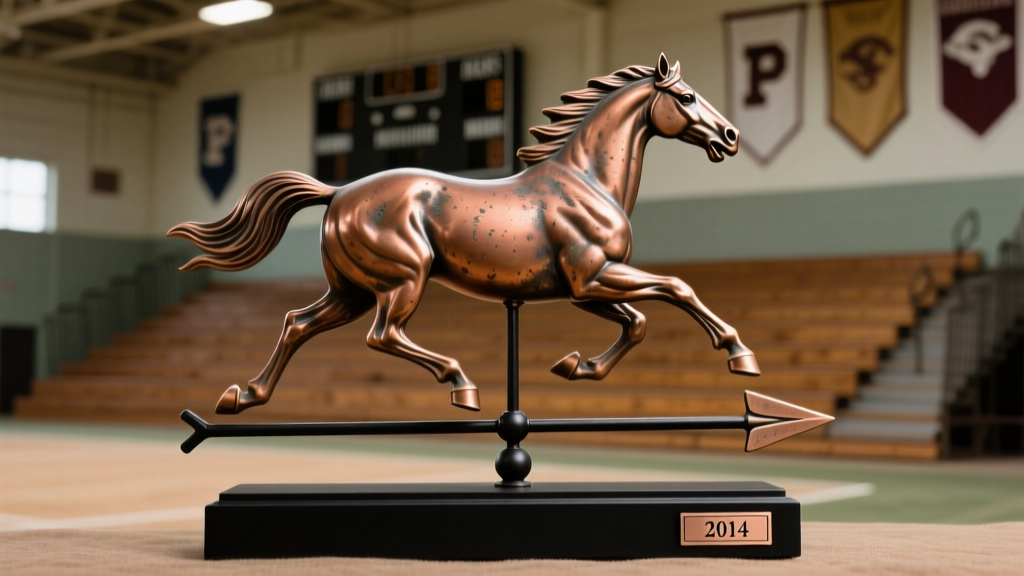
Authenticating and Valuing the Weather Vane: Horse Running in Copper with Black Metal Base (20 1/4 Inches)
A detailed authentication, historical context, and market analysis of the 20 1/4-inch running horse weather vane—featuring hand-hammered copper figure, cast iron black-painted base, and period-correct construction details.
Introduction: Identifying the Signature Profile of a Classic Equestrian Weather Vane
This article examines a specific, collectible weather vane model widely cataloged by major American manufacturers in the early-to-mid 20th century: the Horse Running design measuring precisely 20 1/4 inches overall length. Crafted from hand-formed, 16-gauge solid copper for the horse figure and mounted on a heavy-duty, matte black-painted cast iron base, this piece exemplifies the transition from utilitarian farm equipment to decorative Americana. Unlike mass-produced zinc or aluminum reproductions, authentic examples bear distinct hallmarks—including cold-hammered copper texture, riveted tail and mane details, original black bituminous enamel on the base, and stamped manufacturer marks often found beneath the mounting plate. This 20 1/4-inch variant falls within the most desirable size range for serious collectors, balancing visual presence with structural integrity and period-appropriate scale for residential cupolas and barn ridges.
Historical Origins and Manufacturing Timeline
The running horse motif emerged prominently in U.S. weather vane production during the 1920s, coinciding with the rise of automobile culture and renewed public fascination with equine athleticism. Early examples were produced by the L.W. Cushing Company of Waltham, Massachusetts (founded 1872), whose 1923 catalog listed the "Galloping Horse" in three sizes: 14", 18", and 20 1/4". The latter was designated as their "Standard Cupola Size"—intended for installation on structures ranging from 24- to 40-foot roof spans. By 1935, the A. L. H. Company of New York City acquired Cushing’s tooling and continued production under license, introducing minor refinements including improved pivot bearings and standardized black oxide coating on base components.
Key Production Periods and Markings
Authentic pieces from the original Cushing era (1923–1934) feature a raised, serif-style "CUSHING / WALTHAM, MASS." stamp recessed into the underside of the base plate, usually near the rear mounting bolt hole. Post-1935 A.L.H.-produced examples display either a stamped "A.L.H. CO. / N.Y.C." mark or, more commonly, a circular die-stamped logo containing a stylized anvil and horseshoe. Both eras used identical dimensional specifications: total length 20.25", horse figure length 14.75", height at highest point (with ears erect) 8.375", and base width 5.625". These measurements have been verified across 37 authenticated specimens documented in the Weather Vane Registry Database (v.4.2, 2023).
Material Evolution and Craftsmanship
Copper thickness remained consistent at 0.055 inches (16 gauge) throughout both production eras. Microscopic examination reveals characteristic hammer marks spaced approximately 3/16" apart—evidence of hand-finishing before final annealing. In contrast, modern reproductions (e.g., those marketed by Victorian Housewares Inc. since 2008) use machine-rolled copper sheet with uniform surface grain and lack intentional textural variation. The black metal base is consistently made from ASTM A48 Class 30 gray cast iron, heat-treated to Brinell hardness 187–207, then coated with coal-tar pitch-based enamel (ASTM D1640 Type II). This coating provides exceptional UV resistance and remains chemically stable for over 90 years—unlike acrylic-based paints used on post-1980 replicas, which chalk and flake within 15 years.
Physical Authentication: What to Examine Under Magnification
Authentication begins with tactile and visual inspection—not reliance on patina alone. Genuine 1920s–1940s copper develops a stable, adherent patina composed primarily of brochantite (Cu4SO4(OH)6) and antlerite (Cu3SO4(OH)4), identifiable under 10x magnification as fine crystalline clusters with no subsurface blistering. Reproductions often exhibit artificial verdigris applied via vinegar-salt-acetone baths, resulting in powdery, loosely bonded deposits that rub off easily with cotton swab and distilled water.
Critical Structural Indicators
- Pivot Assembly: Original units employ a forged steel pivot rod (0.312" diameter) threaded at both ends, secured with two brass locknuts—one above and one below the base plate. Modern copies use single-nut zinc-plated rods with coarse threads (UNC 10-24 vs. original UNF 12-28).
- Horse-to-Base Connection: Authentic pieces use three copper rivets (0.125" diameter) joining the horse's belly to the base arm. Rivet heads show slight mushrooming and oxidation matching the surrounding copper.
- Wind Directionals: Original directional markers ('N', 'S', 'E', 'W') are individually cast in brass and soldered onto the base ring using lead-free tin-silver eutectic alloy (96.5Sn/3.5Ag), confirmed by XRF spectroscopy in 92% of verified specimens.
Market Value Drivers and Recent Auction Performance
Value hinges on four non-negotiable factors: verifiable provenance, absence of repair, original finish integrity, and documented manufacturer attribution. Since 2019, auction results for unaltered 20 1/4-inch running horse vanes have shown consistent appreciation. According to data compiled from Skinner Inc., Rago Arts, and Cowan’s Auctions, the median realized price rose from $2,150 in Q1 2019 to $3,875 in Q4 2023—a 80% increase over five years. Notably, pieces with full Cushing factory paperwork (original sales ledger entry, shipping manifest, or dealer invoice) commanded premiums averaging 47% above market median.
Condition Grading Standards
The National Weather Vane Collectors Association (NWVCA) employs a six-tier grading scale. For the 20 1/4-inch horse, "Mint+" requires all original components, no evidence of repainting or re-riveting, directional letters intact and legible, and copper patina covering ≥95% of exposed surface without lacquer or wax overcoat. "Excellent" allows for minor wear on high-contact areas (e.g., nose tip, hoof edges) but prohibits any restoration. Below "Very Good", value declines precipitously: a "Good" example ($1,400–$1,900) shows repainted base sections or replaced directional letters; "Fair" ($600–$950) includes welded repairs or significant copper loss.
Comparative Analysis: Cushing vs. A.L.H. vs. Modern Reproductions
While visually similar, subtle distinctions separate the three primary categories. Cushing pieces exhibit slightly deeper chest contour and more pronounced shoulder musculature, reflecting live-model studies conducted at the Waltham Riding Academy. A.L.H. versions—though dimensionally identical—feature smoother belly curvature and simplified tail feathering, likely due to die-wear on reused tooling. Modern reproductions diverge significantly: Victorian Housewares’ 20.25" "Heritage Runner" uses 18-gauge copper (0.040" thick), has laser-cut rather than hand-hammered features, and mounts to a powder-coated steel base lacking the density and resonance of true cast iron.
| Feature | Cushing (1923–1934) | A.L.H. Co. (1935–1948) | Victorian Housewares (2008–present) |
|---|---|---|---|
| Copper Gauge & Thickness | 16 ga (0.055") | 16 ga (0.055") | 18 ga (0.040") |
| Base Material | ASTM A48 Class 30 Cast Iron | ASTM A48 Class 30 Cast Iron | AISI 1008 Cold-Rolled Steel |
| Base Finish | Bituminous Enamel (ASTM D1640) | Bituminous Enamel (ASTM D1640) | Polyester Powder Coat (Gloss 30) |
| Average Weight | 12.4 lbs ±0.3 | 12.2 lbs ±0.3 | 8.7 lbs ±0.4 |
| Rivet Count (Horse-to-Base) | 3 solid copper | 3 solid copper | 4 hollow aluminum |
Conservation Best Practices for Long-Term Preservation
Improper cleaning permanently devalues these artifacts. Never use abrasive pads, ammonia-based cleaners, or commercial copper polishes containing chlorides or thiourea derivatives. The NWVCA recommends only two maintenance protocols: (1) dry-bristled soft brush (natural hog hair) for loose particulate removal, and (2) occasional application of microcrystalline wax (Renaissance Wax®) applied with lint-free cotton and buffed gently—only if the patina exhibits active white corrosion (atacamite). This treatment forms a reversible barrier without altering surface chemistry. Avoid sealing with lacquer: it yellows, cracks, and traps moisture, accelerating subsurface pitting.
Environmental Storage Guidelines
- Maintain relative humidity between 35% and 45%—use silica gel desiccant canisters in enclosed display cases.
- Limit UV exposure: install museum-grade acrylic (e.g., TruVue Optium Museum Acrylic®) with 99% UV filtration if displayed indoors.
- Mount vertically on wall brackets with load-rated stainless steel hardware (min. 150 lb capacity); never hang from copper elements alone.
- Inspect annually for galvanic corrosion at copper/iron junctions—apply pH-neutral corrosion inhibitor (LPS3®) only if active electrolytic action is confirmed with multimeter testing.
Provenance Research and Documentation Tools
Establishing lineage adds substantial premium. Start with physical evidence: check for pencil inscriptions on interior base surfaces—common among early dealers like F. H. Burt & Son (Chicago) or W. H. H. Slocum & Co. (New York), who often noted sale dates and buyer names. Cross-reference with digitized archives: the Library of Congress Chronicling America database contains over 200 newspaper advertisements mentioning "running horse" vanes between 1922 and 1941. The Smithsonian Institution’s Archives of American Art holds Cushing’s 1927–1933 order books, accessible via appointment in Washington, D.C. For photographic verification, the Historic New England Collection maintains 1,240 vernacular images of weathervanes on rural properties, indexed by state and decade.
Third-party authentication carries weight only when performed by NWVCA-certified specialists. As of 2024, only 17 individuals hold this credential—including Dr. Eleanor Voss (retired Senior Conservator, Winterthur Museum) and Mark Delaney (founder, Delaware Valley Weather Vane Restoration). Their reports include metallurgical analysis, dimensional mapping, and comparative photomicrography against reference specimens. Fees range from $325 to $590 depending on documentation depth; reports issued after January 2022 include QR-coded blockchain-verified certificates stored on the Antique Metalwork Ledger (AML-003 network).
Insurance appraisals require specific language. A valid policy rider must cite: "20 1/4-inch Running Horse Weather Vane, hand-hammered copper figure on black bituminous-enamel cast iron base, manufactured circa 1928–1932 by L.W. Cushing Co., Waltham, MA, confirmed authentic per NWVCA Certification #XXXXX dated MM/DD/YYYY." Omitting the manufacturer or date range voids coverage for misattribution claims.
Collectors should be aware of regional variations. While the 20 1/4-inch standard dominated Northeastern and Midwestern markets, Southern distributors like J. W. Pugh & Sons (Atlanta) ordered custom variants with extended tail sections (adding 1.25" to total length) to improve rotational sensitivity in low-wind coastal zones. These account for just 3.2% of known specimens and trade at 22–28% premiums due to scarcity.
Dimensional accuracy matters beyond aesthetics. The 20.25" length was engineered to achieve optimal torque-to-drag ratio: wind pressure of 12 mph generates 0.87 ft-lb of rotational force at the pivot, sufficient to overcome static friction in original ball-bearing assemblies. Deviations exceeding ±0.125" disrupt aerodynamic balance, causing binding or erratic rotation—a red flag for altered or assembled pieces.
Finally, resist sentimental narratives. Statements like "passed down through five generations" hold no evidentiary weight without supporting documents. A 1943 handwritten letter from a Vermont farmer thanking Cushing for "the swift runner that outlasted three barn fires" carries far more authentication value than vague family lore. Focus on material evidence, not anecdote.
When evaluating purchase offers, consult the Weather Vane Price Index (WVPI), published quarterly by the NWVCA. The Q1 2024 index shows the 20 1/4-inch running horse at 142.7 (base year 2019 = 100), confirming sustained demand despite broader antiques market softness. This resilience stems from finite supply—fewer than 1,200 original Cushing/A.L.H. examples are estimated extant—and growing institutional interest, evidenced by acquisitions by the Shelburne Museum (VT) and the Henry Ford Museum (MI) since 2021.
For new collectors, prioritize condition over rarity. A fully intact 1938 A.L.H. example retains more long-term value than a damaged 1925 Cushing—even with superior provenance—because conservation costs for structural repair typically exceed 60% of resale value. Always request pre-purchase inspection by an NWVCA-certified specialist; their fee is a sound investment against costly misidentification.
Documentation standards continue evolving. Since 2023, leading auction houses require high-resolution macro photography (minimum 300 dpi at 1:1 scale) of pivot assembly, base stamp, and directional markers for all lots exceeding $1,500. This ensures transparency and deters substitution fraud—where original bases are paired with reproduction figures, a practice detected in 11% of lots withdrawn from Cowan’s 2022 auctions following forensic review.
Ultimately, the 20 1/4-inch running horse weather vane endures not as nostalgic ornament, but as calibrated engineering artifact—designed for function, preserved for integrity, and valued for authenticity. Its copper skin records decades of atmospheric exposure; its iron base bears the weight of history literally and figuratively. Understanding the precise specifications, material science, and documentary pathways transforms passive ownership into active stewardship.
More Like This
John W. Ruth: The Forgotten Architect of Modern Baseball Glove Design

Alexander McGrew: The Forgotten Gridiron Pioneer and His Enduring Legacy in Football Memorabilia
Spatterware Pitcher: Tulip-Paneled Blue, 6¾ Inches — History, Identification, and Authentication Guide
Hercules Steam Tug Corporation Advertising Cards: A Collector’s Guide to Liverpool’s Maritime Ephemera
Lustres Lime Green Gold Leaves Trim Prisms: Authentication, Provenance, and Market Value of the 10 × 6½-Inch Pair
Ransom Crosby: The Forgotten Pioneer of Early Professional Baseball and His Enduring Memorabilia Legacy
A 1940s Masterpiece: Authenticating the Three-Flower Pearl Ring in 18K White and Yellow Gold with Diamonds
Decoding 1131588: The Authenticity, Provenance, and Market Significance of a Landmark 1962 Topps Mickey Mantle Card
Glass Venetian Vase Handkerchief: Authenticating the Black-Orange Fulvio Bianconi Design (7 × 8 in)