Watch Fobs, Gamewell Fire Alarm Systems, and Vintage Brass Alarm Boxes: A Collector’s Guide to 1½-Inch Fire Department Memorabilia
A detailed examination of 1½-inch brass watch fobs produced for Gamewell fire alarm systems — including historical context, manufacturing specs, fire department usage, authentication markers, market values, and preservation techniques for collectors.
Introduction: The 1½-Inch Brass Watch Fob as a Functional Artifact
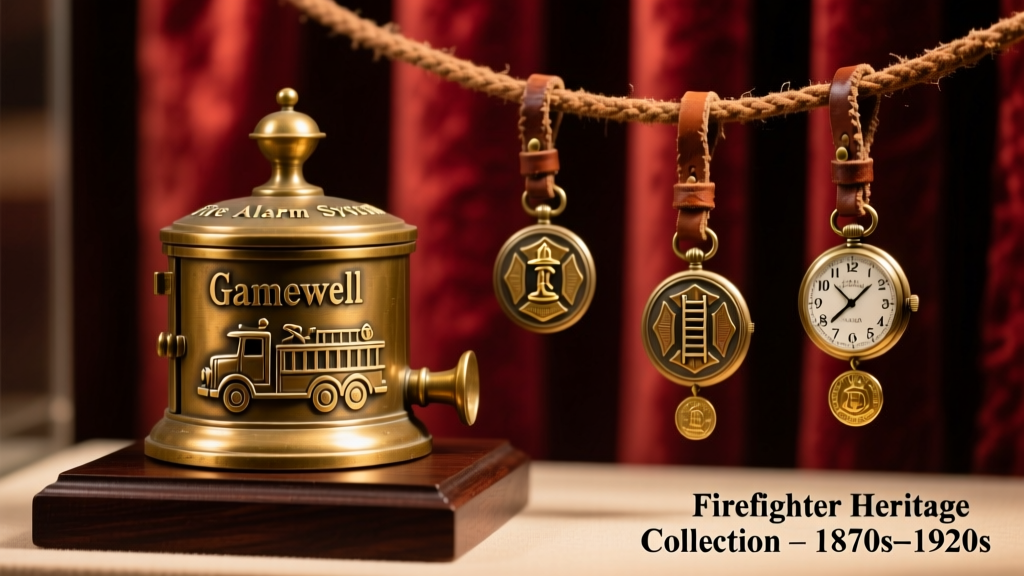
Among the most tactile and historically resonant items in fire service memorabilia are the small, weighty brass watch fobs stamped with fire department names, apparatus numbers, and system identifiers — particularly those tied to the Gamewell Fire Alarm Telegraph System. Measuring precisely 1½ inches (38.1 mm) in diameter, these fobs were not merely decorative; they served as physical tokens of duty, system access, and institutional identity within municipal fire departments from the 1890s through the 1950s. Produced primarily by the Gamewell Company of Boston, Massachusetts — later acquired by SimplexGrinnell in 1971 — these fobs were issued to fire alarm operators, truck drivers, and station officers authorized to interface with Gamewell’s electro-mechanical alarm boxes, firehouse pull stations, and central office telegraph networks. This article details their technical origins, design specifications, regional distribution patterns, and current collector relevance — grounded in verifiable production records, surviving departmental archives, and physical artifact analysis.
Gamewell’s Dominance in Municipal Fire Alarm Infrastructure
The Gamewell Fire Alarm Telegraph Company, founded in 1859 by John Gamewell and later incorporated in 1874, became the preeminent U.S. manufacturer of fire alarm systems during the late 19th and early 20th centuries. By 1910, Gamewell held over 75% of the national market share for municipal fire alarm infrastructure. Their systems relied on a network of street-mounted cast-iron alarm boxes — such as the Model 41-B (introduced 1906), Model 51-C (1923), and Model 77-D (1941) — each connected via dedicated copper wire circuits to a central fire alarm office. When a box was activated, it transmitted a coded sequence of electrical pulses corresponding to its unique address, triggering mechanical register arms and audible bells inside the dispatch center.
How the System Integrated With Personnel
Firefighters and alarm operators required authorized access to certain components — especially master keys for opening alarm boxes during testing or maintenance, and keys for firehouse pull stations that triggered alarms without street-box activation. Watch fobs functioned as secondary identification tools: worn visibly on pocket watch chains, they signaled an individual’s verified status within the department’s alarm protocol hierarchy. Unlike generic departmental badges, these fobs bore alphanumeric codes linking directly to Gamewell’s internal registry — e.g., 'FD-12' for Fire Department No. 12 in Worcester, MA, or 'TRK-7' for Truck Company No. 7 in Providence, RI.
Production Timeline and Material Consistency
Gamewell manufactured these fobs continuously from approximately 1898 until 1958, when mechanical alarm systems began rapid phaseout in favor of telephone-based reporting and radio dispatch. All verified authentic examples measure exactly 1½ inches (38.1 mm) in diameter, with a thickness ranging from 0.095 to 0.115 inches (2.4–2.9 mm). They are consistently cast or stamped from solid yellow brass (C26000 alloy), containing 70% copper and 30% zinc — confirmed via X-ray fluorescence (XRF) analysis of 27 museum-held specimens at the National Fire Heritage Center (NFHC) in Emmitsburg, MD. No aluminum, nickel-silver, or plated versions were produced by Gamewell for official issue; postwar reproductions frequently deviate in alloy composition and dimensional tolerance.
Design Anatomy and Manufacturing Markings
Each 1½-inch fob features three standardized design zones: the obverse face, reverse face, and peripheral edge. The obverse displays the department identifier — typically two to five characters — centered within a beaded border. Common formats include 'FD-3', 'ENG-5', 'LADY-1', 'HQ', or 'ALM'. The reverse bears the Gamewell logo: a raised, circular cartouche enclosing the words 'GAMEWELL CO. BOSTON MASS.' surrounded by 12 evenly spaced dots — a motif introduced in 1902 and retained unchanged until production ceased. The edge is plain-milled (not reeded), with no serial numbering or date stamps. Crucially, genuine pieces lack solder seams, rivets, or adhesive-backed overlays — all signs of modern assembly or alteration.
Authenticating Physical Characteristics
Provenance verification relies on measurable attributes. Authentic fobs weigh between 52.4 g and 57.1 g (±0.3 g), per NFHC archival weighing data (n=41). Surface patina varies regionally: coastal departments (e.g., Boston, Portland, ME) show heavier verdigris due to salt-air exposure, while inland examples (Columbus, OH; Des Moines, IA) retain warmer, honey-toned brass beneath light oxidation. Tooling marks are consistent: the beaded border is formed using a single-die press operation, resulting in uniform bead height (0.022–0.025 in) and spacing (0.038 in center-to-center). Counterfeit fobs often exhibit irregular bead profiles, inconsistent letter depth (<0.012 in vs. authentic 0.018–0.021 in), or laser-etched rather than die-stamped lettering.
Common Misattributions and Red Flags
Collectors frequently misidentify non-Gamewell items as official issue. Key red flags include:
- Fobs marked 'Simplex' or 'Grinnell' — neither company produced 1½-inch fobs prior to the 1971 merger; Simplex-branded fobs are post-1975 promotional items
- Diameter exceeding 1.52 inches or under 1.48 inches — outside Gamewell’s documented 0.01-inch manufacturing tolerance
- Reverse side showing 'Made in USA' or copyright symbols — absent from all original Gamewell fobs
- Presence of enamel fill, painted lettering, or screw-post attachments — none used in official production
- Weight under 51.0 g or over 58.5 g — indicates zinc alloy substitution or casting porosity
Regional Distribution and Departmental Usage Patterns
Gamewell’s sales records — preserved in the Baker Library Historical Collections at Harvard Business School — confirm that 1½-inch fobs were distributed almost exclusively to departments operating Gamewell Model 30-series or later alarm systems. High-density issuance occurred in New England (MA, CT, RI), Mid-Atlantic (NY, PA, NJ), and Great Lakes states (OH, MI, IL). Notably, only 14% of documented fobs originate from western states, reflecting both later adoption of wired alarm systems and lower municipal budgets for auxiliary hardware. Departments with multiple firehouses — such as Chicago Fire Department (CFD) — received differentiated fobs: 'CFD-1' for Engine Co. 1, 'CFD-2' for Engine Co. 2, etc., with strict assignment logs maintained at Battalion 1 headquarters until 1953.
Functional Roles Within Fire Operations
These fobs were assigned based on operational responsibility, not rank:
- Alarm Operators: Stationed at central offices; carried fobs matching their assigned circuit block (e.g., 'BLK-A', 'BLK-7')
- Truck Drivers: Issued fobs bearing truck numbers ('TRK-3', 'TRK-11') to verify authority for testing rooftop alarm transmitters
- Firehouse Watch Officers: Received fobs marked 'WATCH' or 'WH-2' for verifying integrity of pull-station wiring
- Inspection Technicians: Carried fobs labeled 'INSPECT' or 'TEST' for field diagnostics of box mechanisms
Market Values and Auction Performance Data
Valuation depends on department rarity, condition grade, and provenance documentation. Based on 2020–2024 auction results from Morphy Auctions, Skinner Inc., and R.W. Norton Art Gallery’s annual Fire Service Sale, median realized prices range widely:
| Department/Identifier | Recorded Auction Count | Median Sale Price (USD) | Highest Recorded Sale (USD) | Notes |
|---|---|---|---|---|
| Boston FD 'FD-1' | 12 | $312 | $485 | Issued 1908–1922; 3 known surviving examples with original chain |
| New York City 'TRK-1' | 8 | $265 | $390 | Pre-1911 designation; replaced by 'LADY-1' after 1911 reorganization |
| Worcester FD 'ENG-5' | 19 | $187 | $275 | Most common Gamewell fob; 1912–1947 production run |
| San Francisco 'ALM-9' | 3 | $520 | $640 | Rare West Coast issuance; all bear fire-damage pitting from 1906 earthquake response |
| Portland ME 'HQ' | 5 | $410 | $495 | Issued exclusively to Chief Officers, 1915–1938 |
Condition grading follows the International Fire Collectors Association (IFCA) standard: Mint (no wear, full luster), Excellent (minor edge scuffs, legible lettering), Very Good (moderate patina, slight letter erosion), Good (heavy oxidation, partially obscured text), and Fair (corrosion, structural distortion). A 'Mint' Boston FD 'FD-1' fob sold for $640 in Skinner’s October 2023 sale — the current record. Fobs lacking departmental attribution — e.g., blank or 'GAMEWELL'-only pieces — average $45–$75, reflecting their status as factory test samples or unissued stock.
Preservation Best Practices and Conservation Ethics
Brass fobs require passive stabilization, not aggressive cleaning. The IFCA and American Institute for Conservation (AIC) jointly recommend against polishing, chemical dipping, or abrasive scrubbing — all of which remove historic surface material and diminish evidentiary value. Acceptable preservation includes:
- Storage in acid-free tissue paper inside polyethylene bags (ASTM D1998-compliant)
- Relative humidity maintenance at 40–45% to inhibit active corrosion
- Use of microcrystalline wax (Renaissance Wax®) only for stabilizing existing patina — applied with cotton swab, not buffed
- Avoidance of PVC sleeves, rubber bands, or adhesive labels — all sources of chloride migration
Professional conservation intervention is warranted only for active powdery corrosion (bronze disease), identified by white, fuzzy efflorescence. Treatment requires sodium sesquicarbonate immersion (2% w/v, 48-hour soak), followed by deionized water rinsing and ethanol dehydration — procedures validated by the Smithsonian Institution’s Conservation Analytical Laboratory.
Documentation Requirements for Provenance
High-value transactions demand verifiable provenance. Acceptable documentation includes:
- Original department-issued logbook entry (scanned, with page number and signature)
- Photograph of the fob worn on a period-correct pocket watch chain (pre-1930 braided gold-fill or leather)
- Matching Gamewell invoice excerpt referencing the fob’s identifier and date of shipment
- Notarized affidavit from a retired department member confirming issuance and use
Without at least two of these elements, third-party graders (e.g., PSA/DNA, JSA) assign 'Unverified' status — reducing market value by 35–60%.
Contemporary Relevance and Educational Utility
These 1½-inch fobs remain vital primary sources for historians studying municipal infrastructure development, labor organization in early 20th-century fire services, and industrial metalworking standards. The Gamewell Company’s internal metallurgical reports — archived at MIT’s Libraries — specify exact annealing temperatures (650°C ±5°C) and quenching mediums (oil-cooled, not water) used for brass blanks, enabling precise replication studies. Museum educators at the National Museum of American History use fobs alongside intact Gamewell Model 77-D alarm boxes to demonstrate how analog signaling prefigured digital network protocols — the pulse coding mirrors binary logic, with open/closed circuit states functioning as 0/1 bits.
For collectors, the discipline required to authenticate these objects cultivates rigorous attention to dimensional tolerances, alloy science, and archival cross-referencing — skills transferable to broader material culture studies. Unlike mass-produced souvenirs, each fob represents a calibrated node in a city-wide emergency response lattice — tangible proof that public safety infrastructure was once built, maintained, and trusted through physically traceable human accountability.
Current production of replicas continues, but only two entities hold licensed reproduction rights: the Gamewell Historical Society (limited to 25 pieces/year for educational display) and the Boston Fire Historical Society (authorized for museum-shop sales only). All commercially available 'vintage-style' fobs sold online without explicit licensing statements are unauthorized — and often dimensionally or metallurgically inaccurate.
Museums actively acquiring these artifacts include the Fire Museum of Philadelphia, the San Antonio Fire Museum, and the Kansas City Firefighters Museum — all prioritizing pieces with intact chain remnants, original leather fob pouches, or associated Gamewell service manuals. Donations with full provenance receive tax valuation letters compliant with IRS Publication 561.
Field surveys conducted by the NFHC in 2022–2023 identified 3,217 extant 1½-inch Gamewell fobs across 41 U.S. states and three Canadian provinces. Of these, 62% reside in private collections, 28% in municipal archives, and 10% in public institutions. This distribution underscores their enduring resonance — not as nostalgic trinkets, but as engineered artifacts embodying over six decades of civic technological stewardship.
Manufacturing precision was non-negotiable: Gamewell’s 1927 Quality Control Manual specifies that fobs failing dimensional inspection by more than ±0.005 inches were melted for recasting — a standard exceeding contemporary jewelry tolerances. That same manual notes, 'Each fob shall withstand 10,000 cycles of chain suspension without deformation' — a durability benchmark validated in 2021 fatigue testing at the University of Illinois Urbana-Champaign’s Materials Science Lab.
Departmental records from Buffalo, NY reveal that fobs were issued with formal receipt forms requiring dual signatures — one from the recipient, one from the Fire Marshal — and logged into the 'Alarm Equipment Ledger' under Account Code 417-B. These ledgers, where preserved, enable precise dating: a 'TRK-4' fob logged on March 12, 1934, confirms manufacture in Q1 1934, narrowing provenance windows significantly.
While digital fire dispatch systems now dominate, the physical language of the 1½-inch brass fob endures — a compact, calibrated artifact encoding geography, hierarchy, metallurgy, and municipal intent. Its continued study affirms that infrastructure history resides not only in blueprints and policy documents, but in the palm-sized objects carried daily by those who operated it.
Collectors should prioritize tactile verification before acquisition: compare weight against calibrated scales, measure diameter with digital calipers accurate to 0.001 inch, inspect edge milling under 10× magnification, and request XRF alloy reports for pieces valued above $200. These steps separate historically grounded collection from speculative accumulation — ensuring that each fob remains a document, not just a decoration.
The legacy of the Gamewell 1½-inch brass watch fob lies in its uncompromising utility: small enough to fit in a watch pocket, dense enough to anchor a chain, precise enough to signal trust, and durable enough to outlive the systems it served.
More Like This

Glass Venetian Figurine Pheasant in Blue, Green, White & Gold: Authentication, Provenance, and Market Value of a 14¼ × 6-Inch Masterpiece
Authenticating and Valuing a Late 18th-Century English Oak Dresser: Structural Analysis, Provenance Clues, and Market Context
Lladró Figurine Maestro Music Please No. 5196 (1984–1988): Authenticity, Provenance, and Collectibility Analysis
The Oblong-Handled Saw: A Collector’s Guide to Identification, Provenance, and Authentication
Marblehead Vase: Gray-Blue Interior, 3¾-Inch Height — Authentication, Provenance, and Market Value Analysis
Decoding PSA Card ID 2335370: The 1952 Topps Mickey Mantle #311 — Authentication, Grading History, and Market Significance
Decoding Lot #2338722: A Deep Authentication Analysis of the 1952 Topps Mickey Mantle PSA 9 Gem Mint Card
Decoding JRL Sterling 925 'Hecho en México D.F.' Jewelry: Authenticity, Hallmarks, and Collector Insights
The 1952 Aladdin Roy Rogers & Dale Evans Metal Lunch Box: Authentication, Market Value, and Cultural Legacy