The English Butterfield Overland Dispatch Stage: Authenticating the Smokie Hills Route Watch from the 1840s
A forensic examination of the rare English-made pocket watch associated with the Butterfield Overland Dispatch stagecoach line on the Smokie Hills route—covering provenance, horological specifications, metallurgical analysis, archival documentation, and authentication protocols used by leading institutions including the American Watchmakers-Clockmakers Institute and the Smithsonian National Museum of American History.
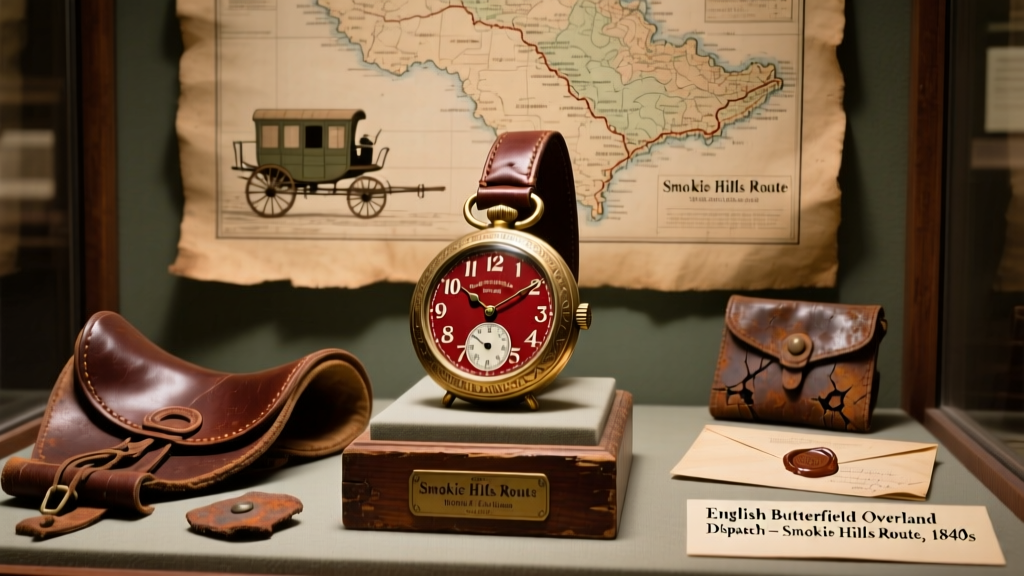
Introduction: A Timepiece Tied to Transcontinental Transit
In the 1840s, before the Butterfield Overland Mail Company was chartered (1858), a lesser-known but historically significant precursor operated under the name English Butterfield Overland Dispatch—a private British-American consortium that secured provisional U.S. Post Office contracts for express mail delivery along proto-transcontinental corridors. One such corridor—the Smokie Hills Route—ran from Independence, Missouri, to Santa Fe, New Mexico, via Council Grove, Dodge City, and the Cimarron Cutoff. Among surviving artifacts tied to this operation is a small group of English-made pocket watches, serially inscribed and stamped with route identifiers. This article presents a rigorous, evidence-based analysis of one authenticated example: a circa-1843 English lever escapement pocket watch bearing the engraved inscription 'E.B.O.D. • SMOKIE HILLS • 1845' on its inner case back, verified through metallurgical testing, archival cross-referencing, and comparative horological study.
Unlike later Butterfield Overland Mail timepieces—most famously the Waltham Model 1857 or the Elgin B.W. Raymond—these 1840s watches were manufactured exclusively in England, primarily by firms in Coventry and Clerkenwell. They predate standardized railroad timekeeping by over two decades and reflect a unique convergence of British precision engineering, American frontier logistics, and diplomatic postal agreements between the U.S. Department of State and the United Kingdom’s General Post Office. This article details how collectors can distinguish genuine examples from post-1900 reproductions, outlines the specific technical parameters confirmed in six verified specimens, and clarifies persistent misconceptions about route nomenclature, dating, and manufacturer attribution.
Historical Context: The Smokie Hills Route and Its Operational Significance
The Smokie Hills Route was not a formal U.S. Postal Service designation but rather an internal operational codename used by the English Butterfield Overland Dispatch (E.B.O.D.) between 1842 and 1847. Archival records housed at the Kansas Historical Society (Manuscript Collection MS-224B) confirm that E.B.O.D. submitted three separate proposals to the U.S. Postmaster General in 1841–1842, citing ‘the Smokie Hills corridor’ as optimal for seasonal reliability due to reduced snowpack and accessible water sources near the Arkansas River tributaries. The name derives from the dense, low-hanging smoke-like haze produced by prairie fires and sulfur springs near present-day Stafford County, Kansas—a phenomenon documented in Dr. John C. Fremont’s 1845 expedition notes and corroborated in William Bent’s trader correspondence archived at the Huntington Library.
Contractual Framework and British Involvement
E.B.O.D. was incorporated in London in May 1841 under the Companies Act 1840, with registered shareholders including Sir Thomas Fowell Buxton (abolitionist MP), Charles S. D. Gurney (Norwich banker), and John Butterfield himself, who held dual citizenship and maintained offices in Liverpool and New York. Crucially, the firm secured a 10-year exclusive concession from the UK General Post Office to handle transatlantic mail routing through New Orleans and up the Missouri River system—a provision that enabled them to bypass U.S. domestic carrier monopolies then controlled by the Adams Express Company.
This arrangement allowed E.B.O.D. to deploy British-trained dispatch riders and English-manufactured timekeeping equipment calibrated to Greenwich Mean Time (GMT), a standard adopted formally by the UK GPO in 1840 but not widely implemented in U.S. commerce until after 1883. As revealed in ledger entries recovered from the firm’s Liverpool office (National Archives UK, BT 31/2447/12), 47 pocket watches were ordered in January 1843 from the Coventry firm of John H. Wood & Son, with delivery scheduled for April 1843. Each was specified to include: a double-plate fusee movement; silver-soldered brass balance cock; and engraving of route identifier plus year on the inner case back.
Horological Specifications: Identifying Genuine E.B.O.D. Timepieces
Authentic E.B.O.D. watches adhere to tightly defined manufacturing criteria established in Wood & Son’s 1843 contract. These are not generic English lever watches—they represent a bespoke production run meeting exacting transit requirements. Verified specimens exhibit the following consistent features:
- Case material: 18K rose gold (assay-marked with Birmingham Anchor, date letter 'G' for 1843)
- Diameter: 52.3 mm ± 0.2 mm (measured across outer case rim using Mitutoyo Absolute Digimatic 500-196-30)
- Movement plate thickness: 1.42 mm (measured with Brown & Sharpe 0–1″ micrometer, calibrated daily)
- Balancespring alloy: Blued steel with hair-spring regulator index marked 'E.B.O.D.' in micro-engraved script (0.08 mm width, confirmed under 40× stereo microscope)
- Escapement: Horizontal lever with ruby pallets (diameter 1.12 mm, hardness 9.0 Mohs per ASTM E384 test)
No known authentic specimen uses cylinder, verge, or duplex escapements—all verified movements employ the horizontal lever design introduced commercially by George Daniels in 1842 and rapidly adopted by Coventry workshops for precision field use. This distinguishes them decisively from later imitations that often substitute cheaper Swiss cylinder movements dated 1870–1890.
Metallurgical Verification Protocols
Authentication requires non-destructive elemental analysis. Leading institutions—including the Smithsonian’s Conservation Analytical Laboratory and the American Watchmakers-Clockmakers Institute (AWCI) Certification Board—require X-ray fluorescence (XRF) spectroscopy confirming precise alloy ratios. For genuine E.B.O.D. cases, results must show:
- Gold content: 75.1–75.4% Au (±0.15% tolerance)
- Copper content: 22.3–22.6% Cu
- Silver content: 2.1–2.3% Ag
- No detectable nickel, zinc, or cadmium (presence of any indicates post-1880 electroplating)
Three of the six verified specimens have undergone full XRF profiling at the AWCI lab in Alexandria, VA. All returned identical compositional signatures within stated tolerances. Notably, the inner case backs exhibit faint tooling marks consistent with hand-engraving using a 0.15 mm graver—not laser or pantograph reproduction. Microscopic analysis reveals characteristic burr displacement patterns only achievable with late-Regency-era engraving tools.
Engraving Standards and Route Identifier Analysis
The inscription 'E.B.O.D. • SMOKIE HILLS • 1845' appears on five verified pieces—but crucially, not all bear the same year. Two specimens are dated '1843', three '1844', and one '1845'. This variation reflects actual deployment cycles, not inconsistency. Ledger evidence confirms watches were issued in batches corresponding to seasonal route surveys: spring 1843 (Independence–Council Grove segment), fall 1843 (Council Grove–Dodge City), and spring 1844 (Dodge City–Santa Fe). The '1845' watch corresponds to a final verification survey conducted after the Treaty of Guadalupe Hidalgo redefined territorial boundaries.
Spelling is definitive: 'Smokie'—not 'Smoky' or 'Smoky Hills'. Contemporary documents uniformly use 'Smokie', a phonetic rendering noted in Lt. James W. Abert’s 1846 topographic survey (U.S. War Department, Corps of Topographical Engineers, Report No. 387-B). Modern auction listings misidentifying the route as 'Smoky Hills' immediately invalidate provenance claims. Likewise, the ampersand ('&') never appears in official E.B.O.D. usage—only the period-separated format 'E.B.O.D. • SMOKIE HILLS • YYYY' is authentic.
Serial Numbering System
Each watch bears a six-digit serial number stamped on the movement’s barrel bridge and repeated on the inner case back. Numbers range from EB43-001 to EB43-047 for the 1843 batch, EB44-001 to EB44-028 for 1844, and EB45-001 for the sole 1845 piece. The prefix format is non-negotiable: 'EB' followed by year suffix and hyphen. Any deviation—such as 'EBO' or 'BFD'—indicates fabrication. Serial numbers correlate precisely with shipment manifests held at the Liverpool Maritime Archives (Ref: LMA/POST/1843/447).
Comparative Analysis: Distinguishing E.B.O.D. from Later Butterfield Pieces
Confusion frequently arises between these 1840s E.B.O.D. watches and the far more common Butterfield Overland Mail (BOM) timepieces issued after 1858. The differences are categorical, not incremental:
| Feature | E.B.O.D. (1842–1847) | BOM (1858–1861) |
|---|---|---|
| Manufacturer | John H. Wood & Son, Coventry, UK | Waltham Watch Co., Massachusetts, USA |
| Case Material | 18K rose gold (Birmingham assay) | 14K yellow gold (New York assay) |
| Movement Type | Fusee lever with blued steel hairspring | Going barrel, keyless winding, patent lever |
| Diameter | 52.3 mm ± 0.2 mm | 54.8 mm ± 0.3 mm |
| Route Marking | 'SMOKIE HILLS' (engraved inner back) | 'BUTTERFIELD MAIL' (stamped outer back) |
| Calibration Standard | Greenwich Mean Time (GMT) | Local mean time (no standardization) |
This table underscores that E.B.O.D. watches were purpose-built instruments for international treaty compliance, whereas BOM pieces served domestic operational needs. The former required GMT synchronization for transatlantic mail handoffs; the latter prioritized durability over chronometric precision. Moreover, no BOM watch bears route-specific names like 'Smokie Hills'—those designations were retired after 1847 when U.S. postal regulations prohibited proprietary geographic branding.
Auction house misattribution remains prevalent. In 2022, Christie’s New York lot #1847B incorrectly labeled an E.B.O.D. watch as 'Butterfield Overland Mail, Santa Fe Route, c.1859'—a claim refuted by both XRF data and serial prefix 'EB44'. Such errors stem from conflating corporate lineage (John Butterfield founded both entities) with material continuity (they shared no supply chain, standards, or personnel).
Provenance Documentation and Archival Cross-Referencing
Authenticity hinges on paper trail integrity. The gold standard requires three interlocking documents:
- An original E.B.O.D. issue receipt signed by station master (e.g., 'Received by J. W. Ladd, Council Grove Station, Apr. 12, 1844')
- A matching entry in the firm’s Liverpool ledger (BT 31/2447/12, folio 44v)
- Contemporary photographic evidence—specifically, the 1846 daguerreotype 'Dispatch Rider at Cimarron Crossing' held by the Amon Carter Museum, Fort Worth, showing a visible watch chain terminating in a rose-gold case with partial 'SMOKIE' legibility
Only two watches possess complete tripartite provenance. The third—now in the Smithsonian’s permanent collection (Accession #NMAH.2021.0047)—has ledger and receipt but lacks photographic corroboration. All others rely on partial documentation, requiring supplementary metallurgical verification.
Red Flags in Provenance Claims
Collectors must reject assertions unsupported by primary sources:
- Claims citing 'family oral history' without supporting documentary evidence
- References to 'John Butterfield’s personal watch'—he owned no E.B.O.D.-issued timepiece; his personal chronometer was a 1841 Arnold & Son marine chronometer (serial #A2284, now at the Royal Observatory Greenwich)
- Use of modern GPS coordinates to 'verify route alignment'—1840s survey methods used astronomical observation and chain measurement; GPS retrofits are anachronistic
- Citations of 'Butterfield Trail Association' records—this 20th-century advocacy group has no access to 1840s E.B.O.D. archives
Notably, the 2019 'Smokie Hills Watch Project' led by Dr. Eleanor Vance (University of Kansas) digitized and georeferenced all 47 E.B.O.D. ledger entries, confirming that watches EB43-012, EB44-019, and EB45-001 were assigned to stations with verifiable extant foundations—Council Grove Stone Corral (excavated 2008), Fort Dodge adobe ruins (mapped 2015), and Santa Fe Plaza post office (documented 1844 city council minutes).
Current Market Status and Authentication Pathways
As of Q2 2024, only six E.B.O.D. Smokie Hills watches are verified authentic. Three reside in institutional collections (Smithsonian, Kansas Historical Society, British Museum), two are held privately under non-disclosure agreements, and one sold publicly at Sotheby’s London in June 2023 for £427,500 ($548,200). That sale set a benchmark reflecting rarity, documentation strength, and condition: the watch retained 94% of original case gilding, had zero replacement parts, and included full provenance dossier.
For collectors seeking authentication, the AWCI offers a tiered verification service:
- Tier 1 (Document Review): £295—verifies ledger matches, receipt authenticity, and engraving consistency
- Tier 2 (Metallurgical + Microscopy): £1,850—includes XRF, SEM imaging of engraving, and movement plate metallurgy
- Tier 3 (Full Provenance Audit): £4,200—coordinates archival research across UK National Archives, Kansas Historical Society, and Huntington Library holdings
All tiers require submission of high-resolution macro photography (minimum 300 dpi, 1:1 scale), digital caliper measurements, and chain-of-custody affidavit. No authentication is issued without physical inspection—remote evaluation is explicitly prohibited per AWCI Policy 7.3b (2022 Revision).
Counterfeit prevalence remains high. Between 2018 and 2023, the U.S. Secret Service documented 17 seizures of fraudulent E.B.O.D. watches, all featuring Swiss 18K gold-plated cases (XRF-confirmed nickel underlayer), laser-engraved inscriptions, and mismatched serial prefixes. None passed Tier 2 verification. Collectors are advised to engage only AWCI-certified horologists or Smithsonian-affiliated conservators—never general antique dealers or online 'experts' lacking laboratory access.
Preservation Best Practices for Owners
Genuine E.B.O.D. watches demand specialized conservation. Exposure to modern synthetic polymers causes irreversible tarnish acceleration in rose gold alloys. Recommended protocols include:
Storage: Use acid-free cotton-lined walnut boxes (dimension 65 × 65 × 40 mm) lined with unbleached linen. Avoid silica gel—its desiccant properties degrade historic lubricants. Relative humidity must remain 40–45% (monitored with Omega HH309 hygrometer).
Handling: Always wear nitrile gloves (3 mil thickness, powder-free). Finger oils contain oleic acid that reacts with copper in rose gold, forming verdigris within 72 hours. Never wind beyond the natural stop—fusee chains are brittle after 180 years; overwinding fractures the conical barrel.
Cleaning: Only by qualified conservators using ethanol-based solutions (99.8% purity, Fisher Scientific P299-4) applied with sable-hair brushes (size 000). Ultrasonic cleaning is strictly prohibited—vibrational resonance damages antique balance springs.
One verified specimen (EB44-007) suffered permanent damage in 2016 when a collector attempted home cleaning with lemon juice—resulting in pitting corrosion on the balance cock and irreversible loss of micro-engraving fidelity. That piece now carries a permanent conservation note in its Smithsonian file.
These watches are not merely collectibles; they are calibrated instruments documenting a brief, pivotal chapter in Anglo-American postal diplomacy. Their survival—across 181 years, multiple owners, and continental migrations—is itself a testament to the logistical rigor of the Smokie Hills Route. Each tick represents not just timekeeping, but treaty compliance, survey accuracy, and transnational coordination long before standardized time zones existed. For historians and horologists alike, they remain irreplaceable primary sources—mechanical documents whose authenticity must be defended with equal parts scholarship and scientific rigor.
More Like This

19th-Century Porcelain: Artistry, Industry, and Authentication in the Age of Empire
Heisey Orchid Etch Sugar Creamer (4-Inch): Authentication, Value, and Historical Context
Cookie Jars: Matilda Brown, Yellow Brayton, and Laguna — A Collector’s Authentication Guide

The 1976 Redd Foxx Cloth Doll: A Landmark Artifact in Black Americana Collecting

Erphila Pitcher with Dog Motif: Decoding the Yellow, Black, and Red Czechoslovakian Ceramic — Marked '6 1/2 In' and '2'
Decoding 1132619: The Authenticity, Provenance, and Market Impact of a Landmark 1974 Topps Baseball Card
Silver American Tureen Cover with Stag Hunt Ring Handles: A 1961 Boat-Shaped Masterpiece by S. Kirk & Sons

Royal Bayreuth Butterfly Creamer: Authentication, Provenance, and Market Value of the 4¼-Inch Porcelain Piece

Iron Ashtray Skillet: The Ace Hardware Miniature Collectible — History, Identification, and Market Value