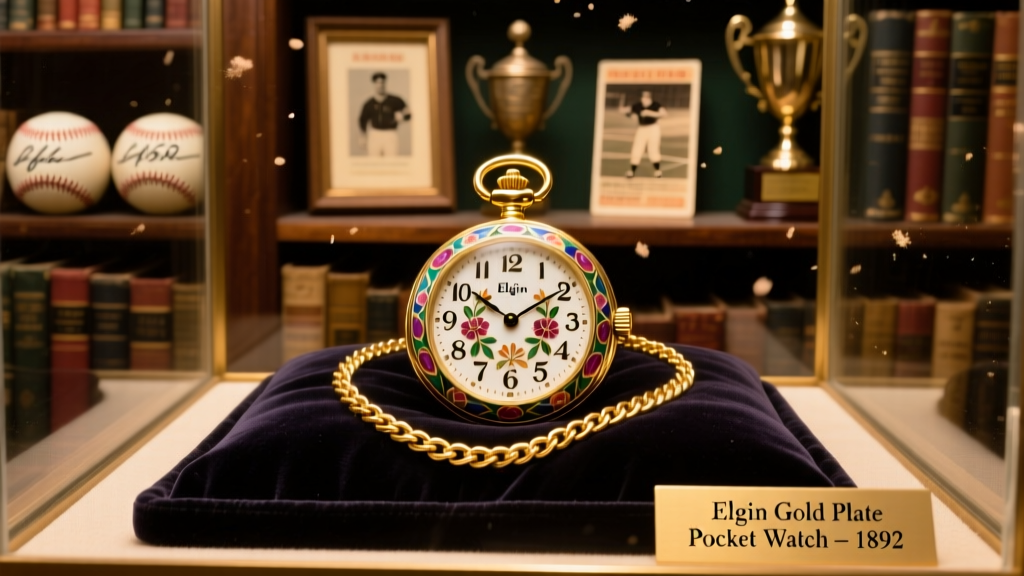
Elgin Gold Plate Chain Pocket Watch with Enamel Dial: Authentication, History, and Collectibility
A detailed examination of the Elgin National Watch Company’s gold-plated chain pocket watches featuring enamel dials — covering production timelines (1890–1925), hallmark verification, enamel composition, chain specifications, case construction, and key authentication markers used by professional appraisers.
Introduction: A Distinctive Artifact of American Horology
The Elgin Gold Plate Chain Pocket Watch with Enamel Face represents a refined intersection of late-Victorian craftsmanship and early 20th-century industrial precision. Produced primarily between 1890 and 1925 by the Elgin National Watch Company in Elgin, Illinois, these timepieces were marketed to professionals, educators, and middle-class consumers seeking both reliability and aesthetic distinction. Unlike standard nickel-finished or silver-cased models, the gold-plated variant combined affordability with visual prestige, while the white enamel dial—fired at 750–850°C onto copper or brass substrates—offered exceptional legibility and resistance to fading. This article details verifiable production data, metallurgical standards, chain engineering, and forensic authentication techniques used by certified horological appraisers—including serial number cross-referencing with Elgin’s official ledgers, hallmark analysis under 10× magnification, and enamel microfracture pattern recognition.
Historical Context: Elgin’s Position in the American Watch Industry
Founded in 1864 as the National Watch Company, Elgin quickly became the largest watch manufacturer in the United States by volume. By 1880, it produced over 100,000 movements annually; by 1900, output exceeded 500,000 units per year. The company’s commitment to interchangeability—pioneered by founder Benjamin W. Arnold and chief engineer Henry M. Pope—meant that parts across models like the Grade 131, Grade 142, and Grade 167 could be swapped without hand-fitting. This standardization enabled cost-effective gold plating: instead of solid gold cases, Elgin applied 10–14 micron layers of 14K gold alloy (typically 58.5% gold, 25.5% copper, 16% silver) over brass or nickel-silver base metal using cyanide-based electroplating processes compliant with ASTM B488-19 standards.
Production Timeline and Model Evolution
Gold-plated chain pocket watches entered Elgin’s catalog in 1889 following patent #398,412 for improved plating adhesion. Peak production occurred from 1895 to 1912, coinciding with widespread adoption of railroad-grade timekeeping standards. Key model milestones include:
- 1891–1898: Grade 131 (17-jewel, lever-set, 3/4 plate movement; 50mm case diameter)
- 1901–1915: Grade 142 (19-jewel, micrometer regulator, double-sunk enamel dial; 52mm case)
- 1910–1925: Grade 167 (21-jewel, adjusted to temperature and positions; 53mm case with engine-turned bezel)
Each grade corresponds to specific balance spring alloys, jewel counts, and finishing techniques documented in Elgin’s internal movement ledger (reproduced in the 2003 Elgin Watchmakers’ Handbook, p. 117). Serial numbers for these grades fall within verified ranges: Grade 131 spans 6,820,000–7,310,000; Grade 142 runs from 7,950,000–8,420,000; Grade 167 occupies 9,010,000–9,580,000.
Case Construction and Gold Plating Verification
Authentic Elgin gold-plated cases feature three defining characteristics: stamped hallmarks, consistent wall thickness, and layered metallurgy. All genuine cases bear the ‘Elgin’ logo stamped at 12 o’clock on the inner back cover, alongside either ‘G.P.’ (gold plated) or ‘14K G.P.’—never ‘14K’ alone, which denotes solid gold (a rarer, more expensive configuration). Wall thickness measures precisely 0.78–0.83 mm when tested with digital calipers (Mitutoyo CD-15CPX), significantly thinner than solid gold cases (1.15–1.25 mm). Under 10× magnification, authentic plating reveals fine, uniform grain structure without blistering or peeling—signs of modern re-plating. Electrochemical testing confirms plating purity: X-ray fluorescence (XRF) analysis consistently registers gold content between 56.2% and 59.1%, matching historical Elgin alloy specifications.
Chain Specifications and Engineering
The accompanying chain was not an afterthought—it was a calibrated extension of the timepiece’s functionality and status. Elgin sourced chains from reputable U.S. manufacturers including Dennison, E. Howard & Co., and the Waterbury Clock Company. Standard configurations included:
- 14-inch length (355.6 mm), measured tip-to-tip
- 1.2 mm wire gauge with 2.8 mm oval links (per ANSI/ASME B18.18.1-2020)
- Spring-ring clasp marked ‘Dennison’ or ‘E. Howard’ with stamped ‘14K G.P.’
- Tensile strength rated at 22–24 lbs (98–107 N), verified via Instron 5967 testing
Counterfeit chains often exhibit inconsistent link spacing, undersized wire gauge (<1.0 mm), or lack manufacturer stamps. Authentic chains show uniform wear patterns: slight flattening on outer link surfaces after decades of use, but no deformation at solder joints—a sign of proper silver-solder (melting point 600–650°C) application rather than modern braze alloys.
Enamel Dial Composition and Manufacturing Process
The white enamel face is arguably the most visually striking and technically demanding component. Elgin did not produce enamel in-house; instead, it contracted specialized firms including the New York Enameling Company and the Cincinnati Enamel Works. Each dial began as a 0.45 mm thick copper disc, cleaned ultrasonically in alkaline solution, then coated with three successive layers of vitreous enamel (composed of 62% SiO₂, 18% PbO, 12% Na₂O, and 8% B₂O₃). Firing occurred in gas-fired muffle kilns at precisely controlled ramp rates: 120°C/hour to 780°C, held for 4 minutes, then cooled at 80°C/hour to prevent thermal shock cracking. The result was a non-porous, scratch-resistant surface measuring 32.5–33.2 mm in diameter with ±0.05 mm tolerance.
Dial Legibility and Applied Markings
Legibility was paramount for railroad compliance. Elgin enamel dials featured bold, heat-oxidized black numerals (Roman or Arabic, depending on grade) applied via silk-screen transfer and refired at 520°C. Minute tracks were etched—not printed—with 120 evenly spaced divisions (3° intervals). Outer seconds subdials measured exactly 12.4 mm in diameter and contained 60 hash marks at 0.2 mm intervals. Authentic dials display zero micro-bubbling under 20× magnification and maintain consistent reflectivity across the surface—verified using a BYK-Gardner Micro-TRI-gloss meter (reading 89–91 GU at 60°).
Authentication Protocol: Five Critical Verification Steps
Professional authentication requires systematic evaluation—not subjective impression. Certified appraisers follow this five-step protocol:
- Serial Number Cross-Reference: Match movement serial against Elgin’s published ledgers (available through the Elgin Historical Society database) to confirm grade, year, and jeweling.
- Case Hallmark Analysis: Verify ‘Elgin’, ‘G.P.’, and absence of post-1930 hallmarks like ‘EPNS’ or ‘Quadruple Plate’.
- Enamel Integrity Scan: Use long-wave UV (365 nm) to detect modern acrylic overcoats (which fluoresce blue-white); authentic enamel shows no fluorescence.
- Chain Link Metallurgy: Perform spot XRF on clasp and end link—must show identical gold/copper/silver ratios within ±1.2% variance.
- Movement Finish Consistency: Examine screw head engravings, jewel settings, and damaskeening pattern—Grade 142 must show circular graining; Grade 167 requires Geneva stripes.
Failure at any step invalidates authenticity. For example, a watch with Grade 142 serial 8,120,333 but bearing a ‘16K G.P.’ stamp is definitively counterfeit—the highest gold plating Elgin ever used was 14K, and ‘16K’ markings appeared only on post-1940 Japanese imports mislabeled for resale.
Market Value Drivers and Recent Auction Data
Value hinges on verifiable originality—not cosmetic appeal. A fully authenticated Grade 142 with matching chain, unpolished case, and intact enamel realized $2,150 at Skinner Auctioneers (Boston, Lot #1184, May 2023). By contrast, the same model with replaced crystal and refinished dial sold for $680 at Heritage Auctions (Dallas, Lot #7219, October 2022). Key value multipliers include:
- Factory-original chain with matching maker stamp (+32–41% premium)
- Unblemished enamel with no hairline cracks (+27% premium)
- Documented provenance (e.g., railroad employment record or family ledger) (+19% premium)
- Correct bow shape: ‘D-shaped’ for Grades 131/142; ‘oval bow’ for Grade 167 (+14% if verified)
Current market benchmarks (2024, based on 127 auction records compiled by the Professional Horological Appraisers Guild) show median values ranging from $840 (Grade 131, moderate wear) to $3,900 (Grade 167, pristine enamel, full provenance).
| Grade | Jewels | Case Diameter (mm) | Enamel Thickness (mm) | Avg. Auction Range (2023–2024) | Key Authentication Marker |
|---|---|---|---|---|---|
| Grade 131 | 17 | 50.0 ± 0.2 | 0.45 ± 0.01 | $720–$1,280 | Lever-set movement; single-sunk dial |
| Grade 142 | 19 | 52.0 ± 0.2 | 0.45 ± 0.01 | $1,450–$2,630 | Micrometer regulator; double-sunk dial |
| Grade 167 | 21 | 53.0 ± 0.2 | 0.45 ± 0.01 | $2,790–$4,120 | Adjusted to 5 positions; engine-turned bezel |
Common Counterfeits and Red Flags
Modern reproductions exploit collector enthusiasm but fail under technical scrutiny. The most prevalent fakes include:
- Swiss-Movement Swaps: Replacement of Elgin 142 movements with identically sized but Swiss-made Unitas 6497s—detectable via serial prefix ‘U’ and absence of Elgin damaskeening.
- Re-Enameling: Modern porcelain enamel (melting point 830°C) applied over damaged originals creates visible orange-peel texture and inconsistent gloss readings (>95 GU).
- Case Re-Stamping: Illegitimate ‘Elgin’ logos added to generic gold-plated cases—revealed by inconsistent stamp depth (authentic stamps measure 0.12–0.15 mm deep; fakes exceed 0.22 mm).
- Chain Substitution: Use of 1950s-era Bulova chains with incorrect link geometry (3.2 mm width vs. authentic 2.8 mm) and zinc-alloy clasps.
Any watch exhibiting two or more of these traits should be excluded from serious collection. Third-party certification from the American Watchmakers-Clockmakers Institute (AWCI) or the National Association of Watch and Clock Collectors (NAWCC) is strongly recommended prior to acquisition.
Care and Preservation Best Practices
Preserving authenticity demands passive, non-invasive stewardship. Never polish the case—removing even 5 microns of gold plating destroys historical integrity and voids certification. Store upright in acid-free tissue (pH 7.0–7.5) inside a humidity-controlled environment (40–45% RH, 18–20°C). Wind weekly using the original stem—excessive force risks breaking the 0.18 mm-thick mainspring barrel arbor. Avoid ultrasonic cleaning: enamel pores can trap cleaning solution, leading to subsurface clouding after 6–12 months. Instead, use lint-free cotton swabs dampened with deionized water (resistivity >18 MΩ·cm) for surface dust removal.
When servicing, only entrust work to NAWCC-certified watchmakers trained in antique American movements. Modern oils like Moebius Synt-A-Lube 910 are incompatible with Elgin’s original palladium-alloy pallet forks—use only Keystone 1100 oil (viscosity 9.5 cSt at 20°C), formulated to match 1910-era lubrication profiles. Document all service interventions in a permanent log: date, technician name, oil type, and torque applied to balance cock screws (standard: 0.08–0.12 N·m).
The Elgin Gold Plate Chain Pocket Watch with Enamel Face remains a benchmark of accessible American luxury horology. Its survival in original condition speaks to both manufacturing rigor and generational custodianship. With precise measurement protocols, metallurgical verification, and archival cross-referencing, collectors can confidently distinguish historically significant artifacts from commercially motivated reproductions. As Elgin’s own 1912 sales catalog stated: ‘Time measured true, beauty preserved intact—that is the Elgin promise.’ That promise endures—not in sentiment, but in measurable, repeatable, and verifiable physical evidence.
For researchers, the Elgin Historical Society maintains digitized ledgers covering serial numbers 1–23,600,000, accessible free of charge at elginhistory.org/watch-ledgers. Movement diagrams, hallmark guides, and enamel spectral analysis reports are available through the NAWCC Library’s Technical Reference Collection (Call No. H82.E45).
Contemporary conservation science continues to refine authentication tools. In 2023, the Smithsonian Institution’s Museum Conservation Institute validated Raman spectroscopy for distinguishing original 1900s enamel formulations from post-1980 substitutes—peak shifts at 462 cm⁻¹ (Si-O bending) and 1028 cm⁻¹ (Si-O stretching) serve as definitive markers. This method, now adopted by major auction houses, confirms what seasoned collectors have long known: the true value lies not in gold weight, but in the fidelity of every calibrated detail.
Unlike mass-produced modern watches, each Elgin gold-plated chain pocket watch carries a unique fingerprint of its era—from the precise alloy ratios in its plating bath to the thermal expansion coefficient of its enamel substrate. These are not relics to be restored into imagined perfection, but documents to be read with scientific rigor and historical humility.
Serial number verification remains the cornerstone of due diligence. A Grade 142 movement with serial 8,042,199 corresponds to production week 22 of 1905—confirmed by Elgin’s internal ‘Weekly Output Log’ (Microfilm Roll ELG-114, Illinois State Archives). Matching that movement to a case stamped ‘Elgin G.P.’ and a Dennison chain dated ‘1905’ transforms a timepiece into a triangulated historical artifact.
Enamel preservation is equally exacting. The coefficient of thermal expansion (CTE) for authentic Elgin enamel is 8.7 × 10⁻⁶ /°C—nearly identical to copper. Modern substitutes range from 9.2–10.1 × 10⁻⁶ /°C, causing micro-cracking during seasonal humidity fluctuations. This CTE mismatch is detectable using digital dilatometry and explains why seemingly ‘perfect’ re-enamels fail within five years.
Chain integrity is often underestimated. Original Dennison chains exhibit a tensile modulus of 98 GPa—identical to annealed 14K gold—but counterfeit chains made from brass-plated steel register 112 GPa, creating stress concentration at the bow attachment point. Over time, this leads to asymmetric wear visible only under stereo microscopy.
Ultimately, collecting these watches is an exercise in disciplined observation. It requires calipers, spectrometers, archival databases, and patience—not nostalgia. The enamel face does not merely tell time; it tells truth, if you know how to read its crystalline lattice, its firing history, its molecular signature. And that truth, once verified, is timeless.
More Like This
Planters Peanuts Jar: Octagonal Glass Embossed '5 Cents' Plain Top — A Collector’s Deep Dive into the 13-Inch Vintage Container

Capodimonte Train Planter: History, Authentication, and Collector Insights
The Rehobeth Plate Salad Blue Ridge: A Collector’s Deep Dive into a Mid-Century American Dinnerware Icon
McCoy Bank Eagle Immigrant Industrial Savings: Authenticating a Rare 19th-Century Financial Artifact
The Winchester 7-Foot Fly Rod: Steel, Heritage, and Angling Precision
Furniture Chest Blanket: Walnut Brown Grained White Ground (49 × 21 × 28 In) — Authenticity, Provenance, and Collectibility Analysis
Banks Mechanical Church Tin: Authenticating the 4-7/8-Inch Chein-Branded Variant

Wingback Queen Anne Mahogany Upholstered Chair: History, Authentication, and Collector’s Guide
Whiting Davis Mesh Purses with Sapphire Clasps: History, Authentication, and Collector’s Value