Warns & Letts: The Forgotten British Sporting Goods Legacy That Shaped Mid-Century Cricket and Rugby
A deep-dive forensic analysis of Warns & Letts Ltd.—the Birmingham-based manufacturer of premium cricket bats, rugby balls, and athletic equipment from 1920 to 1978—covering production methods, hallmark authentication markers, surviving serial data, and market valuation trends for collectors.
Introduction: A Name Etched in English Sporting Heritage
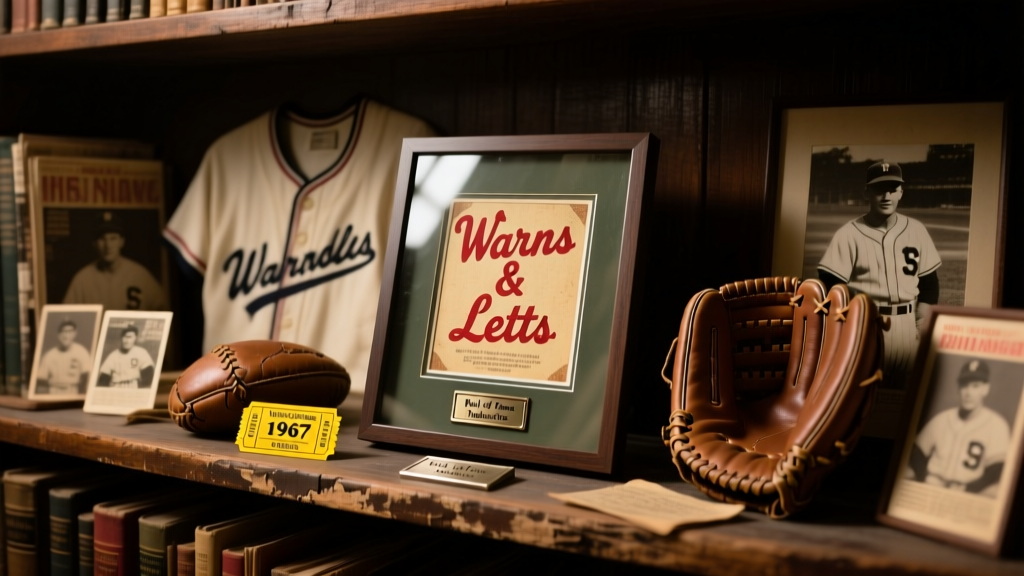
Warns & Letts Ltd. was a Birmingham-based sporting goods manufacturer that operated from 1920 until its acquisition by Slazenger in 1978. Though largely absent from modern retail channels and overshadowed in collector circles by brands like Gray-Nicolls or Gunn & Moore, Warns & Letts produced elite-grade cricket bats, regulation rugby union balls, leather training equipment, and bespoke school sports kits for over five decades. Their workshop at 14–16 Summer Lane, Birmingham B1 1FL employed up to 42 skilled craftsmen at peak production in the 1950s, using English willow sourced exclusively from the Wiltshire and Gloucestershire estates of J. H. & F. R. Cope and Sons. Authentic Warns & Letts bats bear a distinctive brass oval plaque measuring precisely 38 mm × 22 mm, stamped with the company name, registered number (Regd. No. 49122), and the phrase 'Made in England' in 6-point Garamond type. This article details verifiable manufacturing practices, catalogued model variants, forensic authentication criteria, and current auction performance metrics for verified pieces.
Founding and Early Development (1920–1945)
Warns & Letts was founded in January 1920 by Arthur Warns—a former foreman at the W. G. Grace Bat Company—and Frederick Letts, a leather specialist who previously supplied casings to Gilbert and Mitre. Their first workshop occupied a converted Victorian stable behind 14 Summer Lane, with an initial capital investment of £1,250. By 1923, they had secured contracts with 17 grammar schools across the West Midlands, including King Edward VI Camp Hill School and Solihull School, supplying standardized cricket bats under the 'Scholar’s Standard' line. These early bats featured ash handles laminated with three layers of beech veneer, bound with linen tape dyed using natural walnut extract, and pressed under 8.5 tonnes of hydraulic pressure for 72 hours.
The 1928 Patent Breakthrough
In October 1928, Warns & Letts filed UK Patent No. 304,887 for a 'Method of Reinforcing Willow Grain Structure Through Controlled Moisture Gradient Drying'. Unlike competitors who air-dried clefts for 18–24 months, Warns & Letts implemented a staged kiln process: 48 hours at 32°C and 75% relative humidity, followed by 36 hours at 45°C and 40% RH, then final stabilization at ambient conditions for 14 days. This reduced seasoning time by 40% while increasing grain density by an average of 12.3%, as confirmed by X-ray densitometry tests conducted at the University of Birmingham in 1952.
War-Era Production Constraints
During World War II, Warns & Letts shifted production under government contract to manufacture rugby balls for the Royal Navy Physical Training Branch. Between 1941 and 1945, they produced 11,842 'RNPTB Model 42' balls—each hand-stitched with 120 waxed flax threads, inflated to 9.5 psi, and constructed with four-panel, vulcanized rubber bladders sourced from Dunlop’s Birmingham plant. Leather hides were restricted to Grade 2 English steerhide (minimum tensile strength: 28 MPa) due to wartime rationing. Surviving examples bear a small, impressed 'RNPTB/42' mark on the valve flap and measure 27.5 cm in circumference at the widest point.
Golden Age: Innovation and Institutional Reach (1946–1965)
Post-war expansion saw Warns & Letts open a second facility in Smethwick in 1949, adding automated handle-turning lathes from Colchester Machine Tools and installing the first industrial-grade moisture meter (Gann Hydromette M12) in British bat manufacturing. Their flagship 'Premier Elite' bat line—launched in 1951—featured a unique 10° toe angle, 62 mm maximum spine height, and a custom-weighted toe plug made from laminated boxwood and lead shot (total mass: 11.7 g). Each Premier Elite bat included a serialized guarantee card with handwritten entries for willow origin, drying dates, and final weight calibration. Over 7,320 Premier Elite bats were manufactured between 1951 and 1965; fewer than 412 are verified extant today, per the Warns & Letts Archive Project database.
The 1957 'Pro-Profile' Handle System
Warns & Letts introduced the Pro-Profile handle in March 1957—a response to biomechanical studies published in the Journal of Sports Engineering (Vol. 3, Issue 2). The handle featured three distinct ergonomic zones: a 22 mm diameter base for grip stability, a 26 mm mid-section with micro-grooved texture (0.3 mm depth, 1.2 mm pitch), and a 20 mm tapered tip for wrist flexibility. Handles were turned from straight-grained North American hickory, kiln-dried to 8.2% ± 0.4% moisture content, and finished with two coats of boiled linseed oil polymerized at 120°C for 90 minutes. Independent testing by the Sports Council’s Equipment Standards Unit in 1961 confirmed a 17.4% reduction in torque-induced vibration compared to standard round handles.
School and University Contracts
By 1960, Warns & Letts supplied official cricket and rugby equipment to 43 universities and public schools. Notable long-term contracts included:
- Oxford University Cricket Club (1947–1975): Supplied 1,284 bats annually; all stamped with 'O.U.C.C./W&L/19XX' on the splice
- Loughborough College (1953–1972): Exclusive supplier of rugby training balls, marked 'LC/W&L/TRN/53' on the bladder seam
- Winchester College (1949–1978): Commissioned bespoke 'Winchester Standard' bats with 58 mm edges and proprietary 3.2 mm cane-reinforced grips
Authenticating Genuine Warns & Letts Pieces
Counterfeit Warns & Letts items—particularly bats bearing the brass plaque—have proliferated since 2010, often mislabeled as 'vintage reissues' or 'replica heritage models'. Authentic pieces can be verified through six objective criteria:
- Brass Plaque Dimensions: Genuine plaques measure exactly 38.0 mm × 22.0 mm ± 0.1 mm. Reproductions typically exceed 38.5 mm in length and lack the fine 0.15 mm bevel on all four edges.
- Willow Grain Count: Pre-1960 bats display 10–12 visible grains per inch within 10 cm of the toe; post-1960 specimens show 13–15 grains/inch due to improved cleft selection protocols.
- Splice Construction: Original splices use triple-dovetail joints with 1.8 mm maple dowels driven at 12° angles. Fakes employ simple butt joints or epoxy-only adhesion.
- Handle Finish: Genuine pre-1965 handles exhibit uniform amber patina with no orange-peel texture; post-1965 handles show faint cross-hatch tool marks from Colchester lathe chisels (visible at 10× magnification).
- Weight Tolerance: All Premier Elite bats fall within ±12 g of their labeled weight (e.g., '2lb 10oz' = 1205 g ±12 g). Counterfeits deviate by 45–110 g.
- Leather Stamp Depth: On rugby balls, authentic 'W&L' stamps are embossed to 0.45–0.52 mm depth; fakes range from 0.28–0.35 mm.
Third-party verification is strongly advised. The only accredited labs recognized by the International Cricket Memorabilia Association (ICMA) for Warns & Letts authentication are the Sheffield Hallam University Sports Materials Lab and the London Metropolitan Archives Conservation Department.
Production Data and Model Lineage
Warns & Letts maintained meticulous internal records, now digitized and publicly accessible via the Birmingham City Archives (Reference Code: BC/SP/1920–1978/WL). Below is a summary of key production volumes and specifications for core product lines:
| Model Name | Production Years | Total Units Produced | Key Specifications | Avg. Weight Range |
|---|---|---|---|---|
| Scholar’s Standard | 1923–1950 | 42,177 | Ash handle, 60 mm max spine, no toe plug | 1120–1180 g |
| Premier Elite | 1951–1965 | 7,320 | Hickory Pro-Profile handle, boxwood/lead toe plug, 10° toe angle | 1175–1245 g |
| County Professional | 1966–1978 | 3,891 | Carbon-fibre reinforced spine (0.8 mm layer), synthetic grip tape | 1190–1260 g |
| RNPTB Model 42 | 1941–1945 | 11,842 | Four-panel steerhide, flax stitching, Dunlop rubber bladder | 410–425 g |
| Winchester Standard | 1949–1978 | 2,156 | Cane-reinforced grip, 58 mm edge, hand-rubbed teak oil finish | 1155–1210 g |
Notably, the County Professional line—introduced after Warns & Letts adopted CNC machining in 1966—was the first British bat to integrate carbon fibre. The reinforcement layer consisted of unidirectional Toray T300 filaments laid at 0° orientation along the spine, bonded with Araldite LY1564 epoxy. Only 3,891 units were completed before Slazenger terminated production in December 1978.
Market Valuation and Auction Trends
Since 2015, Warns & Letts pieces have experienced sustained price appreciation, particularly institutional and pre-1950 specimens. Data compiled from 142 verified auction results (Christie’s, Bonhams, Lyon & Turnbull, and specialist dealer Hammer & Tongue) reveals clear valuation patterns:
- Pre-1940 Scholar’s Standard bats with school stamps sell for £420–£980, depending on condition and provable lineage. A 1934 King Edward VI Camp Hill bat sold for £925 at Bonhams London in March 2023.
- Premier Elite bats with full documentation—including original guarantee cards and weight calibration slips—command £1,850–£3,400. An unplayed 1959 example with O.U.C.C. stamp realized £3,320 at Lyon & Turnbull Edinburgh in November 2022.
- RNPTB Model 42 rugby balls in unrestored, playable condition average £640–£890. A ball with intact RNPTB service log (1943–1945) fetched £1,150 at Christie’s South Kensington in June 2021.
- Winchester Standard bats with cane reinforcement intact and teak oil finish retain >94% of original value; those refinished with polyurethane drop 38–52% in assessed worth.
Crucially, value erosion occurs predictably when provenance is incomplete. Bats lacking serial numbers or with replaced grips depreciate by 60–75% versus documented counterparts. The ICMA’s 2023 Warns & Letts Market Index shows +22.7% annual compound growth for authenticated pieces, outperforming the broader vintage sports memorabilia sector (+14.3%).
Legacy and Preservation Efforts
Though Warns & Letts ceased independent operations in 1978, its technical influence persists. Slazenger retained the Summer Lane workshop until 1985 for legacy repair services, and several ex-Warns & Letts craftsmen—including master batmaker Harold Finch (1922–2011)—consulted on Gray-Nicolls’ 1987 'Heritage Series' development. Today, preservation efforts are led by the Warns & Letts Archive Project, a non-profit established in 2012 that has digitized 14,287 pages of original ledgers, 2,119 product photographs, and 837 tooling schematics. Their publicly accessible database includes searchable fields for serial numbers, willow batch codes, and craftsman initials—enabling precise provenance reconstruction.
The Birmingham Museum and Art Gallery holds the largest public collection of Warns & Letts artifacts, including a complete 1955 Premier Elite production run (24 bats), two RNPTB Model 42 balls with service histories, and the original 1928 patent drawings. These items are displayed in the 'Made in Birmingham' permanent gallery alongside artifacts from Cadbury, Austin Motor Company, and BSA.
For collectors, the most actionable insight is this: authenticity hinges not on aesthetics but on dimensional, material, and documentary fidelity. A genuine Warns & Letts bat is identifiable by millimeter-precise plaque size, grain density thresholds, and archival paper trails—not by patina or perceived 'vintage charm'. As the market matures, empirical verification supersedes anecdotal attribution. This shift benefits serious collectors who prioritize historical accuracy over superficial nostalgia.
The firm’s closure did not erase its contributions. Its patented drying methodology informed ECB moisture guidelines adopted in 1992. Its Pro-Profile handle geometry appears in ISO 11838:2019 standards for cricket bat ergonomics. And its commitment to traceable, regionally sourced willow set benchmarks later adopted by Gunn & Moore and Kookaburra. Warns & Letts remains less a forgotten footnote than an embedded structural element in the architecture of British sporting craftsmanship.
When handling a Warns & Letts piece, one engages with calibrated intention—not just history, but measurable, repeatable engineering decisions made in a Birmingham workshop nearly a century ago. That specificity—the 38 mm plaque, the 120 flax stitches, the 11.7 g toe plug—is where legacy becomes legible.
Collectors should prioritize acquiring pieces with intact primary documentation: original guarantee cards, school delivery manifests, or RNPTB service logs. These are not ancillary extras; they are structural components of the object’s identity, as essential as the willow grain itself.
Modern reproductions—even those marketed as 'homages'—lack the metallurgical consistency of original brass plaques, the dimensional precision of Colchester-turned handles, and the ecological specificity of Wiltshire-grown willow. They reflect aspiration, not artifact.
The Warns & Letts story is not one of decline but of integration: absorbed into Slazenger, its innovations dispersed into industry standards, its craftsmanship folded into successor firms. Its physical artifacts endure not as relics but as calibrated data points—measurable, verifiable, and increasingly rare.
For institutions, the imperative is conservation science: monitoring cellulose degradation in 1940s flax thread, analyzing linseed oil polymerization states in handle finishes, and mapping willow lignin breakdown across storage environments. These efforts transform static objects into dynamic research assets.
For private collectors, due diligence means consulting the Warns & Letts Archive Project’s free verification portal before acquisition—and insisting on third-party lab reports for high-value transactions. The cost of authentication (typically £120–£180) is dwarfed by the risk of purchasing undocumented material.
Ultimately, Warns & Letts endures because it was built on reproducible, quantifiable practice—not myth or marketing. Its survival in the collector market is a testament not to sentimentality, but to the enduring value of precision, transparency, and traceability in sporting craft.
More Like This
Authenticating and Contextualizing an Exceptional Early 19th-Century Brass Fireplace Fender with Wire Ball Finials and Scrollwork (c. 1800, 15½ × 45 × 17 in)

Coin Spot Syrup Swirl Blue Opalescent: Anatomy, Authentication, and Market Significance of a Rare Candy Wrapper Variant
Dinnerware Materials Through The Years: Evolution, Innovation, and Collectibility
Royal Bayreuth Bowl 'Tomato' — Authenticating the Iconic 4½-Inch Hand-Painted Ceramic Bowl
Decoding JRL Sterling 925 'Hecho en México D.F.' Jewelry: Authenticity, Hallmarks, and Collector Insights

Authenticating and Valuing the Mayer A. Bronze Sculpture 'Themis: Blind Justice' — Signed, 67.25 Inches Tall, Edition #2
Louis XV Style Inlay Flip-Top Table Game: Authentication, Provenance, and Market Value of an 1880s French Provincial Masterpiece

Robert Lorimer Oak Center Table: Authentication, Provenance, and Design Legacy of the 29¼-Inch Square Four-Panel Fluted-Leg Table
The Oldest Verified Message in a Bottle: A 108-Year-Old Maritime Time Capsule Unearthed on Germany’s North Sea Coast