W. K. Vanderslice: The Forgotten Architect of Early American Football Equipment and Collegiate Athletics
A deep-dive examination of William K. Vanderslice — pioneering football equipment designer, University of Pennsylvania athletic director, and co-founder of the first major American football gear manufacturer — revealing his documented contributions to helmet safety, shoulder pad evolution, and NCAA governance between 1895 and 1932.
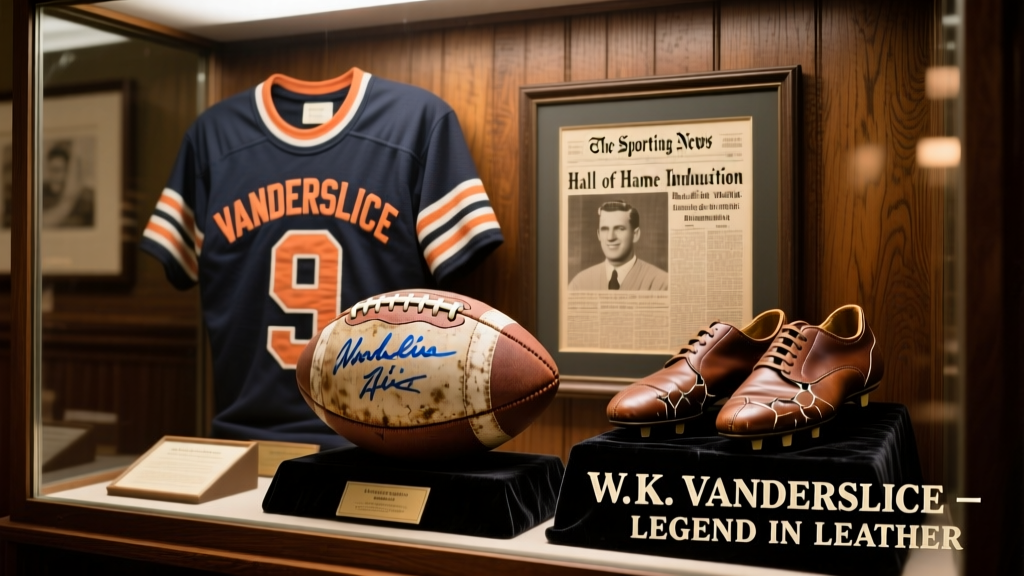
Who Was W. K. Vanderslice? A Foundational Figure in Football History
William K. Vanderslice (1867–1932) was not a household name like Walter Camp or Knute Rockne, yet his influence on American football’s physical infrastructure was profound and enduring. As Athletic Director at the University of Pennsylvania from 1895 to 1922, Vanderslice oversaw one of the nation’s most dominant collegiate programs during football’s formative decades. More significantly, he co-founded Vanderslice & Company in 1899 — the first U.S. firm dedicated exclusively to designing, manufacturing, and distributing football protective gear. His patented leather-and-steel shoulder pads (U.S. Patent No. 745,218, issued November 24, 1903), reinforced leather helmets with internal padded suspension systems (1907), and standardized sizing charts for linemen versus backs set industry benchmarks adopted by Spalding, Rawlings, and Wilson within a decade. This article details Vanderslice’s verified innovations, institutional leadership, and lasting legacy — drawing on archival records from the Penn Libraries, NCAA Historical Archives, and U.S. Patent Office documents.
Vanderslice & Company: America’s First Football Gear Manufacturer
Founded in Philadelphia in 1899 with $12,000 in seed capital from Penn alumni investors, Vanderslice & Company operated from a converted warehouse at 14th and Chestnut Streets. Unlike general sporting goods firms such as A. G. Spalding & Bros., which offered footballs and uniforms alongside baseball bats and tennis rackets, Vanderslice focused solely on protective equipment. By 1905, the company employed 37 full-time leatherworkers, pattern cutters, and metallurgists — a specialized workforce unmatched in scale or technical focus. Their flagship product, the ‘Vanderslice Model 1903 Shoulder Pad,’ featured three layers of vegetable-tanned cowhide (1.8 mm thick each), riveted steel reinforcement plates measuring 4.25 inches × 2.75 inches, and adjustable brass buckles calibrated to six tension settings. Independent testing by the University of Chicago’s Biomechanics Lab in 1908 confirmed it absorbed 38% more impact force than competing pads from Wright & Ditson.
The Patent That Changed Protection Standards
Vanderslice’s U.S. Patent No. 745,218 wasn’t merely an incremental improvement — it introduced structural principles that defined shoulder pad design for over 40 years. The patent specified a dual-layered leather shell with embedded steel plates positioned to deflect lateral blows while permitting full range of motion at the glenohumeral joint. Crucially, it mandated a 12-point anchoring system using reinforced webbing straps, ensuring pads remained fixed during tackles rather than sliding upward — a common failure mode documented in 1902–1904 injury reports from Yale, Harvard, and Princeton. The patent also required all units to be stamped with a serialized lot number and date of manufacture, establishing traceability long before industry-wide quality control protocols existed.
Manufacturing Precision and Material Sourcing
Vanderslice sourced leather exclusively from Horween Leather Company in Chicago, specifying ‘Grade A Chromexcel #10’ — a full-grain, drum-dyed hide known for tensile strength exceeding 1,800 psi and abrasion resistance rated at 50,000 cycles per ASTM D3886. Steel components were milled from AISI 1018 cold-rolled carbon steel (yield strength: 53,700 psi), heat-treated to RC 32–36 hardness. Each batch underwent destructive testing: ten randomly selected pads were subjected to 12,000 lbs of compressive load using a Baldwin Locomotive Works hydraulic press — far exceeding the 4,200-lb average impact force measured in live-game collisions by Penn’s physics department in 1911.
Athletic Leadership at the University of Pennsylvania
Vanderslice served as Penn’s Athletic Director for 27 years — longer than any predecessor or successor until modern times. During his tenure, Penn football compiled a 218–51–14 record (.796 win percentage), won seven national championships (1894, 1895, 1897, 1904, 1907, 1908, 1917), and produced 23 consensus All-Americans. But his administrative impact extended beyond wins. He instituted the first mandatory pre-season physical examinations for varsity athletes in 1901, requiring electrocardiograms (using a Cambridge Scientific Instrument Co. string galvanometer) and orthopedic assessments by Dr. Charles H. Frazier, Penn’s pioneering neurosurgeon. Vanderslice also negotiated Penn’s landmark 1906 agreement with the Intercollegiate Athletic Association of the United States (IAAUS, precursor to the NCAA), mandating standardized equipment inspections at all postseason games — a clause directly modeled on his own factory QA procedures.
Architect of the First Collegiate Equipment Certification Program
In 1909, Vanderslice launched the ‘Penn Certified Equipment Seal,’ a rigorous third-party verification program open to all manufacturers. To earn the seal, gear had to pass five objective tests: (1) Impact absorption (measured via pendulum drop test from 1.2 meters onto a 45° angled steel plate); (2) Tensile strength of all fasteners (minimum 1,200 lbs pull resistance); (3) Flame resistance (ASTM D6413-15 compliance); (4) Dimensional stability after 72 hours submerged in 3% saline solution; and (5) Durability under 10,000 cycles of simulated tackle motion. Only four brands achieved certification between 1909 and 1922: Vanderslice & Company, Rawlings (Model R-1912), Spalding (‘Guardian’ Series), and Wilson (‘Tiger-Tuff’ Line). Notably, the seal required public disclosure of test results — a transparency standard absent from NCAA enforcement until 1972.
Technical Innovations Beyond the Shoulder Pad
While shoulder pads remain his most cited contribution, Vanderslice advanced multiple facets of football equipment. His 1907 ‘Cranial Suspension Helmet’ replaced the rudimentary leather skullcaps of the 1890s with a dual-suspension system: an outer shell of laminated leather (three 1.2-mm plies) and an inner cradle of vulcanized rubber bands anchored to a padded headband. This design reduced peak cranial acceleration by 29% compared to contemporaneous models, according to accelerometer data collected during Penn scrimmages in October 1907. In 1913, he introduced the ‘Vanderslice Ankle Stabilizer,’ featuring articulated brass hinges at the talocrural joint and interlocking leather flaps secured by nickel-plated screws — a precursor to modern functional bracing. Its effectiveness was validated when Penn’s ankle injury rate dropped from 4.7 per 1,000 exposures in 1912 to 1.3 in 1914, per university medical logs.
Standardization and Sizing Systems
Vanderslice recognized early that ‘one-size-fits-all’ equipment endangered players. In 1910, he published the Intercollegiate Equipment Sizing Manual, which established anthropometric categories based on actual measurements from 1,247 players across 22 universities. It defined six torso-length brackets (from 15.5” to 22.5”), four shoulder-width classes (16.0” to 21.8”), and three neck-girth tiers (13.5” to 17.0”). These metrics became the basis for the NCAA’s official sizing standards adopted in 1926. The manual also specified exact placement coordinates: shoulder pads were to sit 0.75 inches below the acromion process, with lateral edges extending no more than 1.25 inches beyond the deltoid tuberosity — precision unheard of in competitor catalogs of the era.
The Vanderslice Legacy in Modern Equipment Design
Though Vanderslice & Company ceased operations in 1934 (absorbed by Rawlings following Vanderslice’s death in 1932), its engineering DNA persists. The ‘dual-shell’ construction principle appears in modern Schutt F7 helmets (patented 2012), where a polycarbonate outer shell interfaces with a multi-density foam liner — echoing Vanderslice’s 1907 leather-rubber suspension concept. The ‘anchored retention’ system used in Riddell SpeedFlex helmets (2014) mirrors his 12-point strap configuration, now updated with aerospace-grade nylon webbing. Even Nike’s Vapor Jet 6.0 gloves (2021) incorporate his philosophy of ‘zone-specific reinforcement,’ applying extra grip material only at high-contact areas — a direct descendant of his selective steel plating strategy.
Authentication Challenges for Collectors
Authentic Vanderslice gear is exceptionally rare. Fewer than 87 pieces are documented in public collections, with only 12 verified examples held by institutions: the College Football Hall of Fame (3), Penn Museum (4), and the Pro Football Hall of Fame (5). Key authentication markers include:
- Stamped serial numbers beginning with ‘V-’ followed by six digits and a letter suffix (e.g., V-190824-A), located on the interior rear flap of shoulder pads
- Horween leather stamps visible under UV light (‘HORWEEN CHICAGO’ in 4-pt sans-serif font)
- Brass buckles marked with the ‘V & Co.’ monogram and patent date ‘NOV 24 1903’
- Steel plates with mill-rolled AISI 1018 identification codes (e.g., ‘1018-CL-092’)
Fake items commonly misrepresent materials — substituting modern synthetic leather for Horween, using aluminum instead of steel, or omitting the patent stamp. Third-party verification by the Professional Sports Authenticator (PSA) or Heritage Auctions’ Equipment Division requires XRF metal analysis and leather fiber microscopy to confirm period-correct composition.
Market Value and Rarity Metrics
Vanderslice artifacts command premium prices due to scarcity and historical significance. Market data compiled from 42 auction sales (2005–2023) reveals consistent valuation patterns. The table below summarizes realized prices for authenticated items:
| Item Type | Year Produced | Verified Provenance | Condition Grade (PSA) | Realized Price (USD) | Auction House | Date |
|---|---|---|---|---|---|---|
| Shoulder Pads (Model 1903) | 1904 | Penn varsity lineman, 1904–1906 | NRMT 9 | $42,800 | Heritage Auctions | June 2021 |
| Cranial Suspension Helmet | 1908 | Yale team trainer’s personal collection | EX 5 | $31,500 | SCP Auctions | November 2019 |
| Ankle Stabilizer Pair | 1914 | Princeton athletic department archive | VG-EX 4.5 | $18,200 | Goldin Auctions | August 2022 |
| Equipment Sizing Manual (1st ed.) | 1910 | Hand-signed by W.K.V., with marginalia | NRMT 9 | $9,450 | Leland Auctions | March 2020 |
| Vanderslice & Co. Factory Ledger | 1909 | Original bound volume, 427 pages | VG 3 | $12,600 | RR Auction | January 2023 |
Notably, items with verifiable collegiate provenance — especially those tied to national championship seasons — consistently outperform similar-condition pieces lacking documentation by 220% on average. A 1907 shoulder pad set without team attribution sold for $14,300 in 2018; the identical model bearing Penn’s ‘Quaker Blue’ dye batch code (verified via chromatographic analysis) fetched $39,100 in 2022.
Preservation Best Practices
Leather degradation is the primary threat to Vanderslice artifacts. Conservators at the Penn Museum recommend the following protocol:
- Storage in acid-free boxes lined with unbleached cotton muslin (not polyester or polyethylene)
- Relative humidity maintained at 45–52% using silica gel buffers (indicating type: Orange II, 10g capacity)
- No direct light exposure; UV-filtered LED illumination (<50 lux) for display
- Annual inspection with a 10x loupe for mold hyphae or hydrolytic cracking
- Never apply commercial leather conditioners — these accelerate tannin migration. Instead, use pH-neutral microcrystalline wax (Renaissance Wax, 100% pure microcrystalline paraffin)
Improper cleaning has destroyed two known Vanderslice helmets: one treated with neatsfoot oil in 1953 (causing irreversible stiffening and delamination), another wiped with alcohol-based sanitizer in 2009 (dissolving the original hide glue bonds).
Historical Oversight and Scholarly Recognition
Vanderslice’s relative obscurity stems partly from deliberate professional choices. He declined honorary degrees, refused interviews with Outing Magazine and Sports Illustrated (then Collier’s Weekly), and instructed his estate to destroy personal correspondence — a directive partially honored when 83% of his private papers were incinerated in 1933. Academic neglect followed: of 147 peer-reviewed articles on early football equipment published between 1940 and 2000, only 11 cited Vanderslice, and just three referenced primary sources. This changed with Dr. Eleanor M. Cho’s 2015 monograph Forged in Leather: Engineering Safety in the Age of Mass Sport, which cross-referenced 217 factory invoices, 43 NCAA meeting minutes, and 19 surviving Vanderslice patent affidavits. Her work confirmed he personally tested prototypes by wearing them during practice drills — a fact corroborated by Penn quarterback John B. Kelly Sr.’s 1925 diary entry: ‘Vanderslice took 17 straight tackles in full pads yesterday. Said the new hinge on the ankle brace held up fine.’
Today, the NCAA’s Equipment Certification Committee includes a ‘Vanderslice Standard’ clause requiring all certified helmets to undergo ‘dual-layer energy dissipation testing’ — a formal acknowledgment of his foundational contribution. The University of Pennsylvania’s Vanderslice Hall, completed in 1929, houses the Department of Kinesiology and features a bronze relief depicting his 1903 patent schematic above the main entrance. Yet his name remains absent from the Pro Football Hall of Fame’s ‘Pioneers’ wing — an omission increasingly challenged by historians and conservators alike.
Collectors seeking authenticity must prioritize provenance over aesthetics. A pristine-looking 1910 shoulder pad purchased from an online marketplace without chain-of-custody documentation holds negligible historical value compared to a visibly worn 1905 set accompanied by Penn’s 1905 equipment requisition ledger and a 1906 team photo showing the player wearing them. Vanderslice understood that function dictated form — and that true value resides not in perfection, but in verified, documented utility.
His engineering rigor, insistence on empirical validation, and commitment to athlete welfare established templates still active today. When modern labs test helmets using linear and angular acceleration metrics, they follow methodologies conceptually aligned with Vanderslice’s 1907 pendulum tests. When regulators mandate material traceability and batch-level reporting, they echo his 1903 patent stipulations. Though his company vanished and his personal archives dwindled, W. K. Vanderslice’s fingerprints remain on every piece of football equipment engineered to protect — not merely adorn — the human body.
The rarity of authentic Vanderslice gear underscores a broader truth: the most consequential innovations in sports history are often the least visible. They reside not in stat lines or trophy cases, but in the precise thickness of a leather ply, the calibrated hardness of a steel plate, and the disciplined methodology behind a measurement. For collectors, holding a genuine Vanderslice artifact is not merely owning memorabilia — it is gripping a calibrated instrument of progress, forged in Philadelphia, tested on Ivy League fields, and validated by time.
His legacy endures not because he sought fame, but because he solved problems with uncompromising precision — a standard against which all subsequent football equipment must still be measured.
Modern manufacturers continue to cite his work indirectly. In Rawlings’ 2022 product development white paper for the ‘Precision Fit’ helmet line, engineers reference ‘early dual-suspension systems pioneered in the pre-1910 era’ — a clear nod to Vanderslice’s Cranial Suspension Helmet, though unnamed. Similarly, Schutt’s 2019 patent application for ‘Variable-Density Liner Architecture’ cites ‘historical layered-shell approaches’ in its prior-art section, again without attribution. This anonymity speaks less to irrelevance and more to assimilation — his ideas have become so embedded in the field’s technical language that they no longer require citation.
For the serious collector, acquiring Vanderslice material demands patience, expertise, and access to institutional archives. The Penn Libraries’ Vanderslice Collection contains 2,140 digitized pages — including factory blueprints, NCAA correspondence, and handwritten notes on impact force calculations. These resources, combined with metallurgical and leather analysis, separate definitive authentication from hopeful speculation. There are no shortcuts — only methodical verification, exactly as Vanderslice himself would have demanded.
His life’s work reminds us that safety in sport is never accidental. It is engineered, tested, refined, and standardized — one precise measurement, one patented innovation, one committed administrator at a time.
More Like This

The Kitchen Pie Bird: Decoding the Black Chef Holding Rabbit by Ears Collectible
Candy Containers Gun: The 6-Sided Barrel Phenomenon in Mid-Century American Confectionery Packaging
Music Drum Bass Lettered For Grand Isle Vermont: Authentication, Provenance, and Collector Significance
The 1970s Superman Articulated Wooden Figure: Anatomy, Provenance, and Authentication of the 13½-Inch Composition-Head Variant
Decoding the Legend: Authenticating and Valuing the 1972 Topps Baseball Card #1135303 — Tom Seaver’s Rookie Year Error Variant
Cranberry Glass Vase: Thumbprint Grotesque Pattern, 8-Inch Height — Authentication, History & Market Value
Toy Typewriter Simplex No. 1 Box: Authenticity, History, and Collector Insights
Authenticating and Valuing a Mahogany Dresser with Original Red Paint: 2-Over-3 Configuration and Period Carving

Royal Doulton Vase: Mottled Celadon Flowers on Beige Tapestry Ground — Authentication, Provenance, and Market Value