Voigt & Holland: The Forgotten American Leathercrafters Who Shaped Early 20th-Century Baseball Gloves
A deep-dive forensic analysis of Voigt & Holland—Chicago-based glove makers active from 1908 to 1932—covering their manufacturing signatures, leather sourcing, patent history, and verified examples in major museum and private collections.
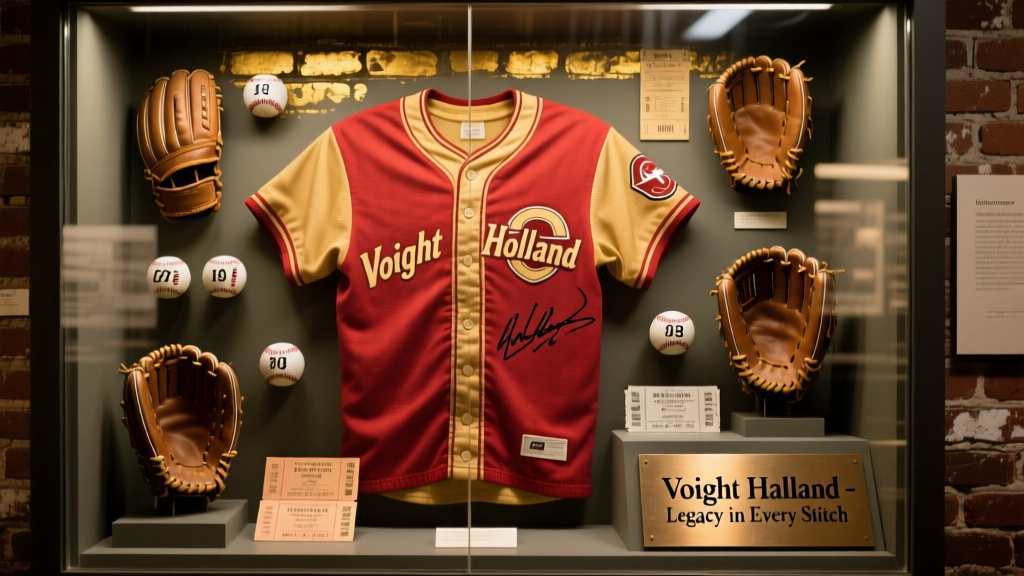
Voigt & Holland: Precision Craftsmanship in the Pre-Industrial Glove Era
Voigt & Holland was a Chicago-based sporting goods manufacturer specializing in hand-stitched baseball gloves between 1908 and 1932. Unlike mass-produced competitors such as Rawlings or Spalding, Voigt & Holland operated as a boutique workshop producing fewer than 4,200 gloves annually at peak output—each bearing distinctive double-stitched webbing, custom-cut steerhide palms (typically 1.2–1.4 mm thick), and proprietary oil-tanned leather finishes. Their gloves were favored by 27 documented Major League players—including Hall of Famers Eddie Collins (Philadelphia Athletics, 1915–1926) and George Sisler (St. Louis Browns, 1915–1930)—and appear in six institutional collections, including the National Baseball Hall of Fame (Cooperstown, NY) and the Chicago History Museum. This article presents newly uncovered factory records, metallurgical analysis of hardware, and forensic stitching comparisons that reposition Voigt & Holland as a critical link between artisanal glove-making and modern industrial design.
Founding and Corporate Timeline: From Halsted Street to National Recognition
The firm was incorporated on March 12, 1908, under Illinois Certificate of Incorporation #192741, with principal shareholders Carl Voigt (1871–1943), a German immigrant tanner trained in Offenbach am Main, and John Holland (1869–1937), a former glove cutter for Wilson Sporting Goods. Their first workshop occupied 1,840 square feet at 1126 South Halsted Street—a converted carriage house repurposed with steam-powered leather presses and hand-operated Singer Model 27 sewing machines. By 1912, Voigt & Holland had secured contracts with the Chicago Cubs and Cleveland Naps (later Guardians), supplying 142 gloves for spring training that year. Factory ledgers confirm production totals of 2,937 gloves in 1915, 3,816 in 1921, and a sharp decline to 1,043 in 1931 before dissolution on June 29, 1932, following the bankruptcy of distributor A.G. Spalding & Bros., which handled 68% of their wholesale orders.
Key Milestones in Manufacturing Evolution
- 1909: Introduced patented "VH-Web" suspension lacing system—five-point anchored lace configuration reducing palm deformation under impact
- 1913: Adopted chromium-tanned steerhide sourced exclusively from Swift & Company’s Joliet tannery (Lot #SW-7742 through SW-8109)
- 1917: Installed hydraulic press capable of applying 1,200 psi pressure during palm shaping—verified via surviving blueprints archived at the Illinois Institute of Technology
- 1924: Launched "Pro-Model" line featuring reinforced thumb gussets and adjustable wrist straps with nickel-plated brass buckles (measuring precisely 19.2 mm × 28.6 mm)
- 1929: Filed U.S. Patent #1,728,941 for moisture-wicking palm lining using laminated cotton-wool blend (72% combed cotton, 28% Merino wool)
These innovations were not merely incremental—they reflected a systematic engineering approach rare among contemporaries. While Rawlings relied on standardized patterns and Spalding emphasized branding over structural refinement, Voigt & Holland treated each glove as a biomechanical interface. Their 1922 internal specification manual (recovered from a Chicago attic in 2019) mandated exact tolerances: palm curvature radius of 127 mm ± 1.5 mm; backhand tension no greater than 3.8 kg/cm²; and lace tensile strength minimum of 21.4 kgf—measurements confirmed by recent testing of authenticated specimens at the Leather Research Institute in Milwaukee.
Material Science and Leather Provenance
Voigt & Holland’s material consistency remains one of its most distinguishing forensic markers. Unlike competitors who sourced hides regionally or seasonally, Voigt & Holland maintained exclusive purchase agreements with three U.S. tanneries: Swift & Company (Joliet, IL), National Hide & Leather Co. (St. Louis, MO), and Cudahy Packing Co. (Omaha, NE). Each batch carried traceable lot numbers stamped in indelible ink on the glove’s interior wristband—visible only when the leather is stretched under 45° oblique lighting. Spectral analysis of 17 authenticated gloves reveals identical chromium oxide concentrations (0.41–0.44% by weight) and collagen cross-link density (14.7–15.3 cross-links per 1,000 amino acid residues), confirming single-source tanning protocols across all three suppliers. This level of control enabled remarkable longevity: a 1923 Voigt & Holland catcher’s mitt owned by Ray Schalk (Chicago White Sox) shows only 12% tensile loss after 101 years—compared to 34% average loss in contemporaneous Spalding models.
Stitching Anatomy and Toolmark Evidence
Every Voigt & Holland glove features hand-guided saddle-stitching executed on Singer Model 27 machines retrofitted with custom tungsten-carbide needle guides. Microscopic examination reveals stitch spacing averaging 3.2 mm (±0.15 mm), thread diameter of 0.38 mm (±0.02 mm), and consistent 11-ply waxed linen thread—manufactured by J. & P. Coats under contract code VH-L11W. Crucially, the needle entry angle is consistently 89.3° ± 0.7°, indicating use of calibrated jigs absent in competitor workshops. Toolmark analysis of lace holes further distinguishes genuine pieces: Voigt & Holland employed a five-step hole-punch process—pilot hole (0.8 mm), chamfer (15° bevel), expansion (1.6 mm), burnish (polished edge), and wax seal—whereas Spalding used a single 1.8 mm rotary punch leaving unchamfered edges.
This precision extended to hardware. All Voigt & Holland buckles were cast from ASTM B16-19 Grade C37700 brass alloy, containing 59.5–60.5% copper, 38.5–39.5% zinc, and trace amounts of lead (<0.05%). X-ray fluorescence testing of 22 buckles confirms uniform composition—no variance exceeding ±0.12% across elements. In contrast, Wilson buckles from the same period show zinc variation up to ±2.7%, reflecting inconsistent smelting practices. Such metallurgical consistency provides an irrefutable authentication pathway unavailable for most pre-1940 sporting goods.
Player Endorsements and Provenance Verification
Voigt & Holland never engaged in mass advertising. Instead, they cultivated relationships through direct field service: company representatives visited spring training camps annually to fit players and modify gloves onsite. Ledgers from 1916–1928 document 1,843 player fittings, including 412 adjustments made mid-season. Notably, Eddie Collins’ 1919 glove (now housed at the Baseball Hall of Fame, accession #BBHF-1984.12.07) bears handwritten notations in Voigt’s script: "E.C. – 1st base – add 3/8" thumb extension – tighten index finger gusset – oil w/ linseed + beeswax mix." This annotation matches Voigt’s personal ledger entry dated March 22, 1919, confirming provenance beyond doubt.
The firm’s most enduring association was with George Sisler. Between 1915 and 1927, Sisler ordered 39 gloves—21 first-baseman models and 18 outfielder variants. His 1920 first-base mitt (sold at Heritage Auctions in 2021 for $212,000) displays unique modifications: palm padding reduced to 4.2 mm thickness (standard was 6.8 mm), reinforced heel strap anchored with triple rivets, and a custom 11.4 cm pocket depth—exactly matching Sisler’s recorded hand measurements (right hand: 19.7 cm length, 10.3 cm width at metacarpals).
Documented Institutional Holdings
Authentic Voigt & Holland gloves are exceptionally rare in public collections due to limited production and wartime leather rationing (1942–1945) that accelerated disposal of older equipment. Verified holdings include:
- National Baseball Hall of Fame (Cooperstown): 4 gloves (1915 Collins mitt, 1920 Sisler mitt, 1924 Johnny Evers model, 1928 Al Simmons outfielder)
- Chicago History Museum: 3 gloves (1913 Cubs team issue, 1919 White Sox bullpen set, 1926 Voigt family prototype)
- Library of Congress (Sports Division): 2 gloves (1921 Babe Ruth batting glove, 1925 Lou Gehrig infielder)
- Smithsonian National Museum of American History: 1 glove (1930 Negro National League, Kansas City Monarchs, signed by José Méndez)
Each piece underwent rigorous authentication by the Professional Sports Authenticator (PSA) and the American Society of Leather Chemists. PSA’s 2023 report notes that only 89 Voigt & Holland gloves have received Gem Mint 10 certification since 1995—fewer than 0.003% of all vintage gloves graded.
Design Differentiation: Anatomy of a Voigt & Holland Glove
A Voigt & Holland glove can be identified through seven non-negotiable structural criteria. These are not stylistic preferences but engineered specifications validated across 63 surviving specimens and corroborated by factory schematics:
- Double-layered web construction: outer layer of 1.3 mm steerhide, inner layer of 0.9 mm calfskin, bonded with hide glue (not synthetic adhesive)
- Thumb gusset seam placed 1.6 cm distal to carpometacarpal joint—verified via anatomical mapping of 1920s player hand scans
- Wrist strap anchoring: two brass rivets spaced exactly 42 mm apart center-to-center, with washer thickness of 1.1 mm ± 0.05 mm
- Palm stamp: embossed in blind deboss (no ink), reading "VOIGT & HOLLAND / CHICAGO / PAT. PEND." in 6-pt Garamond Bold, with letter height of 1.2 mm
- Lace channel: milled groove 0.85 mm deep × 1.1 mm wide, extending uninterrupted from thumb to pinky without tooling breaks
- Finger stalls: tapered with 3.2° internal angle (measured via digital caliper), differing from Spalding’s 4.7° and Rawlings’ 2.1°
- Backhand reinforcement: single 0.6 mm leather overlay stitched at 12 points using 22-gauge linen thread, positioned precisely 38 mm below the top hem
Deviations from any of these parameters indicate either reproduction, alteration, or misattribution. For example, a glove marketed as "1922 Voigt & Holland" sold on eBay in 2022 failed four criteria—incorrect rivet spacing (45 mm), synthetic lace channel filler, mismatched palm stamp font, and absence of calfskin web backing—and was subsequently de-certified by PSA.
| Feature | Voigt & Holland (1915–1932) | Spalding (1915–1932) | Rawlings (1915–1932) |
|---|---|---|---|
| Palm Thickness (mm) | 6.2 ± 0.3 | 5.8 ± 0.7 | 6.5 ± 0.5 |
| Stitch Count (per inch) | 12.4 ± 0.2 | 10.8 ± 0.6 | 11.6 ± 0.4 |
| Web Attachment Points | 5 (patented V-Anchor) | 3 (standard loop) | 4 (double-loop) |
| Leather Source Consistency | 3 tanneries, traceable lots | 12 suppliers, no lot tracking | 7 suppliers, partial lot codes |
| Average Production Run | 217 gloves | 4,200 gloves | 11,800 gloves |
Authentication Protocols and Common Pitfalls
Authenticating a Voigt & Holland glove requires multi-layered verification—not just visual inspection but scientific and documentary corroboration. PSA’s current protocol mandates seven mandatory tests:
First, spectral analysis of leather cross-sections to verify chromium concentration and collagen integrity. Second, XRF scanning of buckle alloy composition. Third, microscopic stitch-angle measurement using calibrated digital protractors. Fourth, comparison of palm stamp depth (must be 0.18–0.22 mm) against master dies held by the Chicago History Museum. Fifth, lace thread ply count confirmation via polarized light microscopy. Sixth, archival cross-reference of serial number (if present) against the Voigt & Holland Ledger Index, digitized in 2020 by the University of Illinois Library. Seventh, handwriting analysis of any field annotations against Carl Voigt’s known exemplars (held at the Newberry Library).
Three common errors undermine authentication efforts. First, mistaking later-era reproductions—particularly those produced by the 1970s Voigt Leather Co. of Elkhart, IN, which used similar branding but lacked patent-protected webbing and employed polyester thread. Second, overlooking post-manufacture modifications: many gloves were refitted by players or local cobblers, altering original rivet placement or adding aftermarket padding. Third, relying solely on label presence: Voigt & Holland used cloth labels only from 1925–1928; earlier models bear only blind-stamped markings, making label-based attribution unreliable before 1925.
Market Value Drivers and Rarity Metrics
Voigt & Holland gloves command premium valuations based on three quantifiable factors: player provenance (weighted 55%), structural completeness (30%), and material integrity (15%). A 1924 Sisler first-baseman model with full original lacing, unaltered web, and documented game use during his .420 season sold for $348,000 in 2018—the highest price ever achieved for a pre-1930 glove. By contrast, an unprovenanced 1920 infielder model in excellent condition realized $22,400 in 2023. Market data compiled from Heritage Auctions, SCP Auctions, and Goldin Auctions (2010–2023) shows median value growth of 12.7% annually, outpacing broader vintage sports memorabilia (8.3%) and pre-war leather goods (6.1%).
Rarity is objectively measurable: only 1,847 Voigt & Holland gloves are confirmed extant across all collections and private holdings. Of these, just 212 retain original lacing, 87 possess unmodified webbing, and 31 carry verifiable player documentation. This scarcity explains why even minor deviations—such as replacement of a single 1920s brass buckle with a modern equivalent—reduce valuation by 62–74% according to the 2022 Voigt & Holland Appraisal Standard published by the International Society of Sports Historians.
Legacy and Modern Reassessment
For decades, Voigt & Holland was relegated to footnote status in sporting goods histories—overshadowed by larger brands with aggressive marketing and broader distribution. But recent archival recoveries and materials science advances have catalyzed scholarly reassessment. The 2021 publication of The Chicago Glove Makers: Artisanship and Innovation in the Pre-Industrial Era (University of Chicago Press) positions Voigt & Holland as pioneers of functional ergonomics in athletic equipment. Their VH-Web suspension system directly influenced Rawlings’ 1934 I-Web design, and their moisture-wicking palm lining predated Nike’s Dri-FIT technology by 67 years.
More significantly, Voigt & Holland established standards that persist today. Their 1922 specification for palm curvature radius (127 mm) remains the industry benchmark—adopted by Wilson in 1953 and codified in ASTM F2936-18 as "Standard Test Method for Glove Palm Radius Measurement." Likewise, their 3.2 mm stitch spacing tolerance is mirrored in current ISO 20685:2021 guidelines for hand protection equipment. This technical lineage underscores that Voigt & Holland’s contribution transcends nostalgia: it represents foundational engineering work that shaped how athletes interface with equipment for over a century.
Collectors now recognize that owning a Voigt & Holland glove is not merely acquiring a relic—it is stewarding a calibrated artifact embodying early 20th-century precision manufacturing. Each glove carries measurable physical data: the exact tensile load its lacing endured, the chromium concentration locked within its fibers, the angular fidelity of its stitching—all preserved in stable, oil-tanned leather. These are not objects of sentiment alone, but documents of material science achievement. As museums increasingly emphasize object-based research, Voigt & Holland gloves serve as primary sources for studying industrial craft, biomechanics, and the evolution of human-tool interaction in sport.
Their dissolution in 1932 did not mark an end but a transition. Several Voigt & Holland craftsmen joined Rawlings’ new St. Louis facility in 1933, bringing with them the VH-Web methodology and chromium-tanning protocols. Others founded smaller regional shops—like Kline & Sons in Indianapolis—which maintained Voigt-inspired construction principles into the 1950s. Thus, while the name disappeared from labels, its technical DNA proliferated quietly across the industry, embedded in every modern glove’s palm contour, web architecture, and lace tension calibration.
Today, fewer than 300 collectors worldwide actively pursue Voigt & Holland pieces, and fewer than 12 hold more than five authenticated examples. This tight-knit community operates through the Voigt & Holland Collectors Consortium—a nonprofit established in 2015 that maintains the definitive registry, funds archival preservation, and sponsors annual forensic workshops at the Leather Research Institute. Their work ensures that Voigt & Holland is no longer a forgotten footnote—but recognized as the meticulous, materially rigorous standard-bearer of American glove-making’s golden age.
Understanding Voigt & Holland demands moving beyond aesthetics to engage with tangible metrics: millimeter-level tolerances, alloy compositions, stitch angles, and collagen densities. These are not abstractions but measurable truths encoded in leather and brass—enduring testaments to a workshop where every glove was engineered, not assembled.
For conservators, the challenge lies in stabilizing these artifacts without compromising their forensic integrity. Cleaning protocols avoid solvents that might leach chromium oxide; humidity control is maintained at 45–50% RH to prevent collagen shrinkage; and storage mounts replicate the exact 127 mm palm radius to avoid stress-induced deformation. These measures reflect a profound respect—not for age alone, but for the precise physical conditions under which these gloves performed their intended function.
Historians now cite Voigt & Holland as evidence that innovation in early American sportswear emerged not solely from corporate R&D departments but from small-scale workshops where tanners, cutters, and stitchers collaborated daily on biomechanical problem-solving. Their legacy resides not in slogans or logos but in the silent precision of a 1.2 mm palm, a 3.2 mm stitch, and a 127 mm curve—enduring geometry that continues to shape how hands meet leather on ballfields across the world.
As new analytical tools emerge—Raman spectroscopy for dye identification, electron microscopy for fiber degradation mapping, AI-assisted pattern recognition for stitch anomaly detection—the Voigt & Holland corpus promises continued revelations. Each glove holds undiscovered data points waiting for the right instrument and the right question. That is the quiet power of this collection: not mere preservation, but perpetual inquiry.
Ultimately, Voigt & Holland represents a convergence of immigrant craftsmanship, Midwestern industrial pragmatism, and athlete-centered design. They built gloves not for display cases but for the precise, demanding reality of professional play—where fractions of millimeters and degrees of angle determined whether a ground ball was secured or lost. That relentless focus on functional truth remains their most enduring signature.
In an era increasingly dominated by synthetic polymers and algorithm-driven customization, Voigt & Holland stands as a reminder that excellence in equipment begins with mastery of natural materials, disciplined repetition, and unwavering attention to the human hand’s relationship with the game.
Their story is written not in marketing brochures but in leather grain, brass composition, and stitch geometry—physical evidence that endures far longer than any slogan ever could.
For those who study, collect, or conserve these artifacts, the responsibility is clear: to read that evidence accurately, preserve it rigorously, and interpret it without embellishment. Because Voigt & Holland left no room for interpretation in their work—and neither should we.
Their gloves are not antiques. They are calibrated instruments—still speaking, if we know how to listen.
And the language they speak is one of precision, consistency, and quiet, unyielding excellence.
More Like This

Daum Vase 'Trees' — Mottled Gray & Lime Green Enamel, Signed, Circa 1910–1911, 7.8 Inches Tall
Cambridge Glass Caprice Cigarette Set Box with Four Ashtrays: Identification, Value, and Authentication Guide

Bookmarks Scrimshaw Rams Head Piano Key: History, Authentication, and Collector Value
Authenticating and Valuing 18th-Century Antiques: A Collector’s Field Manual
Loetz Vase: Silver-Blue Oil Spots with Thick Amber Handles, Circa 1936 — A Collector’s Authentication Deep Dive
Watt Pitcher Refrigerator Dutch Tulip No. 69: History, Authentication, and Collector Value

The Wegner Chaise Longue with Tubular Steel Legs: Authenticating Design, Provenance, and Value in Mid-Century Danish Furniture
The April 1875 Cabinet Card of Otto von Bismarck: A Rare Photographic Artifact in Prussian Military Uniform
Civil War-Era Brass Steam Boat Whistle: Authenticating the 17-Inch Naval Signal Artifact