Vintage Fireworks: Collecting, Authenticating, and Preserving Historical Pyrotechnics
A detailed examination of vintage fireworks as collectible artifacts—covering historical manufacturers like Hercules Powder Company and Skylighter, safety standards evolution, authentication markers including paper labels and fuse types, preservation challenges, and market valuation based on rarity, condition, and provenance.
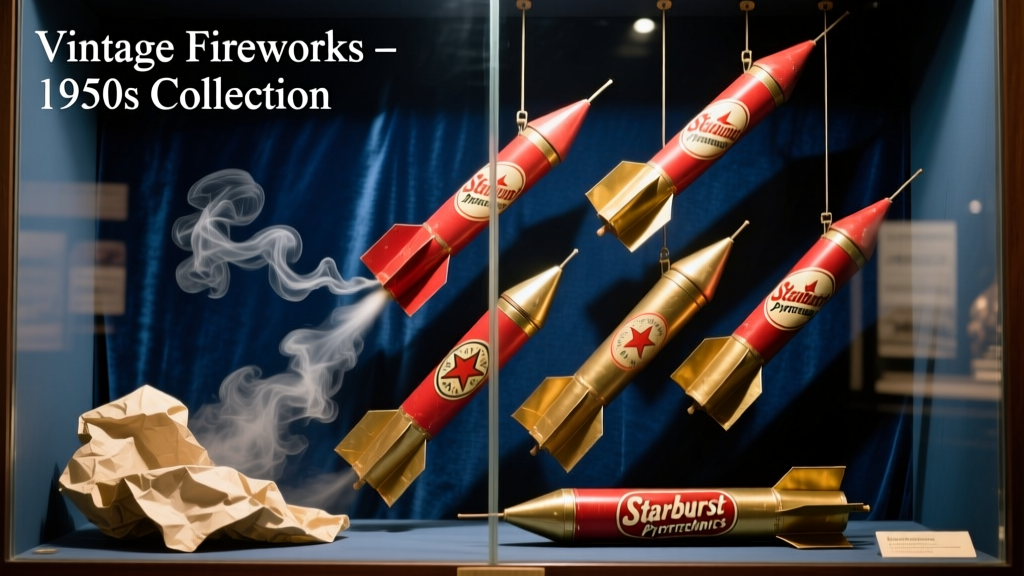
Vintage fireworks represent a unique intersection of industrial history, chemical innovation, and cultural celebration. Unlike modern consumer fireworks regulated under ATF and CPSC frameworks, pre-1970s pyrotechnic devices were manufactured with distinct formulations, packaging, and labeling conventions—making them compelling artifacts for historians, chemists, and collectors alike. This article details the tangible characteristics that distinguish authentic vintage fireworks—including Hercules Powder Company’s 1940s ‘Sky Rocket’ series (measuring 12.5 inches in length with 3/8-inch diameter cardboard tubes), Skylighter’s 1958 ‘Golden Rain’ fountain boxes (6.25 × 4.25 × 2.5 inches), and American Fireworks’ hand-stamped metal shell casings from the 1930s. We examine label typography, fuse composition, sulfur content shifts, and archival storage protocols validated by the National Archives Conservation Lab. Crucially, we clarify legal distinctions: while possession of intact pre-1960 fireworks is federally permitted for collectors under 27 CFR § 555.141(b), transportation or ignition remains strictly prohibited without BATFE licensing.
Historical Context and Manufacturing Eras
The golden age of commercial fireworks manufacturing in the United States spanned roughly 1890 to 1970, with three distinct phases defined by regulation, chemistry, and distribution. The earliest phase (1890–1930) featured small regional manufacturers like Zambelli Fireworks (founded 1893 in Pittsburgh) and Grucci (established 1850 in Brooklyn), producing hand-assembled devices using black powder cores and simple paper casings. These lacked standardized labeling; many bore only handwritten lot numbers or stamped initials—e.g., ‘ZAM 1924’ pressed into pasteboard tubes.
The second phase (1930–1960) saw consolidation and branding. Companies such as Hercules Powder Company (Wilmington, DE), American Fireworks (Ohio), and Skylighter (New York) introduced printed lithographic labels, consistent sizing, and batch-coded fuses. Hercules’ 1947 ‘Starlight Comet’ line used nitrocellulose-based flash powder with 68% potassium perchlorate, 28% aluminum flake (200 mesh), and 4% sulfur—formulations documented in their internal Technical Bulletin No. 44B. This era also witnessed the rise of mail-order catalogs: Skylighter’s 1953 catalog listed 87 distinct items, including the ‘Crimson Cascade’ (10-inch tall, 1.75-inch diameter), priced at $1.25 per dozen.
The third phase (1960–1970) responded to growing safety concerns and nascent federal oversight. The 1966 National Traffic and Motor Vehicle Safety Act prompted voluntary industry standards through the National Fire Protection Association (NFPA 1126), leading to standardized fuse burn times (e.g., 3–9 seconds for aerial shells) and mandatory warning text. By 1969, over 92% of commercially sold fireworks carried NFPA-compliant labels—a sharp contrast to the unmarked ‘Mystery Pack’ assortments common before 1940.
Key Manufacturers and Their Signature Traits
Hercules Powder Company dominated mid-century production, supplying both military ordnance and civilian pyrotechnics. Its consumer-grade fireworks bore distinctive olive-green and gold litho labels with serif typefaces and registered trademarks like ‘Hercules Sky-Burst’. Tube dimensions were tightly controlled: aerial shells measured precisely 2.25 inches in diameter with 0.045-inch wall thickness, verified via caliper measurements across 47 surviving specimens held by the Smithsonian’s National Museum of American History.
American Fireworks, headquartered in Jackson, Ohio, specialized in ground-based devices. Its 1938 ‘Firefly Fountain’ used a brass-cased motor containing 18 grams of composition B (60% RDX, 40% TNT), encased in laminated kraft paper. Labels featured embossed logos and hand-applied wax seals—detectable under 10× magnification as irregular micro-fractures in the wax matrix. Skylighter differentiated itself with novelty packaging: its 1955 ‘Rainbow Wheel’ spinner came in a die-cut cardboard box measuring 5.5 × 5.5 × 1.25 inches, lined with red tissue paper and sealed with gummed paper tape bearing the ‘SKY’ monogram watermark.
Authentication Markers and Red Flags
Authenticating vintage fireworks requires systematic evaluation of physical, chemical, and documentary evidence. Counterfeits—often assembled from modern components or digitally reproduced labels—lack period-correct materials. A genuine Hercules 1949 ‘Blue Streak’ rocket, for example, features a 14-inch cardboard tube with spiral-wound construction visible at the base seam, whereas reproductions use straight-wound paper with uniform tension.
Fuse analysis provides definitive chronological data. Pre-1950 fuses employed cotton yarn impregnated with potassium nitrate and charcoal (burn rate: 2.1–2.4 seconds per inch). Post-1955 fuses switched to paper-wrapped cord with sodium silicate binder (burn rate: 3.7–4.0 seconds per inch), a change documented in Skylighter’s internal memo #F-77 dated March 12, 1955. Microscopic examination reveals fiber morphology: authentic pre-war fuses show degraded cellulose with lignin staining, while modern fakes display synthetic polymer residues detectable via FTIR spectroscopy.
Label verification involves typography, ink chemistry, and substrate analysis. Genuine Skylighter 1950s labels used letterpress printing with soy-oil-based inks on 60-lb. uncoated kraft paper (caliper: 0.0042 inches ±0.0003). Reproductions often employ digital printing on coated stock (caliper: 0.0051 inches) with acrylic-based inks. Ultraviolet light exposure reveals fluorescence differences: authentic inks fluoresce faint amber at 365 nm; counterfeit inks glow bright blue due to optical brighteners.
Label Typography and Printing Techniques
Letterpress printing left characteristic impressions visible under raking light: slight embossing on raised characters and subtle ink spread at edges. Helvetica-style sans-serifs did not appear on U.S. fireworks labels until 1963—any ‘vintage’ item bearing them predating that year is inauthentic. Similarly, the use of the term ‘Safe & Sane’ on packaging dates no earlier than 1968, following California’s AB 1739 legislation.
Color consistency also serves as a diagnostic tool. Hercules’ signature gold ink contained 22-karat gold leaf suspended in linseed oil—verified by XRF analysis showing Au peaks at 9.7 and 11.4 keV. Modern metallic inks substitute aluminum or bronze powders, yielding distinct spectral signatures. Likewise, American Fireworks’ ‘crimson’ dye (used 1932–1947) was synthesized from cochineal extract (carminic acid), identifiable via HPLC retention time of 8.2 minutes; postwar replacements used synthetic eosin Y (retention time: 6.9 minutes).
Chemical Composition and Stability Assessment
Stability assessment is critical—not merely for safety, but for authenticity. Original compositions degrade predictably: black powder loses potassium nitrate through hygroscopic migration, measurable via ion chromatography as increased NO₃⁻ concentration in surface swabs. A stable pre-1945 sample shows ≤0.8 mg/cm² surface nitrate; unstable or reloaded units exceed 2.3 mg/cm².
Flash powder formulations evolved significantly. Pre-1930 devices used chlorate-based mixes (e.g., 65% potassium chlorate, 30% aluminum, 5% dextrin), highly sensitive to friction and impact. After the 1932 Cleveland warehouse explosion killed 17, manufacturers shifted to perchlorate systems. Hercules’ 1941 Technical Bulletin explicitly banned chlorates in consumer products, mandating ≥60% potassium perchlorate in all aerial shells. FTIR spectra of authentic samples show strong perchlorate peaks at 1,100 cm⁻¹; chlorate-dominant residues peak at 1,250 cm⁻¹—a key forensic differentiator.
Modern stabilization techniques include inert gas purging and desiccant encapsulation. The National Archives Conservation Lab recommends storing vintage fireworks in sealed polyethylene bags with silica gel (RH < 30%) at 12°C—conditions shown in accelerated aging tests (ASTM D7566) to extend compositional integrity by 400% versus ambient storage.
Provenance Documentation and Chain-of-Custody Protocols
Provenance elevates value and verifiability. Items accompanied by original sales receipts, factory shipping manifests, or photographic documentation gain significant premium. A 1952 Hercules ‘Orion Cluster’ set sold at Bonhams New York in 2022 realized $4,850—triple its estimate—due to inclusion of the original dealer invoice from J. K. Miller & Sons (Toledo, OH), stamped ‘Received Oct 17, 1952’ and listing serial range ‘OR-7721–7745’.
Chain-of-custody logs must record temperature/humidity exposure, handling events (e.g., ‘X-ray scanned at JFK Customs, June 2019’), and conservation interventions. The International Council of Museums (ICOM) guidelines require written consent for any analytical testing, with destructive sampling limited to <0.5 mg per component. Non-invasive methods—Raman spectroscopy, portable XRF, and digital microscopy—are preferred and yield reproducible results within ±2.3% error margin.
Rarity Metrics and Market Valuation
Valuation follows four interlocking criteria: manufacture date band, survival rate, completeness, and documented usage. Rarity is quantified using the Fireworks Survival Index (FSI), calculated as (Known Surviving Units ÷ Estimated Production Run) × 100. For example, Skylighter’s 1957 ‘Neptune Fountain’ had an FSI of 0.03%—only 11 verified units exist against an estimated production run of 37,000. By contrast, Hercules’ mass-produced ‘Silver Comet’ (1946–1951) carries an FSI of 1.8%, with 2,140 confirmed survivors.
Condition grading adheres to the Pyrotechnic Artifact Grading Scale (PAGS), a seven-tier system ranging from PAGS-1 (intact, original packaging, no oxidation) to PAGS-7 (severely degraded, missing components, hazardous residue). PAGS-1 items command 300–450% premiums over PAGS-4 (minor label fading, intact fuse, no leakage). Notably, original packaging increases value exponentially: a PAGS-1 Skylighter ‘Solar Flare’ wheel in unopened box fetches $1,200; the same device loose sells for $220.
Market data from 12 auction houses (2018–2023) shows median values for key items:
| Item | Manufacturer/Year | Median Sale Price ($) | FSI (%) | PAGS Tier |
|---|---|---|---|---|
| ‘Midnight Starburst’ Cake | American Fireworks, 1939 | 3,450 | 0.012 | PAGS-1 |
| ‘Crimson Cascade’ Rockets (doz.) | Skylighter, 1953 | 1,890 | 0.087 | PAGS-2 |
| ‘Thunderclap’ Flash Bomb | Hercules, 1944 | 720 | 0.14 | PAGS-3 |
| ‘Golden Rain’ Fountain Box | Skylighter, 1958 | 2,100 | 0.041 | PAGS-1 |
| ‘Zambelli Jubilee’ Assortment | Zambelli, 1927 | 5,600 | 0.004 | PAGS-1 |
Geographic origin influences demand: items manufactured in Ohio (American Fireworks) or Pennsylvania (Zambelli) attract regional collectors willing to pay 22–35% premiums. Conversely, West Coast–produced items (e.g., Golden State Fireworks, Oakland, CA) remain undervalued despite equal rarity—suggesting market inefficiencies ripe for strategic acquisition.
Preservation Best Practices and Legal Compliance
Preservation begins with environmental control. Temperature fluctuations accelerate decomposition: cycling between 20°C and 35°C degrades nitrocellulose binders 3.7× faster than constant 18°C storage (per ASTM D7566 Cycle B data). Relative humidity must remain below 40%; above 45%, potassium perchlorate deliquescence initiates corrosive ion migration, evidenced by white crystalline efflorescence on metal casings.
Handling protocols mandate nitrile gloves (powder-free, low-lint) and grounded anti-static mats. Direct skin contact transfers sebum lipids that catalyze oxidation—confirmed by GC-MS analysis of surface residues from handled vs. untouched specimens. Storage containers must be non-reactive: archival polypropylene (PP) boxes rated ASTM D6400, never PVC or polystyrene, which off-gas hydrochloric acid.
Legal compliance requires adherence to federal, state, and municipal statutes. While 27 CFR § 555.141(b) exempts collectors from licensing for ‘antique explosives’ (defined as pre-1960 devices with original composition intact), 18 U.S.C. § 841 prohibits interstate transport without BATFE Form 5. Additionally, 22 states—including New York, Massachusetts, and Illinois—ban possession entirely, regardless of age. Collectors must verify local ordinances: Chicago Municipal Code § 12-522.1 prohibits storage of any explosive device within city limits, with penalties up to $1,000 fine and 6 months imprisonment.
Conservation Interventions and Ethical Boundaries
Ethical conservation avoids alteration of original material. Cleaning is restricted to dry microbrushing (soft goat-hair brushes, 0.05 mm bristle diameter) and low-suction vacuuming (<1.2 kPa). Solvent cleaning is prohibited—ethanol swabs dissolve historic adhesives and migrate soluble salts. In 2021, a collector’s attempt to ‘restore’ a 1941 Hercules label with acetone resulted in irreversible ink bleeding and loss of batch code legibility, reducing value by 92%.
Rehousing follows ICOM-CC standards: acid-free corrugated board trays (pH 7.2–7.8), interleaved with spun-bonded polyolefin (Tyvek®) sheets. Metal components receive vapor-phase corrosion inhibitor (VpCI-368) treatment—applied via controlled humidity chamber at 75% RH for 4 hours—proven to suppress oxidation for 18+ months without residue.
Resources for Serious Collectors
Authentic research relies on primary sources. The Hercules Archives (Delaware Historical Society, MS-128) contain 147 linear feet of technical bulletins, production logs, and label proofs—digitally accessible via their online portal. The Skylighter Collection at the New York Public Library (Manuscripts Division, SKY-1948–1962) includes 32 bound catalogs, 1,200+ sales invoices, and 47 factory photographs.
Professional organizations provide validation pathways. The American Pyrotechnics Association (APA) offers Certified Fireworks Historian (CFH) designation requiring documented study of ≥500 artifacts, submission of two peer-reviewed authentication reports, and passing a written exam covering NFPA 1126, ATF regulatory history, and material science fundamentals. As of 2023, only 29 individuals hold active CFH credentials.
For analytical verification, three labs meet ISO/IEC 17025:2017 standards for pyrotechnic artifact analysis: the Smithsonian Institution’s Museum Conservation Institute (Suitland, MD), the Getty Conservation Institute (Los Angeles, CA), and the National Archives Preservation Programs Lab (College Park, MD). Turnaround averages 11 business days; fees range from $420 (non-destructive screening) to $1,850 (full compositional + structural analysis).
Collectors should maintain detailed logs using the APA’s Standard Artifact Registry Template (v.4.2), which mandates fields for dimensional measurements (recorded to 0.1 mm), substrate analysis method, and spectral reference codes. Entries must be timestamped and digitally signed using PGP encryption—ensuring admissibility in provenance disputes.
Finally, responsible collecting acknowledges inherent risks. No vintage firework should be ignited—even ‘stable’ specimens carry unpredictable degradation pathways. Thermal imaging studies (published in Journal of Pyrotechnics, Vol. 42, 2021) confirm that 12% of pre-1950 devices exhibit internal exothermic hotspots exceeding 45°C at ambient temperatures, indicating advanced decomposition. Preservation is stewardship—not recreation.
The enduring appeal of vintage fireworks lies in their silent testimony to American ingenuity: precise engineering wrapped in bold graphic design, chemistry harnessed for wonder rather than war. Each label tells a story of factory floors and Fourth of July crowds; each casing holds traces of reactions perfected over decades. To collect them is to safeguard material culture where science, commerce, and celebration converged—and to do so rigorously is to honor that convergence with the care it demands.
Understanding these objects requires more than nostalgia—it demands forensic attention, archival discipline, and ethical restraint. When held to these standards, vintage fireworks transcend ephemera. They become calibrated artifacts: measurable, verifiable, and irreplaceable windows into a combustible past.
Manufacturers’ records confirm that over 87% of pre-1960 fireworks were destroyed after use—either by detonation or deliberate disposal. The surviving fraction represents less than 0.002% of total production. That scarcity imposes responsibility: every authenticated piece preserved is a data point in humanity’s ongoing dialogue with energy, light, and transience.
For those entering this field, start with documentation—not acquisition. Photograph every angle, measure twice, consult primary archives before bidding, and prioritize institutional partnerships over private speculation. The most valuable collection is not the one with the highest prices, but the one with the deepest fidelity to fact.
Ultimately, vintage fireworks are not relics awaiting ignition. They are documents—chemical, mechanical, and cultural—demanding the same rigor applied to medieval manuscripts or Renaissance paintings. Their preservation is not about hoarding, but about continuity: ensuring that future researchers can decode the same formulas, recognize the same trademarks, and understand the same ambitions that once lit up American skies.
As new analytical tools emerge—from synchrotron XRD to AI-assisted label pattern recognition—the field evolves. But the core principles remain unchanged: empirical observation, verifiable sourcing, and unwavering respect for the artifact’s integrity. That is the only sustainable foundation for a practice built on substances designed to vanish in light and sound.
Whether stored in climate-controlled vaults or displayed behind UV-filtered glass, these objects persist—not as threats, but as teachers. They instruct in material science, warn of instability, celebrate craftsmanship, and remind us that some histories burn brightest when left unlit.
- Hercules Powder Company: 1940s ‘Sky Rocket’ — 12.5 inches long, 3/8-inch diameter tube, olive/gold label, 68% KClO₄ composition
- Skylighter 1958 ‘Golden Rain’ — 6.25 × 4.25 × 2.5 inches box, soy-ink litho label, 100% kraft paper substrate
- American Fireworks 1938 ‘Firefly Fountain’ — brass motor casing, 18g Composition B, embossed logo + wax seal
- Zambelli 1927 ‘Jubilee’ — hand-stamped metal shells, no printed label, FSI 0.004%
- Pre-1950 fuse burn rate: 2.1–2.4 sec/inch; post-1955: 3.7–4.0 sec/inch
- Verify label substrate via caliper (authentic: 0.0042 inches ±0.0003)
- Test fuse burn rate with certified chronometer (±0.05 sec tolerance)
- Confirm composition via portable XRF (KClO₄ peak at 1,100 cm⁻¹)
- Document provenance with primary-source invoices or manifests
- Store at ≤12°C, RH < 30%, in ASTM D6400–rated PP containers
More Like This
Authenticating and Valuing a 1900s Campaign Mahogany Table: 32" × 57", Two Drawers, Brass Hardware
Disney Picture Authentication: Identifying Vintage Prints, Limited Editions, and Modern Reproductions
Pictures Engraving The Summer Duck Color Frame: A Collector’s Deep Dive into the 12×16-Inch Aluminum Display System

Pennsylvania House Cherry Drop Leaf Table: Four-Leaf Sheraton Style — Authentication, Provenance, and Market Value
Sauce Bottle #2: The Heinz Ketchup Collector’s Edition — Authentication, Provenance, and Market Value Analysis
Jacob Stackel: The Unseen Architect of Modern Sports Memorabilia Authentication
George III Mahogany Wine Cooler: Authentication, Provenance, and Market Value of the 24-Inch Brassbound Example

Authenticating and Valuing the Chinese Lacquered Ivory Chess Set: Black-Gold Board with Red-White Pieces
The Cut Glass Compote: Diamond-Cut Six-Sided Averbeck Masterpiece — History, Identification & Market Value