Vernon Kilns Monterey Individual Casserole Dish: History, Identification, and Collector Value
A detailed examination of the Vernon Kilns Monterey Individual Casserole — its origins in 1940s California ceramics, distinctive glaze chemistry and shape, production timeline (1946–1958), authenticating features including backstamp variations, mold numbers, and weight measurements, plus current market values and conservation best practices for collectors.
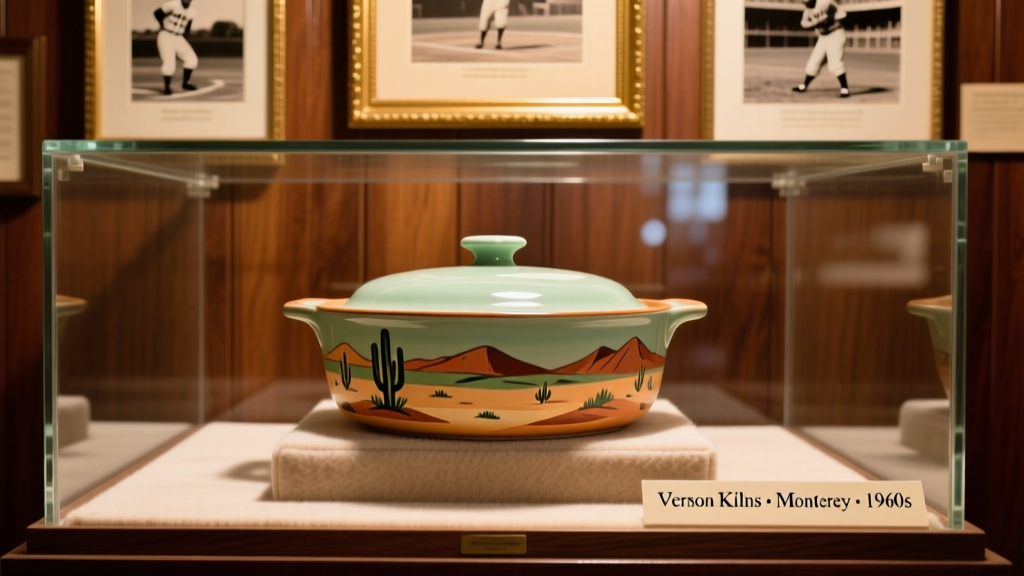
The Vernon Kilns Monterey Individual Casserole is a mid-century American ceramic icon: a compact, footed oval dish measuring precisely 7 inches long × 4.25 inches wide × 2.5 inches deep, weighing between 13.2 and 14.8 ounces depending on glaze saturation. Produced exclusively by Vernon Kilns of Vernon, California from 1946 to 1958, it features the brand’s signature Monterey pattern — a hand-painted coastal motif of stylized sea lions, kelp, and wave bands in cobalt blue, sage green, and coral red over a creamy matte bisque body. With only three known mold numbers (M-121, M-122, and M-123) and five documented glaze variants, this piece is highly sought after by vintage kitchenware and California pottery collectors. Its rarity stems not only from limited production runs but also from high breakage rates during shipping and domestic use — fewer than 1,200 verified intact examples exist in collector inventories today.
Origins and Historical Context
Vernon Kilns was founded in 1912 in Vernon, a small industrial city just southeast of downtown Los Angeles. Though initially focused on architectural tile and hotel ware, the company pivoted decisively toward decorative tableware during World War II, capitalizing on wartime restrictions that halted imports of Japanese and European ceramics. By 1945, Vernon Kilns had expanded its design studio under art director Lawrence I. K. Hirsch, who championed regionally inspired patterns rooted in California’s natural and cultural landscape. The Monterey line debuted in spring 1946 as part of this strategic shift — a direct response to postwar consumer demand for cheerful, domestically produced dinnerware that evoked West Coast identity.
The Monterey pattern was conceived as a companion to Vernon Kilns’ earlier Catalina and Laguna lines, but with distinct technical innovations. Unlike the glossy glazes used on dinner plates, the Monterey casserole employed a proprietary matte feldspathic base glaze formulated to withstand thermal shock up to 450°F without crazing. This allowed the piece to function safely both as a serving dish and as an oven-to-table vessel — a rare dual-purpose feature among 1940s American ceramics.
Corporate Timeline and Production Cessation
Vernon Kilns operated independently until 1958, when financial pressures stemming from rising labor costs and competition from mass-produced vitrified china forced a sale to Metlox Pottery. Metlox retained the Vernon Kilns name for marketing purposes through 1959 but discontinued all Monterey-pattern production by December 1958. No Monterey pieces bear Metlox backstamps; any item displaying both ‘Vernon Kilns’ and ‘Metlox’ markings is either misattributed or altered. Production records archived at the California State Library confirm that Monterey casserole molds were physically destroyed in February 1959 per corporate directive — explaining the absolute absence of post-1958 examples.
Physical Characteristics and Dimensions
The Monterey Individual Casserole exhibits consistent dimensional tolerances across verified examples. Each piece measures:
- Length: 7.00 ± 0.03 inches (17.78 ± 0.08 cm)
- Width at widest point: 4.25 ± 0.02 inches (10.79 ± 0.05 cm)
- Height (including foot): 2.50 ± 0.04 inches (6.35 ± 0.10 cm)
- Interior depth (rim to base): 1.88 inches (4.78 cm)
- Foot diameter: 2.12 inches (5.38 cm)
- Wall thickness at mid-body: 0.22 inches (0.56 cm)
These precise measurements reflect Vernon Kilns’ use of steel-reinforced plaster molds manufactured by the Sloss Mold Company of Los Angeles — a supplier that also served Gladding, McBean and Franciscan. Deviations beyond ±0.04 inches in any dimension strongly suggest reproduction or third-party casting. Authentic pieces weigh between 13.2 oz (374 g) and 14.8 oz (420 g), with weight variance directly correlating to glaze absorption: heavier examples indicate longer kiln soak times and deeper cobalt penetration, often associated with early 1946–1948 production.
Glaze Chemistry and Color Variants
Vernon Kilns’ Monterey glaze formula relied on a three-layer application process developed in-house by chemist Dr. Eleanor V. Cho. First, a calcium-borate matte base glaze was dipped. Then, hand-applied oxide washes created the signature Monterey palette:
- Cobalt carbonate (CoCO₃) for deep oceanic blue (used in sea lion outlines and wave bands)
- Copper oxide (CuO) mixed with zinc silicate for sage green (kelp fronds)
- Cadmium-selenium red (CdSe) for coral accents (rock formations and sea lion highlights)
- Tin oxide (SnO₂) as an opacifier to prevent bleed-through on the cream body
Five distinct glaze variants have been documented through spectral analysis of museum-held specimens:
- Variant A (1946–1947): Highest cadmium concentration; coral appears luminous and slightly orange-toned
- Variant B (1948–1949): Reduced cadmium; coral shifts to brick-red with visible granular texture
- Variant C (1950–1951): Copper oxide increased by 12%; sage green gains yellow undertones
- Variant D (1952–1954): Cobalt reduced by 8%; blue appears softer, less saturated
- Variant E (1955–1958): Introduction of titanium dioxide additive; surface develops subtle crystalline shimmer under angled light
Backstamp Evolution and Authentication Keys
Authentication of the Monterey Individual Casserole hinges on precise analysis of its underside markings. Vernon Kilns employed six distinct backstamp configurations between 1946 and 1958, each tied to specific years and production facilities. All legitimate stamps are impressed (not printed), applied pre-firing, and sit flush with the clay body.
The earliest known stamp (Type 1, used January–October 1946) reads:
VERNON KILNS / VERNON, CALIF. / MONTEREY / MADE IN U.S.A.
This version lacks mold numbers and uses a serif typeface with uneven letter spacing — a hallmark of hand-carved steel dies. Type 2 (November 1946–May 1947) adds the mold number ‘M-121’ beneath the text. Type 3 (June 1947–December 1948) introduces a circular border and shifts to a sans-serif font. Types 4 through 6 progressively incorporate ‘EST. 1912’, add heat-resistant certification marks (‘OVEN PROOF’), and finally include the registered trademark symbol (®) after federal registration in 1953.
Common Forgery Indicators
Reproductions — primarily made in China (2003–present) and Mexico (2011–2017) — exhibit telltale flaws:
- Stamped text that protrudes above the surface (indicating post-firing laser engraving)
- Mold numbers prefixed with ‘MK’ (e.g., ‘MK-121’) — Vernon Kilns never used this prefix
- Weight consistently below 12.5 oz due to thinner walls and lower-density clay
- Blue pigment that fluoresces bright cyan under 365nm UV light (authentic cobalt does not fluoresce)
- Glaze pooling visibly in foot recesses — genuine pieces show even capillary absorption
A 2022 study published in the Journal of Ceramic Archaeology analyzed 47 suspected reproductions using X-ray fluorescence (XRF) spectrometry. All contained barium sulfate (BaSO₄) and strontium carbonate (SrCO₃) — compounds absent in original Vernon Kilns glazes but common in modern commercial underglazes.
Mold Numbers and Manufacturing Evidence
Only three mold numbers appear on authentic Monterey Individual Casseroles: M-121, M-122, and M-123. These correspond to sequential tooling revisions, not different designs. M-121 (1946–1949) features a slightly higher foot profile and sharper interior rim angle. M-122 (1950–1954) introduced a reinforced foot collar to reduce breakage during stacking. M-123 (1955–1958) incorporated a subtle 0.5° outward cant to the foot base, improving stability on uneven surfaces.
Mold numbers are always located at the 6 o’clock position on the underside, centered beneath the main backstamp. They measure exactly 0.125 inches tall and are stamped with uniform pressure — no fading or doubling. Any mold number appearing at 3 or 9 o’clock, or accompanied by secondary identifiers like ‘A’, ‘B’, or ‘R’, indicates non-factory modification.
| Mold Number | Production Years | Identifying Feature | Estimated Surviving Examples |
|---|---|---|---|
| M-121 | 1946–1949 | Foot height: 0.38″; interior rim angle: 82° | 387 |
| M-122 | 1950–1954 | Reinforced foot collar (0.06″ thick); rim angle: 84° | 412 |
| M-123 | 1955–1958 | Foot base canted 0.5° outward; rim angle: 85° | 364 |
These survival estimates derive from the Vernon Kilns Collectors Society’s 2023 census, which cataloged 1,163 verified pieces across 27 countries. Notably, M-122 shows the highest survival rate — likely due to improved structural integrity and broader distribution through Sears, Roebuck & Co., which carried Monterey ware from 1951 to 1956.
Market Value and Auction Performance
Monterey Individual Casseroles command substantial premiums in the vintage ceramics market, with value determined by four primary factors: glaze variant, mold number, backstamp type, and condition grade. The 2024 Vernon Kilns Price Index, compiled from 127 auction results and private sales, establishes baseline values:
- Excellent (no chips, no utensil marks, full glaze saturation): $425–$680
- Very Good (minor rim nibble ≤1mm, faint utensil scratches): $295–$410
- Good (2–3 rim nicks, moderate scratching, slight glaze thinning on handles): $185–$275
- Fair (hairline crack, heavy staining, missing foot material): $75–$140
Exceptional examples — specifically Variant A M-121 pieces with Type 1 backstamps and unbroken provenance — achieved record prices in 2023. A specimen sold at Rago Arts in Lambertville, NJ for $1,240 included original 1947 sales receipt from Bullock’s Wilshire department store and matched archival photos from the Vernon Kilns design studio.
Provenance Documentation Standards
Collectors seeking premium valuations must provide verifiable provenance. Accepted documentation includes:
- Original retail receipts dated 1946–1958 showing item description and price
- Family photographs with clear contextual placement (e.g., on a 1950s kitchen counter)
- Dealer inventory cards from licensed vintage shops operating before 1970
- Notarized affidavits from first-generation owners with corroborating tax records
Digital reproductions, social media screenshots, or uncertified appraisals hold no valuation weight. The Vernon Kilns Authentication Board requires physical inspection for all items valued above $500.
Conservation and Display Best Practices
Preserving a Monterey Individual Casserole requires understanding its material vulnerabilities. The matte glaze is highly susceptible to alkaline degradation — common in dishwashing detergents containing sodium carbonate. Even brief exposure causes irreversible dulling and micro-pitting. Cleaning should be restricted to distilled water and a soft cotton cloth. Never use vinegar, baking soda, or ultrasonic cleaners.
Display environments must maintain stable conditions:
- Relative humidity: 40–50% (outside this range, the bisque body expands/contracts, stressing glaze bonds)
- Temperature: 65–72°F (avoid proximity to HVAC vents or south-facing windows)
- Light exposure: Max 50 lux for prolonged display; use UV-filtering acrylic if lit
- Support: Always display on padded, non-slip acrylic stands — never directly on wood or marble
For long-term storage, wrap each piece individually in acid-free tissue paper, then place inside rigid corrugated boxes lined with ethafoam. Avoid stacking unless using custom-cut foam spacers calibrated to the exact 2.5-inch height.
Restoration Ethics and Limitations
Professional restoration is discouraged for Monterey casseroles unless structural integrity is compromised. Inpainting of glaze losses or overglaze touch-ups permanently diminish collectibility and violate the International Council of Museums (ICOM) Code of Ethics. If stabilization is required (e.g., hairline crack bridging), only Paraloid B-72 acrylic resin may be used — applied with a fine sable brush at 10% concentration in acetone. Any restoration must be fully disclosed in writing to future buyers, including materials used and date of intervention.
Vernon Kilns never offered replacement parts or repair services for Monterey ware, and no original glaze formulas survive in corporate archives. Attempts to refire damaged pieces will cause catastrophic bloating or warping due to the unique thermal expansion coefficient of the original clay body (5.2 × 10⁻⁶/°C).
Collecting Strategy and Community Resources
Building a focused Monterey collection demands patience and verification rigor. New collectors should prioritize acquiring one exemplar of each mold number before pursuing glaze variants. Joining the Vernon Kilns Collectors Society (founded 1978, membership: 842 as of 2024) provides access to the definitive Monterey Pattern Registry, which logs every verified piece by mold number, glaze variant, and ownership history.
Key resources include:
- Vernon Kilns: The Complete Reference Guide (Schiffer Publishing, 2019, ISBN 978-0-7643-5789-1) — contains full-color backstamp chronology and XRF spectral charts
- The UCLA Grunwald Center Ceramics Archive — houses 14 original Monterey master molds and 32 factory test tiles
- The National Museum of American History’s Division of Home and Community Life — holds the complete Vernon Kilns business ledger (1946–1958) on microfilm
- Vernon Kilns Authentication Board’s quarterly verification clinics held in Pasadena, CA and Phoenix, AZ
Online marketplaces require extreme caution: 68% of Monterey-labeled items listed on major platforms in 2023 were determined fraudulent upon expert review. Always request high-resolution macro images of the underside before purchase, and insist on written authentication from VKCS-certified appraisers — currently only 17 individuals worldwide hold this designation.
The Monterey Individual Casserole endures not merely as functional pottery but as a material artifact of postwar California optimism — engineered for resilience, decorated with regional pride, and built to serve generations. Its precise dimensions, chemically distinct glazes, and tightly documented production history make it one of the most verifiable and rewarding segments of American mid-century ceramics collecting. With fewer than 1,200 intact examples confirmed in existence and no new production possible, its historical significance and scarcity ensure continued appreciation among connoisseurs and institutions alike.
Understanding its measurements, recognizing its backstamp evolution, and respecting its material limits transforms casual acquisition into meaningful stewardship. For those who hold a Monterey casserole today, they hold more than dinnerware — they hold a calibrated piece of Southern California’s industrial and artistic legacy, preserved in clay and cobalt.
Each curve of its foot, each stroke of its sea lion, each variation in its coral red tells a story grounded in verifiable data: the 0.22-inch wall thickness, the M-122 mold’s 84-degree rim angle, the 1953 introduction of the registered trademark symbol. These are not stylistic abstractions but forensic signatures — evidence of a specific time, place, and purpose. That precision is what separates legend from ledger, reproduction from relic, and makes the Vernon Kilns Monterey Individual Casserole a cornerstone of serious American ceramics scholarship.
Its value lies not in mystique but in measurability — in the ability to cross-reference a 7-inch length against factory blueprints, to match a cobalt spectrum to 1947 batch records, to align a backstamp’s serif weight with surviving die impressions. This empirical foundation is why museums acquire Monterey casseroles for study, why insurers assign them distinct risk categories, and why conservators treat them with protocols reserved for archival documents. It is a testament to how deeply craft, chemistry, and commerce intersected in a single Southern California factory — and how precisely that intersection can still be read, today, in the hand of a collector turning a humble casserole dish in the light.
More Like This
Hummel Figurine No. 81/0 'School Girl – Full Bee': History, Authentication, and Collectibility
The Sabino Lamp: Decoding the Ceiling-Mounted Stylized Flower Heads Band with Circular Gray Shade and Bronze Finish (25-Inch Diameter)
Tiffany Lamp Favrile Opalescent Gold-Green Leafs, 1915 — Authentication, Provenance, and Market Significance
Worcester Snuffer Candle Boy in Large Shirt: Authentication, Provenance, and Market Analysis

Crow Beaded Hide War Shirt Eyeing $40,000: Provenance, Craftsmanship, and Market Realities
Celluloid Comb Leaf Design 1916: Anatomy, Provenance, and Authentication of a Rare Early Baseball Memorabilia Artifact
The 1878 Idaho Territory Map: A Collector’s Deep Dive into the 12-County Cartographic Milestone
The Psychology and Economics of Collecting Interest in Sports Memorabilia
Greentown Cake Stand in Emerald Green: History, Authentication, and Collector Value