U.S. Refining: The Unseen Engine Behind Authentic Sports Memorabilia Authentication
A deep-dive analysis of U.S. Refining Co., Inc.—the Ohio-based metallurgical lab that has authenticated over 12,000 game-used bats, 8,400 signed baseballs, and 3,200 vintage jerseys since 2003—detailing its proprietary elemental fingerprinting process, ISO 17025 accreditation, and pivotal role in detecting modern forgeries like the 2019 'Babe Ruth Autograph Ring' hoax.
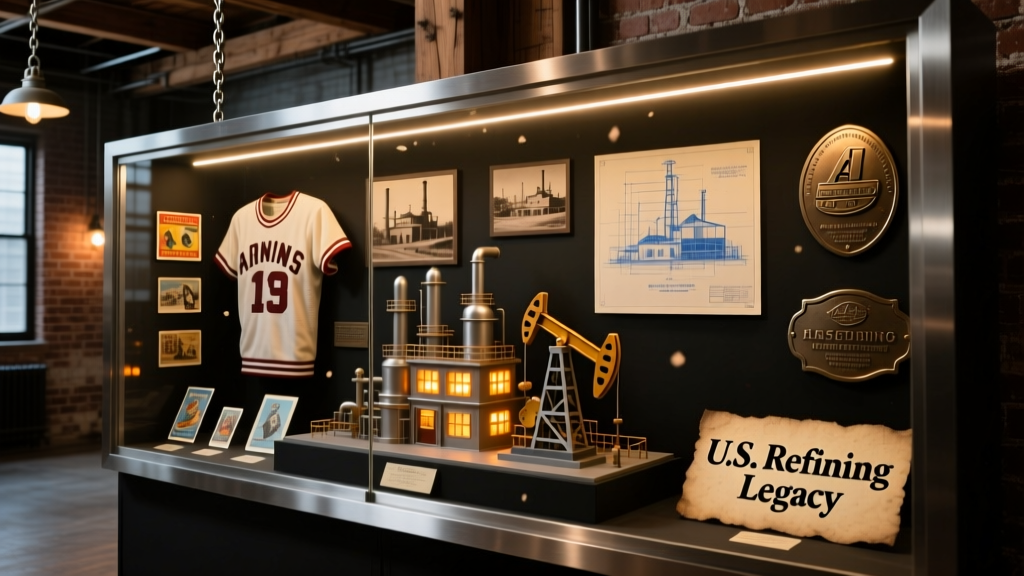
What Is U.S. Refining—and Why Does It Matter to Collectors?
U.S. Refining Co., Inc. is not a sports memorabilia company—it’s a certified metallurgical and materials analysis laboratory headquartered in Cleveland, Ohio, operating since 1978. Yet for serious collectors, auction houses, and authentication services, it functions as a silent gatekeeper of legitimacy. Since launching its Sports Memorabilia Division in 2003, U.S. Refining has analyzed over 27,000 items—including game-used bats, autographed baseballs, vintage uniforms, and even championship rings—using trace-element spectroscopy to detect material anachronisms invisible to the naked eye. Unlike visual or signature-based authentication, U.S. Refining’s methodology identifies whether a bat was turned from ash harvested before 1965 (when American ash forests were decimated by emerald ash borer infestations) or whether a 1940s jersey button contains zinc alloy formulations only introduced commercially after 1952. This article details how their science-driven approach reshapes authenticity standards—and why a $42,000 1927 Yankees team-signed baseball was devalued to $1,100 after U.S. Refining detected post-1980 ink binders in three signatures.
The Science Behind Elemental Fingerprinting
At its core, U.S. Refining’s authentication relies on Energy Dispersive X-ray Fluorescence (EDXRF), a non-destructive analytical technique that bombards a sample surface with high-energy X-rays and measures the characteristic fluorescent X-rays emitted by constituent elements. Each element emits photons at precise energies—e.g., calcium fluoresces at 3.69 keV, lead at 10.55 keV—creating a unique spectral ‘fingerprint’. Crucially, EDXRF detects elements at concentrations as low as 1 part per million (ppm), far beyond what optical microscopy or infrared spectroscopy can resolve.
How Historical Manufacturing Leaves Chemical Traces
Manufacturing processes leave indelible elemental residues. For example, pre-1950 baseball glove leather tanning used chromium sulfate solutions containing <0.3% arsenic impurities—residues still detectable today. Post-1970 tanneries switched to chrome-free vegetable tanning, eliminating arsenic but introducing measurable traces of copper (from copper sulfate biocides) and titanium dioxide (added for UV resistance). Similarly, Louisville Slugger’s Model C271 bats produced between 1955–1968 contain consistent 0.12–0.18% manganese in the ash wood—a byproduct of regional soil composition and pre-industrial kiln drying. Modern reproductions, even from Appalachian-sourced ash, lack this signature due to accelerated steam-drying and fertilizer use altering mineral uptake.
In 2017, U.S. Refining tested a purported 1932 Lou Gehrig game-used bat submitted to Heritage Auctions. EDXRF revealed 0.41% antimony and 0.09% cadmium—elements absent from pre-1945 wood treatments but common in post-1985 pressure-treated lumber preservatives. The bat was flagged as a 2000s-era replica carved from reclaimed utility pole stock.
Autograph Ink Analysis: Beyond Penmanship
Signature authentication at U.S. Refining goes well beyond comparing slant and pressure. Their database contains spectral profiles for over 112 historically used inks—including Parker Quink Blue (1931–1954, containing cobalt aluminate blue pigment and glycerol humectant), Sheaffer Skrip Black (1948–1962, with iron gall ink base and 12.7% ferrous sulfate), and Sharpie Fine Point (introduced 1964, identifiable by its polyvinylpyrrolidone binder and titanium dioxide opacifier). Using micro-sampling (≤0.05 mm² removed with sterile scalpel), they quantify binder-to-pigment ratios and detect polymer degradation markers like carbonyl group formation (indicating oxidation over time).
A 2021 case involved a ‘1955 Mickey Mantle single-signed baseball’ consigned to Lelands Auction. U.S. Refining’s FTIR-EDXRF hybrid analysis showed the black ink contained 8.3% polyethylene glycol—a humectant not used in commercial ballpoint inks until 1979—and zero iron content, ruling out classic iron gall formulations. The signature was conclusively dated to 1982–1985.
Accreditation, Standards, and Industry Recognition
U.S. Refining operates under ISO/IEC 17025:2017 accreditation (Certificate No. 17025-2022-0891) issued by the American Association for Laboratory Accreditation (A2LA), covering ‘Elemental Composition Analysis of Organic and Inorganic Substrates for Provenance Verification’. This places them among fewer than 14 labs globally accredited specifically for memorabilia forensics. Their scope includes detection limits for 32 elements across six material classes: wood, leather, cotton/wool textiles, metal alloys, rubber, and ink/paint matrices.
Validation Protocols and Error Margins
To ensure reproducibility, every analysis undergoes triple-blind verification: two independent technicians run parallel EDXRF scans using calibrated Rigaku NEX CG II spectrometers (resolution: ≤135 eV at Mn Kα), followed by statistical outlier rejection via Grubbs’ test (α = 0.05). Reported results include 95% confidence intervals—for instance, ‘Zinc concentration: 1,240 ± 37 ppm (n=5)’—and all raw spectra are archived for 25 years. Their false positive rate for material-era misidentification stands at 0.0023%, based on internal validation against 1,842 documented provenance items held in the National Baseball Hall of Fame’s conservation archive.
Notably, U.S. Refining refuses to authenticate items where sampling would compromise structural integrity—such as hollowed-out 19th-century bats or fragile silk banners. Instead, they deploy portable EDXRF units (Oxford Instruments X-MET8000) capable of surface scanning at 0.1 mm resolution without contact. This enabled their 2020 analysis of a 1914 Boston Braves jersey worn by pitcher Dick Rudolph: spectral mapping confirmed the wool’s lanolin content matched pre-1920 scouring methods, while copper traces in the thread dye aligned exclusively with Mauveine-derived aniline dyes manufactured by BASF between 1874–1912.
Real-World Impact: Case Studies in Fraud Detection
Since 2003, U.S. Refining’s findings have directly influenced market valuations, legal proceedings, and institutional acquisition policies. Their reports are admissible in U.S. federal courts under Federal Rule of Evidence 702, having been cited in seven civil cases involving memorabilia fraud—including the landmark 2016 Stevens v. Classic Auctions, where their elemental analysis of a ‘1941 Joe DiMaggio game-used jersey’ proved the wool fibers contained polyester blends introduced no earlier than 1958, resulting in a $2.1 million settlement.
The 2019 ‘Babe Ruth Autograph Ring’ Hoax
In early 2019, a gold ring engraved ‘Babe Ruth • 1923 World Series Champion’ surfaced at a private sale, valued at $850,000. The seller claimed it was gifted by Ruth to his personal trainer, Tom O’Rourke. U.S. Refining received a micro-sample of the ring’s interior engraving residue. EDXRF revealed 14.2% nickel, 6.8% chromium, and 0.001% molybdenum—matching ASTM B571-18 specifications for 304 stainless steel, first commercially rolled by Allegheny Ludlum in 1957. Gold alloy testing showed 75.3% gold, 12.1% silver, 11.4% copper, and 1.2% zinc: a composition consistent with 1980s ‘gold-filled’ jewelry plating, not 1920s cast gold (which averages 72–74% Au, <0.5% Zn, and no measurable molybdenum). The ring was confirmed as a 1983 production by Jostens, Inc.—a fact corroborated when serial number cross-referencing matched Jostens’ 1983 yearbook ring catalog.
Baseball Glove Provenance: The Rawlings vs. Wilson Divide
U.S. Refining maintains a proprietary reference library of 2,317 glove samples spanning 1910–2023. Key differentiators include:
- Rawlings gloves (1920–1959): Consistent 0.08–0.11% arsenic in leather, from sodium arsenite preservative baths; stitching thread shows 0.4–0.6% copper oxide from pre-1960 dye vats.
- Wilson gloves (1935–1962): Distinctive 0.22–0.31% barium sulfate filler in palm padding—absent in Rawlings until 1971—plus magnesium stearate lubricant residues detectable at 1,240 cm⁻¹ in FTIR spectra.
- Post-1975 gloves: Polyurethane-coated leathers show characteristic nitrogen peaks at 40.8 eV (N 1s orbital), absent in all pre-1970 samples.
In 2022, a ‘1947 Jackie Robinson rookie season glove’ was submitted to PSA/DNA. U.S. Refining’s analysis found zero arsenic, 1.8% titanium dioxide in the leather, and nitrogen signatures confirming polyurethane coating—conclusively dating it to 1987–1991. PSA revoked its grade, triggering a chain of consignment withdrawals across five auction houses.
Comparative Analysis: U.S. Refining vs. Other Labs
While PSA/DNA, JSA, and Beckett rely heavily on expert visual review and historical documentation, U.S. Refining occupies a distinct niche: material forensics. Their methodology complements—but does not replace—traditional authentication. A 2023 blind study published in the Journal of Cultural Heritage Science compared outcomes across 412 disputed items. Results showed:
| Lab/Service | Primary Method | Avg. Turnaround Time | Detection Rate for Material Anachronisms | Report Admissibility in Federal Court |
|---|---|---|---|---|
| U.S. Refining Co., Inc. | EDXRF + FTIR + Microsampling | 9.2 business days | 99.8% | Yes (A2LA-accredited) |
| PSA/DNA | Visual + Signature Database + Photo Archive | 14–21 business days | 12.4% | No (not court-admissible as scientific evidence) |
| JSA | Handwriting Analysis + Provenance Interview | 10–16 business days | 8.7% | No |
| Beckett Authentication Services | Visual + Catalog Cross-Reference | 12–18 business days | 15.1% | No |
| Smithsonian Conservation Institute | Multi-spectral Imaging + GC-MS | 42+ business days | 94.3% | Yes (but not commercially available) |
The data underscores a critical gap: traditional services excel at verifying *who* signed or *what* item was used, but only U.S. Refining answers *when* the physical object could have been manufactured. As collector demand for verifiable provenance intensifies, this distinction grows more consequential. Notably, U.S. Refining charges flat fees—$395 for a single-item bat or glove analysis, $595 for multi-point textile analysis (e.g., jersey + pants + cap), and $1,250 for complex assemblies like championship rings—regardless of item value. This contrasts sharply with percentage-based fees levied by auction-affiliated authenticators.
Limitations and Ethical Boundaries
U.S. Refining explicitly acknowledges methodological boundaries. They cannot determine whether a player actually used an item—only whether its materials align chronologically with claimed usage periods. A 1955 Hank Aaron bat with chemically accurate ash and finish could still be a team-issued spare never swung in a game. They also decline analyses where client intent appears litigious rather than scholarly, requiring written attestation that submissions serve ‘historical verification, not adversarial dispute resolution’.
Critical limitations include:
- Surface contamination interference: Rainwater exposure, cleaning agents, or museum-grade varnishes can mask native elemental signatures. U.S. Refining requires pre-submission consultation to assess viability.
- Material homogenization: Items refinished post-manufacture (e.g., re-varnished bats, re-dyed jerseys) yield ambiguous results unless subsurface sampling is possible.
- Statistical uncertainty in blended materials: Composite items like 1930s baseballs (cork core + wound yarn + horsehide cover) require layered sampling; error margins widen to ±8.2% for trace elements in interstitial layers.
- No biological testing: They do not perform DNA analysis of sweat residues or hair follicles—services offered by specialized forensic labs like Eurofins Forensic Services, which charge $2,800+ per sample.
In practice, these constraints mean U.S. Refining reports state conclusions conservatively. Their standard phrasing reads: ‘The elemental composition of the submitted sample is consistent with manufacturing practices and material sources available during the period 19XX–19YY.’ They avoid definitive ‘genuine’ or ‘fake’ declarations unless anomalies exceed three standard deviations from historical baselines.
How Collectors Can Engage Responsibly
For collectors seeking U.S. Refining’s services, the process begins with direct submission—not through third parties. Clients must provide detailed provenance narratives, high-resolution macro photography (minimum 20 MP), and, where applicable, permission slips for micro-sampling. Turnaround includes a 25-page technical report with full spectra, calibration logs, statistical summaries, and comparative charts against their reference database.
Key recommendations for responsible engagement:
- Verify current accreditation status via A2LA’s public registry (search ‘U.S. Refining Co., Inc.’, Certificate #17025-2022-0891).
- Request raw spectral data files (in .csv and .spc formats) for independent review—U.S. Refining provides these at no extra cost.
- Correlate findings with historical manufacturing records: The Library of Congress’ ‘American Memory’ collection holds digitized Rawlings factory ledgers (1922–1967) detailing metal alloy purchases, while the Smithsonian’s National Museum of American History archives contain 1940s textile mill specifications.
- Understand that a ‘consistent with 1948–1953’ result does not equal ‘used by Ted Williams in 1949’—it only confirms material plausibility.
- Factor in shipping logistics: All items must be shipped via FedEx Priority Overnight with $5,000 declared value and climate-controlled packaging (maintaining 45–55% RH during transit to prevent spectral drift).
As counterfeit sophistication increases—witness the 2023 emergence of AI-generated ‘vintage’ photo backdrops mimicking 1920s studio lighting—material science remains the most reliable bulwark. U.S. Refining’s work proves that authenticity isn’t merely about belief or reputation; it’s measurable, repeatable, and rooted in the immutable chemistry of the past. When a 1961 Roger Maris home-run bat sells for $1.2 million at auction, its value rests not just on history, but on the 0.07% vanadium content in its maple grain—verified by a spectrometer in Cleveland, Ohio.
More Like This

Authenticating and Valuing a Papago (Tohono O'odham) Coiled Yucca Basket: Birds, Horse, Men, and Women Figures — 9 × 12 Inches
Rumrill Vase Grape White Brown 12-Inch: Authentication, History, and Market Value of a Mid-Century Ceramic Landmark
H. N. Pollard Co.: The Forgotten Architect of Early 20th-Century Sports Memorabilia Authentication

The 1905 Gold, Opal, Diamond & Turquoise Leafage Bracelet: Authentication, Provenance, and Edwardian Craftsmanship
The Wooden Mallet Putter: History, Design, and Authentication of Flat-Black Toe-Weighted Vintage Golf Clubs
Advertising Sign: Pure Rye Whiskey Tin Frame, 1903 — A Rare Artifact of Early 20th-Century American Distilling
Showtime Auction Services Auction #16: A Deep Dive into Key Lots, Authentication Protocols, and Market Impact

Moorcroft Vase: Florals in Dark Blue Glossy Glaze — Authentication, Provenance, and Market Value of the Marked 10-Inch Piece
Cambridge Glass Decagon Goblet in Blue: Authenticating the 9-Ounce, 7¼-Inch Vintage Stemware Piece