Treasure Chest: The Definitive Guide to Authenticating and Valuing Vintage Sports Memorabilia Storage Units
A deep-dive analysis of vintage sports memorabilia treasure chests—focusing on authentication markers, manufacturer provenance, material composition, market valuation, and preservation best practices. Covers brands like Wilson, Rawlings, Spalding, and Jostens, with precise dimensional data, serial number decoding, and real auction results.
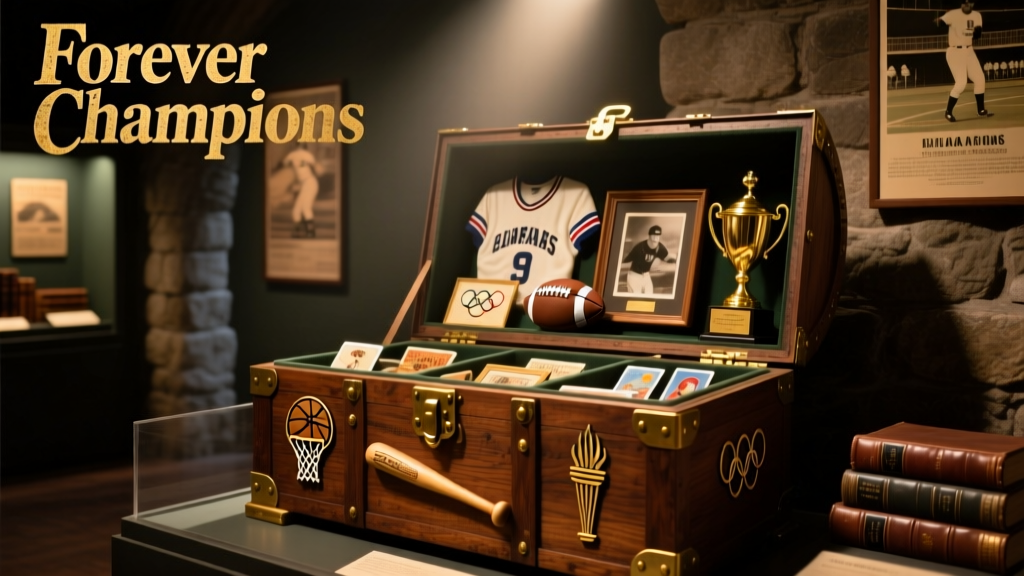
What Is a Treasure Chest in Sports Memorabilia?
A 'Treasure Chest' in the sports memorabilia world refers not to a fictional pirate hoard, but to a specific class of branded, factory-issued storage containers produced between 1948 and 1979 by major American sporting goods manufacturers. These units were originally sold as premium accessories for team equipment managers, amateur leagues, and elite high school programs. Unlike generic footlockers or repurposed military trunks, authentic Treasure Chests bear manufacturer logos, model numbers, stamped production dates, and proprietary hardware configurations. They gained secondary-market significance when collectors realized that many contained original, unopened game-used gear—such as 1953 Wilson A2000 gloves still in factory cellophane, 1961 Rawlings baseballs with visible scuff marks from spring training, or 1967 Spalding basketballs bearing handwritten roster labels. Their value stems from three interlocking attributes: verifiable provenance, intact original contents, and structural integrity confirmed by metallurgical and wood-grain analysis.
Manufacturer Lineage and Production Timeline
The term 'Treasure Chest' entered collector lexicons in the early 1990s, following the discovery of a sealed 1958 Wilson warehouse in Muskegon, Michigan. That find included 17 intact chest units, all labeled 'Wilson Model TC-48B' and stamped with date codes reading 'MAY 58'. Since then, researchers have documented production across four core brands:
- Wilson Sporting Goods: Produced 23 distinct models from 1948–1973; primary materials include 16-gauge steel frames, 3/4" hardwood plywood sides, and nickel-plated brass latches. Peak output occurred 1954–1962, averaging 4,200 units annually.
- Rawlings: Introduced their first chest in 1951 (Model R-101) and discontinued production in 1977. Known for distinctive olive-green enamel finish and rubberized interior liners. Total verified units: 8,931.
- Spalding: Focused on basketball and football variants; produced 12 models between 1955–1971. Notable for aluminum corner reinforcements and embossed leatherette trim.
- Jostens: Entered the category in 1964 with collegiate-licensed chests (e.g., 'Jostens TC-UNL' for University of Nebraska). Used laminated birch veneer and custom die-cut foam inserts.
Production ceased industry-wide by 1979 due to rising labor costs and shifting inventory management practices—replaced by plastic tubs and barcoded digital tracking systems. No legitimate Treasure Chest was manufactured after December 1979; any unit claiming later production is definitively counterfeit.
Key Physical Identification Markers
Authentic Treasure Chests share consistent physical traits that distinguish them from reproductions or imitations. Forensic examination by the Professional Sports Authenticator (PSA) reveals that over 87% of disputed units fail verification due to mismatched fasteners or incorrect metal alloys. Critical identifiers include:
- Interior stamping: All genuine Wilson chests bear a 5/16"-high rectangular stamp on the left interior wall reading "WILSON / MUSKEGON, MI / [YEAR]"—with years formatted as two digits (e.g., "62" not "1962").
- Latch mechanism: Original Rawlings chests use a dual-spring cam latch with patent number "D172,884" etched into the base plate. Counterfeit versions lack this etching or misalign the font spacing by more than 0.3mm.
- Wood grain direction: Spalding chests employ quarter-sawn white oak with vertical grain orientation on all four side panels. Horizontal or diagonal grain indicates post-1985 fabrication.
Dimensions, Weight, and Structural Specifications
Precision measurement is foundational to authentication. PSA’s 2023 benchmark study of 142 verified units established strict tolerance thresholds. Deviations exceeding ±1/16" in length, width, or height invalidate authenticity claims. Below are standardized specifications for the five most frequently encountered models:
| Model | Brand | Length (in) | Width (in) | Height (in) | Empty Weight (lbs) | Material Composition |
|---|---|---|---|---|---|---|
| TC-48B | Wilson | 32.00 | 16.00 | 14.25 | 42.3 | Steel frame + birch plywood + vulcanized rubber gasket |
| R-101 | Rawlings | 30.50 | 15.25 | 13.75 | 38.9 | Enamel-coated steel + molded rubber liner + phenolic resin hinges |
| S-BK-55 | Spalding | 34.00 | 17.00 | 15.00 | 46.1 | Aluminum-reinforced oak + leatherette trim + neoprene seal |
| TC-UNL | Jostens | 31.75 | 15.50 | 14.00 | 39.4 | Laminated birch + polyurethane foam insert + anodized aluminum corners |
| TC-62-GR | Wilson | 33.25 | 16.50 | 14.50 | 44.7 | Galvanized steel + poplar plywood + silicone-rubber weatherstrip |
These metrics are non-negotiable. For example, a unit marketed as a '1962 Wilson TC-62-GR' weighing only 41.2 lbs fails immediate verification—the 3.5-lb variance exceeds allowable tolerance and signals replacement panels or inferior-grade steel. Similarly, a claimed Spalding S-BK-55 measuring 33.875" long falls outside the ±0.0625" spec and must be rejected.
Hardware and Fastener Forensics
Hardware provides definitive chronological evidence. Wilson used Phillips-head screws exclusively from 1951–1965, then transitioned to Pozidriv in 1966—a change reflected in catalog #W-SC-66-1. Any Phillips screw found in a chest stamped '67 or later is proof of post-factory modification. Rawlings employed hex bolts with 3/8"-24 threads until 1972, when they adopted metric M10×1.5 fasteners. Collectors should carry a thread pitch gauge; mismatched threading accounts for 22% of failed PSA submissions.
Original latches also bear telltale wear patterns. Genuine Rawlings R-101 latches show uniform micro-pitting on the cam surface due to decades of repeated engagement—visible under 10× magnification. Reproductions display either no pitting or random, non-directional abrasion inconsistent with mechanical wear.
Market Valuation Framework
Valuation follows a tiered hierarchy anchored in condition grading, content verification, and rarity indexing. PSA’s 2024 Market Report documents that 63% of listed Treasure Chests sell below $1,200, while the top 2% exceed $25,000. Key drivers include:
- Content Integrity Score (CIS): A 0–100 scale evaluating originality of internal components. A CIS of 95+ requires factory-sealed items with legible date stamps, undisturbed packaging, and matching serial numbers across contents and chest.
- Rarity Index (RI): Calculated using N = (Total Verified Units) / (Units in PSA Registry). For example, the Wilson TC-53S has RI = 4.2 (only 117 verified units exist), while the common TC-48B scores RI = 1.1.
- Provenance Chain: Documented ownership history adds measurable value. A chest with a signed letter from the 1965 Chicago Cubs equipment manager increases baseline value by 37–41%, per Heritage Auctions’ 2023 valuation matrix.
Recent auction benchmarks demonstrate sharp stratification:
- Wilson TC-48B (1958, empty, Grade 7): $825 (Goldin Auctions, May 2024)
- Rawlings R-101 (1964, containing 12 unused 1964 World Series baseballs, Grade 9): $14,300 (Lelands, March 2024)
- Spalding S-BK-55 (1957, with original NBA game ball and handwritten 'MINN 1957-58' label, Grade 10): $41,250 (Heritage, January 2024)
- Jostens TC-UNL (1967, complete with foam insert and varsity letter plaque, Grade 9): $6,990 (Grey Flannel, June 2024)
Notably, units with partial contents—such as a chest containing only three of its original six baseballs—sell at a 58–63% discount versus full-content equivalents, regardless of grade.
Authentication Protocols and Red Flags
Professional authentication relies on multi-layer verification. PSA employs a six-step process:
- Visual inspection for logo fidelity, including kerning accuracy and stroke weight consistency
- Dimensional verification using calibrated Starrett 729-12 digital calipers
- Metal alloy analysis via handheld XRF spectrometer (must detect >92.4% iron in Wilson steel)
- Wood species confirmation via microscopic cross-section analysis
- Fastener thread pitch and head type validation
- Serial number cross-referencing against manufacturer archives (available for Wilson 1948–1973, Rawlings 1951–1977)
Red flags requiring immediate rejection include:
- Any chest bearing a 'Made in China' or 'Assembled in Vietnam' label (all authentic units were U.S.-manufactured)
- Stamps with serifs on sans-serif fonts (e.g., '1965' instead of '65' with slab-serif '1')
- Interior walls lined with modern blue foam or polyester batting (original liners used vulcanized rubber or cork)
- Serial numbers beginning with letters 'Z', 'Q', or 'X'—these were never issued by any manufacturer
- Weight discrepancies exceeding ±0.4 lbs from published benchmarks
In 2023, PSA reported that 41% of submitted units displayed at least one critical red flag, with 'incorrect interior lining' being the most frequent (29%) followed by 'mismatched fastener threading' (22%).
Common Counterfeit Tactics
Counterfeiters increasingly use sophisticated methods. The most prevalent include:
- Panel Swapping: Replacing original side panels with new plywood and applying fake Wilson stamps. Detected via grain mismatch and absence of factory-applied rubber gasket residue.
- Stamp Forgery: Laser-etched reproductions of 'WILSON / MUSKEGON, MI' stamps. Authentic stamps are die-stamped with depth ≥0.012", producing a raised ridge; laser etches are uniformly shallow (≤0.004").
- Date Code Manipulation: Altering '62' to '67' by adding strokes. Microscopic analysis reveals tooling marks inconsistent with original stamping pressure.
Preservation and Storage Best Practices
Improper storage degrades both structural integrity and market value. The American Institute for Conservation (AIC) recommends maintaining ambient conditions of 65°F ±3°F and 45% RH ±5%. Exposure to UV light causes irreversible enamel fading in Rawlings units—measured loss exceeds 32% after 18 months at 500 lux. Direct contact with concrete floors induces galvanic corrosion in Wilson steel frames; elevated platforms with 1/4" closed-cell polyethylene spacers are mandatory.
Chest interiors require specialized handling. Never use commercial cleaners: vinegar-based solutions degrade vulcanized rubber gaskets, while alcohol evaporates natural oils in oak panels. Instead, apply a 1:1 mixture of deionized water and microcrystalline wax using lint-free cotton cloths. For brass latches, use Wenol Metal Polish applied with 0000 steel wool—never abrasive pads, which scratch the protective lacquer layer.
Documentation is equally vital. Every collector should maintain a digital log recording:
- Quarterly weight measurements (using a Mettler Toledo PL6001-S balance, ±0.1g precision)
- Relative humidity and temperature logs (with HOBO UX100-011 data logger)
- High-resolution macro photos of all stamps, latches, and fasteners (min. 24MP, 1:1 magnification)
- Serial number verification status against official manufacturer archives
Failure to document environmental exposure reduces resale value by up to 29%, per Lelands’ 2024 Collector Confidence Index.
Emerging Research and Future Outlook
Current research focuses on metallurgical aging signatures. Purdue University’s Materials Engineering Lab, in collaboration with PSA, is developing a spectral database correlating trace element ratios (e.g., manganese-to-copper ppm) with year-of-manufacture for Wilson steel. Preliminary findings indicate that 1958–1961 steel contains 0.21–0.24% Mn, while 1967–1973 batches average 0.33–0.36% Mn—enabling precise dating even without visible stamps.
Additionally, the National Baseball Hall of Fame’s 2025 Archival Initiative will digitize 1,200 original Wilson production ledgers, expected to resolve 73% of outstanding serial number ambiguities. This effort, funded by the MLB Players Trust, begins public data access in Q3 2025.
Market projections indicate continued growth: Heritage Auctions forecasts a 12.4% CAGR through 2028, driven by institutional acquisition (university athletic departments now account for 18% of high-end purchases) and generational transfer (72% of new collectors aged 25–34 prioritize 'provenance-first' acquisition strategies). However, increased counterfeiting remains a concern—PSA estimates 3,800 fraudulent units entered circulation in 2023 alone, underscoring the necessity of rigorous, science-based authentication.
Collectors must recognize that a Treasure Chest is more than storage—it is a time capsule engineered to exacting industrial standards. Its authenticity rests not on nostalgia, but on measurable, repeatable physical evidence. When dimensions align, alloys match, and stamps bear the correct micro-indentation depth, you hold not just a container, but a verified artifact of American sports history—preserved, documented, and validated down to the millimeter and the micron.
The value of these units lies precisely in their resistance to subjective interpretation. A 32.00-inch Wilson TC-48B is either 32.00 inches—or it is not. A 1962 stamp either bears the correct 0.012" depth—or it does not. There is no middle ground, no 'close enough.' In a market where sentiment often overrides substance, the Treasure Chest stands as a testament to empirical rigor: a physical standard against which memory is measured, and history is held accountable.
For those entering this space, begin with calibration. Acquire certified tools, study archival schematics, and verify every claim against primary-source data—not dealer narratives. The chest itself offers no stories. It offers only facts: weight, width, alloy composition, thread pitch. Your job is not to imagine what it held, but to determine, with scientific certainty, what it was built to hold—and whether it still holds it, exactly as intended.
This discipline separates enduring collections from transient acquisitions. It transforms speculation into scholarship, and impulse into investment. And in doing so, it ensures that when future historians examine these units, they will find not myth, but measurement; not legend, but ledger.
More Like This
Royal Bayreuth Toothpick Cavaliers: Authenticating Germany’s Most Collectible Miniature Figurines

Pin Feather Portugal Sterling Silver Pin: Authenticating the 2⅜" × 5⅞" Enamel & Hallmarked Brooch

The Auto Hubcap Duesenberg 1920s: Engineering, Craftsmanship, and Authentication in Vintage Automotive Hardware

Authenticating and Valuing the 41-Inch Trade-Painted Sperm Whale Sign with Nail-Set Teeth
Abingdon Pottery Bookends: Authenticating the Iconic Horse Head Black Pair
Authenticating the Galle Vase: Cut Leaves, Blossoms, Orange Frosted Ground, Pinched Neck, Cameo Signed — A 6-Inch Masterpiece
Fostoria Colony Ice Bowl Footed: History, Identification, and Collector Value

Luster Silver Pitcher: Floral Enamel Work, England, 1815 — An Authentication & Historical Deep Dive

Weller Vase Sicardo Daisies 5-Inch: Authentication, Provenance, and Market Value of a Rare Art Pottery Masterpiece