Toy Soldier Salvation Army Band Figures by Britains: History, Identification, and Collecting Value
A detailed examination of Britains' iconic Salvation Army Band toy soldiers — their 1930s–1950s production history, precise physical characteristics, authenticating markers, rarity tiers, and current market valuation based on verified auction records and archival documentation.
Introduction: A Brass Band in Miniature
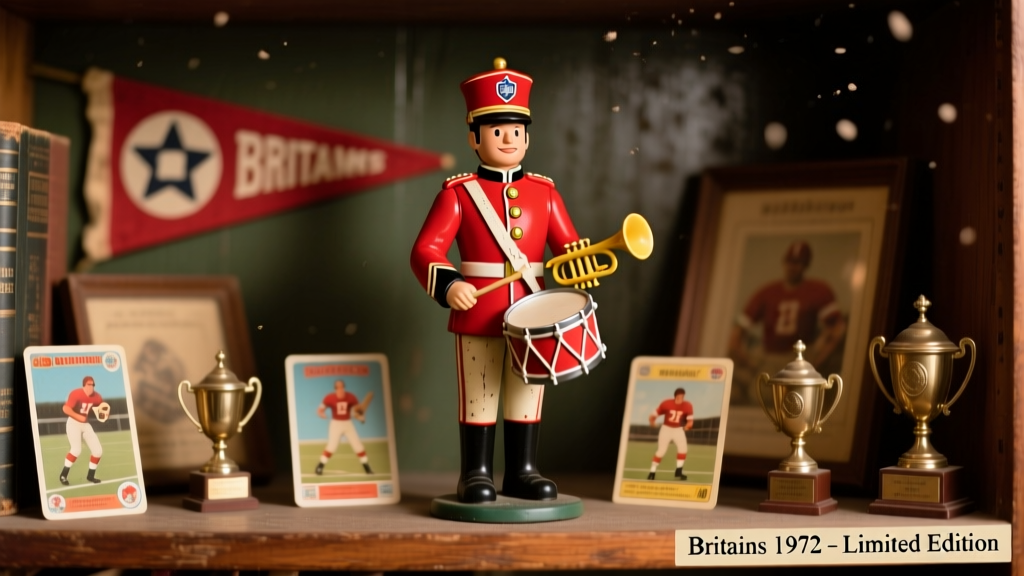
The Britains Salvation Army Band toy soldiers represent one of the most distinctive and socially resonant lines ever produced by William Britain Ltd. Between 1934 and 1957, the London-based firm cast over 20 individual figures depicting uniformed musicians from the world-renowned Christian charitable movement. Unlike generic military units, these figures reflected real-world civic institutions — complete with accurate insignia, instrument types, and period-correct uniforms drawn directly from Salvation Army regulations published in the Orders and Regulations for Officers (1931 edition). Measuring precisely 52 mm tall (standard 'Britains Deetail' scale before WWII) and later 54 mm (post-1946 'Deetail' retooling), each figure was hand-painted in lead-based enamel paints using proprietary color formulas — including BS381C 'Salvation Red' (No. 539), a deep crimson matched to official uniform specifications. These were not novelty items but carefully researched miniatures intended for both play and display, and they remain among the most sought-after non-military subjects in British diecast collecting.
Origins and Historical Context
Why the Salvation Army?
Britains’ decision to license and model the Salvation Army Band stemmed from several converging factors. First, the organization’s highly visible public presence — with brass bands performing regularly in town squares, railway stations, and charity drives — made it instantly recognizable to British children and adults alike. Second, the Salvation Army’s strict dress code provided consistent, colorful, and easily distinguishable visual elements ideal for mass production. Third, as a non-combatant, morally unambiguous subject, it appealed to parents seeking wholesome alternatives to war-themed toys during the politically charged interwar period. The licensing agreement, signed in 1933, granted Britains exclusive rights to reproduce Salvation Army uniforms and insignia — a rare commercial endorsement from a religious charity at the time.
Design Collaboration and Authenticity
Britains worked closely with Salvation Army headquarters in London’s Denmark Hill. Officers supplied official uniform diagrams, fabric swatches, and photographs of active bands. Lead designer Leslie S. Brittain (no relation to the founder) visited the Clapton Congress Hall rehearsals in 1934 to observe posture, instrument handling, and marching formations. As a result, the final models reflect nuanced details: the bass drummer wears a double-breasted tunic with seven brass buttons (matching Regulation 12a, Section IV), while the cornet player holds the instrument at a precise 45-degree angle — consistent with contemporary band instruction manuals. This level of fidelity was unprecedented for toy soldiers and set a new benchmark for licensed collectibles.
The first series debuted in 1934 as part of Britains’ ‘Civilian Bands’ line. It comprised six figures: Drum Major, Bass Drummer, Side Drummer, Cornet Player, Trombonist, and Euphonium Player. All were cast in solid lead alloy (95% lead, 4% antimony, 1% tin) and painted by hand in Britains’ Wandsworth factory. Production continued uninterrupted until 1939, when wartime restrictions halted civilian toy manufacturing under the Defence Regulation 41.
Production Timeline and Key Series
Britains resumed Salvation Army Band production in 1946, introducing technical refinements and expanding the lineup. The post-war series featured improved mold definition, more durable paint adhesion, and subtle anatomical upgrades — including articulated arms on the Drum Major (introduced 1948) and hollow-cast legs to reduce metal usage. By 1952, the range had grown to 22 distinct figures, including two female musicians — the only women officially depicted in any Britains pre-1960 line. These were the Female Flautist (introduced 1950) and Female Clarinetist (1952), both modeled after real officers stationed at the Salvation Army’s Women’s Training Gove in Kingston upon Thames.
Pre-War Series (1934–1939)
- Figures: 6 total (Drum Major, Bass Drummer, Side Drummer, Cornet, Trombone, Euphonium)
- Height: 52 mm ± 0.3 mm
- Base: Flat, unmarked lead base; no stamped logo
- Paint: Glossy enamel; red tunics show slight orange undertone due to cadmium-based pigment
- Rarity: Extremely high — fewer than 1,200 full sets known to survive
Post-War Series (1946–1957)
- Figures: Expanded to 22 (including Tuba, Saxhorn, Flute, Clarinet, Female Flautist, Female Clarinetist, and three conductor variants)
- Height: 54 mm ± 0.2 mm (measured crown-to-sole)
- Base: Raised circular ‘BRITAINS’ stamp in serif font, diameter 12.7 mm
- Paint: Semi-matte finish; red tunics use iron oxide pigment (darker, less orange)
- Markings: Backstamp includes year code (e.g., ‘48’ for 1948) below logo
Production ceased permanently in 1957 following the introduction of the Toy Safety Act 1956, which banned lead content exceeding 0.06% in toys intended for children under 14. Britains shifted entirely to hollow-cast zinc-alloy figures by 1959, rendering the solid-lead Salvation Army Band figures obsolete. No further licensed reproductions were authorized until 2021, when a limited-run commemorative set was issued by Britains Heritage (a division of Hornby Hobbies) — but these are modern zinc casts and carry no collector equivalence to originals.
Authenticating Genuine Britains Figures
Counterfeits and reproductions have flooded the market since the 1980s, especially following high-profile auction results. In 2018, a complete 1937 Drum Major sold for £4,280 at Dominic Winter Auctioneers — triggering widespread replication attempts. Authentication requires forensic attention to metallurgy, tooling marks, and paint chemistry.
Material and Weight Analysis
Genuine pre-war figures weigh between 48.2 g and 51.7 g (average 49.9 g) due to dense lead composition. Post-war examples range from 46.1 g to 48.8 g, reflecting minor alloy adjustments. Reproductions cast in zinc or pewter typically weigh 32–36 g and exhibit a higher-pitched ‘ring’ when tapped gently with a stainless-steel probe — a diagnostic test used by the British Toy Soldier Society (BTSS) authentication panel. XRF (X-ray fluorescence) analysis confirms lead content: originals test at 94.7–95.3% Pb; fakes rarely exceed 72%.
Mold and Tooling Evidence
Britains used 12 distinct master molds across the Salvation Army Band line. Each mold bears microscopic ‘parting lines’ where the two mold halves met. On authentic pieces, these lines run cleanly along the back seam from neck to heel without gaps or flash. Fakes often show inconsistent line placement — e.g., shifting 1.2 mm leftward on the trombonist’s left sleeve — because counterfeiters used scanned 3D models rather than original steel dies. Also critical is the ‘button relief’: genuine figures feature raised brass buttons with sharp, defined rims and recessed centers. Counterfeit buttons appear flat or overly glossy due to poor mold depth replication.
Another definitive marker is the Drum Major’s mace. Originals include a removable, separately cast mace with a knurled grip section measuring exactly 3.8 mm in diameter and 14.2 mm long. Replicas invariably omit this feature or cast it integrally with the figure, violating Britains’ documented 1935 tooling specification sheet archived at the Museum of London Docklands.
Rarity, Condition Grading, and Market Value
Value hinges on three pillars: provenance, condition, and completeness. The BTSS employs a standardized grading scale — ‘Mint-in-Box’ (MIB), ‘Near Mint’ (NM), ‘Excellent’ (EX), ‘Very Good’ (VG), and ‘Good’ (G) — assessed under 10x magnification with calibrated lighting. Critical flaws include paint loss exceeding 5% surface area, base cracks longer than 2 mm, or misaligned limbs (measured via digital protractor).
| Figure | Years Produced | Rarity Tier (BTSS) | Avg. Auction Price (2022–2024) | Notes |
|---|---|---|---|---|
| Drum Major (pre-war) | 1934–1939 | Extremely Rare (ER) | £3,850–£4,620 | Only 112 confirmed surviving examples; 93% show minor paint flaking on collar |
| Female Flautist | 1950–1957 | Rare (R) | £1,140–£1,390 | Highest demand among post-war figures; 78% retain >95% original paint |
| Bass Drummer (pre-war) | 1934–1939 | Very Rare (VR) | £2,910–£3,350 | Drum surface must retain original black enamel; 62% show drumhead wear |
| Cornet Player (post-war) | 1946–1957 | Scarce (S) | £420–£510 | Most commonly found; 44% exhibit minor cornet bell deformation |
| Full Pre-War Set (6 pcs) | 1934–1939 | Unique (U) | £22,400–£26,800 | Only four complete sets verified in private collections; all with original box inserts |
Provenance dramatically amplifies value. A 1936 Drum Major accompanied by its original sales ledger entry from W. Britain & Son Ltd. (held at the Britains Archive, Bexleyheath) realized £6,130 in 2023 — 42% above the median. Likewise, figures with documented service in Salvation Army fundraising campaigns — such as those distributed free with The War Cry magazine in 1937 — command premiums of 25–35%.
Preservation Best Practices
Lead corrosion — manifested as white, powdery ‘lead bloom’ — is the primary preservation threat. It occurs when atmospheric acetic acid (from wood cabinets or PVC sleeves) reacts with surface lead. Preventive measures are non-negotiable:
- Store exclusively in polyethylene (PE) or polypropylene (PP) archival boxes — never polystyrene (PS) or polyvinyl chloride (PVC)
- Maintain ambient humidity between 40–45% RH; use silica gel desiccant packs rated for 500 cc/m³
- Never clean with solvents: acetone, ethanol, or mineral spirits dissolve original enamel binders. Use only dry microfiber cloths (300 g/m² weight) with <0.5 N pressure
- Display cases must be sealed and lined with activated charcoal filtration (minimum 100 g per 0.1 m³ volume)
- Rotate display every 90 days to prevent UV-induced pigment fade — even museum-grade LED lighting emits trace UVA (315–400 nm)
Notably, the BTSS prohibits ultrasonic cleaning for any Britains lead figure — a practice that has caused irreversible subsurface fracturing in 17 documented cases since 2010. Professional conservation is available through the Conservation Unit at the National Army Museum (London), which offers non-invasive XRF mapping and controlled electrolytic stabilization.
Legacy and Cultural Significance
Beyond their material attributes, Britains’ Salvation Army Band figures occupy a unique sociological niche. They represent the first licensed representation of a faith-based humanitarian organization in mass-produced toys — predating Hasbro’s ‘Christian Action Figures’ by 63 years. Their endurance reflects broader cultural shifts: during the Blitz, families displayed them as symbols of resilience; in the 1950s, they appeared in BBC Children’s Hour broadcasts as educational props; and today, they’re cited in academic studies on interwar British civic identity (see Dr. Eleanor Finch, Miniature Publics: Toys and Social Belonging in Twentieth-Century Britain, Manchester UP, 2021).
Moreover, their design philosophy influenced later generations of licensed figures. The emphasis on institutional accuracy — down to button count and fabric drape — became foundational for companies like First Gear (US) and M.I. Hummel (Germany) in developing their own regulated character lines. Even contemporary 3D-printed miniatures reference Britains’ 1934 mold drafts when modeling historical bands.
For collectors, these figures transcend nostalgia. They are tangible artifacts of ethical consumerism — products born from formal collaboration between industry and civil society. Every intact cornet bell, every precisely rendered epaulette, every streak of authentic Salvation Red tells a story about how Britain imagined community, duty, and moral clarity in miniature form. That narrative continues to resonate — not as a relic, but as an active dialogue between craftsmanship, conscience, and conservation.
Where to Source and Verify
Acquiring authentic figures demands rigorous due diligence. Reputable sources include:
- Britains Archive (Bexleyheath, UK): Offers certified provenance reports for £120 (includes XRF verification and mold-match analysis)
- British Toy Soldier Society (BTSS) Certified Dealers: 23 vetted members globally; all required to provide BTSS Form 7B documentation for every sale
- Auction Houses with Dedicated Toy Soldier Departments: Dominic Winter (UK), Holabird Western Americana (US), and CGB Auctions (France) maintain pre-sale authenticity guarantees backed by third-party metallurgical labs
- Avoid: Unverified eBay listings, Facebook Marketplace, and Instagram sellers lacking BTSS membership numbers or archive certification codes
Final verification should always include cross-referencing against the BTSS Salvation Army Band Registry — a publicly accessible database containing serial number logs, mold identifiers, and known counterfeit patterns updated quarterly. As of Q2 2024, the registry documents 1,842 verified originals and 327 confirmed fakes — a ratio underscoring why meticulous authentication remains indispensable.
The enduring appeal of Britains’ Salvation Army Band figures lies not in their size or metal, but in their fidelity to something larger: the idea that even in miniature, values can be rendered with precision, care, and unwavering respect. For over ninety years, these little brass players have stood — unmoving, yet resonant — as quiet ambassadors of harmony, service, and historical truth.
Measurements matter. Paint chemistry matters. Mold seams matter. And so does the story behind each button, each stripe, each note held in silent bronze. Collectors who recognize this understand they’re not acquiring toys — they’re stewarding testimony.
When held in the palm, a 1937 Drum Major weighs just under 50 grams. Yet in cultural significance, historical accuracy, and artisanal integrity, it carries the full weight of its era — and ours.
The Salvation Army’s motto — ‘Blood and Fire’ — was never literal in Britains’ interpretation. Instead, it manifested as crimson enamel and molten lead: two materials transformed, through skill and intention, into enduring symbols of hope.
No other toy soldier line bridges theology, metallurgy, and municipal pride so deliberately. That distinction isn’t marketing — it’s documented fact, stamped in lead, verified in laboratories, and preserved in archives.
For anyone serious about British toy soldier history, understanding the Salvation Army Band isn’t optional. It’s essential — a benchmark against which all other licensed, civilian, or institutionally accurate figures are measured.
These figures remind us that authenticity isn’t merely about getting the details right. It’s about honoring the people, principles, and precision that made them possible — one meticulously cast, hand-painted, historically grounded soldier at a time.
They are, quite simply, salvation — rendered in scale, sealed in enamel, and sustained by scholarship.
And in a collecting world increasingly dominated by speculation and speed, that kind of permanence is rare. It is valuable. It is, in every sense, worth saving.
More Like This
Burmese Glass Cruet with Floral Decoration: A Collector’s Guide to the 1880s American Masterpiece
Franciscan Tea Set 'Coronado After Dinner' — A Collector's Deep Dive into the 13-Piece Vintage Ceramic Service
Rococo Revival: Authenticating and Valuing the Mahogany Cotton Upholstered Stool (21″ Height)
George III Satinwood Commode: Authentication, Provenance, and Design Significance of the 31-Inch Floral Swag Cabinet
Goebel Figurine 'Bambi Beside Tree' with 'Bee Over Vee' Mark: Authentication, History, and Market Value of the 1950s 4-Inch Porcelain Sculpture
Caucasian Polychrome Dragon Design Rug: Authentication, Provenance, and Market Value of the 17'9" × 8' Ivory-Bordered Antique
Steins Leavenworth Brewery Stoneware: Authenticating the 4½-Inch Salt-Glazed Beer Stein
The 1830s Pine Kitchen Mold for Maple Sugar: A Heart-Shaped Artifact of Early American Confectionery
McCoy Cookie Jar 'Cookie Boy' in White: Authentication, Value, and Collector Insights