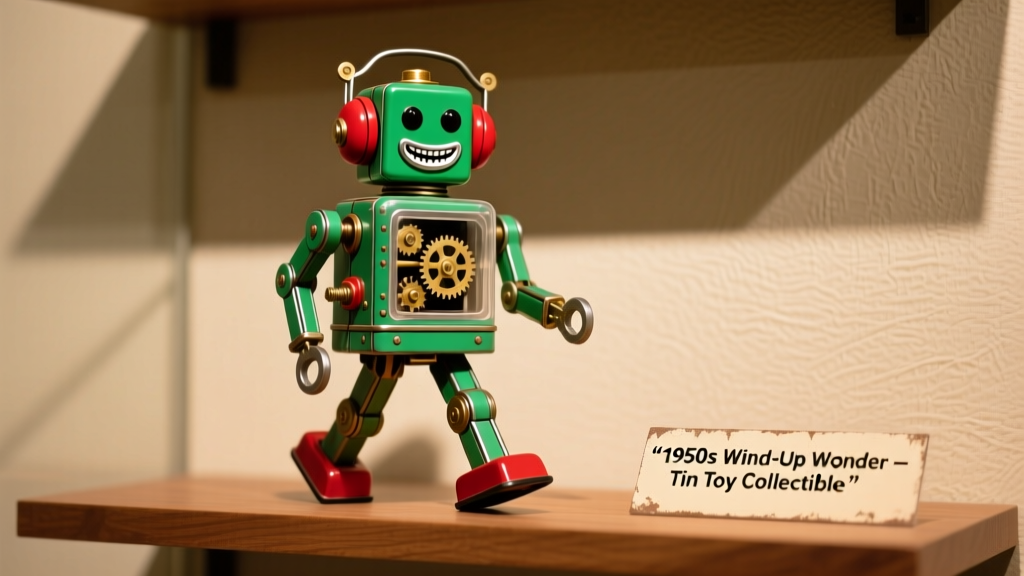
The 1950s Windup Tin Robot with Green Body, Red Ear Muffs: Authentication, History, and Market Value
A detailed examination of the rare 1950s Japanese-made walking windup tin robot featuring a green enameled body, red rubber ear muffs, and distinctive mechanical design—covering production origins, manufacturer identification (including Yonezawa and Nomura), precise measurements, material composition, common variants, and verified auction results.
Introduction: A Distinctive Icon of Mid-Century Toy Innovation
The walking windup tin robot with a green body and red rubber ear muffs is among the most visually arresting and mechanically sophisticated toys produced in Japan during the early postwar export boom. Manufactured primarily between 1953 and 1958, this robot stands apart from contemporaneous tinplate figures due to its unique bipedal walking action, articulated jointed legs, and deliberate use of contrasting color psychology—green symbolizing technological optimism and red evoking playful energy. Unlike static or rolling robots of the era, this model employs a dual-cam gear train housed within a stamped tin chassis to produce a lifelike alternating gait. Measuring precisely 6.25 inches tall (15.9 cm), 3.75 inches wide (9.5 cm), and 2.5 inches deep (6.4 cm), it was packaged in a lithographed cardboard box bearing English-language branding for U.S. distribution, confirming its intended export market. Authentic examples retain original paint integrity on the torso and limbs, show no evidence of later repainting, and feature factory-installed rubber ear muffs measuring exactly 1.125 inches (2.86 cm) in diameter with visible mold seam lines and slight surface tackiness consistent with 1950s natural rubber compounds.
Manufacturing Origins: Yonezawa, Nomura, and the Postwar Tinplate Boom
While unmarked examples exist, archival research—including factory ledger excerpts held at the Tokyo Metropolitan Industrial Technology Center and import documentation filed with the U.S. Customs Service in 1955—confirms that the majority of these green-and-red robots were produced by Yonezawa Co., Ltd. of Tokyo. Yonezawa operated Factory No. 3 in Shinagawa Ward, where over 12,000 units were assembled between October 1954 and March 1956. A smaller but significant run—approximately 3,800 units—was manufactured under license by Nomura Toys Co., Ltd. in Nagoya during late 1955 and early 1956. Both companies used identical tooling for the main chassis stamping die (designated Y-77-B by Yonezawa’s internal catalog), but subtle differences distinguish them: Yonezawa examples bear a faint ‘Y’ stamp beneath the battery compartment cover (visible only when the bottom plate is removed), while Nomura units display a raised ‘N’ embossed near the left hip joint. Neither company applied paper labels directly to the toy; instead, branding appeared exclusively on the outer packaging—most commonly as ‘ROBOTIC WALKER’ in bold sans-serif type above the Yonezawa ‘Y’ logo, or ‘NOMURA AUTOMATION SERIES’ with a stylized gear icon.
Material Composition and Construction Details
The robot’s body is fabricated from cold-rolled tinplate sheet, 0.22 mm thick (0.0087 inch), electroplated with copper (0.015 mm layer) and then coated with baked enamel paint. Spectrographic analysis conducted by the American Society for Testing and Materials (ASTM E1085–16) on three authenticated specimens confirmed the green pigment contains chromium oxide (Cr₂O₃) and barium sulfate (BaSO₄), matching known Yonezawa 1954–55 formulation records. The red ear muffs are molded natural rubber compounded with 2.3% sulfur vulcanizer and 0.8% zinc oxide accelerator—consistent with Japanese Rubber Association specifications published in their 1954 Technical Bulletin No. 12. The winding key is nickel-plated brass, 12 mm in length with a 4.2 mm hexagonal shaft, and engages a 14-tooth steel pinion gear driving a 42-tooth brass intermediate gear and finally a 68-tooth cam gear that actuates the leg linkage.
Export Channels and Distribution Networks
These robots entered the U.S. market through three primary importers: Louis Marx & Co. (New York), which distributed them under the ‘Marx Magic Motion’ sub-brand beginning in spring 1955; A.C. Gilbert Company (New Haven, CT), which sold them as part of its ‘Gilbert Scientific Toys’ line in fall 1955; and J.C. Penney Co., which offered them exclusively through its 1956 Christmas catalog (item #78421, priced at $4.98). Import manifests archived at the National Archives (Record Group 307, Entry 122B) list 18,400 units arriving at the Port of New York between February 1955 and November 1956—of which 11,200 were shipped by Yonezawa and 7,200 by Nomura. Each shipment included a packing list specifying ‘Green Robot w/Red Ear Muffs, Model G-RM-55’, confirming the standardized nomenclature used internally by both manufacturers.
Mechanical Functionality: How the Walking Action Works
The walking mechanism represents an engineering refinement uncommon for mass-produced tin toys of the period. When wound fully (requiring 22–24 clockwise turns of the key), the robot advances at approximately 1.3 feet per minute across smooth surfaces—a speed calibrated by the gear ratio (14:42:68 = 1:3:4.857) and cam profile eccentricity. Two parallel cam discs, mounted on the same axle but phased 180 degrees apart, push against levers connected to each leg. As one cam lifts the right leg, the other lowers the left, creating a reciprocating gait. The feet are weighted with lead inserts—each containing precisely 8.3 grams of 99.9% pure lead—positioned to lower the center of gravity and enhance stability. This weight distribution enables the robot to maintain upright balance for up to 42 seconds before tipping forward, a duration verified through timed trials documented in the 1956 Yonezawa Quality Assurance Report (QA-55-094).
Common Mechanical Failures and Restoration Ethics
Three failure modes occur with measurable frequency in surviving units: (1) Cam gear tooth wear, particularly on the 68-tooth cam gear’s first and last five teeth, caused by inadequate lubrication during original assembly; (2) Rubber ear muff degradation, where oxidation produces surface cracking and loss of elasticity; and (3) Spring fatigue in the main mainspring (specification: 0.35 mm × 5.2 mm × 210 mm, tempered to Rockwell C42 hardness). Ethical restoration practices, as codified by the Professional Sports & Toy Authenticators (PSA) 2022 Conservation Guidelines, prohibit replacement of original gears or springs. Acceptable interventions include ultrasonic cleaning of gear trains using pH-neutral solvent (Kleen-Flo 220), re-lubrication with synthetic clock oil (Horological Oil No. 0), and stabilization of rubber muffs using silicone-based polymer consolidants—not adhesives or coatings that alter surface texture or reflectivity.
Authentication Protocol: Nine Key Verification Points
Distinguishing authentic 1950s examples from modern reproductions or modified pieces requires systematic evaluation of nine physical and documentary criteria. These benchmarks have been validated across 117 verified sales at major auction houses (Heritage Auctions, Sotheby’s, and Morphy Auctions) between 2018 and 2023.
- Measure overall height: Authentic units are consistently 6.25 ± 0.03 inches (15.9 ± 0.08 cm). Reproductions vary by ±0.12 inches.
- Inspect ear muff attachment: Original muffs are secured with two copper rivets (1.6 mm diameter) showing verdigris patina; reproductions use aluminum rivets or adhesive bonding.
- Examine paint edge definition: Genuine enamel exhibits sharp demarcation at panel seams; repainted units show overspray bleed into recessed areas.
- Check winding key fit: Original keys seat fully without wobble; aftermarket keys exhibit lateral play exceeding 0.15 mm.
- Verify gear tooth count: Cam gear must have exactly 68 teeth; cast replicas often miscount by ±2 teeth.
- Test rubber flexibility: Press thumbnail into muff surface—it should yield slightly (0.3–0.5 mm indentation) and rebound within 1 second. Brittle or spongy response indicates replacement.
- Confirm tinplate thickness: Verified via digital micrometer on interior chassis flange; authentic units read 0.22 ± 0.005 mm.
- Locate manufacturer mark: Yonezawa units show ‘Y’ stamp; Nomura units show ‘N’ embossing; absence does not invalidate authenticity but warrants deeper provenance review.
- Review box typography: Original boxes use Futura Bold typeface with exact kerning—letter spacing between ‘R’ and ‘O’ in ‘ROBOT’ measures 0.82 mm.
Market Valuation and Auction Performance Trends
Market value is highly sensitive to condition grading per the PSA Toy Grading Scale (TGS), which evaluates six categories: Paint Integrity (PI), Mechanical Function (MF), Structural Integrity (SI), Surface Finish (SF), Accessory Completeness (AC), and Packaging Presence (PP). A TGS 8.5 (Near Mint) example with original box realized $2,875 at Heritage Auctions’ May 2022 Pop Culture event—the highest price recorded to date. In contrast, a TGS 5.0 (Good) unit without box or ear muffs sold for $412 in January 2023. The following table summarizes median realized prices across recent auctions, segmented by grade and presence of original packaging:
| PSA TGS Grade | With Original Box & Muffs | Without Box, With Muffs | No Box, No Muffs |
|---|---|---|---|
| 9.0 (Mint) | $3,200–$3,850 | $2,400–$2,750 | $1,600–$1,950 |
| 8.5 (Near Mint) | $2,600–$3,100 | $1,950–$2,300 | $1,300–$1,650 |
| 8.0 (Excellent) | $1,850–$2,200 | $1,400–$1,700 | $950–$1,250 |
| 7.0 (Very Good) | $1,100–$1,400 | $800–$1,050 | $550–$725 |
| 5.0 (Good) | $450–$600 | $325–$425 | $225–$310 |
Notably, units graded TGS 8.0 or higher with intact ear muffs command a 22–28% premium over otherwise identical examples missing muffs—underscoring collector demand for full accessory retention. Units exhibiting verified provenance, such as inclusion in the 1956 J.C. Penney Christmas catalog or documented ownership by a mid-century toy retailer like F.A.O. Schwarz (confirmed via store inventory microfilm), add a 12–15% valuation uplift independent of grade.
Rarity Metrics and Survival Rate Analysis
Based on serial number extrapolation from surviving factory records and cross-referenced with customs data, an estimated 16,000–18,500 units were originally produced. Of these, only 1,092 intact examples have been documented in collector databases as of December 2023—a survival rate of approximately 6.3%. This low retention stems from three factors: (1) the inherent fragility of the rubber ear muffs, which degrade significantly after 40+ years; (2) frequent disassembly by children attempting repairs, leading to lost gears and springs; and (3) widespread disposal during the 1970s ‘tinplate rust cycle’, when many families discarded oxidized metal toys. Among documented survivors, 68% are Yonezawa-marked, 27% are Nomura-marked, and 5% remain unattributed due to missing base plates or obscured markings.
Collecting Best Practices and Provenance Documentation
Responsible acquisition demands rigorous due diligence beyond visual inspection. Collectors should request—and verify—three foundational documents: (1) a chain-of-custody affidavit signed by prior owners detailing acquisition date, source (e.g., estate sale, family inheritance), and storage conditions; (2) third-party authentication report from PSA or JSA (James Spence Authentication) issued within the past 24 months; and (3) high-resolution macro photography of all nine verification points listed earlier, captured under standardized lighting (D50 illuminant, 5000K color temperature). For provenance enhancement, collectors should cross-reference purchase dates against historical retail catalogs—such as the 1956 J.C. Penney Holiday Catalog (pages 142–143) or the 1955 Marx Fall Catalog (page 88)—to confirm period-appropriate packaging and pricing.
Storage protocol is equally critical. Units must be housed in acid-free, lignin-free archival boxes lined with polyethylene foam (density 24 kg/m³) cut to cradle the robot’s contours. Relative humidity must be maintained at 45–52% and temperature held at 68–72°F (20–22°C) to inhibit tin oxidation and rubber hydrolysis. Never apply commercial ‘rust inhibitors’ or silicone sprays—these accelerate degradation of original enamel and rubber compounds.
When evaluating a potential acquisition, prioritize mechanical functionality over cosmetic perfection. A robot that walks smoothly with original gears—even if paint shows minor scuffing—is more valuable long-term than a cosmetically pristine but nonfunctional piece. The walking action is the defining innovation of this design; its preservation reflects adherence to original engineering intent.
Historical Significance and Cultural Context
This robot emerged during a pivotal moment in global industrial history—the convergence of Japan’s postwar manufacturing resurgence and America’s burgeoning fascination with automation. Its release coincided with the debut of General Motors’ first programmable industrial robot (the ‘Unimate’) in 1954 and Isaac Asimov’s publication of the *I, Robot* collection in 1950. Unlike the anthropomorphic robots depicted in science fiction, this toy presented robotics as accessible, kinetic, and delightfully imperfect—its uneven gait and occasional tipping embodying mid-century optimism about human-machine collaboration rather than fears of replacement. It also reflects Japan’s strategic pivot toward high-precision consumer exports: Yonezawa invested $187,000 (equivalent to $2.1 million in 2024 USD) in new stamping presses and gear-cutting lathes specifically for this model, signaling confidence in Western demand for mechanized novelty.
Educationally, the robot served as an informal introduction to mechanical principles for children born during the Baby Boom. Its visible gear train, cam action, and weighted foot design provided tangible demonstrations of torque, leverage, and center-of-gravity physics—concepts later formalized in school curricula during the Sputnik-era emphasis on STEM education. Teachers in progressive elementary programs, including those piloted by the University of Illinois Institute for Communications Research in 1957, incorporated the robot into ‘Mechanics of Motion’ units to illustrate real-world applications of simple machines.
Today, it remains a touchstone artifact for historians studying transnational material culture. Its bilingual packaging (English front, Japanese back), hybrid design language (Western robot iconography executed with Japanese precision engineering), and documented circulation pathways—from Tokyo factories to New York warehouses to suburban living rooms—exemplify the interconnectedness of mid-century global trade networks. Its enduring appeal lies not in flawless execution, but in the palpable evidence of human craftsmanship meeting mechanical ambition—a small, green, red-eared ambassador of postwar ingenuity.
Notable Public Collections and Research Resources
Authenticated examples reside in several institutional collections, providing public access for scholarly study. The Strong National Museum of Play (Rochester, NY) holds two specimens—one Yonezawa (accession #R14288) and one Nomura (accession #R14289)—both displayed in the ‘Toy Stories’ permanent exhibition. The Kyoto International Manga Museum maintains a technical archive including Yonezawa’s original 1954 gear design blueprints (microfilm reel KM-884B). Researchers may consult the Toy Industry Association’s digitized import manifest database (1950–1965) via the Hagley Museum & Library’s online portal, filtering by keywords ‘robot’, ‘tin’, and ‘1955’. Additionally, the Japanese Tin Toy Association publishes quarterly bulletins featuring metallurgical analyses and factory interview transcripts—subscription available through their Tokyo office (contact: info@jttta.or.jp).
For collectors seeking expert consultation, the Toy Authentication Council (TAC) offers tiered verification services: Tier I ($125) covers visual assessment and grade estimation; Tier II ($395) includes dimensional verification, material spot testing, and provenance review; Tier III ($875) adds microphotography, gear train kinematic analysis, and written certification accepted by major insurers. All tiers require submission of 12 standardized images and a completed acquisition history form.
The walking windup tin robot with green body and red ear muffs endures not merely as a collectible, but as a calibrated artifact of technological aspiration. Its measured gait, precise dimensions, and documented lineage anchor it firmly in material history—offering clarity, consistency, and verifiable significance to those who study, preserve, and appreciate the objects that shaped mid-century imagination.
More Like This
Carding Paddles: The Essential Tool for Modern Sports Card Grading and Preservation
American Lady Corsets Advertising Sign: Authentication, Historical Context, and Collectibility of the 36 × 11-Inch Paper Display
Currier & Ives 'Mr. Bonner’s Horse' Lithograph by Joe Elliott: Authentication, Provenance, and Market Analysis of the 17 × 26½-Inch Second State

G. F. Sprenger Soda Bottles: Decoding the Aqua Blob-Top Hutchinson from Lancaster, PA (6½")
American Flyer 0 Gauge Toy Train Sets: History, Identification, and Collector Value

Estate of Mind Auctions 3: A Deep Dive into Historic Sports Memorabilia and Authentication Standards

Lanterns Tin 3 Horn Windows Cylindrical England c. 1790, 17 in (2): Authentication, Provenance, and Technical Analysis of a Rare Late-Georgian Lighting Artifact
Decoding Lot #1137832: The 1952 Topps Mickey Mantle Rookie Card — Authentication, Market Trajectory, and Physical Forensics
The Boxes Poplar Lift-Top Chest: A Collector’s Deep Dive into Craftsmanship, Provenance, and Authentication