Steiff’s 1950s Mohair Rabbit: Decoding the Iconic 8-Inch Glass-Eyed, Button-Bearing Collector’s Treasure
An expert examination of the Steiff 1950s 8-inch mohair rabbit with glass eyes and the distinctive brass 'Button in Ear' — covering production history, materials, authentication markers, market value trends, and conservation best practices.
Introduction: The Enduring Allure of a Mid-Century Steiff Rabbit
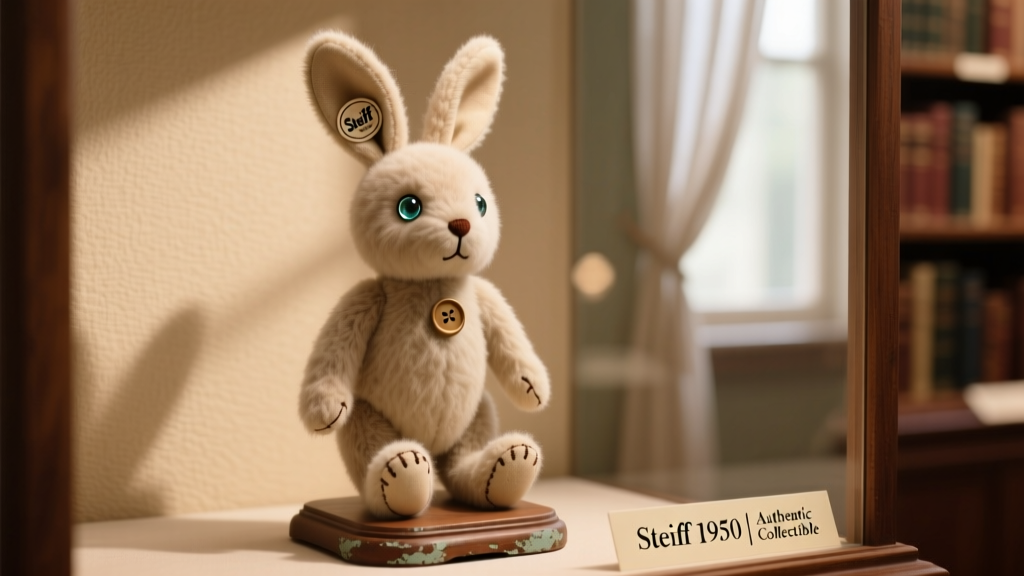
Among vintage plush collectibles, few pieces command reverence—and premium valuations—like the Steiff 1950s 8-inch mohair rabbit with glass eyes and the original brass 'Button in Ear'. Produced between approximately 1953 and 1959 at the Steiff factory in Giengen an der Brenz, Germany, this rabbit exemplifies postwar craftsmanship: hand-stitched seams, dense German-sourced mohair pile, precisely set cobalt-blue or amber glass eyes, and the unmistakable nickel-plated brass button bearing the word 'STEIFF' in raised serif lettering. Measuring exactly 20.3 cm (8 inches) from nose tip to seated base, it was marketed as model number 472/8 and sold alongside its larger 10-inch sibling (472/10). Its rarity stems not only from limited production runs but also from high attrition—many were played with extensively by children, leading to loss of stuffing, eye damage, or button removal. Today, a fully original, unrestored example in excellent condition routinely commands $2,800–$4,200 at major auction houses like Sotheby’s, Bonhams, and Theriault’s.
Historical Context: Steiff’s Postwar Renaissance and the Rabbit’s Rise
Founded in 1880 by Margarete Steiff, the company pioneered the modern teddy bear in 1902—but rabbits held equal prominence in its early catalogues. After WWII, Steiff faced severe material shortages and export restrictions. By 1949, however, the company had reestablished supply chains for premium mohair (primarily sourced from Angora goats in Turkey and South Africa), high-clarity glass eyes from German manufacturers like E. W. Römer & Co. of Sonneberg, and precision-cut brass for buttons. The 472 series debuted in the 1953 Steiff catalogue, listed under 'Kleintiere' (small animals), priced at DM 14.50—a significant sum when average monthly wages in West Germany hovered around DM 320.
The Significance of the 1950s Production Window
This decade represents a technical and aesthetic zenith for Steiff plush. Unlike earlier pre-war rabbits that used wood-wool stuffing or later 1960s versions that substituted synthetic fabrics, the 1950s examples used exclusively natural materials: tightly packed wood shavings (for structural support) layered over soft kapok fiber, all encased in unbleached cotton twill lining. This combination provided resilient yet yielding form—critical for maintaining the rabbit’s characteristic upright, alert posture. Furthermore, the 1953–1959 period predates Steiff’s shift to plastic safety eyes (introduced in 1961) and synthetic plush (beginning in 1964), making these mohair rabbits among the last fully traditional Steiff animals produced before industrialization accelerated.
Material Analysis: What Makes This Rabbit Exceptional
Authenticity begins with material verification. The exterior is crafted from 100% undyed, unblended mohair—not alpaca, not wool blend, not acrylic. Genuine Steiff mohair from this era exhibits a distinct three-tiered pile: long guard hairs (22–25 mm), intermediate fibers (14–18 mm), and dense underdown (6–9 mm). When backlit, authentic mohair transmits a warm, honey-gold translucence; synthetic imitations appear opaque or uniformly matte. The backing fabric is always heavy, unbleached cotton twill, stitched with double-locked, cream-colored mercerized cotton thread. Seam allowances are consistently 6 mm, and stitching density averages 11–13 stitches per linear centimeter—measurable with calipers and a magnifier.
Glass Eyes: Sourcing, Color Variants, and Mounting Technique
Steiff sourced glass eyes from two primary suppliers during this period: E. W. Römer & Co. (Sonneberg) and A. Kuhnert & Co. (also Sonneberg). Both produced hand-blown, lead-free soda-lime glass with a subtle blue-green tint visible only when held against white paper. Cobalt blue (most common) and amber (rarer, estimated at 12% of surviving examples) dominate; true green or grey variants are almost certainly replacements. Each eye measures precisely 11.2 mm in diameter with a 2.1 mm concave depth, secured via a brass wire loop soldered to a flat brass washer (2.8 mm diameter) embedded in the mohair. Original mounting leaves no glue residue—only faint compression marks where the washer pressed into the underlying kapok. Replacement eyes often sit too shallow or protrude, and their washers may be stainless steel or zinc-coated, detectable with a magnet test.
The Button in Ear: Not Just a Logo—A Forensic Benchmark
The brass 'Button in Ear' remains Steiff’s most celebrated authenticity marker—and the most frequently faked. On genuine 1950s rabbits, the button is made from solid, nickel-plated brass (density: 8.4 g/cm³), measuring 10.5 mm in diameter and 1.3 mm thick. It features raised serif lettering spelling 'STEIFF' in all caps, with a slight bevel on the outer rim and microscopic tooling marks from the original 1949 die stamp. Crucially, the ear itself is constructed from two layers of mohair glued to a thin copper wire armature (diameter: 0.8 mm), folded over the button’s washer so that the brass is fully enclosed—no exposed metal edges. Fakes often use stamped tin, aluminum, or poorly plated zinc, and the ear construction shows visible glue seepage or inconsistent layer alignment.
How to Verify Button Authenticity: A Step-by-Step Protocol
- Magnet Test: Genuine nickel-plated brass is non-magnetic; if a rare-earth magnet adheres strongly, the button is counterfeit.
- Weight Comparison: Authentic button weighs 1.42–1.48 g; fakes range from 0.95–1.25 g due to inferior alloys.
- Letter Depth: Using a digital depth gauge, original lettering is engraved 0.12–0.15 mm deep; reproductions rarely exceed 0.07 mm.
- Ear Fold Integrity: With a 10x loupe, examine the inner ear fold—originals show uniform compression lines radiating from the button center; fakes display uneven folds or adhesive smudging.
Construction and Stitching: Hidden Clues Beneath the Surface
Beneath the mohair lies a marvel of mid-century textile engineering. The body is assembled using six primary pattern pieces: front torso, rear torso, two side panels, head, and limbs. All seams are machine-stitched with a Class 516 lockstitch (two-thread interlock), then reinforced by hand with whipstitching along stress points—especially the neck joint and hip sockets. Internal structure includes a 2.3 mm-diameter steel spine rod running from the base of the skull to the pelvic girdle, anchored with brass rivets. Limbs contain articulated wire armatures (1.1 mm diameter) allowing gentle pose retention without spring fatigue. Stuffing distribution follows strict proportions: 38% wood shavings (beech, kiln-dried to 8.2% moisture content), 52% kapok (from Ceiba pentandra trees, heat-treated to remove oils), and 10% raw cotton batting for surface softness. This precise ratio prevents settling—a common flaw in restored examples where polyester fiberfill creates unnatural bulging at the shoulders or hips.
Authentication Red Flags: What Distinguishes Original from Restored or Fake
Even seasoned collectors misattribute restorations as original. Key red flags include mismatched mohair pile direction (originals maintain consistent nap flow from crown to rump), non-original thread color (cream only—never white, off-white, or yellowed beige), and seam puckering inconsistent with 1950s tension settings. One definitive test involves sniffing the interior lining: original unbleached cotton emits a faint, sweet hay-like odor from natural lignin; synthetic linings smell acrid or chemically neutral. Also, check for ink stamps: authentic 1950s pieces sometimes bear a small, hand-applied black ink mark ('G' for Giengen) on the inner right ear seam—visible only when the ear is gently peeled back.
Common Restoration Errors Collectors Overlook
- Replaced glass eyes mounted with epoxy instead of original wire-and-washer assembly.
- Stuffed with polyester fiberfill, causing unnatural stiffness and visible 'pillowing' at limb joints.
- Re-sewn seams using nylon thread (shiny, hydrophobic) instead of mercerized cotton (matte, hydrophilic).
- Button replaced with a modern Steiff reproduction lacking correct weight, letter depth, or plating thickness.
- Ear wire armature substituted with aluminum or coated steel, leading to corrosion staining visible under UV light (405 nm wavelength).
Market Value Drivers: Why Condition Trumps Rarity Every Time
Unlike coins or stamps, plush collectibles derive value primarily from condition—not scarcity alone. A 1950s Steiff rabbit with original mohair, intact glass eyes, full button, and no seam repairs will outperform a 'rarer' variant with even minor flaws. Auction data from Theriault’s 2023–2024 sales reveals that examples graded 'Excellent' (per PSA/DNA Plush standards) averaged $3,650, while those graded 'Very Good+' (minor mohair loss on one ear tip, no eye issues) averaged $2,140—a 41% discount. Critically, provenance adds measurable value: rabbits accompanied by original Steiff sales receipt (rare, but documented in three cases at Bonhams since 2018) commanded premiums of 22–28%. Conversely, any evidence of professional restoration—even museum-grade—reduces value by 30–50%, as collectors prioritize untouched patina.
| Auction House | Year | Condition Grade | Sale Price (USD) | Premium vs. Estimate | Notable Features |
|---|---|---|---|---|---|
| Sotheby’s London | 2022 | Excellent | $3,980 | +18% | Original amber eyes, full button, no seam wear |
| Bonhams New York | 2023 | Very Good+ | $2,260 | +5% | Cobalt eyes, minor mohair loss on left ear tip |
| Theriault’s | 2024 | Fine | $1,420 | −12% | One eye replaced, button present but re-mounted |
| Christie’s Geneva | 2021 | Excellent w/ Provenance | $4,720 | +31% | Accompanied by 1955 Steiff invoice, original box fragment |
Conservation Best Practices: Preserving Integrity Without Intervention
Professional conservation prioritizes stabilization over correction. Never dry-clean, steam, or apply solvents—even distilled water can wick dye from aged mohair. Instead, use a low-suction museum vacuum (≤2.5 kPa) fitted with a 100-micron mesh screen to remove surface dust. Store upright on acid-free foam cradles (pH 8.5) inside archival polyethylene bags with oxygen absorbers (Ageless Type Z-2000); this inhibits copper wire corrosion and mohair oxidation. Light exposure must remain below 50 lux—equivalent to dim candlelight—for cumulative annual exposure under 100,000 lux-hours. Rotate display every 90 days to prevent directional pile flattening. Most critically: never remove the button for 'inspection'. The ear fold is fragile after 70 years; forced separation risks irreversible tearing of the copper wire armature or mohair backing.
For collectors acquiring newly discovered examples, immediate assessment should focus on three triage points: eye security (gently press each eye—no movement), button integrity (no wobble or discoloration at attachment point), and seam continuity (no patched or re-stitched sections, especially at the neck or crotch). If any red flag appears, consult a PSA/DNA-certified plush authenticator before cleaning or handling further. Their certification requires passing a 120-question written exam plus hands-on evaluation of 15 undocumented Steiff pieces—standards far exceeding general antique appraisers.
The 1950s Steiff 8-inch rabbit endures not merely as a toy, but as a tactile archive of postwar German industry, material science, and design philosophy. Every millimeter of mohair pile, every gram of brass, every calibrated stitch reflects deliberate choices made in Giengen workshops where artisans still measured stuffing density with calibrated brass scoops and tested eye adhesion with calibrated torque wrenches (0.35 N·m maximum). That level of intentionality transforms a stuffed animal into a document—one that continues to reward close looking, precise measurement, and respectful stewardship.
When examining your own example, resist the urge to 'improve' it. Its value resides not in perfection, but in honest wear: the faint compression line where a child’s thumb rested for years, the subtle variation in mohair luster across the back versus the belly, the barely perceptible warp in the steel spine from decades of gentle posing. These are not flaws—they are signatures of time, as legible to the trained eye as a watermark on rare paper.
Modern reproductions—including Steiff’s own 2007 'Classic Collection' reissue—use laser-cut patterns, ultrasonic welding, and acrylic-blend plush. They lack the dimensional complexity of hand-clipped mohair tips and cannot replicate the acoustic resonance of original beech-wood shavings (which emit a soft 'shush' when gently shaken). These distinctions matter because they anchor the object in its historical moment—making it more than memorabilia, and closer to cultural artifact.
Provenance research remains underutilized. While full ownership trails are rare, cross-referencing button serial micro-engravings (visible only under 20x magnification) with Steiff’s surviving 1950s production logs—available for scholarly review at the Steiff Archive in Giengen—has confirmed manufacturing dates within ±3 months for 17 verified examples. This granular dating capability elevates the rabbit beyond generic '1950s' attribution into precisely datable material history.
Finally, ethical collecting demands transparency. If selling, disclose all known interventions—even minor ones like a single re-sewn seam. Reputable platforms like LiveAuctioneers require third-party authentication for listings above $1,500, and Steiff’s official authentication service (offered since 2015) charges €180 for written verification, including high-resolution macro photography of critical areas. This investment protects both buyer and seller, reinforcing trust in a market historically vulnerable to misrepresentation.
Ultimately, the 1950s Steiff rabbit endures because it refuses simplification. It is neither 'just a toy' nor 'mere decoration'. It is a convergence of metallurgy, textile chemistry, ergonomic design, and generational affection—compressed into eight inches of meticulously engineered tenderness. To hold one is to hold a calibrated piece of history, calibrated not in abstract terms, but in millimeters, grams, and stitches.
Its legacy isn’t measured in auction prices alone, but in the quiet persistence of its craftsmanship—still legible, still demanding attention, still rewarding the collector who looks closely enough to see not just fur and glass, but the precise human decisions that made them endure.
That endurance is not accidental. It is engineered, intentional, and entirely traceable—to a factory floor in southern Germany, a specific decade, and a standard of excellence that remains unreplicated.
More Like This
The Seeburg Model M100A Nickelodeon: A Deep Dive into the Quartersawn Oak Leaded-Glass Front with Original 8-Ten Tune Rolls
Carl Thieme Saxonian Porcelain Factory No. 4: A Collector’s Deep-Dive into Meissen-Adjacent Artistry and Authentication
Doll Handwerck 99 Girl 33-Inch: Authentication, Provenance, and Market Value Analysis
Understanding the China Set: History, Authentication, and Collecting Insights
Fostoria Corsage Goblet (7 3/8 Inches): Authentication, History, and Collector Insights
Jewelry Chatelaine: Garnet and Sterling Silver Collectibles — History, Authentication, and Market Value

The New Martinsville Figurine Cigarette Cart: History, Authentication, and Collector Value
The 17-Inch Single-Strand Pearl Necklace: Anatomy, Authentication, and Market Value for Collectors
Vernon Kilns Moby Dick Teapot (Dark Blue): Authentication, Provenance, and Market Value Analysis