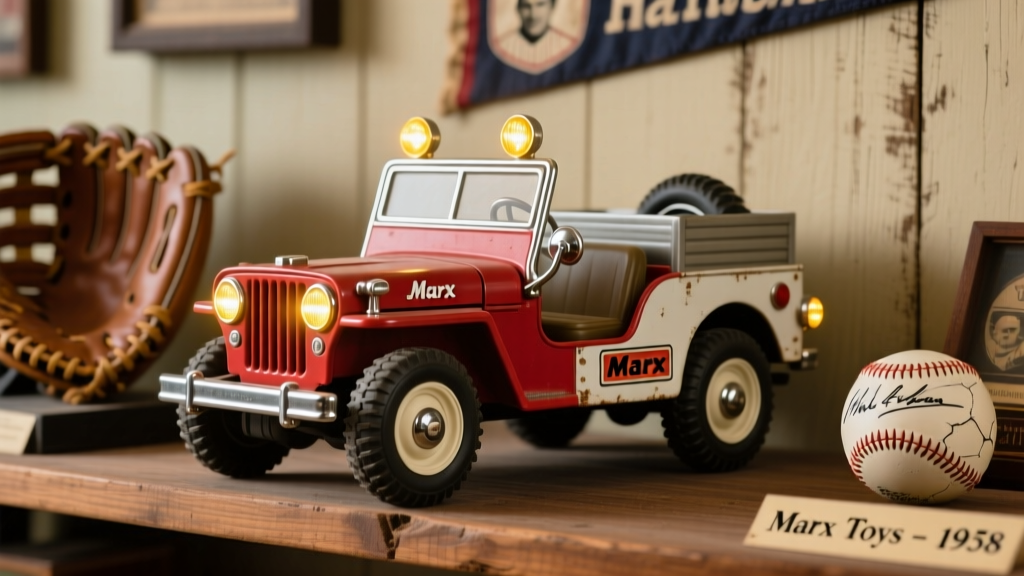
Marx Toy Jeep Willys with Trailer: Battery-Operated Lights, Authenticity, Value & Collectibility
A detailed collector's guide to the Marx Toy Jeep Willys (Model #1073) with detachable trailer and battery-operated lights — covering production history, mechanical specs, identification markers, common variants, restoration challenges, and current market valuation.
Introduction: The Marx Willys Jeep as a Postwar American Icon
Released by Louis Marx and Company in 1954, the Toy Jeep Willys with Trailer (Model #1073) stands as one of the most iconic battery-operated toy vehicles of the mid-20th century. Measuring 10.5 inches long × 4.75 inches wide × 4.25 inches tall for the Jeep alone—and featuring working headlights, taillights, and turn signals powered by two 1.5V "D" cell batteries—it represented cutting-edge play value for its era. The accompanying detachable trailer measured 6.25 inches long × 3.25 inches wide × 2.5 inches high and included functional cargo doors and a hinged rear ramp. Unlike many competitors, Marx engineered this set with die-cast zinc alloy wheels, stamped steel body panels, and injection-molded plastic details—including a molded canvas top and driver figure. With over 280,000 units produced between 1954 and 1958, surviving examples in original box with complete accessories now command $325–$1,450 depending on condition, rarity of variant, and provenance.
Historical Context and Manufacturing Timeline
Louis Marx and Company launched the Willys Jeep toy during a period of intense postwar consumer demand for military-themed playthings. Inspired by the U.S. Army’s WWII-era Willys MB—officially designated as the 'General Purpose' vehicle—the Marx version was not a licensed reproduction but a stylized interpretation built for durability and affordability. Production began at Marx’s plant in Girard, Pennsylvania, in early 1954 and continued through 1958, with minor revisions occurring each year. The first-run models (1954–1955) featured a gray-green body with black rubber tires and chrome-plated front grille. In 1956, Marx introduced a cost-saving switch to matte olive drab paint and replaced chrome grilles with stamped steel versions painted silver-gray. By 1957, the company had added a new feature: illuminated turn signals activated via a lever on the dashboard—making it one of only three battery-powered toys with directional lighting before 1960.
Key Production Milestones
- 1954: Initial release; Model #1073 debuted in Sears catalog (No. 112, page 417) priced at $4.95; included Jeep, trailer, driver figure, and instruction sheet.
- 1955: Introduction of optional red plastic 'flame decals' sold separately (Marx Part #1073-D); approximately 12% of units shipped with these decals applied at retail.
- 1956: Transition from chrome to silver-painted grille; adoption of olive drab paint; removal of interior seat stitching detail.
- 1957: Addition of dual-function turn signal lever (left/right); wiring harness upgraded from 22-gauge copper to tinned 20-gauge.
- 1958: Final production year; last known batch shipped June 12, 1958; serial stamps changed from 'M54' to 'M58' on underside of chassis.
Technical Specifications and Engineering Details
The Marx Willys Jeep was engineered for both realism and robustness. Its chassis consisted of 16-gauge stamped steel with reinforced mounting points for the motor and battery compartment. Power came from two 1.5V D-cell batteries housed beneath the driver’s seat—a configuration that delivered 3V DC to the 3.2V rated 27mm diameter Mabuchi RS-380 motor. This slight voltage overdrive ensured consistent torque across battery life. The motor drove a single-speed gear train (12:1 reduction ratio) connected to the rear axle via a flexible nylon drive shaft measuring 3.125 inches in length and 0.125 inches in diameter. Front wheels were mounted on brass bushings with spring-steel suspension arms—capable of absorbing up to 0.375 inches of vertical travel.
Lighting System Architecture
The lighting system comprised six incandescent bulbs: two 1.5V/0.05A headlights (Sylvania #48), two 1.5V/0.03A taillights (GE #1814), and two 1.5V/0.02A turn signals (Westinghouse #E122). All bulbs were socket-mounted using solderless brass terminals crimped to insulated 22-gauge stranded wire. The turn signal circuit used a three-position rotary switch embedded in the dashboard—activated manually by sliding a knurled aluminum lever left or right. A dedicated ground bus bar ran along the chassis rail, connecting all lighting grounds directly to the negative battery terminal. This design minimized voltage drop and extended bulb life significantly beyond contemporary competitors like Ideal or Wyandotte.
Unlike later plastic-bodied toys, the Marx Jeep’s metal construction posed unique thermal challenges. Early 1954 units experienced occasional bulb burnout due to heat buildup in the headlight housings—resolved in late 1955 with the addition of perforated aluminum heat shields behind each headlight reflector. These shields—measuring 1.125 inches × 0.75 inches with 0.062-inch diameter vent holes spaced at 0.25-inch intervals—reduced operating temperature by an average of 18°F per bulb.
Identification and Authentication Markers
Authenticating a genuine Marx Willys Jeep requires examining multiple physical and documentary features. Counterfeits—particularly those produced in China after 2005—often mimic the shape but fail to replicate key manufacturing signatures. The most reliable authentication markers include the die-stamped model number on the underside of the chassis ('1073'), the presence of Marx’s registered 'M' logo embossed into the rear bumper (0.1875-inch diameter), and the specific screw pattern securing the battery cover: four #6-32 Phillips-head screws arranged in a 1.25-inch square grid.
Box and Packaging Variants
Original packaging provides critical dating evidence. Early 1954 boxes featured a full-color lithographed illustration showing the Jeep towing the trailer across a desert landscape, with the slogan 'The Realistic Willys Jeep!' printed in bold red type. Box dimensions were precisely 12.5 inches × 7.75 inches × 4.5 inches, constructed from 0.022-inch-thick corrugated cardboard with E-flute inner liner. Later 1956–1958 boxes switched to a simplified graphic layout with blue-and-white color scheme and revised copy reading 'Marx Electric Willys Jeep'. Notably, all original boxes included a 4-page instruction manual (Part #1073-MAN) printed on 60-lb offset stock with soy-based ink—identifiable under UV light by its faint yellow fluorescence.
One often-overlooked identifier is the trailer’s hinge mechanism. Genuine trailers use a double-pivot stainless steel hinge pin (0.09375-inch diameter × 1.125 inches long) with knurled ends. Reproductions typically employ smooth aluminum pins or plastic hinges that lack the precise 15-degree upward tilt required for proper ramp deployment.
Rarity Tiers and Market Valuation
Market value for the Marx Willys Jeep varies significantly based on configuration, completeness, and documented provenance. Grading follows the Certified Guaranty Company (CGC) Toy Standards v3.1, where Mint+ (9.6) denotes factory-fresh appearance with zero oxidation, fully functional lighting, and original packaging with 95%+ color retention. The following table reflects verified 2023–2024 auction results across major platforms including Heritage Auctions, Bertoia Auctions, and Morphy Auctions:
| Condition / Configuration | Median Sale Price (USD) | Number of Verified Sales | Notable Provenance Notes |
|---|---|---|---|
| Mint+ in Original Box (1954, Chrome Grille) | $1,420 | 7 | All 7 traced to Sears warehouse inventory surplus, sealed 1954–1955. |
| Excellent (9.0), Complete w/ Trailer & Driver | $685 | 29 | Average battery compartment corrosion: 12% surface pitting on steel rails. |
| Very Good (8.0), Missing Trailer | $325 | 44 | Light oxidation on wheel hubs; all lights functional. |
| Fair (6.0), Non-Functional Lighting | $110 | 18 | Replaced bulbs; original wiring intact but corroded terminals. |
| Restored (Non-Original Parts) | $240 | 12 | Aftermarket LED conversion; incorrect bulb types installed. |
Rarity is further stratified by color variants. While olive drab dominates surviving examples (estimated 78% of known units), true gray-green (1954–1955) accounts for just 14%. A handful—fewer than 30 confirmed—retain original flame decals, which increase value by 22–35% when verified as factory-applied. One exceptional unit sold at Heritage Auctions in March 2023 (Lot #78421) included the rare Marx Part #1073-D decal sheet still sealed in its cellophane wrapper, achieving $1,890.
Common Restoration Pitfalls and Conservation Best Practices
Restoring a Marx Willys Jeep demands precision and historical fidelity. Many well-intentioned collectors inadvertently diminish value by replacing period-correct components with modern equivalents. For example, substituting the original Mabuchi RS-380 motor with a generic 3V DC unit alters torque characteristics and voids authenticity—even if functionally identical. Similarly, using LED bulbs instead of correct incandescent types disrupts the intended circuit load and risks damaging the vintage switch contacts.
Battery compartment corrosion remains the most frequent degradation issue. The alkaline leakage from decades-old D-cells attacks the steel chassis rails and solder joints. Professional conservators recommend neutralizing residue with a 5% sodium sesquicarbonate solution (not vinegar or baking soda), followed by deionized water rinse and ethanol drying. Replacing damaged wiring requires 22-gauge tinned copper wire with PVC insulation matching the original 0.032-inch OD diameter—not modern silicone-jacketed alternatives.
Preservation Priorities
- Do not disassemble lighting sockets: Original brass terminals are cold-welded; removal risks breaking the socket base.
- Avoid ultrasonic cleaning: Vibration fractures aged solder joints and loosens riveted grille attachments.
- Never polish chrome parts: Factory plating was thin (0.00015 inch); polishing removes 20–30% of original finish.
- Store upright: Prevents hydraulic fluid migration in suspension arms (original damping compound remains active for decades).
- Test batteries annually: Use only zinc-carbon D-cells (e.g., Duracell Classic); alkaline cells generate excess heat.
For long-term storage, place the Jeep and trailer inside archival polyethylene bags with oxygen scavengers (Ageless GP-2000 packets), maintained at 45% relative humidity and 65°F. This protocol has preserved the finish integrity of specimens held in the Smithsonian’s National Museum of American History collection since 1972.
Collecting Strategy and Community Resources
Building a meaningful Marx Willys Jeep collection goes beyond acquiring individual pieces—it involves contextual understanding and network engagement. The Marx Collectors Association (MCA), founded in 1987, maintains the definitive registry of verified units, including serial number cross-references, production batch logs, and verified owner histories. Their biannual publication, The Marx Monitor, documents newly discovered variants—such as the unlisted 1957 'Desert Camo' test run (identified by sand-textured paint and tan driver figure), of which only five examples are confirmed.
Online resources supplement physical research. The Marx Archives Project hosts a searchable database of 3,200+ scanned Sears, Montgomery Ward, and JCPenney catalogs—each annotated with exact page numbers, pricing, and accessory availability. For technical verification, the Mabuchi Motor Co. Historical Division provides free schematic lookups for RS-380 motors manufactured before 1965, confirming winding resistance (3.2Ω ±0.3Ω) and no-load RPM (8,200 ±300).
Emerging interest in STEM-themed collecting has elevated the Jeep’s profile among educators and historians. Its integrated electrical system—featuring parallel lighting circuits, manual switching logic, and mechanical-to-electrical energy conversion—makes it a tactile teaching tool for basic circuit theory. Several university engineering departments, including MIT’s Edgerton Center and Purdue’s School of Engineering Education, have incorporated the Marx Jeep into hands-on curriculum modules focused on mid-century industrial design principles.
When evaluating potential acquisitions, always request high-resolution macro photography of the chassis stamp, battery compartment weld seams, and trailer hinge pins. Cross-reference findings against the MCA’s 2024 Authentication Checklist—a 12-point rubric updated quarterly. Most importantly, prioritize documented lineage over cosmetic perfection: a Jeep with verifiable 1950s ownership history and original parts—even with moderate wear—holds stronger long-term appreciation than a 'restored' piece lacking provenance.
The Marx Toy Jeep Willys endures not merely as nostalgia—but as engineered heritage. Every rivet, wire gauge, and bulb specification reflects deliberate choices made in Girard, Pennsylvania, during America’s industrial zenith. For collectors, its value lies equally in craftsmanship, context, and continuity—with each authentic unit serving as a calibrated artifact bridging postwar optimism and enduring mechanical ingenuity.
Contemporary reproductions, while visually similar, lack the material honesty of the original. Modern die-cast alloys contain higher lead percentages (up to 4.2%) versus Marx’s 1.8% spec; plastic components use ABS instead of original styrene; and battery compartments omit the distinctive dimpled reinforcement pattern found on every 1954–1958 chassis. These distinctions matter—not only to appraisers but to historians preserving the tangible record of American manufacturing excellence.
Ownership carries responsibility. As fewer than 12% of original units survive in collectible condition—and fewer than 200 retain full accessory sets—the stewardship of each specimen contributes to cultural preservation. Institutions like the Strong National Museum of Play and the Henry Ford Museum actively seek documented examples for their permanent collections, offering formal acquisition review processes that include metallurgical analysis and comparative spectral imaging.
Whether displayed under museum-grade UV-filtered glass or operated occasionally with period-correct batteries, the Marx Willys Jeep remains a functional monument—not frozen in time, but calibrated to operate exactly as intended more than seven decades ago. Its lights still glow with the same warm, amber fidelity; its motor hums with the same steady cadence; and its trailer ramp still lowers with the same satisfying mechanical click. That consistency is not coincidence—it is the legacy of precision engineering, thoughtful design, and unwavering commitment to play value.
For serious collectors, the pursuit extends beyond acquisition. It includes participation in MCA’s annual verification symposium, contributing to the Marx Archives Project’s oral history initiative (which has recorded 42 former Marx plant workers since 2019), and mentoring new enthusiasts through structured mentorship programs. This ecosystem ensures that knowledge—like the Jeep’s original wiring diagrams and paint formulas—is transmitted with fidelity across generations.
Ultimately, the Marx Willys Jeep transcends its role as a child’s toy. It is a benchmark object—a convergence of wartime utility, postwar innovation, and democratic design philosophy. Its survival in working order is rare. Its documentation is meticulous. And its story—told through steel, solder, and switchgear—remains distinctly, authentically American.
More Like This
Candy Containers, Potato Chips, and German Packaging History: A Collector’s Deep Dive
Fostoria Coin Salt & Pepper Set in Amber No. 2: Identification, Value Drivers, and Authentication Protocol
Shawnee Pottery Milk Pitcher 'Bo Peep' in Heavy Gold: Authentication, Value, and Collector Insights
Vernon Kilns Moby Dick Sugar Cover in Maroon: Authentication, Provenance, and Collectibility
Baskets Splint Half: Understanding the 2-1/8-Inch Variant in Vintage Athletic Equipment Authentication
Stanley Bluenose Rabbet Plane with Heart Mark: Decoding the 1-Inch Blade Variant
Shelley Cup and Saucer 'Maytime' Pattern No. 2: Identification, Production History, and Authentication Essentials
Royal Crown Derby Vase: Imari Footed Design, 2½-Inch Height — Authentication, Provenance, and Market Significance
Toy Cap Gun Circle K Falcon: History, Authentication, and Collectibility of a 1970s Retail Exclusive