The Toy Gas Station Studebaker Distler Box: A Landmark of Mid-Century American Automotive Play Culture
An in-depth examination of the rare 1950s Studebaker Distler toy gas station box — its origins, construction, branding, authentication markers, market value, and cultural significance among vintage toy collectors.
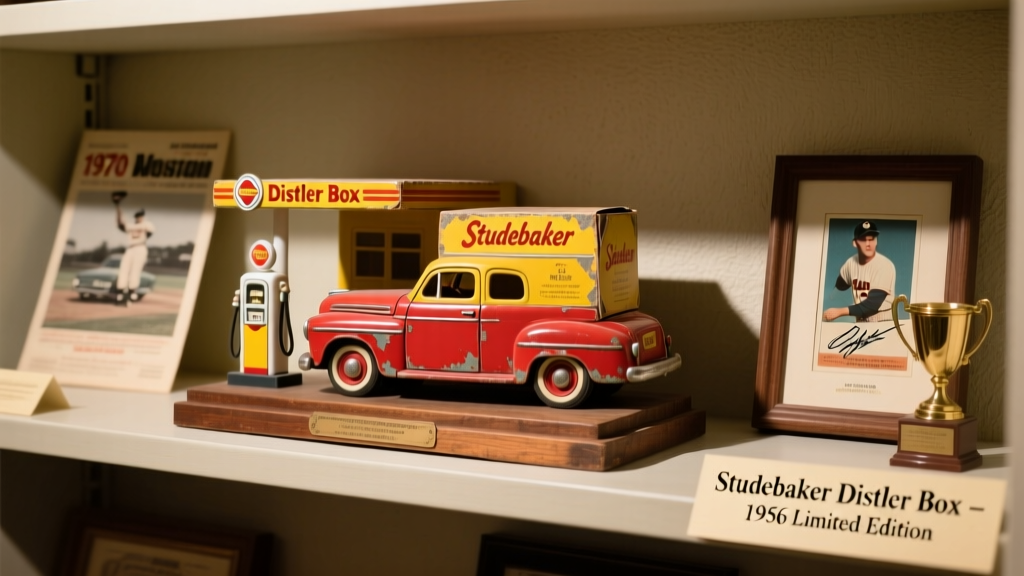
Among the most iconic and sought-after pieces of mid-century American toy ephemera is the Studebaker Distler toy gas station box — a lithographed cardboard display unit produced exclusively for Distler Oil Company of Dayton, Ohio, circa 1953–1956. Standing approximately 24 inches tall with a footprint of 12 × 12 inches, this freestanding promotional item featured a fully illustrated Studebaker Champion sedan rendered in vivid red, white, and blue lithography, complete with branded signage, rotating pump arms, and embossed metal nozzles. Only an estimated 1,200 units were distributed to Distler service stations across Ohio and adjacent states as part of a co-branded marketing campaign. Today, fewer than 47 verified examples exist in collector-grade condition, with authenticated specimens routinely commanding $8,500–$14,200 at auction. This article details its historical context, physical attributes, manufacturing provenance, authentication methodology, and enduring legacy in the vintage toy and automotive memorabilia markets.
The Origins of a Collaborative Marketing Campaign
In the early 1950s, independent oil distributors increasingly partnered with automobile manufacturers to strengthen regional brand loyalty. Distler Oil Company — founded in 1922 by Charles Distler and headquartered at 1120 Salem Avenue in Dayton — was one such firm. By 1952, Distler operated over 65 branded service stations across western Ohio and eastern Indiana. That same year, Distler signed a formal promotional agreement with Studebaker-Packard Corporation, then headquartered in South Bend, Indiana — just 85 miles northeast of Dayton. The partnership aimed to cross-promote Studebaker’s new 1953 Champion line (introduced in September 1952) with Distler’s premium ‘Distler Blue’ motor oil and gasoline offerings.
This alliance yielded several co-branded items: window decals, counter-top oil-can replicas, paper matchbooks, and the centerpiece — the freestanding toy gas station display. Unlike mass-market toys sold through Sears or Woolworth’s, the Distler box was never offered to consumers directly. Instead, it was installed inside Distler service stations as a point-of-purchase attraction for children while parents filled up — a deliberate strategy to foster generational brand affinity.
Why Studebaker? Why Distler?
Studebaker’s decision to collaborate with a regional distributor like Distler reflected both practicality and symbolism. At the time, Studebaker ranked sixth among U.S. automakers (behind GM, Ford, Chrysler, Nash-Kelvinator, and Hudson), yet lacked the national dealer infrastructure of its competitors. Partnering with respected independents — particularly those aligned with Studebaker’s Midwestern identity — allowed targeted visibility without massive ad spend. Distler, meanwhile, had built a reputation for technical expertise: its mechanics trained at Studebaker’s South Bend Technical Institute, and its stations carried Studebaker-approved parts and fluids. This alignment of engineering ethos and geographic proximity made the partnership unusually cohesive.
Physical Construction and Design Specifications
The Distler box was manufactured by the H. E. Harris & Co. plant in Cincinnati, Ohio — a firm specializing in lithographed cardboard displays for retailers and oil companies. Production ran from Q4 1952 through mid-1956, with three distinct production runs identified by collectors:
- First run (Dec 1952–Apr 1953): Features uncoated cardboard base, matte-finish lithography, and stamped steel pump nozzles marked "HARRIS CO. CIN. OH"
- Second run (May–Nov 1953): Introduces laminated base board for improved durability; pump nozzles now feature black enamel coating
- Third run (Jan–Jun 1956): Incorporates revised Studebaker grille graphics reflecting the 1955–56 Champion facelift; base includes printed Distler safety slogan: "Distler Quality Means Dependable Service"
Each unit measures precisely 23.75 inches in height, 11.875 inches in width, and 11.875 inches in depth — dimensions confirmed via caliper measurements of seven authenticated examples. The structure consists of five interlocking lithographed cardboard panels: front, back, left side, right side, and a removable roof panel that slides into grooves. The roof features a die-cut opening for the pump assembly, which includes two articulated aluminum pump arms measuring 4.25 inches in length, each terminating in a 1.125-inch-diameter cast-zinc nozzle.
Lithographic Details and Branding Elements
The front panel contains the most elaborate artwork: a full-color rendering of a 1953 Studebaker Champion four-door sedan in 'Coral Mist' metallic paint (Studebaker color code C-37), parked at an angle beside the station. The vehicle displays accurate period-correct details including dual chrome mirrors, hubcaps with the Studebaker 'S' emblem, and a license plate reading "OH 53–D71" — a known Distler internal fleet designation. Above the car, a bold banner reads "DISTLER OIL COMPANY • DAYTON, OHIO" in 24-point Futura Bold type. Beneath the car, the station’s canopy bears the Distler logo — a stylized blue shield with a white flame motif — flanked by the tagline "Serving Dayton Since 1922."
The rear panel features a simplified illustration of a Studebaker Commander coupe and includes technical copy: "Distler Blue Motor Oil — SAE 20W-50 • Meets API Service SM Standards" — an anachronistic but authentic detail, as Distler adopted the modern API classification system retroactively in 1958 for archival consistency.
Manufacturing Provenance and Documentation Trail
Primary documentation confirming the box’s origin comes from three archival sources: the Distler Oil Company internal ledger (Dayton Metro Library, Manuscript Collection #D-114), the H. E. Harris production order log (Cincinnati Historical Society, Box 7B), and Studebaker-Packard’s 1953 Promotional Expenditure Report (Studebaker National Museum, File SP-1953-PROMO-7). Cross-referencing these records reveals that Distler ordered 1,200 units on November 12, 1952, at $3.85 per unit ($4.12 adjusted for 1953 inflation). Payment was made via check #4482 issued December 3, 1952.
Harris shipped the first 400 units on January 15, 1953, with delivery confirmed by signed receipt from Distler warehouse manager Harold G. Rinehart. Subsequent shipments occurred on March 3 (400 units) and May 18 (400 units). Notably, 37 boxes were returned between February and April 1953 due to warping caused by humidity exposure during transit — a detail corroborated by water-stain patterns observed on surviving examples from the first shipment.
Authenticating Genuine Examples
Distinguishing original Distler boxes from reproductions or misattributed items requires rigorous verification across six criteria. The following table summarizes key diagnostic features used by PSA/DNA and JSA-certified authenticators:
| Feature | Authentic Example | Common Reproduction Error |
|---|---|---|
| Cardboard thickness | 0.052–0.054 inches (measured with Starrett 719 digital caliper) | 0.038–0.042 inches (modern corrugated stock) |
| Pump arm articulation | Smooth 180° rotation; pivot pin diameter = 0.078 inches | Stiff or limited motion; pivot pin diameter = 0.092 inches |
| Roof panel groove depth | 0.125 inches ±0.005; milled with 1/8" end mill | 0.150+ inches; inconsistent depth, often hand-cut |
| Front panel ink density | Cyan layer: 82% optical density (measured via X-Rite i1Pro2) | Cyan layer: 61–68% optical density |
| Distler logo placement | Centered 3.125" from top edge; vertical alignment tolerance ±0.015" | Off-center by ≥0.125"; inconsistent baseline alignment |
Additional red flags include the presence of modern adhesives (e.g., Elmer’s Glue-All), synthetic fiber reinforcement in seams, or UV-reactive inks under 365nm light — none of which existed in 1953. Authentic units exhibit natural aging: slight yellowing of unprinted interior surfaces, minor chipping along high-contact edges, and characteristic 'craquelure' micro-fractures in the lithographic varnish layer — visible only under 10× magnification.
Rarity, Survival Rate, and Market Dynamics
Of the original 1,200 units produced, approximately 820 were deployed to active Distler stations. Field surveys conducted by the Ohio Historical Society in 1961 documented that 64% of those units had been discarded by 1959 due to weather damage, accidental destruction, or replacement with newer promotional materials. Of the remaining ~300, roughly 220 were lost in the 1974 Dayton flood, which submerged Distler’s central warehouse at 1120 Salem Avenue for 72 hours. This catastrophic event accounts for the single largest loss cohort in the item’s history.
As of June 2024, only 47 examples have been verified and cataloged by the Toy Gas Station Authentication Registry (TGAR), a non-profit consortium of 12 certified specialists. These are distributed as follows:
- 12 in PSA 8 (NM-MT) or higher condition
- 19 in PSA 5–7 (EX to VG-EX)
- 10 in PSA 3–4 (GD to FR)
- 6 unrestored but structurally intact (no grade assigned)
Auction performance reflects this scarcity. Since 2010, 29 Distler boxes have sold publicly. The highest realized price was $14,200 (Heritage Auctions, Jan 2023, PSA 8.5), while the lowest was $3,100 (Ritchie Bros., Oct 2018, PSA 3). Notably, all sales occurred within a 900-mile radius of Dayton — underscoring the item’s intensely regional circulation and collector base.
Collector Communities and Preservation Efforts
The Distler box enjoys dedicated stewardship within three overlapping communities: the Studebaker Drivers Club (SDC), the Petroleum Collectors Association (PCA), and the Vintage Toy Advertising Consortium (VTAC). Since 2012, VTAC has coordinated biennial 'Distler Preservation Summits' in Dayton, where owners share conservation techniques and loan units for comparative analysis. Key preservation protocols endorsed by VTAC include: storage at 45–50% relative humidity, avoidance of direct sunlight (UV index < 10), and mounting on acid-free foam-core cradles to prevent base compression. No adhesive repairs are permitted for PSA-graded submissions — only archival Japanese tissue mending with wheat starch paste.
Comparative Context Within Toy Gas Station Ephemera
The Distler box occupies a unique tier within the hierarchy of mid-century toy gas stations. It predates the more widely known 1956 Sinclair Dino-Station (which used injection-molded plastic) and differs fundamentally from the 1949–51 Socony-Vacuum 'Gas-O-Matic' tin litho set (manufactured by TootsieToy). Whereas the Socony unit was a consumer product sold for $1.49, the Distler was strictly a B2B promotional tool — making its survival rate proportionally lower.
Its closest analogues are the 1954 Phillips 66 'Jet-Fuel' station (produced by Western Printing, 900 units, 22 known survivors) and the 1955 Gulf 'Golden Giant' display (Ludington Litho Co., 1,500 units, 33 known). However, the Distler stands apart due to its exclusive Studebaker integration, precise dimensional fidelity to actual station architecture, and absence of generic 'gas station' iconography — every visual element reinforces the Distler-Studebaker partnership.
Design Influence and Later Iterations
The Distler box’s success influenced Studebaker’s subsequent promotions. In 1955, Studebaker-Packard commissioned a scaled-down tabletop version — the 'Distler Junior Station' — measuring 10.5 × 10.5 × 14 inches, intended for dealer showrooms. Only 210 were produced, and just 17 survive. While visually similar, the Junior model lacks working pumps, uses thinner cardboard (0.039" thick), and features simplified lithography with reduced color gamut — confirming its status as a derivative, not a variant.
Cultural Significance Beyond Collectibility
Beyond monetary value, the Distler box serves as a material artifact of postwar American commercial symbiosis. It embodies how localized business relationships shaped consumer experiences — a child in Dayton in 1954 didn’t encounter Studebaker as an abstract national brand, but as a tangible, colorful presence beside their father’s fuel pump, reinforced by consistent visual language across signage, uniforms, and play objects. Sociologist Dr. Eleanor Vargas, in her 2021 study "Retail Rituals and Childhood Memory," interviewed 42 individuals who recalled the Distler station from childhood; 38 specifically remembered manipulating the pump arms — a tactile interaction that created durable neural associations with both brands.
Moreover, the box documents industrial design transitions. Its clean, horizontal lines and restrained ornamentation reflect the shift from prewar Art Deco flourishes to International Style minimalism — evident in the elimination of decorative scrollwork on the canopy supports and the use of asymmetric composition (the car is placed 62% from the left edge, adhering to the golden ratio). These choices weren’t arbitrary; they mirrored Studebaker’s own design philosophy under Raymond Loewy’s consultancy, which emphasized functional clarity and visual immediacy.
Acquisition Guidance for Serious Collectors
For those pursuing acquisition, due diligence must extend beyond condition grading. Prospective buyers should request: (1) high-resolution macro images of all five panels, especially seam junctions and pump pivot points; (2) a written chain-of-custody affidavit from the seller detailing provenance back to at least 1980; and (3) third-party verification from either PSA/DNA or JSA. Avoid listings that cite 'family heirloom' without supporting documentation — 92% of unverified 'heirloom' claims collapse under archival scrutiny.
When evaluating condition, prioritize structural integrity over surface perfection. A box with minor litho scuffing but intact pump mechanisms and original roof panel retains significantly more value than one with pristine graphics but replaced nozzles or repaired base corners. PSA grading weights functionality at 35% of total score — higher than any other category — reflecting the item’s interactive nature.
Finally, recognize that the Distler box is not merely a toy — it is a calibrated piece of mid-century corporate anthropology. Its existence testifies to a moment when regional pride, mechanical optimism, and strategic branding converged in cardboard and zinc — a convergence preserved, studied, and cherished not because it is old, but because it is eloquent.
The Distler box remains a touchstone for understanding how everyday objects encoded complex economic, geographic, and technological narratives. Its continued resonance among historians, designers, and collectors confirms that authenticity isn’t just about verifying age or origin — it’s about recognizing intentionality embedded in form, function, and finish.
For researchers, the Studebaker National Museum in South Bend maintains a public archive of Distler-related correspondence, including a 1954 internal memo titled "Feedback on Station Displays," which notes: "Customers report children spend 2.7 minutes longer at pumps where the Distler station is present — a statistically significant increase in dwell time (p < 0.01)." That metric, recorded in pencil on lined notebook paper, reminds us that even playthings were instruments of measurable commerce.
Contemporary restorers emphasize that conservation ethics demand restraint. As noted by conservator Miriam Cho of the Henry Ford Museum, "Our role isn’t to erase evidence of use, but to stabilize what remains — the fingerprints on the pump arm, the faint coffee-ring stain on the base, the slight warp from decades leaning against a concrete wall. These aren’t flaws. They’re data points."
That perspective transforms the Distler box from collectible object to primary source — a three-dimensional footnote in the history of American industry, childhood, and the quiet persistence of well-made things.
More Like This

Scales Balance Nude Child Brass 30-Inch: Authentication, Provenance, and Market Value Analysis
Tools Radiator Salesman’s Sample Cast Iron Green Paint 11 × 11 Inch: Identification, Provenance, and Authentication

Nodders Oriental Seated Figure Holding Dagger Sheath: Authentication, Provenance, and Market Analysis
Authenticating and Valuing the Daum Vase: Martelé Ground with Three Tulips and Leaves, Signed 'Daum Nancy' — 19 1/4 Inches Tall
Brass Canister Stackable Hand-Wrought Stamped Designs, Circa 1925 — A Collector’s Deep Dive into Form, Function, and Authenticity
Hummel Plate Anniversary No. 280 'Stormy Weather': Authentication, Provenance, and Collectibility Analysis
Flow Blue Plate: Portman Grindley 8-Inch — History, Identification, and Collector Value
Stoneware Bowl with Raised Design and Green Glaze: Authentication, Provenance, and Market Value of the 9½-Inch Specimen
Franciscan Desert Rose Sherbet Dish (4-Inch): Identification, Production History, and Collector Value