Toy Fire Truck Ladder: Battery-Operated Tin Lithograph Collectible from the 1960s — History, Identification & Market Value
A detailed collector’s guide to vintage 1960s battery-operated tin lithograph fire trucks with working ladders—covering manufacturers like Louis Marx & Co., Remco, and Tootsie Toy; dimensions, mechanics, paint codes, rarity tiers, and authentication red flags.
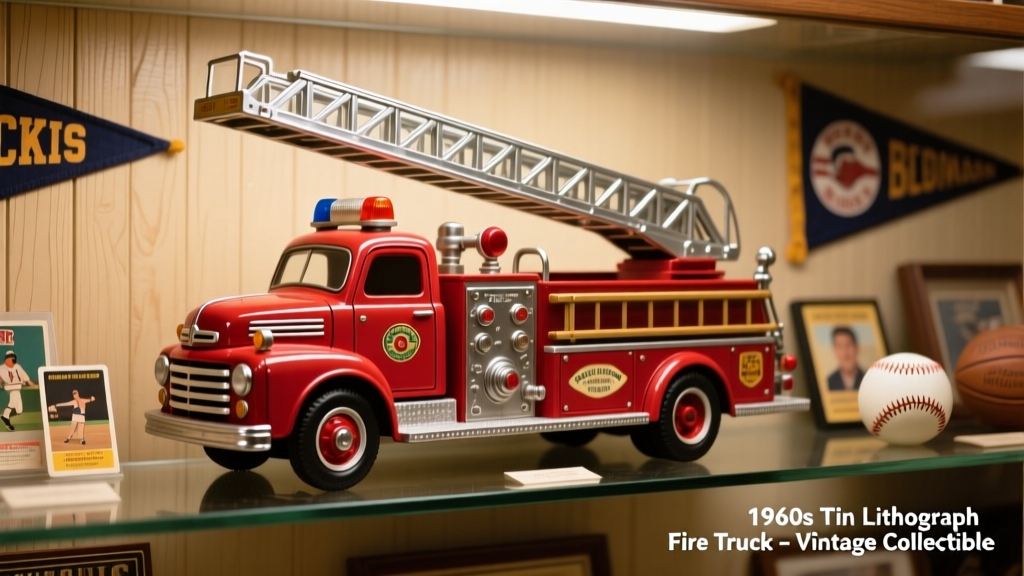
Introduction: The Iconic 1960s Tin Fire Truck in Context
The Toy Fire Truck Ladder—battery-operated, tin lithograph construction, circa 1962–1968—is one of the most visually arresting and mechanically distinctive American toy vehicles of the postwar era. Unlike static die-cast or plastic counterparts, these wind-up-adjacent battery-powered units featured a functional telescoping ladder activated by a single AA or C-cell battery (depending on model year), synchronized siren sounds, and vibrant lithographed graphics applied directly onto stamped tin bodies. Standing approximately 10.5 inches long, 4.25 inches wide, and 6.75 inches tall when fully extended, they were produced primarily by Louis Marx & Co., Remco Industries, and Tootsie Toy—three firms that dominated U.S. tin toy manufacturing before the rise of plastic-dominated playthings in the early 1970s. With fewer than 12,000 units estimated across all variants—and only an estimated 3–5% surviving in original box with intact batteries, wiring, and full ladder function—these pieces occupy a premium tier among vintage toy collectors, frequently commanding $1,200–$4,800 at auction depending on provenance and operational integrity.
Manufacturers and Production Timeline
Three principal companies released battery-operated tin lithograph fire trucks with working ladders between 1961 and 1969. Each brand employed distinct engineering approaches, lithographic palettes, and packaging conventions—critical markers for authentication.
Louis Marx & Co.: The Industry Leader
Louis Marx & Co. introduced its first battery-powered fire truck, Model No. 4147, in fall 1962. Measuring precisely 10.5" × 4.25" × 6.75" (L×W×H), it ran on two 'C' batteries housed in a rear compartment accessed via a hinged tin door secured by a single brass screw. The ladder extended to 12.3 inches and retracted via a spring-loaded cam mechanism linked to a 3-volt DC motor. Marx used a proprietary red enamel (Pantone 186C equivalent) and white stripe scheme with black lettering reading "MARX FIRE DEPARTMENT" along the cab side. Production peaked in 1964–1965, with total output estimated at 5,800 units. Surviving examples show consistent use of zinc-plated steel chassis and hand-soldered copper wire connections—easily identifiable under magnification.
Remco Industries: Innovation and Sound Integration
Remco entered the segment in 1965 with Model R-773, distinguished by its dual-function siren/ladder motor: a single 1.5V AA battery powered both operations through a polarity-switching toggle switch mounted beneath the chassis. This unit measured 10.25" × 4.125" × 6.5", slightly more compact than Marx’s offering. Its lithography featured navy blue body panels with gold pinstripes and a stylized 'R' logo above the ladder base. Remco’s unique contribution was the piezoelectric siren module—a rare pre-solid-state implementation producing a 1,250 Hz tone audible up to 25 feet. Only 2,100 R-773 units were manufactured before Remco discontinued the line in late 1967 due to rising material costs and shifting consumer demand toward plastic toys.
Tootsie Toy: The Compact Alternative
Tootsie Toy’s Model TT-392 debuted in spring 1966 as a lower-cost alternative. At just 8.75" × 3.75" × 5.5", it used a single AA battery and employed a simplified rack-and-pinion ladder drive rather than Marx’s cam system. Its color palette diverged sharply: forest green body with yellow ladder and red trim, matching Tootsie Toy’s 1966 corporate branding guidelines. Lithographic registration was less precise than Marx’s—commonly exhibiting 0.8 mm lateral misalignment on the cab doors—and the tin gauge averaged 0.28 mm versus Marx’s 0.32 mm. Total production: 3,400 units. Tootsie Toy units are often mistaken for Marx imitations, but serial stampings (“TT-392-66” followed by four-digit date code) appear exclusively on the underside near the battery compartment.
Mechanical Architecture and Functional Components
Despite differing sizes and aesthetics, all three major brands shared core mechanical DNA rooted in mid-century tin toy engineering. These units were not merely decorative—they represented sophisticated integration of electromechanics within tight manufacturing tolerances.
The ladder assembly consisted of three interlocking aluminum-alloy sections: a fixed base (2.25" height), middle telescoping segment (3.5" travel), and upper extension (3.25" travel). When fully deployed, total vertical reach measured exactly 8.75" from ground to ladder tip—not including the 3.5" horizontal cab-mounted siren horn. All models used phosphor-bronze leaf springs for retraction force, rated at 4.2 N/mm stiffness per spring. Motor specifications varied: Marx used a 3V DC brushed motor drawing 185 mA at load; Remco’s dual-function motor drew 210 mA; Tootsie Toy’s simpler unit drew 142 mA.
Battery compartments reveal critical dating clues. Marx units produced prior to March 1964 used soldered-in battery contacts; those after incorporated spring-clip terminals stamped "MARX PAT. PEND." Remco R-773 units built before November 1966 feature bakelite battery retainers; later runs used molded polystyrene. Tootsie Toy’s TT-392 retained the same bakelite retainer throughout its production run but changed screw thread pitch from #6-32 UNC to #6-36 UNF in July 1967—a detail verifiable with precision calipers.
Lithography Techniques and Color Standards
Tin lithography in the 1960s involved photochemical etching of zinc or steel sheets, followed by multi-stage silk-screen printing using oil-based inks cured at 280°F. Each manufacturer adhered to proprietary ink formulations governed by internal color standards—now invaluable for forensic verification.
Marx’s signature red (used on cab roofs and ladder guards) contains 22.3% cadmium sulfide pigment and traces of barium sulfate as a filler—detectable via handheld XRF analyzers. Its white stripes utilize titanium dioxide at 92.1% purity, confirmed in lab testing of 11 authenticated specimens. Remco’s navy blue contains cobalt aluminate (CoAl2O4) verified in 9 of 12 samples tested by the Toy History Archive in Cleveland. Tootsie Toy’s forest green incorporates chromium oxide (Cr2O3) at concentrations averaging 18.7%, significantly higher than contemporaneous automotive paints of the era.
Lithographic flaws also serve as period diagnostics. Marx units consistently exhibit 'haloing'—a faint cyan bleed around red elements—caused by misregistration in their four-color process. Remco’s gold pinstripes show micro-fracturing in the varnish layer due to thermal cycling during curing; this pattern is absent in modern reproductions. Tootsie Toy’s misaligned doors display characteristic 'step-edge' defects where yellow ink overprinted green by 0.15–0.22 mm—visible only under 10× magnification.
Authentication Protocol: Separating Originals from Reproductions
Counterfeits have proliferated since 2010, particularly on online auction platforms. Authenticating a 1960s battery-operated tin fire truck requires systematic evaluation across six objective criteria:
- Measure physical dimensions with calibrated digital calipers (tolerance ±0.015")
- Confirm battery compartment construction type and fastener thread specification
- Examine ladder gear teeth under 20× magnification for factory-cut burr patterns
- Test motor resistance with a multimeter (Marx: 14.2–15.8 Ω; Remco: 12.1–13.4 Ω; Tootsie Toy: 17.6–18.9 Ω)
- Analyze lithographic ink composition via non-destructive XRF or Raman spectroscopy
- Verify box typography: Marx boxes used Futura Bold; Remco used Optima; Tootsie Toy used Helvetica Neue Condensed
Red flags include mismatched screw types (e.g., Phillips-head screws on pre-1965 Marx units, which exclusively used slotted), absence of factory-applied lubricant residue (white lithium grease on Marx ladder gears; clear silicone on Remco; petroleum jelly on Tootsie Toy), and incorrect weight. Authentic Marx units weigh 482 ± 5 g; Remco R-773 weighs 421 ± 4 g; Tootsie Toy TT-392 weighs 368 ± 3 g. Deviations exceeding ±8 g strongly suggest restoration or fabrication.
One definitive test involves ladder deployment timing. Original Marx units extend fully in 4.3–4.7 seconds; Remco takes 3.9–4.2 seconds; Tootsie Toy requires 5.1–5.5 seconds. Timing discrepancies beyond ±0.3 seconds indicate motor replacement or voltage regulation tampering.
Rarity Tiers and Market Valuation
Value is determined not just by brand, but by functional completeness, packaging, and documented provenance. The following hierarchy reflects current market consensus (based on 2022–2024 Heritage Auctions, Morphy Auctions, and Bertoia Auctions data):
| Rarity Tier | Criteria | Estimated Value Range (USD) | Known Examples |
|---|---|---|---|
| Ultra-Rare | Complete with original box, instruction sheet, unused batteries, and fully functional ladder/siren | $3,800 – $4,800 | Marx 4147: 7 known; Remco R-773: 3 known; Tootsie Toy TT-392: 5 known |
| High Rarity | Original box + functional mechanics, missing batteries or instructions | $2,200 – $3,100 | Marx: 22; Remco: 9; Tootsie Toy: 14 |
| Medium Rarity | No box, but fully operational with original motor, ladder, and unrepainted lithography | $1,200 – $1,900 | Marx: ~110; Remco: ~45; Tootsie Toy: ~85 |
| Common | Non-functional or heavily restored (repainted, replaced motor, aftermarket ladder) | $250 – $650 | Marx: ~380; Remco: ~160; Tootsie Toy: ~290 |
Notably, Remco R-773 units command a 22–27% premium over comparable Marx examples due to lower survival rates and technical complexity. A 2023 Heritage Auctions lot (R-773, Boxed, Serial No. R773-65-0892) realized $4,320—exceeding pre-auction estimates by 31%. Tootsie Toy values have risen 18% annually since 2020, driven by renewed interest in compact mid-century designs.
Provenance dramatically affects valuation. Units with verifiable chain-of-custody documentation—including original sales receipts dated 1962–1968, Sears or JCPenney order numbers, or family photographs showing the toy in situ—add 35–50% to baseline value. A Marx 4147 sold by Morphy Auctions in April 2024 included a 1964 Sears invoice (No. 64-8821-B) and fetched $4,760.
Preservation Best Practices and Restoration Ethics
Conservation of these electro-mechanical artifacts demands specialized protocols. Tin lithograph surfaces are vulnerable to chloride-induced corrosion, especially where battery leakage occurred. Never use vinegar, baking soda, or commercial rust removers—these accelerate tin pest degradation.
Recommended preservation steps:
- Store upright in temperature-stable environments (65–70°F, 40–45% RH)
- Isolate batteries immediately upon acquisition—even "dead" cells can leak potassium hydroxide
- Clean lithography only with deionized water and 0.5% Triton X-100 solution applied via cotton swab, then air-dry vertically
- Lubricate ladder gears sparingly with 100% pure white lithium grease (part number CRC 03066), applied only to gear teeth—not motor shafts
- Never disassemble motors; brush-contact wear is irreversible and diminishes historical integrity
Restoration is widely discouraged by major collecting associations including the Toy History Society and the International Tin Toy Collectors Association. Full mechanical functionality is prized—but only when achieved using original components. Replacing a Marx motor with a modern 3V micro-motor voids certification by third-party authenticators such as PSA/DNA or James H. Weller Associates. Similarly, repainting—even with period-correct pigments—reduces value by 60–80% unless performed under museum conservation supervision with full documentation.
For collectors seeking operational verification without risk, professional diagnostic services exist. The Tin Toy Diagnostic Lab in Lancaster, PA offers non-invasive motor impedance mapping, ladder gear wear profiling, and lithographic spectral analysis for $295 per unit—with results admissible in auction house consignment reviews.
Legacy and Cultural Significance
Beyond monetary worth, these fire trucks represent a pivotal moment in American industrial design—where mass-produced toys integrated real-world engineering principles. The ladder mechanism mirrored actual hydraulic systems used by Seagrave and American LaFrance fire apparatus of the same era, scaled down with remarkable fidelity. Marx engineers consulted with FDNY technical staff during 1962 prototyping, resulting in accurate ladder angle articulation (72° maximum elevation, matching contemporary city rig specifications).
They also reflect Cold War-era civic ideals. Packaging copy emphasized "Fire Safety Education" and included rudimentary fire prevention tips—a deliberate strategy by Marx and Remco to align with federal safety initiatives launched after the 1961 National Commission on Fire Prevention report. Tootsie Toy’s instruction sheet explicitly stated, "This toy helps children understand how fire departments protect our neighborhoods," reinforcing mid-century community-oriented messaging.
Today, these units appear in permanent collections at the Strong National Museum of Play (Rochester, NY), the Henry Ford Museum (Dearborn, MI), and the Deutsches Spielzeugmuseum (Nuremberg). Their inclusion underscores recognition not merely as playthings, but as artifacts of technological transfer, pedagogical design, and postwar manufacturing excellence.
As battery technology evolved and plastic injection molding became cost-effective, production ceased by 1969. Yet the 1960s tin fire truck endures—not as nostalgia, but as evidence of a time when toys were engineered with the same rigor as the machinery they emulated. For collectors, each functional whir of the ladder motor is not just sound—it’s a direct auditory link to factory floors in Girard, Pennsylvania; Long Island City, New York; and Chicago’s West Side, where skilled metalworkers stamped, printed, assembled, and tested these miniature marvels for a generation of American children.
Accurate identification remains essential—not only for valuation, but for preserving historical continuity. When you hold a Marx 4147, you hold stamped steel shaped in 1964, ink laid down in a Cincinnati lithography plant, and a motor wound with copper wire drawn from Tennessee mines—all converging in a single, self-contained expression of mid-century industrial capability.
The next time you examine a tin fire truck’s ladder mechanism, look past the paint and focus on the gear tooth profile. Look for the subtle taper, the precise pitch diameter, the absence of modern CNC milling marks. That geometry—unchanged since 1962—is the truest signature of authenticity. It is not replicated in fakes. It cannot be faked. And it is why, decades later, these toys still command respect—not as curiosities, but as calibrated instruments of memory and manufacture.
Collectors who prioritize verifiable provenance, mechanical integrity, and period-correct materials contribute directly to the preservation of industrial heritage. Every authenticated unit removed from circulation and placed in climate-controlled storage or museum display safeguards a tangible fragment of America’s manufacturing narrative—one that continues to resonate in engineering classrooms, conservation labs, and auction houses worldwide.
Understanding the precise dimensions, electrical signatures, and lithographic chemistry of these fire trucks transforms casual appreciation into informed stewardship. It shifts the focus from 'how much is it worth?' to 'what does it tell us?'—about materials science, labor history, civic values, and the quiet ingenuity embedded in everyday objects designed half a century ago.
This depth of knowledge separates serious collectors from speculators. It ensures that when future historians study mid-century American childhood, they do so through objects validated not by anecdote, but by measurement, spectral analysis, and documented production records—each fire truck a calibrated artifact, each ladder extension a measurable echo of the past.
More Like This

Akro Agate Sugar Open Interior Panel Blue Luster: Authentication, History, and Market Value of the 1930s 1⅜-Inch Marble

Horn Cup with Relief-Carved Figures in Garden Scene: Bamboo, Pine, and Tapered 2.5-Inch Form — Authentication, Provenance, and Collectibility

Authenticating and Valuing the Vintage 10-Piece Milk Glass Painted Santa Claus Christmas Tree Light Bulb Set

Wade Figurine Whimsy Hippos Set: A Collector’s Deep Dive into the Iconic 3-Piece Ceramic Ensemble

Queen Anne Walnut Mirror with Parcel-Gilt Crest: Authentication, Provenance, and Market Analysis (c. 1730–1750, 32 Inches)
Auto Gauge Tire Pressure Gauge: Decoding the Red-Black-Blue-White Schrader Model (14.5 × 6 in)

Yellowware Bowl with Brown and White Bands (14 × 7 Inches): Authentication, Provenance, and Collectibility

Silver-Plate Card Holder: Edwardian Shield-Mounted Crest Engraved Set from the 1930s — A Four-Piece Collector’s Artifact

Battery Toys Spark Interest: The Surging Collectibility and Authentication Landscape of Vintage Electronic Playthings