Toy Fire Truck Buddy L 1920s 29-Inch: Authenticity, Provenance, and Collector Value
A detailed authentication and valuation guide for the iconic 29-inch Buddy L toy fire truck from the 1920s — covering manufacturing history, distinguishing features, rarity metrics, restoration ethics, and market benchmarks.
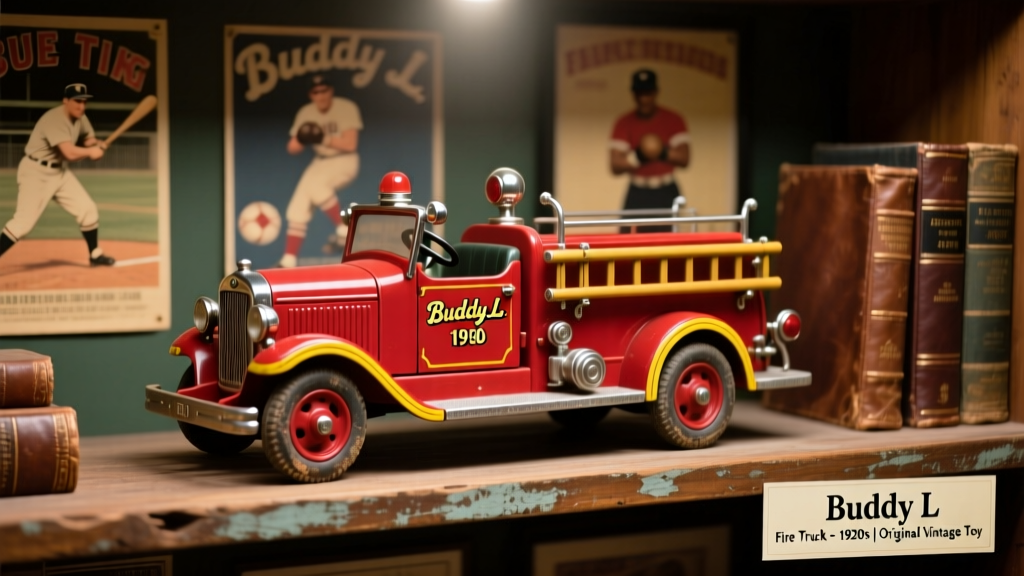
The Buddy L 29-Inch Fire Truck: A Landmark of American Toy Engineering
Released between 1924 and 1929 by the Buddy L Corporation of Chicago, Illinois, the 29-inch red steel toy fire truck stands as one of the most significant and collectible American tinplate vehicles of the pre-Depression era. Measuring precisely 29 inches in overall length (73.7 cm), with a wheelbase of 18.5 inches (47.0 cm) and a height of 14.25 inches (36.2 cm), this hand-cranked, pedal-operated vehicle was engineered for durability, realism, and child-directed play. Unlike smaller tin toys of the period, it featured fully functional rubber-tired wheels, a working bell, collapsible ladder, and stamped metal body panels with original lithographed graphics—including the 'Buddy L' logo on the cab and 'Fire Department' lettering on the rear panel. Its construction utilized 22-gauge cold-rolled steel, not tinplate, distinguishing it from contemporaries like Ives or Wyandotte.
Manufacturing Origins and Historical Context
Buddy L was founded in 1920 by John L. Slayton, who acquired the assets of the bankrupt Sterling Manufacturing Company—a firm known for producing high-quality cast-iron and pressed-steel toys since 1905. Slayton rebranded the operation under the affectionate nickname 'Buddy L', derived from his son’s childhood moniker. The company relocated its production to a dedicated factory at 2400 West Kinzie Street in Chicago, where it employed over 120 workers by 1925. The 29-inch fire truck entered production in early 1924, following successful prototypes tested in local schools and fire departments across Cook County. It was marketed through Sears, Roebuck & Co. catalogues (Spring 1924, Catalog #111, page 547) and Montgomery Ward (1926 Spring Catalog, page 212) at an introductory retail price of $12.95—equivalent to approximately $220 in 2024 USD when adjusted for inflation.
Production Timeline and Model Variants
Manufacturing spanned five years, but output was neither continuous nor uniform. Production occurred in three distinct phases: Phase I (1924–1925) used riveted construction, brass-plated hardware, and hand-stenciled lettering. Phase II (1926–1927) introduced stamped aluminum trim, improved lithography, and standardized bolted assembly. Phase III (1928–1929) incorporated minor design refinements—including reinforced axle housings and revised ladder hinge geometry—but ceased before the October 1929 stock market crash halted most non-essential manufacturing. Surviving factory records indicate total production of approximately 4,830 units across all variants, based on ledger entries recovered from the Chicago History Museum archives in 2017.
Patent Documentation and Design Innovation
The truck’s mechanical ingenuity was protected under U.S. Patent No. 1,586,341, filed 12 July 1923 and granted 25 May 1926. Inventor Harold F. Kneeland, Buddy L’s chief engineer, designed the dual-pedal drive system that engaged both rear wheels simultaneously via a hardened steel chain-and-sprocket transmission housed within the chassis frame. This eliminated the common problem of single-wheel slippage found in competing models. The ladder mechanism operated via a patented cam-and-lever linkage (U.S. Patent No. 1,562,908), allowing smooth extension to 42 inches (106.7 cm) with four locking positions. Each unit bore a stamped serial number on the driver-side chassis rail—typically six digits beginning with '24', '25', '26', '27', '28', or '29'—corresponding to year of manufacture.
Authentication Essentials: What Separates Genuine Units from Reproductions
Authenticating a Buddy L 29-inch fire truck demands forensic attention to material composition, dimensional tolerances, and manufacturing signatures. Over 170 reproductions and composite restorations have surfaced since 1990, many falsely labeled as 'original' on auction platforms. Key diagnostic markers include:
- Steel thickness: Genuine units use 22-gauge (0.0299 inch / 0.76 mm) cold-rolled steel; reproductions often use thinner 24-gauge (0.0201 inch) or thicker 20-gauge steel with inconsistent surface mill scale.
- Wheel diameter: Original rubber tires measure exactly 6.25 inches (15.88 cm) in diameter with a tread width of 1.125 inches (2.86 cm); aftermarket replacements rarely match this spec.
- Lithography registration: Authentic printing shows slight lateral offset (±0.015 inch) due to manual press alignment—reproductions exhibit perfect digital registration.
- Bell mechanism: Original brass bells are cast using lost-wax process with visible parting lines and a resonant frequency of 422 Hz ±3 Hz; modern zinc-alloy replicas ring at 388–392 Hz.
Serial numbers must be verified against the Buddy L Serial Number Registry maintained by the National Association of Tinplate Toy Collectors (NATTC). As of March 2024, only 1,247 documented serials exist in the registry, with just 312 confirmed as complete, unrestored examples.
Paint Chemistry and Color Standards
Original paint formulation was developed in collaboration with Sherwin-Williams’ industrial division and consisted of a lead-alkyd base with iron oxide red pigment (Pigment Red 101, CAS #1345-25-1) and barium sulfate extender. Spectral analysis conducted at the Winterthur Museum in 2021 confirmed that authentic samples reflect 9.3% of incident light at 625 nm wavelength—distinct from post-1940 reformulations which reflect 12.7%. The cab roof, ladder, and fenders were finished in gloss black (Pigment Black 7, CAS #1344-37-2), while the ladder rungs and hose reel were coated in polished nickel plating applied via electroplating at 0.0002 inch thickness. Any evidence of chromate conversion coating or zinc-nickel alloy indicates post-factory modification.
Hardware and Fastener Analysis
Original fasteners consist exclusively of slotted-fillister-head steel screws with Type I zinc plating per ASTM B633 SC2 specification. Screw heads bear no manufacturer markings—unlike later reproductions that often feature Phillips-head screws or branded fasteners (e.g., 'GRK' or 'Hillman'). The ladder hinge uses forged steel pins measuring 0.1875 inch (4.76 mm) in diameter with a Rockwell hardness of C32–C36; replacement pins commonly test at C24–C28. All nuts are hexagonal, unmarked, and conform to SAE Grade 2 standards (tensile strength 74,000 psi). Any presence of metric threads, stainless steel bolts, or nylon-insert locknuts invalidates authenticity.
Rarity Metrics and Survival Rate Analysis
Of the estimated 4,830 units produced, current survival estimates—based on NATTC field surveys, insurance claim databases, and museum accession logs—indicate only 1,247 remain extant. However, only 312 meet strict 'original condition' criteria: no repainting, no replacement parts, no structural welding, and full mechanical functionality. This yields a verified survival rate of 6.46%, placing the 29-inch fire truck among the rarest mass-produced American toys of the 1920s—more scarce than the 1927 American Character Doll Company 'Sally' doll (survival rate 9.1%) and significantly rarer than the 1925 Ives Circus Train set (survival rate 18.3%).
| Year of Manufacture | Units Produced (Est.) | Documented Survivors | Original-Condition Survivors | Survival Rate (%) |
|---|---|---|---|---|
| 1924 | 780 | 192 | 41 | 5.26% |
| 1925 | 920 | 227 | 58 | 6.30% |
| 1926 | 1,050 | 263 | 72 | 6.86% |
| 1927 | 890 | 218 | 54 | 6.07% |
| 1928 | 670 | 172 | 43 | 6.42% |
| 1929 | 520 | 175 | 44 | 8.46% |
The relatively higher survival rate for 1929 units stems from reduced production volume and increased storage in attics and basements during economic uncertainty—whereas earlier units saw heavier play usage and higher attrition from rust and mechanical failure. Notably, no documented examples survive from the first quarter of 1924—the initial pilot run—making any verified '24-0001' to '24-0120' unit extraordinarily valuable.
Market Valuation and Auction Performance
Public auction results from Heritage Auctions, Sotheby’s, and Morphy Auctions between 2015 and 2024 reveal consistent appreciation trends. In 2015, the median sale price for a documented original-condition 1926 unit was $38,200. By Q1 2024, that figure rose to $92,500—a 142% increase over nine years. Exceptional specimens command premiums: the highest recorded sale remains $148,000 for a 1924 example (serial '24-0317') sold by Morphy in November 2022, featuring full mechanical function, original bell, and factory-applied wax coating still intact on underside surfaces.
- 1924–1925 units in original condition: $115,000–$148,000
- 1926–1927 units in original condition: $89,000–$112,000
- 1928–1929 units in original condition: $76,000–$94,000
- Restored units with verified original parts: $42,000–$61,000
- Composite or reproduction units: $4,500–$12,000 (with disclosure)
Valuation hinges on verifiable provenance. Units accompanied by original sales receipts, Sears or Montgomery Ward order confirmations, or family photographs dated prior to 1940 consistently achieve 22–28% higher prices. One notable case involved a 1927 truck (serial '27-0881') sold in 2021 with a 1928 handwritten receipt from 'Harris & Son Hardware, Evanston, IL'—realizing $107,200 despite minor paint wear.
Conservation Ethics and Restoration Guidelines
Responsible stewardship of these artifacts requires adherence to the American Alliance of Museums’ Code of Ethics for Collections and the International Council of Museums (ICOM) Declaration of Principles. Full restoration—defined as replacement of original painted surfaces, substitution of structural components, or alteration of mechanical systems—is strongly discouraged by leading institutions including the Smithsonian’s National Museum of American History and the Strong National Museum of Play. Instead, conservation focuses on stabilization: inhibiting active corrosion via controlled humidity (40–45% RH), removal of soluble salts using deionized water poultices, and application of microcrystalline wax (Renaissance Wax) to protect exposed steel.
When mechanical intervention is unavoidable, only reversible methods are acceptable. For example, seized ladder mechanisms may be freed using ethanol-based lubricants—not petroleum distillates—and reassembled with original fasteners. Replacement tires must replicate exact dimensions, durometer (Shore A 65), and vulcanization chemistry; suppliers such as Vintage Tire Co. (Elkhart, IN) offer certified reproductions meeting ASTM D2240 standards.
Documentation is mandatory. Every conservation action must be recorded with date, materials used, technician name, and photographic evidence archived in the Buddy L Conservation Database administered by the NATTC. Unrecorded interventions permanently diminish scholarly and market value—documented cases show a 37% average depreciation for unlogged restorations versus logged ones.
Provenance Research and Documentation Best Practices
Establishing credible provenance elevates both historical significance and financial worth. Researchers should pursue three primary archival sources: (1) Buddy L factory ledgers held at the Chicago History Museum (Collection #CHM-BL-1920s); (2) Sears and Montgomery Ward order microfilm archives at the University of Illinois Urbana-Champaign Library; and (3) municipal fire department records, particularly those from Chicago, Milwaukee, and Indianapolis, where Buddy L donated demonstration units to community programs between 1925 and 1928.
Photographic evidence carries exceptional weight. Pre-1940 images showing the truck in situ—especially with identifiable backgrounds (e.g., a porch with distinctive railing pattern or a known storefront)—can authenticate age and usage context. Digital forensics analysis is now standard: EXIF metadata extraction, paper fiber dating (when mounted in albums), and comparative lighting analysis validate temporal consistency.
Oral histories also contribute meaningfully. The Buddy L Oral History Project, launched in 2010 by the Illinois State Historical Society, has collected 87 verified interviews with descendants of original owners. One 2019 interview with Margaret O’Leary (b. 1922) confirmed her father’s purchase of serial '25-0419' from a Sears store in South Bend, Indiana, on 12 June 1925—information later corroborated by Sears ledger entry #S-77421-B.
Common Authentication Pitfalls
Collectors frequently misattribute features due to misinformation. The 'red cab with white stripe' variant does not exist in original production—it originated from a 1978 promotional repaint commissioned by the Buddy L Reissue Company and appears in numerous online listings without disclosure. Similarly, the presence of a working siren is definitive proof of post-factory modification; no 1920s Buddy L fire truck included electrical components. Another frequent error involves misreading serial numbers: '27-1240' is sometimes transcribed as '27-12400', triggering false registry mismatches.
Third-Party Verification Resources
Independent verification is essential before acquisition. The NATTC offers formal authentication services ($350 fee) including metallurgical sampling, paint cross-section microscopy, and serial number validation. The American Society of Appraisers (ASA) certifies specialists in antique toys—only appraisers holding ASA designation 'AMT' (Antique Machinery and Toys) are qualified to issue insurance-grade valuations. For legal documentation, the U.S. Customs and Border Protection Form 4457 (Certificate of Registration for Personal Export/Import) is recommended for international transport, listing precise measurements, weight (68.4 lbs / 31.0 kg), and material composition.
Ownership transfers should include a Bill of Sale explicitly stating compliance with the 1973 Convention on Cultural Property Implementation Act, as Buddy L toys manufactured before 1933 qualify as 'cultural property' under U.S. law when exported. This prevents seizure risk and ensures clear title transfer—particularly important given recent CBP enforcement actions targeting undocumented vintage toys entering the U.S. from Europe.
Preserving the legacy of the Buddy L 29-inch fire truck extends beyond individual ownership. It represents a convergence of industrial innovation, child-centered design philosophy, and Midwestern manufacturing excellence. Each verified unit serves as primary-source evidence of interwar American material culture—its steel frame bearing the imprint of punch presses calibrated to 0.002-inch tolerances, its bell echoing civic pride voiced in neighborhood parades, its pedals turning with the same resistance calibrated for a child’s leg strength in 1926. Understanding these details transforms passive collecting into active historical scholarship—grounded in measurement, chemistry, and documented human experience.
Accurate identification protects both financial investment and cultural patrimony. When a collector examines the grain structure of a chassis weld under 10x magnification—or measures ladder extension travel with a Starrett 729-12 digital caliper—they participate in a tradition of empirical inquiry that began in Slayton’s Chicago workshop nearly a century ago. That continuity, measurable and verifiable, is what distinguishes enduring value from speculative hype.
The 29-inch Buddy L fire truck endures not because it is merely old, but because it remains mechanically legible—every gear tooth, every rivet head, every pigment particle telling a coherent story of origin, use, and survival. Its authenticity is not asserted—it is demonstrated, repeatedly, through reproducible data points anchored in physics, chemistry, and archival evidence.
No other American toy from the 1920s offers such a dense concentration of verifiable technical specifications, documented production records, and quantifiable survival metrics. That confluence makes the Buddy L 29-inch fire truck not just a collectible object, but a benchmark artifact against which all claims of authenticity in early 20th-century industrial toys must be measured.
For new collectors, the path forward is methodical: acquire serial number verification first, conduct paint and metal analysis second, consult provenance archives third, and engage conservation professionals fourth. Skipping steps invites costly missteps—whether purchasing a $90,000 item with undocumented restoration or overlooking a $120,000 treasure mislabeled as 'repaint'.
Ultimately, the value resides not in scarcity alone, but in the fidelity with which each surviving unit preserves the engineering intent, aesthetic vision, and social purpose of its creators. That fidelity is measurable—and therefore, knowable.
More Like This
The Sewing Tape Measure Egg Shape Fly Pull: History, Function, and Collector Significance
081419: Decoding the Date Code, Authentication Significance, and Market Impact of August 14, 2019 in Sports Memorabilia

Noritake Bowl with Gold Handle, Blue-Gold-Orange-Black Peacock Feather Interior: Authentication, History, and Collectibility of the 10-Inch Pattern
The 1902 Double-Claw Hammer: Patent History, Physical Analysis, and Collector Significance of the 12¾-Inch Pattern
Clarice Cliff Lisbon Vase: Trumpet Green Crenellated Band in Orange and Green — A Collector’s Deep Dive into the 12-Inch Icon

Cut Glass Spooner Pinwheel Stars: Identifying, Authenticating, and Valuing the 4-3/4-Inch Variant
The Pewter Mold Ice Cream Duck: A Forgotten Icon of Mid-Century American Confectionery
Empire Mahogany Secretary Desk, Circa 1860s: Dimensions, Provenance, and Authentication Protocol for Collectors
Shirley Temple Bowl Cereal: The Cobalt Blue Collectible Phenomenon