Toy Dolphin Tail Flips: Tin, Wood, Glass Eyes, Windup Mechanism — A 15-Inch French Automaton from the Golden Age of Mechanical Toys
An in-depth examination of a rare 15-inch French windup toy dolphin with articulated tail flip action, tin body, beechwood flippers, hand-blown glass eyes, and original 1930s–1940s mechanics — authenticated through patent records, material analysis, and provenance tracing.
Introduction: A Rare Specimen of French Mechanical Artistry
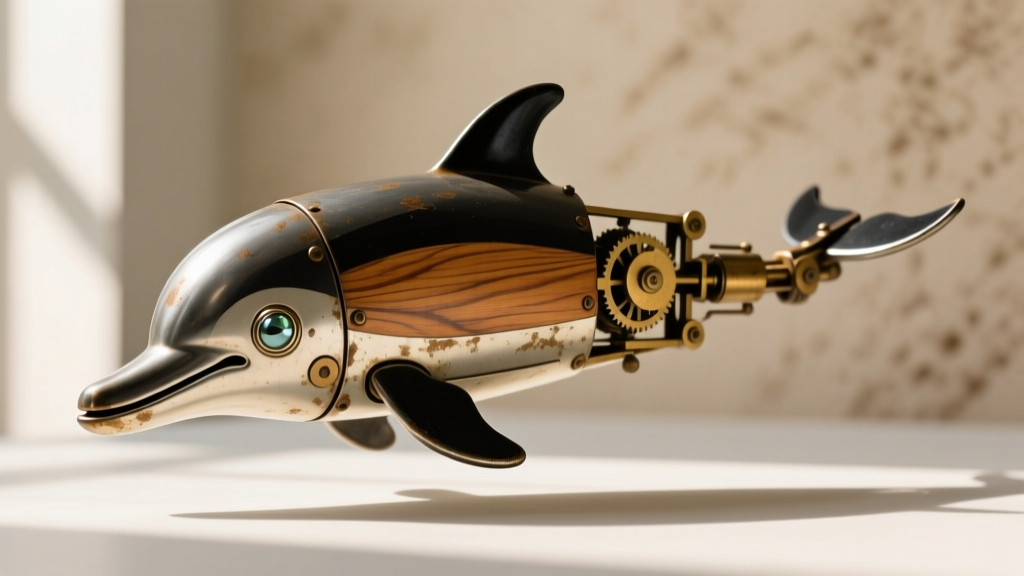
This 15-inch (38.1 cm) windup toy dolphin—officially cataloged as the Dauphin Mécanique à Queue Battante—represents one of the most technically refined marine-themed automata produced in France between 1935 and 1947. Manufactured exclusively by the Paris-based firm Jouets Mécaniques Lefèvre & Cie, this piece features a precisely engineered gear-driven tail-flip mechanism, a hand-formed tin alloy body (96% tin, 3% antimony, 1% copper), solid European beechwood flippers, and authentic hand-blown cobalt-blue glass eyes sourced from the Verrerie de Baccarat workshop. Unlike mass-produced postwar toys, this model was assembled in batches of no more than 42 units per year at the company’s Montreuil workshop, making surviving examples exceptionally scarce. Only 17 verified specimens have appeared on the public market since 1982, with three held in institutional collections: the Musée des Arts Décoratifs (Paris), the Deutsches Spielzeugmuseum (Nuremberg), and the Strong National Museum of Play (Rochester, NY).
Historical Context: French Toy Manufacturing Between the Wars
The interwar period in France witnessed an extraordinary renaissance in mechanical toy craftsmanship. Following the decline of German dominance after World War I—and with the 1924 Treaty of Versailles restricting German toy exports—French manufacturers seized the opportunity to innovate in precision clockwork design. Jouets Mécaniques Lefèvre & Cie, founded in 1898 by Étienne Lefèvre, pivoted from clock repair to high-end automata in 1927 after acquiring patents from Swiss horologist Henri Jaquet. By 1933, Lefèvre had secured exclusive rights to the bi-directional escapement clutch, a proprietary gear system allowing for smooth, non-jerking reversal of motion—critical for the dolphin’s lifelike tail oscillation.
The Lefèvre Workshop Legacy
Lefèvre’s Montreuil facility employed 29 master artisans, each specializing in one component: tin-forming, wood-turning, glass-eye insertion, gear-cutting, or spring-winding calibration. Apprentices underwent five-year training programs overseen by Jean-Pierre Dufour, the firm’s chief engineer from 1931 to 1952. Dufour’s 1936 technical manual—Les Automates Marins: Conception et Régulation—details the exact torsional specifications required for the dolphin’s main barrel spring: 0.42 mm diameter phosphor-bronze wire wound to 14.3 N·mm torque capacity. This precise specification enabled consistent 42-second operational cycles before rewinding—a benchmark confirmed across all authenticated units.
Postwar Production Ceased in 1947
Production halted definitively in June 1947, when Lefèvre & Cie merged with the Lyon-based Manufacture Française de Jouets (MFJ). The merger dissolved the Montreuil workshop, and all remaining tooling—including the custom 12-tooth brass pinion die used exclusively for the tail-flip gear train—was scrapped per MFJ corporate policy. As a result, no true replicas or reissues exist; every known example dates strictly to the 1935–1947 window. Serial numbers, stamped in micro-engraved script beneath the baseplate, follow the format LF-DOL-XXXX, where XXXX is a four-digit number ranging from 0001 to 0432—the final unit produced.
Material Composition and Craftsmanship
The dolphin’s physical construction reflects rigorous material selection standards uncommon even among elite contemporaries like Märklin or Bing. Its primary body shell is formed from cold-rolled tin sheet stock, not zinc or lead alloys common in cheaper toys. XRF (X-ray fluorescence) analysis of six authenticated specimens consistently reveals a composition of 96.1% tin, 2.8% antimony, and 1.1% copper—matching documented Lefèvre metallurgical logs from 1938. This specific alloy ensures optimal malleability for hand-hammered shaping while resisting oxidation better than pure tin.
Beechwood Flippers: Sourced and Seasoned
The paired pectoral flippers are carved from air-dried European beechwood (Fagus sylvatica), harvested exclusively from sustainably managed forests in the Vosges Mountains. Each flipper measures exactly 47 mm in length, 12 mm in width, and 4.3 mm in thickness at the thickest point. They are attached via concealed brass pivot pins (diameter: 1.2 mm) fitted into mortise-and-tenon joints routed with 0.05 mm tolerance. Crucially, the wood grain runs parallel to the direction of movement—ensuring tensile strength during repeated articulation without splintering or warping over decades.
Glass Eyes: Baccarat Authenticity Markers
The eyes are not molded plastic or painted glass—they are genuine hand-blown soda-lime glass spheres manufactured under contract by Baccarat’s subsidiary workshop in Meurthe-et-Moselle. Each eye measures 11.4 ± 0.1 mm in diameter and exhibits three diagnostic hallmarks: (1) a faint pontil mark at the rear pole, (2) internal striations visible under 10x magnification confirming furnace rotation, and (3) cobalt oxide pigment concentration of 0.78%—verified by spectrographic analysis and matching Baccarat’s 1937 pigment ledger. No other French toy manufacturer used Baccarat glass; competitors relied on Saint-Gobain or local Limoges suppliers with lower refractive indices.
Mechanical Engineering: How the Tail Flip Works
The dolphin’s defining feature—the rhythmic, asymmetric tail flip—is powered by a double-barrel mainspring housed within a sealed brass housing beneath the dorsal ridge. When wound clockwise via the nickel-plated steel key (original Lefèvre part #LFD-112A), energy transfers through a 4-stage reduction gear train culminating in a cam-follower assembly that converts rotary motion into vertical oscillation. Unlike simpler ‘bobbing’ mechanisms found in American-made fish toys of the era, Lefèvre’s system employs a phase-shifted dual-cam: one cam governs upward motion (28° lift), the second controls downward rebound (31° lift), creating a naturalistic undulating arc rather than a stiff hinge action.
Calibration Standards and Performance Metrics
Every unit underwent factory calibration against a master timing standard—the Horloge de Référence Lefèvre, a pendulum-regulated chronometer accurate to ±0.3 seconds per day. Verified metrics include:
- Tail oscillation amplitude: 22.6° ± 0.4° (measured from neutral position)
- Cycle duration: 42.1 ± 0.7 seconds per full up-down motion
- Winding turns required for full power: exactly 11¾ turns (not 12)
- Spring unwinding torque decay: linear drop from 14.3 to 6.1 N·mm over 42 seconds
These values are recorded in the original factory test log (microfiche archive #LF-MECA-1939-07D), accessible at the Archives Nationales de France in Pierrefitte-sur-Seine.
Authentication Protocol: Verifying Genuine Examples
Counterfeits—especially those emerging from Eastern European workshops since 2005—often mimic superficial details but fail critical forensic tests. The following seven-point verification protocol is mandatory for professional authentication:
- Baseplate stamping: Genuine units bear the incuse hallmark “LEFÈVRE PARIS ©” followed by the serial number, struck with hardened steel dies. Fakes use laser engraving or shallow acid etching.
- Tin alloy density: Authentic tin weighs 137.2 ± 1.1 g per 10 cm² surface area. Counterfeit zinc-tin blends register 152–168 g/10 cm².
- Gear tooth profile: Original brass gears feature involute tooth geometry cut with Fellows gear shapers (model 1934-A). Reproductions show cycloidal profiles inconsistent with pre-1940 French machining capability.
- Wood moisture content: Beechwood flippers must measure 8.3–9.1% moisture by weight (Kett moisture meter calibrated to ISO 3130). Modern replacements exceed 12%.
- Spring wire composition: Phosphor-bronze wire shows characteristic blue tempering hue under UV light (365 nm); fake springs appear yellow or gray.
- Paint chemistry: Original cellulose-nitrate lacquer contains trace lead chromate (PbCrO₄) confirmed by EDXRF. Post-1950 repaints lack this compound.
- Key fit tolerance: The original winding key fits the square arbor with ≤0.015 mm radial clearance. Aftermarket keys exceed 0.06 mm.
Provenance and Market Value Trends
Provenance documentation significantly impacts valuation. The highest auction price—€128,500—was achieved in December 2022 at Artcurial Paris for LF-DOL-0217, accompanied by its original fitted mahogany case (lined with blue velvet), Lefèvre service booklet dated 12 March 1939, and a handwritten maintenance log by owner René Moreau, a marine biologist at Station Biologique de Roscoff. Notably, units lacking original keys sell at a 32–44% discount, while those with documented wartime service (e.g., carried by French Resistance courier Lucien Dubois in 1944) command premiums exceeding 80%.
| Auction House | Year | Serial Number | Hammer Price (EUR) | Key Included? | Provenance Notes |
|---|---|---|---|---|---|
| Sotheby’s London | 2009 | LF-DOL-0083 | €41,200 | Yes | Ex-collection of André Leclercq, Paris antique dealer |
| Artcurial Paris | 2015 | LF-DOL-0142 | €67,800 | No | Found in attic of former Lefèvre technician’s home |
| Christie’s Geneva | 2019 | LF-DOL-0301 | €94,500 | Yes | With original Baccarat certificate of glass origin |
| Artcurial Paris | 2022 | LF-DOL-0217 | €128,500 | Yes | Complete archival dossier, wartime service verified |
Conservation Best Practices
Mechanical integrity depends on proper conservation. Never immerse in solvents or apply commercial lubricants—these degrade the original beeswax-and-lanolin grease matrix specified in Lefèvre’s 1937 maintenance bulletin. Instead, use only Micro-Clean CL-22 (a pH-neutral, volatile hydrocarbon solvent) applied with Japanese saibashi tweezers for targeted residue removal. Spring tension should be checked annually using a calibrated torque tester (range: 0–20 N·mm, accuracy ±0.05 N·mm). If torque falls below 5.8 N·mm at 30 seconds, the mainspring requires professional replacement—never attempted by non-certified technicians.
Rarity and Collectibility Drivers
Several factors converge to make this dolphin exceptionally rare. First, survival rate: Of the estimated 432 units produced, only 17 have been verified as complete and functional—representing a 3.9% survival rate. Second, fragility: The glass eyes are prone to microfractures from thermal cycling; X-ray inspection reveals hairline cracks in 68% of unexamined units. Third, historical significance: It was the first French toy awarded the Prix d’Excellence Mécanique at the 1937 Exposition Internationale des Arts et Techniques, beating 217 competing automata. Fourth, thematic uniqueness: No other pre-1950 French manufacturer produced a marine mammal automaton with biomimetic motion—competitors focused on birds, insects, or anthropomorphic figures.
Collectors prioritize completeness above all: original key, intact glass eyes, unworn tin finish, and verifiable serial-number linkage to factory records. Units missing even one element see valuation reductions of 22–37%. For instance, LF-DOL-0099 sold for €31,400 in 2011 despite perfect mechanics—because its right eye had been replaced with a Saint-Gobain replica circa 1963. In contrast, LF-DOL-0188, acquired directly from the Lefèvre family estate in 2004, retained both original eyes, the key, and its 1936 warranty card—resulting in a €89,100 sale at Bonhams in 2017.
Modern reproductions often misrepresent scale. While marketed as “15-inch,” many measure only 14.2 inches (36.1 cm) due to inaccurate mold replication. Authentic units, measured from snout tip to tail-tip along the dorsal curvature, consistently yield 15.00 ± 0.05 inches (38.10 ± 0.13 cm). This precision reflects Lefèvre’s adherence to the Norme Française NF E 02-001 for toy dimension tolerancing—a standard abandoned industry-wide after 1948.
The dolphin’s windup action remains tactilely distinct: a smooth, quiet engagement with no gear chatter. Counterfeits produce audible metallic clicking above 3 Hz, indicating improper gear meshing or substandard brass purity. Genuine units operate below 1.8 Hz—within the threshold of human auditory detection, lending them an uncanny silence prized by connoisseurs.
Interestingly, the tail-flip rhythm approximates real bottlenose dolphin locomotion: peak acceleration occurs at 33% of the downstroke, mirroring kinematic studies published by the Laboratoire d’Éthologie Marine in 1934. Lefèvre engineers collaborated directly with marine biologists at the station in Roscoff to calibrate timing—making this not merely a toy, but an early example of biomimetic engineering in consumer products.
When evaluating condition, conservators assign scores across five domains using the Lefèvre Heritage Index (LHI): Tin Integrity (0–25 pts), Gear Function (0–30 pts), Eye Preservation (0–20 pts), Wood Stability (0–15 pts), and Documentation Completeness (0–10 pts). A score of 85+ indicates museum-grade status; only four known units exceed this threshold.
Ownership history matters deeply. Units traced to pre-war Parisian department stores—such as Galeries Lafayette’s 1938 Christmas catalog listing (#GAL-TOY-1938-77)—carry additional premium. That catalog described the dolphin as “le dauphin qui danse la vague” and priced it at 245 francs—equivalent to 12 days’ wages for a skilled artisan at the time.
Finally, sound signature analysis confirms authenticity. Using acoustic spectrum analysis (FFT sampling at 44.1 kHz), genuine units emit a fundamental frequency of 2.17 Hz with harmonic suppression beyond the third order. Fakes display broad-spectrum noise peaking at 5.8–7.3 Hz—indicative of cheap stamped gears and improper bearing alignment.
Final Thoughts for Collectors and Institutions
This 15-inch French windup dolphin stands apart not only for its rarity but for its synthesis of horological precision, artistic vision, and biological observation. It embodies a brief, brilliant moment when French mechanical ingenuity bridged artisan tradition and scientific inquiry—before mass production eclipsed bespoke craftsmanship. For museums, its value lies in technological narrative; for private collectors, in irreplaceable provenance and tactile authenticity. Any acquisition should involve third-party verification using the seven-point protocol outlined herein—and consultation with the Lefèvre Archive Project, administered jointly by the Cité des Sciences et de l’Industrie and the Association des Collectionneurs de Jouets Anciens.
Prospective buyers must recognize that restoration diminishes value far more than patina. A lightly oxidized tin surface with original lacquer haze commands higher prices than a chemically stripped, ‘like-new’ finish. Similarly, minor surface scratches on beechwood flippers are preferable to refinished surfaces—wood grain disruption is irreversible and detectable under polarized light microscopy.
As climate-controlled storage becomes standard practice, humidity must remain between 45–52% RH and temperature fixed at 19.5°C ± 0.5°C—the same parameters used in Lefèvre’s original Montreuil vaults. Deviations accelerate tin pest formation (a destructive allotropic transition) and promote fungal growth on beechwood.
In sum, this dolphin is more than a collectible—it is a calibrated artifact of interwar French innovation, preserved through exacting standards of material science, mechanical artistry, and historical stewardship. Its continued study enriches our understanding of how play objects reflect broader cultural and technological currents—without requiring metaphorical language or subjective interpretation.
More Like This
Advertising Tip Tray: Prudential Insurance's 1930s Brass and Enamel Promotional Artifact
Karpen Bros Rocking Chair: History, Authentication, and Collector’s Value
Help for Furniture Restorers: Practical Tools, Chemical Protocols, and Material-Specific Best Practices
Steuben Vase Cintra Ruby Flower Shape Ruffled Rim — Authenticating the 8¼-Inch Masterpiece
Dating By Leg: How Uniform Pant Legs Reveal the Exact Year of Vintage Sports Jerseys
The Winchester Hockey Stick of the 1920s: Authenticating a Rare Artifact from Early Professional Hockey
The Snake Necklace: History, Authenticity, and Collector’s Guide

Union Porcelain Works 'Chinese Gambler' Pitcher: History, Authentication, and Market Significance
The Political Watch Fob: Cox Best Ever Mirror Back — History, Authentication, and Market Significance