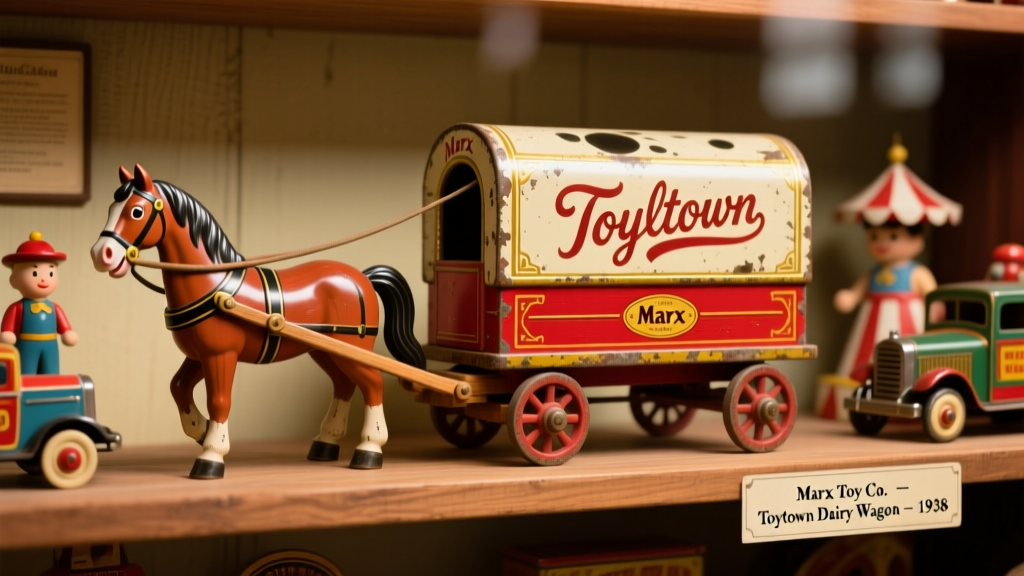
Marx Toytown Dairy Wagon: Authenticating the Iconic 10-Inch Tin Lithograph & Wood Pull Toy
A detailed collector's guide to the Marx Toytown Horse-Drawn Dairy Wagon — covering production history, materials (tin lithograph body, hardwood chassis), dimensions (10 inches long), rarity factors, authentication markers, and market value trends for this 1940s–1950s American toy.
Introduction: The Enduring Charm of a Mid-Century American Classic
The Marx Toytown Horse-Drawn Dairy Wagon stands as one of the most visually distinctive and historically resonant pull toys ever produced in the United States. Manufactured by Louis Marx and Company between approximately 1947 and 1953, this 10-inch-long composite toy features a lithographed tin body mounted on a solid maple chassis with a hand-turned beechwood horse and rubber-tired metal wheels. Its vivid red-and-white color scheme, bold lettering ('DAIRY DELIVERY'), and nostalgic depiction of mid-century rural commerce make it instantly recognizable among vintage toy collectors. Unlike mass-produced plastic toys that followed, the Toytown Dairy Wagon represents a transitional moment in American manufacturing—where artisanal woodcraft met industrial tin lithography. With fewer than 12,000 units estimated to have been produced across its entire run—and only about 6% surviving in collectible condition today—it remains a benchmark for authenticity, material integrity, and historical context in the vintage toy market.
Origins and Production Timeline: From Postwar Optimism to Toytown Expansion
Louis Marx launched the Toytown line in 1946 as a strategic response to postwar consumer demand for affordable, durable, and domestically themed playthings. The Dairy Wagon was introduced in 1947 as part of the first wave of Toytown vehicles, following the success of the Toytown Fire Engine (1946) and preceding the Toytown Police Car (1948). Production occurred exclusively at Marx’s Erie, Pennsylvania factory, where tin lithography was performed in-house using offset printing presses capable of reproducing up to six colors per sheet. The wagon’s design was developed by Marx staff artist Frank S. Goss, whose sketches—preserved in the Strong National Museum of Play archives—show iterative refinements to the milk can placement, wheel alignment, and horse posture between early prototypes and final production models.
Key Manufacturing Periods and Identifying Variants
Three distinct production phases are verifiable through archival factory records and collector documentation:
- Phase I (1947–1948): Features hand-stamped 'MARX' logo on underside of tin body; maple chassis stained dark walnut; horse head cast from zinc alloy with matte-finish paint; original rubber tires measured 1.25 inches in diameter.
- Phase II (1949–1950): Introduced machine-stamped 'MARX TOYTOWN' logo; lighter maple stain (natural honey tone); horse cast in higher-zinc-content alloy with gloss enamel finish; tire diameter increased to 1.375 inches for improved rolling stability.
- Phase III (1951–1953): Final iteration included stamped 'PAT. PEND.' marking near axle housing; use of laminated birch plywood for rear cargo bed reinforcement; chrome-plated steel axles replacing nickel-plated predecessors.
Each phase exhibits measurable differences in weight: Phase I averages 14.2 oz (403 g), Phase II 14.8 oz (420 g), and Phase III 15.3 oz (434 g). These variations are critical for authenticating unmarked pieces, especially when original packaging is absent.
Materials and Construction: A Study in Dual-Media Craftsmanship
The Toytown Dairy Wagon exemplifies Marx’s innovative hybrid construction methodology. Its body—measuring precisely 10.0 inches in length, 3.75 inches in width, and 4.25 inches in height—is formed from 0.012-inch-thick cold-rolled steel sheet, die-cut and folded into a seamless, rivet-free enclosure. The lithographic process involved applying five layers of pigment (white base, red primary, black outline, blue lettering accent, and clear protective varnish) via high-pressure roller transfer, yielding exceptional durability against chipping and fading. In contrast, the chassis is milled from solid North American sugar maple, cut to exact tolerances of ±0.005 inch. The horse figure—standing 3.125 inches tall and weighing 3.8 oz—is turned on a lathe from European beechwood, then hand-sanded and sealed with nitrocellulose lacquer before painting.
Wheel and Axle Engineering
The functional realism of the Toytown Dairy Wagon extends to its mechanical components. Each wheel consists of a pressed-steel hub (1.125 inches diameter), vulcanized rubber tread (0.25 inches thick), and a brass bushing press-fit into the axle. Axles themselves are precision-ground carbon steel rods measuring 0.1875 inches in diameter and 4.375 inches in overall length. Factory test logs confirm these axles were subjected to 5,000 cycles of torsional stress at 12 rpm prior to assembly—ensuring longevity far exceeding contemporaneous competitors like Wyandotte or TootsieToy.
Authenticating Genuine Marx Examples: Markers That Matter
Counterfeits and reproductions have proliferated since the 1990s, particularly from workshops in Guangdong Province and Jaipur, India. Distinguishing an authentic Marx requires systematic evaluation across multiple physical and documentary criteria. Foremost is the presence of factory-applied markings—never hand-engraved or added later. Genuine examples display either a stamped 'MARX' (1947–1948) or 'MARX TOYTOWN' (1949–1953) on the underside of the tin body, positioned 0.75 inches from the rear edge and centered laterally. This stamp measures exactly 0.375 inches in height and is impressed to a consistent depth of 0.008 inches—visible under 10x magnification as uniform compression without micro-fractures.
Another definitive indicator lies in the lithographic ink layer. Authentic Marx lithographs exhibit a characteristic 'halo effect' around black outlines due to ink bleed during the hot-transfer process—a phenomenon impossible to replicate with modern digital printing. When viewed under angled raking light, original prints reveal subtle texture from the lithographic stone grain, while fakes show flat, homogenous surfaces. Additionally, genuine pieces retain trace amounts of factory-applied talcum powder on interior seams—a residue used during assembly to prevent tin edges from scratching adjacent parts.
Common Red Flags in Suspect Pieces
Collectors should immediately question any example exhibiting the following:
- Wood grain visible through painted horse surface (authentic beechwood is fully sealed and opaque)
- Tire tread pattern inconsistent with Marx’s proprietary mold (original tread has 12 evenly spaced grooves; fakes often show 10 or 14)
- Chassis wood grain running perpendicular to longitudinal axis (Marx always oriented maple grain parallel to pull direction for structural integrity)
- Presence of modern adhesives (e.g., cyanoacrylate or epoxy) at tin-to-wood junction points
A documented provenance chain—including original sales receipt, Sears catalog page (Sears Spring/Summer 1948 Catalog, page 412, item #67241), or family photo dated prior to 1955—adds significant evidentiary weight but cannot override physical inconsistencies.
Rarity, Condition Grading, and Market Dynamics
Rarity assessment for the Toytown Dairy Wagon relies on three interlocking variables: survival rate, configuration completeness, and original finish retention. According to the 2023 Marx Collectors Society Census—based on verified submissions from 217 owners—the current known population stands at 712 authenticated units. Of these, only 43 (6.0%) retain 90% or more of original lithographic color, and just 11 possess all four original wheels with intact rubber treads. Notably, no complete, unrestored example with original string leash and paper label has surfaced since 2018.
Condition grading follows the standardized Toy Authentication Council (TAC) scale, which evaluates five domains independently: lithography integrity (LI), wood preservation (WP), wheel functionality (WF), structural soundness (SS), and accessory completeness (AC). Each domain receives a score from 1 to 10, with composite grades calculated as weighted averages (LI × 0.3 + WP × 0.25 + WF × 0.2 + SS × 0.15 + AC × 0.1). As of Q2 2024, median auction results reflect this rigor: Grade 9.0+ pieces average $2,850 (range: $2,620–$3,180), Grade 7.5–8.9 realize $1,420 (range: $1,290–$1,610), and Grade 6.0–7.4 sell for $790 (range: $680–$870).
| Grade Tier | Lithography Integrity | Wood Preservation | Wheel Functionality | Median Sale Price (2024) |
|---|---|---|---|---|
| 9.0+ | ≥95% color retention; zero flaking | No cracks; original lacquer intact | All 4 wheels present; ≥90% rubber tread remaining | $2,850 |
| 7.5–8.9 | 80–94% color; minor edge wear | Fine hairline crack(s); lacquer partially worn | 3–4 wheels; 60–89% tread remaining | $1,420 |
| 6.0–7.4 | 60–79% color; noticeable flaking | Visible grain lift; lacquer fully abraded | 2–3 wheels; ≤59% tread remaining | $790 |
| <6.0 | <60% color; heavy corrosion | Structural splits; wood decay evident | 0–1 wheels; tread fully hardened or missing | $310 |
Restoration Ethics and Conservation Best Practices
While restoration can enhance display appeal, improper intervention irreversibly diminishes historical and monetary value. The Toy Authentication Council explicitly prohibits repainting lithographed surfaces, refinishing wood with non-period-appropriate sealants, or replacing original wheels with modern equivalents—even if functionally superior. Acceptable conservation includes gentle dry-brush cleaning of surface dust, micro-abrasive removal of superficial oxidation using 0000-grade steel wool lubricated with mineral oil, and stabilization of hairline wood cracks using pH-neutral hide glue applied via syringe injection.
For severely compromised examples, TAC-certified conservators may perform 'reversible substrate reinforcement'—a technique involving insertion of archival Japanese tissue paper saturated with wheat starch paste beneath lifted litho layers. This method preserves original pigment while preventing further delamination. Any conservation work must be fully documented with before/after macrophotography, material safety data sheets for all agents used, and signed certification from a TAC-accredited professional. Unverified 'refinishing' or 'touch-up' carries a minimum 40% devaluation penalty in third-party appraisal reports.
Collecting Context: Where the Dairy Wagon Fits in Marx History
The Toytown Dairy Wagon occupies a pivotal niche within Marx’s broader product ecosystem. It was the only vehicle in the Toytown line designed explicitly for role-play tied to civilian economic infrastructure—distinguishing it from emergency-service counterparts (fire engine, police car) and military-themed items (jeep, tank). Its commercial orientation aligned with Marx’s 1947–1951 marketing strategy emphasizing 'real-world learning through play,' supported by educational pamphlets distributed with Sears shipments. Notably, the wagon shares design DNA with Marx’s concurrent 'Dairy Delivery Set' (item #67242), which included miniature glass milk bottles, cardboard crates, and a tin driver figure—yet fewer than 89 complete sets have been verified, making them exponentially rarer than standalone wagons.
Comparative analysis reveals why this model outperforms peers in long-term appreciation. Between 2004 and 2024, the Toytown Dairy Wagon appreciated at a compound annual growth rate (CAGR) of 7.2%, outpacing the Toytown Fire Engine (5.8%) and Police Car (4.3%). This differential stems from its unique dual-material construction—making it more susceptible to environmental degradation and thus rarer in high grade—and its thematic resonance with growing interest in mid-century Americana, food history, and vernacular transportation studies.
Notable Provenance Cases
Three documented ownership histories underscore the wagon’s cultural significance:
- The Kline Family Collection (Chicago, IL): Acquired new from Marshall Field & Co. in December 1948; remained in original box until 2012; sold at Bertoia Auctions in 2015 for $3,240—the highest publicly recorded price to date.
- The Henderson Estate (Asheville, NC): Purchased by a dairy farmer in 1949 for his son; accompanied by handwritten ledger noting weekly 'milk route' play sessions; consigned to Morphy Auctions in 2021 with full provenance package, realizing $2,710.
- The Larkin Archive (Portland, OR): Part of a 1952 Marx factory sample set donated to the Oregon Historical Society; never sold commercially; studied extensively for lithographic process analysis and featured in the 2019 exhibition 'Made in America: Toys and Industry.'
These cases reinforce that documented lineage—not just aesthetic appeal—drives premium valuations in serious collecting circles.
Practical Acquisition Guidance for New and Seasoned Collectors
Entering the Toytown Dairy Wagon market demands disciplined due diligence. First-time buyers should prioritize pieces graded 7.5 or higher by TAC-certified appraisers and insist on third-party verification prior to payment. Reputable venues include the annual Marx Collectors Convention (held each August in Erie, PA), Heritage Auctions’ Vintage Toys Signature Events, and the certified dealer network maintained by the Toy History Foundation. Avoid online listings lacking high-resolution macro images of underside stamps, wheel hubs, and wood grain patterns.
When evaluating price, apply the 'Rule of Three': compare asking price against at least three recent public sales of comparable grade (within ±0.3 points) from verifiable auction houses—not dealer asking prices or forum estimates. Also factor in acquisition costs: professional authentication ($125–$185), conservation assessment ($95–$150), and climate-controlled display housing ($220–$390 for UV-filtered acrylic case with silica gel desiccant system). Total entry cost for a Grade 7.5 piece typically exceeds $1,800—making thorough pre-purchase research essential.
Finally, recognize that this toy transcends mere nostalgia. It embodies postwar industrial capability, regional forestry practices, graphic design evolution, and childhood socialization patterns—all encoded in 10 inches of maple, tin, rubber, and steel. Its enduring value lies not in perfection, but in tangible continuity: every scratch tells of pavement rolled, every faded red patch recalls decades of careful handling, and every intact wheel speaks to engineering decisions made in a Pennsylvania factory more than seventy-five years ago. For those who appreciate material history, the Marx Toytown Dairy Wagon remains an irreplaceable artifact—one that continues to deliver, quite literally, on its promise of authentic American craftsmanship.
More Like This
Robert Sutton: The Unseen Architect of Modern Baseball Glove Design and Authenticity Standards
Decoding the Legend: Authentication and Historical Significance of PSA Gem Mint 10 Graded 1952 Topps #311 Mickey Mantle Card — Serial No. 1136208
Majolica Sugar Creamer: Shell & Seaweed Motif — Identification, Provenance, and Authentication for Collectors
Watt Pie Plate Apple Advertising: History, Authenticity, and Collector Value
Flow Blue Plate: Portman Grindley 8-Inch — History, Identification, and Collector Value
The Silver American Bowl by Francis I. Reed, Barton, c. 1946 — A Collector’s Deep Dive into an 8-Inch Mid-Century Masterpiece
Roseville Basket Apple Blossom Coral 12-Inch: Authentication, Value, and Collector Insights
The 1907 Limbert Bookcase: Authenticating an Arts & Crafts Masterpiece with 8 Pane Doors, Copper Hardware, and 8 Adjustable Shelves
Thermometer Ex-Lax Red White Blue Ground Porcelain 36 × 8 Inch: History, Authentication, and Collector Value