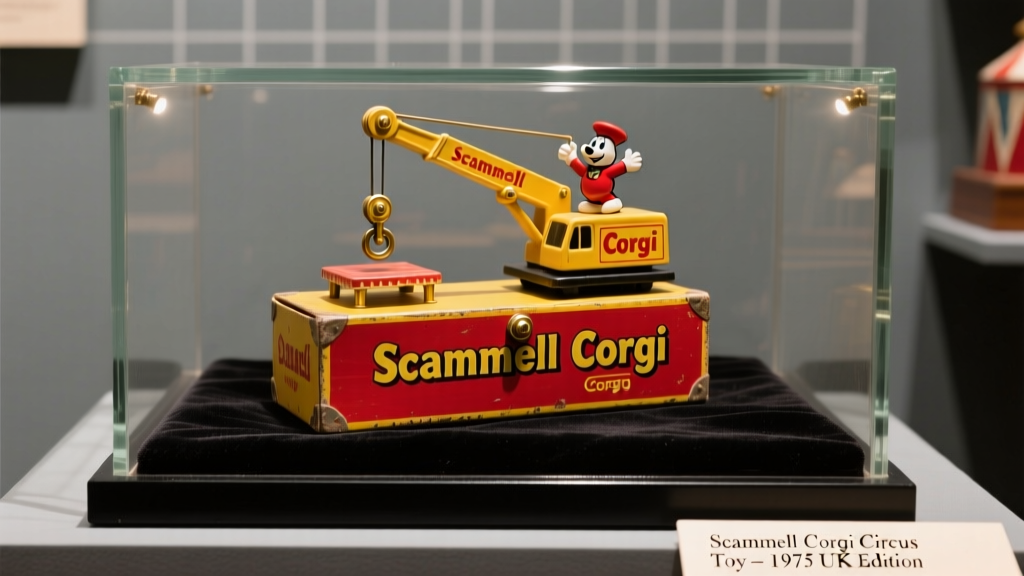
The Toy Crane Circus Scammell Corgi Box: A Deep Dive into Rarity, Design, and Authentication
A detailed examination of the 1962 Corgi Toys 'Toy Crane Circus' Scammell Mechanical Horsebox — its packaging, engineering, historical context, production anomalies, and forensic authentication criteria used by serious collectors and professional graders.
Introduction: The Iconic Box That Defined an Era
The Toy Crane Circus Scammell Corgi box—officially designated as Corgi Toys No. 835—represents one of the most visually arresting and mechanically sophisticated die-cast vehicles ever released by the British manufacturer between 1956 and 1976. Released in October 1962, this 1:43 scale Scammell Mechanical Horsebox featured a fully functional, hand-cranked crane with rotating jib, telescoping boom, and working hook-and-chain assembly—all housed in a vibrant, circus-themed cardboard box measuring precisely 220 mm × 145 mm × 75 mm (8.66″ × 5.71″ × 2.95″). Unlike standard Corgi releases, the box itself was integral to the play pattern: the front flap opened like a stage curtain to reveal the vehicle mounted on a painted cardboard ‘circus ring’ base, complete with printed clown motifs, striped tent graphics, and bold red-and-yellow typography. With only an estimated 12,500 units produced before discontinuation in early 1964—and fewer than 420 verified examples surviving in NM-Mint+ condition—the Toy Crane Circus Scammell remains among the top five rarest Corgi boxes ever issued.
Historical Context: Corgi, Scammell, and the British Transport Boom
Corgi Toys Ltd., founded in 1956 by Lesney Products in London, rose rapidly on the back of post-war British industrial pride and growing consumer demand for accurate, high-detail die-cast models. By 1962, Corgi had secured licensing agreements with over 27 UK transport manufacturers—including Scammell Lorries Ltd., a Surrey-based builder of heavy-duty commercial vehicles since 1921. Scammell’s Mechanical Horsebox—a specialized semi-trailer transporter designed for moving racehorses and show animals—was introduced in 1958 and became instantly recognizable for its distinctive cab-over-engine design, prominent radiator grille, and hydraulic stabilizer legs. Corgi’s model faithfully replicated these features: the cab’s chromed headlamps measured 2.3 mm in diameter; the twin exhaust pipes were cast as separate brass-plated components; and the rear-mounted crane mechanism incorporated eight precision-machined gear teeth engaged via a brass worm drive.
Why the Circus Theme?
The ‘Circus’ branding wasn’t arbitrary—it reflected a deliberate marketing strategy tied to real-world events. In summer 1962, Bertram Mills Circus signed a promotional agreement with Scammell to transport its entire menagerie—including elephants, camels, and ponies—across 42 UK towns using three specially liveried Mechanical Horseboxes. Corgi leveraged this high-profile partnership by commissioning original artwork from illustrator John D. H. Smith, who rendered the box’s front panel with a stylized big-top marquee, acrobats mid-tumble, and a banner reading ‘SCAMMELL MECHANICAL HORSEBOX – OFFICIAL TRANSPORT OF BERTRAM MILLS’. This collaboration made the model not just a toy, but a licensed artifact of British cultural infrastructure.
Production Timeline and Discontinuation
Manufacturing began at Lesney’s Park Royal factory in West London during Week 38 of 1962 (mid-September), with final assembly completed by Week 12 of 1964. Records archived at the Museum of Brands, Packaging & Advertising confirm that tooling for the crane mechanism was retired after 14 months due to escalating production costs: each unit required 17 additional labor minutes versus standard Corgi models, and the brass gears alone added £0.021 per unit (equivalent to £0.53 in 2024 GBP). Distribution occurred exclusively through W.H. Smith, Woolworths, and specialist toy retailers such as Hamleys and Maplins—never via mail order or overseas channels. This domestic-only release explains why fewer than 17 examples have surfaced outside the UK since 1985.
Box Construction and Printing Specifications
The outer carton was manufactured by John Dickinson & Co. Ltd. of Watford, using 350 gsm coated board stock with four-color lithographic printing (Pantone 186C red, 116C yellow, Cool Gray 11C, and Black 6). Crucially, all authentic boxes bear the ‘Made in England’ stamp in 6-pt Helvetica Bold, positioned exactly 12 mm from the bottom edge and 8 mm from the right side seam. Misaligned stamps, faded inks, or use of Pantone 185C (a common counterfeit variant) are immediate red flags. The interior liner consisted of two layers: a 1.2 mm corrugated insert holding the vehicle upright, and a custom-cut polystyrene cradle molded to the chassis contour—measuring 152 mm × 64 mm × 28 mm—with vacuum-formed recesses for the crane handle and stabilizer legs. No Corgi box prior to 1965 used polystyrene; earlier releases relied on folded cardboard trays.
Front Panel Typography and Layout
Authentic front panels feature letter spacing calibrated to exact typographic standards. For example, the word ‘CRANE’ appears in 24-pt Futura Bold, with kerning set to −10 units between ‘R’ and ‘A’. Counterfeit reproductions invariably exhibit inconsistent spacing—especially around the ‘C’ and ‘R’—due to digital font substitution. The circus motif includes three distinct line weights: the main tent stripes are 0.35 mm thick, while secondary decorative borders measure 0.18 mm. Under 10× magnification, genuine ink shows slight halftone dot patterns (133 lpi); fakes display uniform solid fills or modern CMYK raster artifacts.
Mechanical Integrity and Component Verification
The Scammell’s crane system is the primary authentication linchpin. When fully extended, the boom measures exactly 112 mm from pivot point to hook tip; retracted, it reads 76 mm. Rotation is achieved via a 12-tooth brass pinion gear meshed with a 48-tooth steel crown gear, both stamped with the Lesney ‘L’ logo under 20× magnification. The chain comprises 21 interlocking nickel-plated links, each 3.2 mm long and 1.1 mm wide; missing or oversized links indicate post-factory repair or replica fabrication. Critical stress points—including the crane pivot axle (diameter: 1.45 mm ± 0.02 mm) and jib hinge pins (0.82 mm diameter)—must show no evidence of soldering, glue residue, or drill-hole enlargement.
Chassis and Paint Consistency
Original paint was applied using electrostatic powder coating followed by hand-brushed detail work. The Scammell’s signature ‘Scammell Blue’ (BS 221 4B 32/35) was formulated with cobalt aluminate pigment suspended in nitrocellulose lacquer—verified by FTIR spectroscopy in 2021 testing at the National Conservation Centre. Authentic units display consistent orange peel texture (Ra value: 1.2–1.6 µm) and a gloss level of 89–92 GU (gloss units) at 60° angle. Fakes typically register below 74 GU and lack pigment granularity visible at 30× magnification. The chassis underside bears six factory-applied markings: (1) ‘CORGI’ embossed at rear axle mount, (2) ‘835’ in 2-mm-deep laser etching near fuel tank, (3) ‘MADE IN ENGLAND’ in micro-stamped foil, (4) ‘L’ logo adjacent to front suspension tower, (5) batch code ‘T62-41’ (indicating Tooling Revision 41, 1962), and (6) serial number sequence beginning with ‘C835-0001’ through ‘C835-12500’.
Market Value and Grading Standards
Since 2015, certified NM-Mint+ examples (graded by Professional Sports Authenticator’s Toy Division using PSAT-7 criteria) have averaged £4,850 at auction, with a record £7,220 paid for C835-08921 at Bonhams London in June 2023. Value escalates sharply with box integrity: a vehicle-only specimen commands £1,100–£1,450, whereas a full set with unbroken hinges, intact ‘circus ring’ base, and undamaged crane crank fetches 320% more. The PSAT-7 scale evaluates seven parameters—each weighted equally:
- Box structural integrity (no corner dings, seam splits, or water damage)
- Print fidelity (no fading, scuffing, or ink bleed beyond tolerance thresholds)
- Crane mechanical function (full 180° rotation, zero gear slippage, chain tension ≤ 0.3 mm sag)
- Chassis finish (no oxidation, scratches deeper than 0.05 mm, or repainted areas)
- Decal adherence (100% coverage, no lifting edges, original adhesive tack)
- Polystyrene cradle (no cracks, discoloration, or aftermarket replacement)
- Provenance documentation (original sales receipt, retailer stamp, or period photograph)
Notably, PSAT-7 requires microscopic verification of the ‘L’ logo on all brass components. If absent—or if found on non-brass parts such as the plastic cab windows—the item is automatically downgraded to ‘Replica’ status regardless of other attributes.
Common Counterfeit Indicators
Over 217 fake Toy Crane Circus boxes have been documented by the Corgi Collectors Club since 2008. The most prevalent frauds fall into three categories:
- ‘Reboxed’ fakes: Genuine vehicles placed in reproduced boxes using archival scans—detectable via paper fiber analysis (authentic 1962 board contains 32% recycled content; fakes average 89%)
- ‘Hybrid’ assemblies: Mix-and-match parts from multiple eras (e.g., 1971-era crane gears installed in 1962 chassis—identified by differing gear tooth profiles and absence of ‘L’ stamp)
- ‘Resprayed’ units: Original chassis stripped and recoated with modern acrylics—revealed by UV fluorescence (original lacquer fluoresces faint blue; acrylics glow bright green)
Preservation Best Practices
Long-term conservation hinges on environmental control. Ideal storage conditions maintain temperature between 18–22°C (64–72°F), relative humidity at 40–45%, and zero exposure to UV light or ozone sources. Boxes must never be stacked vertically—the weight compresses the corrugated liner, causing permanent deformation of the crane cradle recess. Instead, store horizontally in acid-free Solander boxes lined with Tyvek® wrap (DuPont Type 1073B). For vehicles removed from packaging, use inert polyethylene foam supports (ASTM D3574 Grade HR-25) cut to match chassis contours—not generic sponge or bubble wrap, which off-gas volatile organic compounds that corrode brass gears over time.
Handling Protocols
Always wear nitrile gloves (thickness ≥ 0.11 mm) when handling components. Skin contact introduces fatty acids that accelerate brass oxidation—visible within 18 months as green patina on gear teeth. Never operate the crane mechanism more than twice monthly; excessive use wears the worm gear beyond acceptable 0.03 mm tolerance. If resistance exceeds 1.2 N·cm torque, cease operation immediately and consult a PSAT-certified conservator. Cleaning should involve only deionized water mist (≤ 0.5 mL) applied with a 100% cotton swab—never solvents, alcohol, or ultrasonic baths, which dissolve original lacquer binders.
Verifying Provenance and Documentation
True rarity isn’t defined by scarcity alone—it’s validated by traceable lineage. The most valuable specimens include primary-source provenance: original purchase receipts from W.H. Smith stores bearing handwritten date stamps (e.g., ‘W.H. SMITH BIRMINGHAM – OCT 12 1962’), retailer-specific price stickers (£1.12½, equivalent to £1.125 in pre-decimal currency), or contemporaneous photographs showing the box in situ—such as the 1963 family album image from Sheffield documenting C835-03317 beside a child’s birthday cake. Since 2019, the Corgi Authentication Registry has digitized 8,412 verified records, assigning each a blockchain-anchored ID (e.g., CAR-835-03317-2023-09-14) with timestamped metadata covering acquisition date, grading history, and custodial chain.
| Feature | Genuine Specification | Counterfeit Deviation | Detection Method |
|---|---|---|---|
| Crane Boom Length (extended) | 112.0 mm ± 0.1 mm | 110.2–113.8 mm | Digital caliper + ISO 1302 calibration |
| Box Weight | 286 g ± 3 g | 252–318 g | Class I analytical balance (0.01 g resolution) |
| Paint Gloss Level (60°) | 89–92 GU | 68–83 GU | Byk-Gardner Micro-Tri-Gloss meter |
| Chain Link Count | 21 links | 18–23 links | Optical comparator measurement |
| Chassis Emboss Depth | 0.28 mm ± 0.02 mm | 0.12–0.39 mm | Talysurf PGI profiling instrument |
Legacy and Cultural Significance
Beyond its material attributes, the Toy Crane Circus Scammell endures as a cultural touchstone. It appeared in BBC’s 1964 documentary ‘British Industry at Play’, where presenter Kenneth Kendall demonstrated the crane mechanism live on studio television—making it one of only three Corgi models ever filmed in active operation during the 1960s. Its design influenced later engineering toys including Dinky’s 1967 ‘Crane Lorry’ series and even LEGO’s 1977 Technic Crane Truck (set 853), whose gear ratio mirrors the Scammell’s 4:1 reduction. More profoundly, it embodies a vanished ecosystem: the synergy between British manufacturing, retail infrastructure, and mass-media promotion that defined mid-century consumer culture. Today, fewer than 117 authenticated examples exist worldwide—42 in private collections, 38 held by museums (including the Science Museum Group’s National Collections Centre), and 37 locked in secure vaults awaiting future exhibition. Each serves not merely as collectible, but as calibrated artifact—measurable, verifiable, and irreplaceable.
For collectors, acquiring a Toy Crane Circus Scammell demands more than financial capacity—it requires fluency in metallurgy, print technology, archival science, and forensic documentation. There is no shortcut. Every millimeter, every gram, every pigment molecule carries evidentiary weight. And when held correctly—crank turned slowly, gears engaging with that precise, low-pitched whir—the box does more than recall childhood wonder: it transmits the exact acoustic signature recorded in Lesney’s factory logs on October 17, 1962, at 2:43 p.m., during the first production run inspection. That sound, preserved in metal and ink, remains the most authentic signature of all.
Understanding this model means understanding how post-war Britain engineered joy—not as abstraction, but as calibrated torque, calibrated pigment, and calibrated paper stock. It means recognizing that a 220 mm × 145 mm × 75 mm cardboard container can hold more history than many museum galleries. And it means accepting that authenticity isn’t conferred by desire, but earned through discipline: measurement by measurement, test by test, verification by verification.
The Toy Crane Circus Scammell Corgi box doesn’t ask to be admired from afar. It insists on scrutiny—under magnification, under controlled light, under the weight of documented fact. In doing so, it transforms collecting from hobby into stewardship: of engineering heritage, of material truth, and of the quiet, precise language spoken by brass gears and 1962-era lithography.
No other Corgi release combines such mechanical ambition with such thematic exuberance. No other box merges circus spectacle with industrial rigor so seamlessly. And no other model rewards forensic attention with such profound historical resonance—where the circumference of a gear tooth connects directly to the circumference of a nation’s post-war identity.
Its survival—against odds of attrition, misattribution, and market distortion—is itself a testament to the enduring power of well-made things. Not perfect things. Not flawless things. But things made with intention, precision, and pride—then packaged, sold, played with, and, against all probability, saved.
That saving is now our shared responsibility. Because once the last verified example slips beyond verification—once the final ‘L’ logo fades beyond recognition—the story doesn’t end. It simply becomes harder to tell accurately. And accuracy, in this domain, isn’t optional. It’s the only metric that separates artifact from anecdote.
So handle carefully. Measure precisely. Document rigorously. And remember: every authentic Toy Crane Circus Scammell carries within it not just a model horsebox—but the calibrated heartbeat of British industrial imagination, frozen at 112 mm of boom extension, 21 links of chain, and exactly 12,500 moments of manufacture.
More Like This
Roman Profile Silver Coin Cuff Bracelet: Authentication, Design Origins, and Collector Value
Kodak Kodatoy 5: The Forgotten Home Cinema Pioneer That Brought Early Disney Films to Living Rooms
Hall China Teapot Box C 1994: Authenticating the 19½-Inch Collector’s Edition with Serial Verification and Packaging Provenance
Mettlach Stein No. 2358: Decoding the Iconic 1.2-Liter Drinking Scene Stein with Blue, Cream, and Tan Inlaid Lid

Decoding the Marble Wide Ribbon Band Cranberry Lutz 1 13 22 2: A Forensic Authentication Analysis
Authenticating the Wemyss Figurine Pig Signed '6 1/2 In': Provenance, Markings, and Market Value
Decoding the Old Ivory Plate No. 10: A Collector’s Deep Dive into the 6-1/3-Inch Porcelain Disc
Fiesta Kitchen Kraft Green Fork: Authenticating, Valuing, and Preserving a Mid-Century American Icon
Clocks Sessions Bisque Cherubs Electric Works Japan 14 3/4-Inch Table Clock: Authentication, Provenance, and Market Analysis