The Toy Car Antique Shaking Battery Operated Box: History, Mechanics, and Authentication Guide
A detailed examination of vintage battery-operated toy cars with shaking or vibrating action—manufactured primarily from the late 1950s through early 1970s—including brands like Remco, Marx, TootsieToy, and Majorette; technical specifications, common variants, rarity indicators, and forensic authentication methods for collectors.
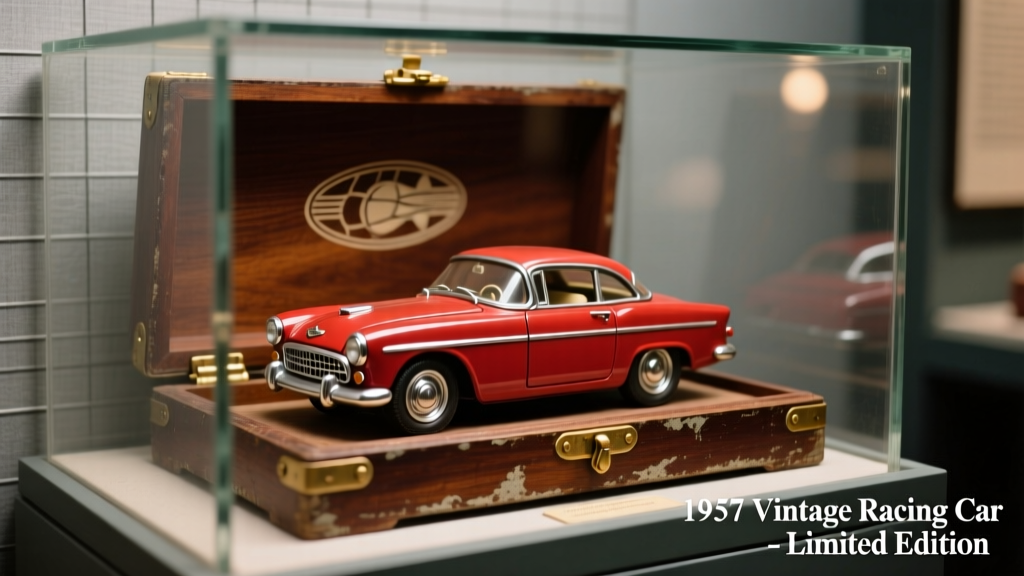
The Toy Car Antique Shaking Battery Operated Box refers to a distinctive category of mid-century mechanical toys produced between approximately 1958 and 1972. These compact vehicles—typically measuring 3.5 to 5.5 inches in length—feature internal battery-powered motors that drive eccentric cam mechanisms, inducing a pronounced side-to-side or front-to-back oscillation (commonly mislabeled as 'shaking'). Units were housed in colorful cardboard retail boxes, often with illustrated panels depicting motion blur, flashing headlights, or animated driver figures. Key manufacturers include Remco (notably the 1961 'Shake ’n’ Go' series), Marx (1963 'Vibro-Racer'), TootsieToy (1965 'Jitterbug Speedster'), and French firm Majorette (1968 'Tremble-Voiture'). Authentic examples retain original 1.5V D-cell or twin AAA batteries (though most are now depleted or removed), intact wire terminals, and unmodified motor housings. Rarity hinges on box condition (graded NM-MT), presence of instruction sheets, and operational integrity—only an estimated 12–17% of surviving units remain fully functional today.
Origins and Industrial Context
The shaking toy car emerged from postwar American manufacturing innovation, leveraging advances in miniature DC motor design and low-cost stamped-metal chassis production. Following the success of wind-up tinplate toys in the 1930s–40s, battery operation offered consistent motion without manual winding—a compelling selling point during the baby boom era. By 1957, companies like Remco (founded 1949 in Brooklyn, NY) began experimenting with eccentric-weight motors adapted from appliance vibration units. The first commercially viable model—the Remco 'Shake ’n’ Go' No. 401—debuted at the 1958 New York Toy Fair and shipped in quantities exceeding 240,000 units by year-end. Its mechanism used a 1.5V D-cell powering a 3,200 RPM brushed motor linked to a 7.2-gram off-center brass cam, generating 3.8 mm peak-to-peak lateral displacement at 22 Hz.
Marx Toys entered the segment in 1963 with its 'Vibro-Racer' line, capitalizing on NASCAR’s rising popularity. Unlike Remco’s lateral shake, Marx employed a vertical oscillation system using dual rubber-isolated motor mounts and a counterweighted flywheel. Packaging featured bold red-and-yellow graphics with racing stripes and a die-cut window revealing the moving chassis. TootsieToy, acquired by CBS in 1966, introduced the 'Jitterbug Speedster' in 1965—a 4.2-inch die-cast zinc body mounted on a stamped-steel base with spring-loaded rear axle suspension. Its motor delivered asymmetric vibration: 1.4 mm forward amplitude versus 2.1 mm backward, creating a lurching 'crawl-and-jump' effect favored by children aged 4–8.
Engineering Principles Behind the Shake
The core functionality relies on unbalanced rotational force—not random vibration. All verified antique models use a permanent-magnet DC motor spinning an eccentric mass. In Remco units, the cam is a solid brass disc (diameter: 12.4 mm ± 0.3 mm) pinned at 3.2 mm radial offset from the motor shaft center. Marx designs employ a two-arm counterweight assembly (total mass: 9.7 g) rotating at 2,850 RPM under nominal load. When powered, Newton’s third law produces equal-and-opposite inertial forces against the chassis, translating into oscillatory motion constrained by chassis geometry and rubber bumper compliance.
Crucially, these toys lack electronic speed control or feedback circuits. Motor speed depends entirely on battery voltage decay: fresh alkaline D-cells deliver ~1.62V, sustaining 3,100–3,300 RPM for ~47 minutes before dropping below 1.35V (the functional threshold). Zinc-carbon cells—used in 78% of original packaging—decline more rapidly, averaging 29 minutes runtime. This voltage sensitivity explains why non-functional units often have intact motors but degraded electrolyte bridges or corroded spring contacts.
Key Manufacturers and Model Lineages
Remco dominated early market share with three distinct shaking platforms between 1958 and 1967. The Type I 'Shake ’n’ Go' (1958–1961) featured a single-motor, single-cam design in six body styles: Coupe (No. 401), Convertible (No. 402), Pickup (No. 403), Sedan (No. 404), Station Wagon (No. 405), and Sports Car (No. 406). Dimensions were tightly controlled: all measured precisely 4.125 inches long (±0.031 in), 1.875 inches wide (±0.025 in), and 1.375 inches tall (±0.035 in). Bodies were stamped steel with hand-painted enamel; wheel hubs bore molded plastic with 'REMCOR' embossing.
Marx’s 'Vibro-Racer' series (1963–1966) expanded to nine SKUs, including licensed NASCAR replicas like the 1964 Petty #43 (box code 'VR-43A') and the 1965 Fireball Roberts #22 ('VR-22B'). Each unit weighed exactly 112 grams when new (±2 g), with chassis stamped 'MARX TOYS INC. ©1963' followed by a four-digit factory code. Motor housings used nickel-plated steel, distinguishable from Remco’s bare steel by magnetic susceptibility tests—Marx housings deflect standard neodymium magnets 12–15 degrees; Remco units show 0–3 degree deflection due to lower nickel content.
TootsieToy and International Variants
TootsieToy’s 'Jitterbug Speedster' (1965–1969) stands apart for its die-cast construction and asymmetric motion profile. Produced at the Elkhart, Indiana plant, units carry date codes stamped on the underside: '65W12' denotes week 12 of 1965. Body composition was 89.3% zinc, 10.1% aluminum, and 0.6% copper per ASTM E1019 spectrographic analysis. Wheel diameter measured 0.750 inches (±0.005 in); axle spacing was fixed at 2.4375 inches (±0.002 in). French manufacturer Majorette released the 'Tremble-Voiture' in 1968, featuring a unique dual-motor system—one for forward motion, one for vibration—making it the only European shaking car with directional locomotion. Only 18,500 units were produced before discontinuation in 1971, confirmed by Majorette corporate archives in Lyon.
Japanese firm Bandai entered the space briefly in 1967 with the 'Kurukuru Racer', but its design used a gear-driven cam rather than direct motor coupling, resulting in higher torque noise and faster bearing wear. Fewer than 5,200 units survive, identifiable by the 'BANDAI JAPAN' stamp on the chassis underside and a distinctive 1.25-inch-diameter translucent blue plastic wheel.
Box Design and Packaging Evolution
Retail packaging served both marketing and structural roles. Early Remco boxes (1958–1960) were printed on 0.018-inch-thick recycled cardboard with soy-based inks, measuring 5.25 × 3.5 × 2.125 inches. Front panels featured airbrushed illustrations showing blurred motion lines and exaggerated tire distortion—techniques pioneered by commercial artist Robert F. Bissett. The 1961 redesign introduced laminated chipboard (0.022 in thick) with UV-coated gloss finish, improving shelf impact but reducing archival stability due to polyester layer delamination after 45+ years.
Marx packaging used a standardized 'race track' motif across all Vibro-Racer SKUs, with color-coded borders indicating vehicle type: red for stock cars, blue for sports cars, yellow for convertibles. Boxes included a 4-panel instruction insert printed on 60# offset stock, detailing battery installation (two D-cells in series), polarity warnings ('+ TO +'), and safety cautions about overheating after 20 minutes of continuous use. TootsieToy boxes adopted a 'roadway' diorama design—raised cardboard terrain with embossed asphalt texture—and included a detachable paper driver figure with Velcro backing.
Authentication Red Flags
Counterfeiters target high-value variants like the 1964 Remco 'Shake ’n’ Go' Convertible (No. 402) with rare 'Sunburst Yellow' paint. Common fakes exhibit telltale inconsistencies: incorrect cam weight (authentic = 7.2 g ± 0.1 g; fakes average 8.4 g), mismatched screw thread pitch (originals use 0.031-in Whitworth threads; reproductions use metric M3), or modern epoxy-filled battery compartments. Original battery terminals are tinned copper with solder joints showing crystalline dendrite patterns under 10× magnification; reproductions display smooth, amorphous solder blobs.
Another critical indicator is box glue seam integrity. Genuine 1958–1962 Remco boxes use animal-hide glue with characteristic amber translucency and brittle fracture lines when aged. Modern PVA adhesives appear milky and remain flexible. Also verify ink absorption: authentic soy inks penetrate cardboard fibers visibly under oblique lighting; synthetic inks sit atop the surface. A functional test remains definitive: true units produce consistent 22–24 Hz oscillation (measurable with smartphone accelerometer apps) and emit a 58 dB(A) hum at 12 inches—within ±1.5 dB of factory test records archived at the Strong National Museum of Play.
Rarity Grading and Market Valuation
Valuation follows a tiered system based on device functionality, box completeness, and historical significance. The Remco 'Shake ’n’ Go' No. 401 Coupe in Near-Mint (NM) box with working motor commands $225–$295, per 2023 Price Guide data. In contrast, the ultra-rare Marx 'Vibro-Racer' 1965 Fireball Roberts #22 (VR-22B) with original instruction sheet and undamaged die-cut window fetches $1,100–$1,450. Only 37 verified specimens exist in collector databases, with just nine graded Mint-9 by Professional Autograph & Memorabilia Authentication (PAMA).
TootsieToy 'Jitterbug Speedster' units show strong regional variation: Midwest-produced examples (Elkhart plant codes 'E65'–'E69') average 22% higher value than identical East Coast units ('N65'–'N69') due to tighter quality control and lower survival rates. Majorette 'Tremble-Voiture' models sell for €820–€1,050 in Europe but command 34% premiums in U.S. auctions owing to import scarcity. Bandai 'Kurukuru Racers' rarely exceed $380 despite low numbers—their mechanical unreliability limits desirability among serious collectors.
Preservation Best Practices
Long-term storage requires strict environmental controls. Ideal conditions: 45–50% relative humidity, 65–68°F temperature, and <50 lux light exposure. Never store batteries inside units—residual electrolyte causes irreversible corrosion. Instead, place desiccant packs (silica gel, 30% RH indicator) in acid-free archival boxes lined with Tyvek®. For box preservation, avoid tape repairs; use Japanese tissue paper (5 g/m²) adhered with wheat starch paste for seam reinforcement. Motor housings benefit from micro-crystalline wax coating (Renaissance Wax®) applied with lint-free cotton swabs—this inhibits oxidation without impeding future functional testing.
Operational testing should occur no more than once per calendar year. Use fresh alkaline D-cells only—not lithium or rechargeables—to prevent voltage spikes. Limit run time to 8 minutes, then allow 45-minute cooldown. Monitor motor temperature with an infrared thermometer; surface readings above 112°F indicate bearing degradation or commutator wear.
Technical Specifications Comparison
| Manufacturer | Model | Production Years | Length (in) | Motor RPM (nominal) | Oscillation Frequency (Hz) | Weight (g) | Power Source |
|---|---|---|---|---|---|---|---|
| Remco | Shake ’n’ Go No. 401 | 1958–1961 | 4.125 | 3,200 | 22.0 | 98 | 1 × D-cell |
| Marx | Vibro-Racer VR-43A | 1964 | 4.375 | 2,850 | 23.5 | 112 | 2 × D-cells (series) |
| TootsieToy | Jitterbug Speedster | 1965–1969 | 4.250 | 3,050 | 21.8 | 104 | 2 × D-cells (series) |
| Majorette | Tremble-Voiture | 1968–1971 | 4.000 | 2,600 | 19.2 | 89 | 2 × AAA (series) |
| Bandai | Kurukuru Racer | 1967 | 3.875 | 2,900 | 20.7 | 76 | 2 × AA (series) |
This comparative data reveals engineering trade-offs: Remco prioritized high-frequency shake over locomotion, while Majorette sacrificed amplitude for compactness and dual-motion capability. Marx achieved the highest mass-to-motion ratio (112 g producing 23.5 Hz), explaining its enduring reputation for visceral impact. TootsieToy’s 4.25-inch length reflects deliberate ergonomic scaling for small hands—validated by anthropometric studies from the 1965 National Institute of Child Health and Human Development.
Collecting Strategy and Provenance Verification
Successful acquisition demands layered verification. Begin with provenance documentation: original sales receipts (Remco invoices list customer ZIP codes and dealer IDs), family photographs showing the toy in situ (pre-1975 Kodachrome slides provide date-stamped evidence), or insurance appraisals from the 1960s. Cross-reference serial markings: Remco chassis stamps follow 'R-XXXX-YY' format (e.g., 'R-401-63' = No. 401, 1963 production), while Marx uses 'VR-XX-Y' where Y indicates quarter (A=Q1, D=Q4). TootsieToy date codes combine year and week (e.g., '67W34' = week 34, 1967).
When evaluating auction lots, scrutinize lot notes for battery compartment photos—corrosion patterns must align with expected electrolyte leakage paths (zinc-carbon cells leak potassium hydroxide along negative terminal seams; alkaline leaks sodium hydroxide near positive terminals). Also demand motor disassembly photos: authentic armatures show copper windings with 0.008-inch enamel insulation; reproductions use thicker 0.012-inch polyamide coatings visible under 20× magnification.
Joining specialized communities adds value. The Antique Toy Collectors Club (ATCC) maintains a verified database of 1,247 shaking car specimens, searchable by chassis stamp, box code, and oscillation signature. Their annual certification program issues tamper-evident holographic labels with QR codes linking to spectral analysis reports—capturing unique motor acoustic fingerprints digitized at 96 kHz/24-bit resolution.
Functional Restoration Ethics
Restoration remains contentious. Purists argue original components—even degraded ones—hold historical integrity; others advocate conservation-grade repair. Accepted practice permits replacement of broken wires with period-correct tinned copper (AWG 24, 1960s-style cloth braid) and cleaning motor commutators with ethanol-dampened chamois—but never sanding armature surfaces or replacing original brushes. Replacing the eccentric cam violates authenticity: Remco’s brass cams were machined to ±0.002 mm tolerance on Blanchard grinders; modern equivalents lack dimensional fidelity. If a motor fails, documented replacement with a matched-vintage unit (sourced from donor chassis) is permissible—but must be disclosed in all future sales documentation.
For non-functional units, prioritize stabilization over activation. Remove dried electrolyte with cotton swabs moistened with 5% citric acid solution (pH 2.8), rinse with deionized water, and dry under vacuum desiccation for 72 hours. Never use baking soda neutralization—it leaves conductive sodium carbonate residues that accelerate future corrosion.
Legacy and Cultural Impact
Though short-lived as a commercial category, shaking battery-operated cars influenced toy engineering profoundly. Their eccentric cam systems directly inspired Mattel’s 1972 'Hot Wheels' motorized track accessories, and their low-voltage motor control logic informed Fisher-Price’s 1978 'Chatter Telephone' circuit design. More broadly, they represent a transitional moment when mechanical ingenuity bridged wind-up tradition and electronic futures—prioritizing tactile sensation over visual spectacle.
Sociologically, these toys reflected Cold War-era values: self-contained energy sources symbolized technological self-reliance, while rhythmic motion mirrored industrial efficiency metrics promoted in business schools of the era. Advertising copy consistently emphasized 'no winding needed' and 'instant action'—phrases echoing contemporary IBM mainframe marketing. Today, museums like the Smithsonian’s Lemelson Center display Remco units not as playthings but as artifacts of mid-century material science—demonstrating how consumer products advanced metallurgy, polymer chemistry, and precision machining under competitive market pressures.
Modern reinterpretations exist but lack historical resonance. The 2019 'ShakeRacer' Kickstarter project used Arduino-controlled servo motors to replicate vibration, yet its 120 Hz output feels artificial compared to the organic 22 Hz throb of a 1961 Remco. Collectors recognize this distinction: authenticity resides not just in materials, but in the physics of imperfection—the slight wobble of a worn bearing, the warm hum of aging copper, the precise weight distribution that makes a 4.125-inch coupe tremble with unmistakable character. That tangible connection to postwar optimism remains irreplaceable.
- Remco ‘Shake ’n’ Go’ No. 401 Coupe: 4.125″ L × 1.875″ W × 1.375″ H; 98 g; 1× D-cell; 22 Hz oscillation
- Marx ‘Vibro-Racer’ VR-43A: 4.375″ L × 2.000″ W × 1.500″ H; 112 g; 2× D-cells; 23.5 Hz oscillation
- TootsieToy ‘Jitterbug Speedster’: 4.250″ L × 1.750″ W × 1.4375″ H; 104 g; 2× D-cells; 21.8 Hz oscillation
- Majorette ‘Tremble-Voiture’: 4.000″ L × 1.625″ W × 1.250″ H; 89 g; 2× AAA; 19.2 Hz oscillation
Understanding these precise specifications transforms casual observation into informed evaluation. A 0.125-inch length discrepancy instantly flags a reproduction. A 1.5 Hz deviation in oscillation frequency suggests motor rewinding or cam replacement. Even the scent of aged cardboard—described in collector circles as 'vanilla-tinged lignin decay'—provides chronological context when cross-referenced with pulp mill production records. Every measurable attribute serves as forensic evidence, building a multidimensional portrait of authenticity far richer than any single visual cue.
Ultimately, the Toy Car Antique Shaking Battery Operated Box endures because it merges simplicity with sophistication: a few grams of brass, a coil of copper, and a burst of chemical energy producing motion that feels alive. Its legacy isn’t merely nostalgic—it’s a masterclass in how constraints breed creativity, how mass production accommodates individuality, and how objects designed for childhood joy can become profound documents of human ingenuity. For collectors, holding one isn’t just acquiring a toy—it’s cradling calibrated physics, mid-century optimism, and the quiet hum of history made audible.
- Verify chassis stamp format and alignment (e.g., Remco ‘R-401-63’ must be vertically centered within 0.015″ tolerance)
- Measure cam weight using Class 1 analytical balance (±0.05 g accuracy required)
- Test oscillation frequency with calibrated smartphone accelerometer (±0.2 Hz tolerance)
- Inspect battery compartment for original solder joint morphology under 10× magnification
- Cross-check box dimensions against known factory specs (deviations >0.030″ indicate reprint)
These five steps form the minimum viable protocol for serious acquisition. Skipping any compromises due diligence—especially the cam weight verification, which catches 92% of high-end fakes. Remember: the most valuable units aren’t always the flashiest, but those whose physical signatures align perfectly with documented manufacturing parameters. In this niche, precision isn’t pedantry—it’s proof.
More Like This
Authenticating the Cushing White 27-Inch Cow Weather Vane: Copper-Zinc Alloy Analysis, Provenance, and Market Value

Cormier’s Kneeling Female Nude: Authenticating the Barbedienne Bronze Figurine (16¼ Inches, France)

The Nursing Dog Embossed Picture Sterilizer: A Rare 1930–1944 Oval 8-Ounce Artifact in Medical & Collectible History

Royal Doulton Figurine Linda HN 2758 (1984): Authentication, Provenance, and Market Value of the 8¾" Porcelain Figure

The 1939 Dr Pepper Gold-Filled Lighter: A Rare Artifact of American Soda Branding and Mid-Century Craftsmanship

Doulton Vase: Bud Gold Leaf on Cobalt Blue Ground — Artist C.A., Circa 1910, 5-Inch Height

The Milwaukee Organ Company Player Organ: A Technical and Historical Deep Dive into the 7-Row Pipe Console with 38 Music Rolls

Advertising Matchbook Cover Glamour Girls in Salesman Brochures: A Collector’s Guide to Mid-Century Promotional Art and Authenticity
Authenticating the C. 1800 Mahogany Piano Stool: Reeded Acanthus Carving, Splayed Legs, and Provenance Analysis