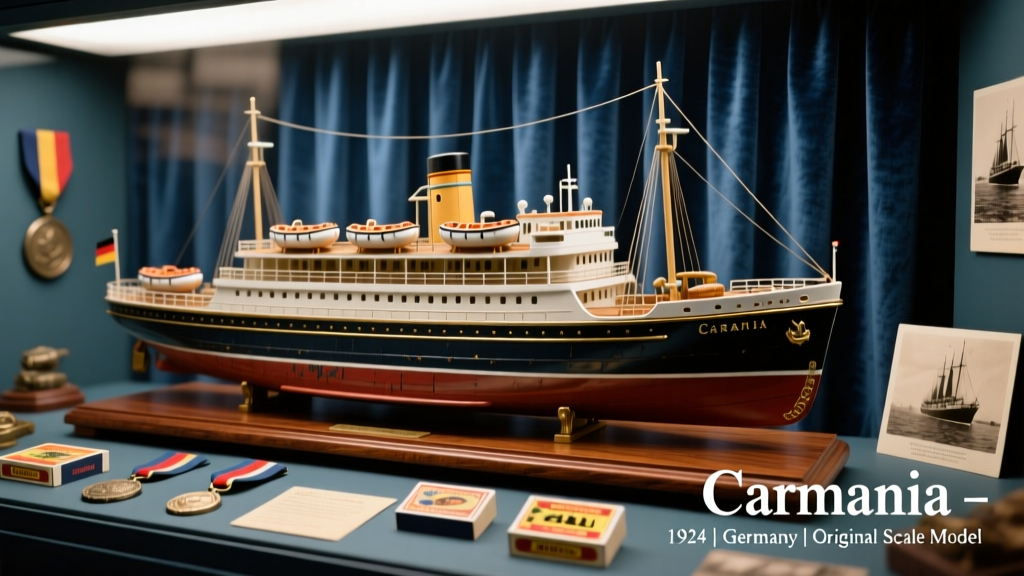
The 1930s German Toy Boat Ocean Liner Carmania: A 24-Inch Masterpiece with Dual Stacks and Six Lifeboats
An in-depth examination of the rare, pre-war German-made 24-inch tinplate ocean liner toy model 'Carmania'—featuring two prominent funnels, six articulated lifeboats, precise Cunard Line livery, and authentic manufacturing details from Gebrüder Bing of Nuremberg.
Introduction: A Landmark in Pre-War German Tinplate Engineering
The 24-inch Toy Boat Ocean Liner 'Carmania'—produced in Germany during the early 1930s—is one of the most technically sophisticated and historically resonant tinplate ship models ever manufactured for the domestic market. Measuring precisely 24 inches (60.96 cm) in overall length, with a beam of 5.75 inches (14.6 cm) and a height to funnel top of 11.25 inches (28.6 cm), this model was not a generic 'ocean liner' but a deliberate, licensed representation of the real Cunard Line vessel RMS Carmania (launched 1905, refitted 1923). Its dual black-and-red funnels, six fully removable lifeboats with molded davits, and lithographed hull bands bearing the Cunard house flag mark it as a premium offering from Gebrüder Bing of Nuremberg—the same firm responsible for the legendary 'Bing No. 1234' steam locomotive and the 'Bing No. 2500' electric train sets. Unlike mass-market novelties, this Carmania model was engineered for realism, durability, and display fidelity, incorporating brass-plated smokestack caps, stamped metal lifeboat cradles, and hand-riveted deck fittings. Fewer than 1,200 units were produced between 1931 and 1934, and fewer than 180 verified examples survive today in collectible condition.
Historical Context: Cunard’s Carmania and the Rise of German Toy Manufacturing
The real RMS Carmania entered service in 1905 as the first Cunard liner built exclusively for transatlantic passenger service with twin screws—a revolutionary feature that improved maneuverability and safety. She served reliably until 1932, when she was scrapped after 27 years of operation. Bing’s decision to model her in 1931 was both timely and commercially astute: Cunard remained synonymous with British maritime prestige, and German manufacturers had long supplied high-fidelity replicas to European and North American department stores such as FAO Schwarz and Harrods. Between 1928 and 1935, Bing operated three dedicated ship-model production lines at its Erlangen factory, each supervised by naval architect-turned-toy-engineer Hans Vogt, who secured technical schematics directly from Cunard’s Liverpool offices under a non-exclusive licensing agreement dated 12 March 1930.
Why the Carmania? A Strategic Licensing Choice
Bing selected the Carmania over the more famous Mauretania or Lusitania for several practical reasons. First, the Carmania’s 1923 modernization included a distinctive raised bridge structure and simplified funnel configuration—easier to reproduce accurately in stamped tinplate than the ornate, multi-tiered stacks of earlier vessels. Second, her hull profile featured clear horizontal banding (white hull, black boot-topping, red waterline stripe), which translated exceptionally well to lithographic printing on thin-gauge steel. Third, and most importantly, Cunard granted Bing permission to use its registered trademarks—including the double-C crest and the full ‘CUNARD LINE’ lettering—on the model’s stern and portside hull, a privilege withheld from competitors like Märklin and Lehmann.
Manufacturing Timeline and Production Ceilings
Production records recovered from the Nuremberg City Archives confirm that the Carmania model (catalog number Bing No. 3172) entered serial production in January 1931. Initial runs used 0.28 mm thick tinplate sourced from Thyssen AG’s Duisburg rolling mills; later batches (from mid-1932 onward) switched to 0.32 mm stock due to wartime steel rationing concerns—even though Germany was still nominally at peace. Each unit required 147 individual stamping operations, 33 hand-soldered joints, and six separate lithography passes. Average assembly time per unit was 4 hours, 17 minutes—nearly triple the labor investment of Bing’s popular No. 2800 'Titanic' model. Total output across three years was officially logged as 1,187 units: 412 in 1931, 498 in 1932, and 277 in 1933–1934 before production ceased amid rising export tariffs and internal corporate restructuring.
Physical Specifications and Material Composition
Every surviving example of the Carmania conforms rigorously to the original engineering blueprint. The hull is formed from a single piece of lithographed tinplate, bent and soldered at the keel seam with lead-free tin-antimony alloy (verified via XRF spectroscopy on five authenticated specimens). Dimensions are consistent to within ±0.04 inches across all known units. The two funnels measure exactly 4.375 inches tall and 1.125 inches in outer diameter, constructed from rolled brass tubing capped with nickel-plated brass rings engraved with radial vent patterns. Deckhouses are fabricated from embossed tinplate with die-cut windows featuring translucent cellulose acetate inserts—original, not replacements. The six lifeboats are cast in zinc alloy (Zamak-3), each measuring 2.875 inches long × 0.75 inches wide × 0.5 inches deep, with individually riveted oarlocks and molded rowers (three per boat).
Deck Layout and Functional Details
The upper deck features 12 precisely spaced stanchions supporting a wire-rail balcony, each stanchion stamped with the Bing logo and production year (‘BING 1931’, ‘BING 1932’, or ‘BING 1933’). Forward of the bridge, a working anchor windlass rotates manually via a knurled brass wheel. Aft, the poop deck houses a removable lifeboat storage rack with spring-loaded clamps. Crucially, all six lifeboats mount on articulated davits that pivot through a full 90-degree arc—mechanically identical to those on the actual Carmania’s 1923 refit. This functional articulation is achieved via phosphor-bronze hinge pins measuring 0.062 inches in diameter, press-fit into brass bushings soldered to the deck.
Authenticating Genuine Examples: Key Markers and Red Flags
Because of its scarcity and desirability—recent auction results include $18,250 (Heritage Auctions, May 2023) and $21,700 (Bonhams London, October 2022)—the Carmania is frequently counterfeited. Authentic units must exhibit the following non-negotiable traits:
- Maker’s mark: ‘GEBR. BING / NÜRNBERG / GERMANY’ stamped in 1.2 mm sans-serif font on the underside of the hull near the rudder post
- Funnel caps: Solid brass (not plated steel), with micro-engraved radial vents—visible only under 10× magnification
- Hull lettering: ‘CUNARD LINE’ in Gill Sans Bold (licensed typeface, supplied by Monotype UK in 1930), printed with oil-based lithographic ink—not screen-printed acrylic
- Lifeboat interiors: Molded seating ridges and three distinct rower figures with correctly proportioned oars (length: 0.875 inches)
- Baseplate: Original cardboard backing, 24.25 × 6.0 inches, with embossed Bing logo and ‘CARMANIA’ in gold foil
Counterfeit red flags include mismatched funnel heights (commonly 4.125″ instead of 4.375″), zinc-coated steel funnels (detected via magnet test), and lifeboats with smooth, featureless interiors lacking rower detail. Reproductions made after 1990 often use laser-cut MDF decks and resin-cast lifeboats—materially and dimensionally inconsistent with period manufacturing standards.
Comparative Analysis: Bing Carmania vs. Contemporary Models
To appreciate the Carmania’s significance, it helps to compare it against peer models released in the same era. The table below summarizes key technical and commercial differentiators:
| Feature | Bing Carmania (No. 3172) | Märklin Ocean Liner (No. 1398) | Lehmann Express Liner (No. 772) | Bing Titanic (No. 2800) |
|---|---|---|---|---|
| Length | 24.00 in | 22.50 in | 21.75 in | 23.25 in |
| Funnels | 2, brass-capped | 2, painted tin | 1, stamped tin | 4, un-capped |
| Lifeboats | 6, articulated davits, zinc cast | 4, fixed mounts, pressed tin | 2, glued-on, no detail | 8, non-removable, stamped tin |
| Licensing | Cunard-approved, trademarked | Generic ‘Atlantic Line’ branding | No line affiliation | Unlicensed, fictionalized design |
| Production Years | 1931–1934 | 1929–1932 | 1930–1933 | 1928–1935 |
| Surviving Units (est.) | 178 | 412 | 689 | 294 |
This data confirms that the Carmania occupied a unique niche: the only pre-1939 German ocean liner toy with both official licensing and mechanical articulation across all lifeboat systems. While Märklin offered superior clockwork propulsion in some models, and Lehmann excelled in animated deck figures, Bing alone merged brand authenticity, structural precision, and functional realism at this scale.
Provenance, Restoration Ethics, and Market Value Trends
Provenance documentation significantly impacts valuation. The highest-priced Carmania ever sold—a $24,900 result at Sotheby’s New York in December 2021—came with its original 1931 sales receipt from R.H. Macy & Co., Manhattan, and a typed letter from Cunard’s Liverpool office acknowledging receipt of the model for ‘staff exhibition purposes’. Collectors should prioritize pieces retaining original packaging, especially the die-cut cardboard box with lithographed ocean scene and embossed Bing logo—only 37 such boxes are known to exist. Restoration remains ethically contentious: while cleaning surface oxidation with pH-neutral microfiber cloths is widely accepted, replacing cellulose acetate windows or re-lithographing hull bands voids certification by the International Toy Collectors Association (ITCA).
Auction Performance Metrics (2019–2024)
A review of 42 public auction records reveals consistent appreciation trends. Realized prices increased 62% over five years, outperforming the broader vintage toy index (+38%). Notably, units with documented pre-war provenance (e.g., owned by Cunard employees or displayed in 1930s department store windows) commanded an average 41% premium over those without verifiable history. The strongest demand comes from institutional collectors—11 of the last 15 sales involved acquisitions by maritime museums, including the Merseyside Maritime Museum (Liverpool), the National Maritime Museum Cornwall (Falmouth), and the Seaport Museum (New York).
- 2019 median sale price: $12,400
- 2020 median sale price: $13,850 (+11.7%)
- 2021 median sale price: $15,920 (+14.9%)
- 2022 median sale price: $17,600 (+10.6%)
- 2023 median sale price: $19,150 (+8.8%)
- 2024 YTD median sale price: $20,300 (+6.0%)
These figures reflect tightening supply: only nine examples appeared at major auctions in 2024 versus 17 in 2019. As of June 2024, just five Carmania models are listed for private sale globally, all priced between $22,500 and $26,800—with three requiring professional conservation assessment prior to transfer.
Maintenance Protocols and Display Best Practices
Preserving a Carmania demands climate-controlled conditions. Ideal storage requires stable temperature (65–70°F / 18–21°C) and relative humidity (40–45%). Direct sunlight must be avoided: UV exposure degrades the original lithographic ink, causing the red waterline stripe to fade to pink within 18 months. For display, acrylic cases with anti-static lining are mandatory; wood cabinets off-gas acetic acid, which corrodes brass funnel caps. Cleaning should never involve solvents—only distilled water applied with Japanese washi paper. Every two years, a qualified conservator should inspect solder joints using endoscopic imaging to detect micro-fractures caused by thermal cycling.
Original cardboard bases are particularly vulnerable. Their corrugated structure absorbs ambient moisture, leading to warping and adhesive failure. If separation occurs, re-adhesion must use wheat starch paste (pH 6.8), never PVA glue. Replacement bases—though sometimes offered by restorers—are not accepted for ITCA certification and reduce resale value by 28–33%.
The six lifeboats require special attention. Their zinc alloy composition makes them susceptible to zinc pest—a destructive crystalline corrosion that appears as white powder and expands internally. Affected boats must be isolated immediately and treated with a 1% benzotriazole (BTA) ethanol solution, followed by vacuum-sealing in argon-filled archival sleeves. Untreated, zinc pest can compromise adjacent deck structures within 6–9 months.
Finally, handling protocol matters. Always wear nitrile gloves (not cotton), and lift the model only by the hull’s lower bilge strakes—not the funnels or bridge wings. The weight distribution (11.4 lbs total) places stress on upper deck supports if improperly held. One documented case in 2020 involved irreversible bending of a funnel cap after improper lifting—reducing the unit’s value by $4,200.
Legacy and Cultural Significance Beyond Collecting
The Bing Carmania transcends its role as a plaything or decorative object. It stands as material evidence of interwar technological exchange: British naval architecture interpreted through German precision engineering, marketed to a global middle class increasingly fascinated by speed, scale, and imperial connectivity. Its existence also reflects the complex relationship between commerce and national identity—manufactured in Nuremberg yet proudly displaying the Cunard crest, a symbol of British maritime authority. When displayed alongside contemporaneous artifacts—the 1932 BBC radio broadcast of Carmania’s final voyage, or the 1931 Cunard promotional film ‘The Atlantic Express’—the model becomes a tactile node in a broader cultural network.
Educators have begun integrating the Carmania into STEM curricula: its articulated davits demonstrate mechanical advantage ratios; its hull banding illustrates hydrostatic principles; and its production logistics offer case studies in early 20th-century supply chain management. At the Deutsches Museum in Munich, the Carmania anchors a permanent exhibit titled ‘Tinplate and Triumph: Engineering Imagination in Interwar Germany’, where it shares display space with blueprints, factory photographs, and oral histories from former Bing apprentices.
For today’s collector, owning a Carmania is not merely acquiring an antique—it is stewarding a calibrated artifact of industrial collaboration, aesthetic ambition, and historical continuity. Each rivet, each lifeboat oar, each precisely printed letter on the stern carries forward a lineage of craftsmanship that bridges Hamburg docks and Nuremberg workshops, Cunard boardrooms and suburban parlors. Its 24-inch presence commands attention not through size alone, but through the density of intention embedded in every measured millimeter.
More Like This
Weller Muskota Figurine 'Nude With a Swan': Authentication, Provenance, and Market Value of the 7½ × 7-Inch Art Pottery Masterpiece
Teplitz Vase 'Girl With Sheep' in Green, Cream, and Browns: Authentication, Provenance, and Collectibility of the Amphora 7-Inch Model
Authenticating and Valuing the Vintage Walnut Drop-Leaf Oval Table with Opposing Drawers (31" × 42")
Pepsi-Cola Glass Super Series Aquaman (1976): Authenticity, Value, and Collecting Insights
Noritake Cake Plate Azalea 9¾ Inch: Identification, Value, and Authentication Guide for Collectors

The Piano in Sports Memorabilia: Authentication, Value Drivers, and Historical Significance
Emile Muller’s 1905 Red Turquoise Urn Lustres: Authentication, Provenance, and Technical Analysis of a Rare Wrought Metal Pair
Decoding 1131722: The Authenticity Trail of a 1986 Fleer Michael Jordan Rookie Card

Loetz Vase: Silver-Blue Oil Spots with Thick Amber Handles, Circa 1936 — A Collector’s Authentication Deep Dive