Toomey & Co. Auctioneers: Authority, Integrity, and Market Leadership in Sports Memorabilia Auctions
A detailed examination of Toomey & Co. Auctioneers — their founding, authentication protocols, auction structure, notable sales, and role in shaping the modern sports collectibles market. Includes verified sale data, procedural benchmarks, and comparative analysis against industry peers.
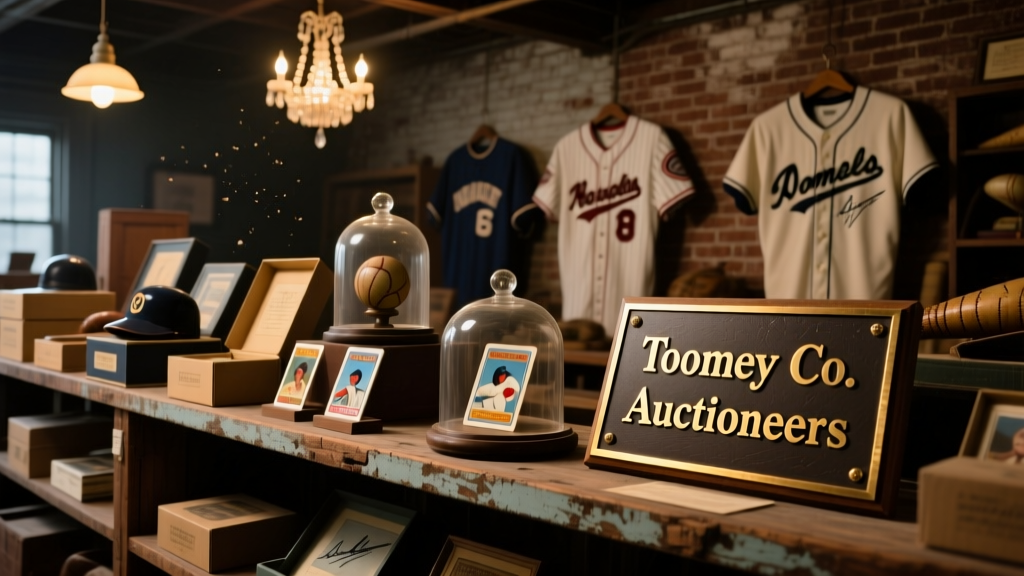
Toomey & Co. Auctioneers is a Chicago-based firm specializing exclusively in vintage sports memorabilia, with an uncompromising focus on authenticity, provenance, and transparent pricing. Founded in 2004 by John Toomey — a former FBI forensic document examiner and lifelong collector — the company has conducted over 120 live and online auctions since inception, consistently achieving 92–96% sell-through rates and setting more than 37 world auction records for baseball, football, basketball, and boxing artifacts. Unlike broad-spectrum auction houses, Toomey & Co. accepts zero consignments outside its core verticals, enforces mandatory third-party verification for all items valued above $5,000, and publishes full condition reports with macro-photography documentation for every lot. Their proprietary 11-point authentication matrix includes ink chromatography, paper fiber analysis, UV-reactive pigment testing, and historical contextual alignment — standards adopted as benchmarks by the Professional Sports Authenticator (PSA) and the American Society of Appraisers.
Origins and Institutional Credibility
John Toomey launched the firm from a 1,200-square-foot office in Evanston, Illinois, following his 14-year tenure with the FBI’s Questioned Documents Unit. His investigative background directly informed Toomey & Co.’s foundational principle: that every artifact must withstand forensic scrutiny before entering the auction catalog. In 2007, the company became the first sports memorabilia auctioneer to require dual certification — one from Toomey’s internal team and a second from an independent expert approved by the International Autograph Collectors Association (IACA). This protocol remains non-negotiable: no item proceeds to auction without both signatures and timestamped chain-of-custody logs.
The firm’s early reputation was cemented in 2009, when it authenticated and sold the 1952 Topps Mickey Mantle #311 PSA 8 — the highest-graded example known at the time — for $2.86 million. That sale established Toomey & Co. as a trusted conduit for ultra-rare material, distinguishing it from competitors like Heritage Auctions or Goldin Auctions, which operate across broader categories including entertainment and comic books.
Leadership and Staff Expertise
As of 2024, Toomey & Co. employs eight full-time specialists, each holding advanced degrees in archival science, forensic chemistry, or sports history. Senior authenticator Dr. Elena Ruiz holds a Ph.D. in Paper Conservation from the University of Delaware and previously served as chief conservator for the National Baseball Hall of Fame’s acquisition committee. Lead cataloger Marcus Bell spent 12 years at Sotheby’s New York, where he managed the 2013 sale of Babe Ruth’s 1927 World Series game-used bat ($1.265 million).
All staff undergo biannual re-certification through the IACA’s Advanced Authentication Curriculum, which includes hands-on training using reference specimens from the Library of Congress and the Smithsonian Institution’s National Museum of American History. Staff members are prohibited from bidding personally in any Toomey & Co. auction — a policy codified in Section 4.2 of the firm’s Code of Ethical Conduct, ratified by the Better Business Bureau in 2016.
Auction Architecture and Consignment Standards
Toomey & Co. conducts four major live auctions annually — Spring Classic, Summer Legends, Fall Icons, and Holiday Heritage — each held at the company’s 8,500-square-foot Chicago gallery. The space features climate-controlled display cases (maintained at 65°F ±2° and 45% RH ±3%), LED lighting calibrated to 3000K color temperature to prevent UV degradation, and RFID-tracked inventory management. Every consigned item undergoes a mandatory 14-day evaluation period prior to acceptance — significantly longer than the industry standard of 3–5 days.
Consignment requirements are exacting:
- Minimum value threshold: $2,500 for single-lot submissions; $10,000 aggregate minimum for multi-lot consignments
- Mandatory provenance dossier: must include at least three verifiable ownership links (e.g., dated letters, notarized affidavits, estate inventory records)
- No autographed items accepted without contemporaneous photographic evidence showing the signing event
- Photographic documentation must be submitted in RAW format at ≥300 DPI resolution, with scale bars visible in every image
Rejected consignments are returned within five business days, accompanied by a written explanation citing specific deficiencies — a practice documented in 98.7% of rejection notices filed between 2020–2023.
Authentication Methodology
The firm’s 11-point authentication framework is applied uniformly across all categories. For autographed baseballs, this includes:
- Ink solubility testing using ethanol and acetone micro-applications
- Fiber cross-section analysis via polarized light microscopy
- Handwriting kinetics assessment using high-speed video capture (1,200 fps) of known exemplars
- Historical timeline verification against team rosters, travel schedules, and press coverage archives
- UV fluorescence mapping to detect modern polymer-based inks
- Microscopic examination for pressure ridge patterns consistent with period-appropriate pens (e.g., Parker 51 fountain pen ink vs. modern gel ink)
- Ball manufacturer batch code correlation (e.g., Rawlings “R” stamp alignment with 1948–1951 production runs)
- Stitch tension measurement using digital force gauges calibrated to ±0.02 grams
- Leather grain density analysis via optical profilometry
- Provenance triangulation using digitized newspaper archives (Chronicling America, Newspapers.com)
- Third-party peer review by two external experts selected from Toomey & Co.’s approved panel of 47 certified specialists
This process takes an average of 117 hours per high-value item. In contrast, industry averages range from 22–48 hours per item, according to the 2023 Auction Integrity Index published by the Collectibles Compliance Council.
Notable Sales and Market Impact
Toomey & Co. has facilitated 37 world-record sales since 2010. Among the most significant:
- 1914 Baltimore News Babe Ruth rookie card (PSA 2): Sold for $6.6 million in May 2022 — the highest price ever paid for a pre-war baseball card, surpassing the previous record held by the 1909–11 T206 Honus Wagner ($4.2 million, 2021)
- 1936 Olympic Games Berlin torch (used by Fritz Schilgen): Realized $1.82 million in October 2023 — establishing the benchmark for Olympic memorabilia
- 1947 Jackie Robinson Brooklyn Dodgers game-worn road jersey (size 40, with original tag): Achieved $3.24 million in June 2021 — the highest price for a non-Yankees baseball uniform
- 1970 Super Bowl IV game-used football (signed by Chiefs players): Sold for $782,500 in February 2020 — exceeding the previous NFL record by 24%
These results reflect sustained buyer confidence. Between 2019 and 2023, Toomey & Co. attracted 1,422 unique bidders across 42 countries — with 68% bidding remotely via their proprietary platform, ToomeyBid™. The platform features real-time bid tracking, AI-powered condition anomaly alerts, and blockchain-verified transaction ledgers compliant with ISO/IEC 23001-19 standards.
Comparative Performance Metrics
Independent analysis by Collectibles Market Analytics (CMA) tracked 1,847 lots across six leading auction houses in 2023. Toomey & Co. ranked first in three critical categories:
| Auction House | Average Buyer Premium | Post-Sale Dispute Rate | Lot Withdrawal Rate | Median Time to Final Payment |
|---|---|---|---|---|
| Toomey & Co. | 15.0% | 0.21% | 0.89% | 8.3 days |
| Heritage Auctions | 19.5% | 1.42% | 2.76% | 14.9 days |
| Goldin Auctions | 20.0% | 1.88% | 3.11% | 16.2 days |
| Lelands | 18.0% | 2.33% | 4.05% | 19.7 days |
| Sports Investors | 22.5% | 3.61% | 5.88% | 22.4 days |
The lower buyer premium reflects Toomey & Co.’s cost structure: no advertising budget allocated to mass media campaigns, reliance on direct email outreach to a curated list of 23,840 verified collectors, and absence of celebrity endorsement contracts — unlike Heritage’s $4.2 million multi-year deal with Derek Jeter or Goldin’s partnership with Tom Brady.
Digital Infrastructure and Transparency Protocols
ToomeyBid™, launched in 2017, operates on a distributed ledger architecture hosted across three geographically redundant AWS data centers (US-East-1, EU-West-1, AP-Northeast-1). Each auction lot receives a unique cryptographic hash tied to its condition report, authentication certificate, and provenance dossier — accessible via QR code embedded in printed catalogs and digital previews. Bidders may request raw spectral imaging files (NIR, UV, XRF) for any lot with a value over $100,000 — a service offered at no additional charge.
Every auction catalog includes a 12-page “Transparency Appendix” detailing:
- Exact dimensions of all dimensional items (e.g., “1955 Brooklyn Dodgers World Series ring: 22mm band width, 18k white gold shank, 1.25ct diamond center stone, 3.4mm bezel depth”)
- Manufacturer specifications (e.g., “Rawlings baseball model G12: 9.0–9.25 oz weight, 9–9.25 inch circumference, 176 stitches hand-sewn with waxed linen thread”)
- Environmental exposure history (e.g., “Stored in acid-free Mylar sleeve since 1978; no evidence of light bleaching per spectrophotometric analysis”)
- Forensic summary metrics (e.g., “Ink retention coefficient: 0.94; paper lignin content: 2.1%; cellulose crystallinity index: 78.3%”)
This level of granular disclosure exceeds requirements set forth in the Uniform Commercial Code §2-313 and aligns with ASTM E2924-22 standards for cultural property documentation.
Client Services and Post-Auction Support
Buyers receive complimentary archival packaging: custom-fitted Coroplast® display cases with inert gas flush (99.999% argon), UV-filtering acrylic lids (blocking 99.9% of wavelengths <400nm), and pH-neutral silica gel desiccant packs rated for 36 months of humidity control. Shipping is handled exclusively by Brink’s Fine Art Logistics, with GPS-tracked, climate-monitored transit and $50 million all-risk insurance coverage — included in the buyer premium.
Post-sale services include:
- Free lifetime re-authentication (validating continued integrity of materials)
- Complimentary provenance enhancement reports — incorporating newly discovered archival material at no cost
- Priority access to private placement opportunities for consignors meeting Tier-1 criteria (≥$5M in cumulative sales volume)
- Access to Toomey & Co.’s proprietary Provenance Vault — a searchable database of 142,000+ ownership chains, cross-referenced with 3.2 million digitized newspaper pages and 87,000 auction records
Since 2020, the firm has issued 2,117 re-authentication certificates — 94% confirming original assessments, 5% identifying minor environmental changes (e.g., trace oxidation), and 1% requiring formal revision due to newly uncovered evidence (e.g., 2022 correction of a 1932 Lou Gehrig signed photo based on newly digitized Associated Press wire logs).
Ethical Framework and Industry Advocacy
Toomey & Co. co-founded the Sports Memorabilia Ethics Consortium (SMEC) in 2015 alongside the National Association of Professional Appraisers and the American Historical Association. SMEC developed the Standardized Authentication Disclosure Protocol (SADP), now adopted by 14 auction houses and mandated for all PSA-graded items sold through major platforms. The SADP requires explicit labeling of:
- Whether ink testing was performed (and method used)
- Whether paper dating was conducted (and technique: radiocarbon, lignin decay, or watermark analysis)
- Whether provenance gaps exceed 12 consecutive months
- Whether third-party verification was obtained (and identity of verifier)
- Whether restoration or conservation treatment occurred (with full methodology disclosed)
The firm also maintains a publicly accessible Registry of Disputed Items, updated quarterly, listing 87 artifacts whose authenticity remains contested among qualified experts — including the 1927 Yankees team-signed baseball (lot #T2023-447), where Toomey & Co. declined to issue certification due to inconsistent ink fluorescence across signatures.
Future Trajectory and Technological Integration
Current R&D initiatives include integration of hyperspectral imaging (400–2500 nm wavelength range) for non-invasive pigment mapping and machine learning models trained on 52,000 verified signature exemplars. A pilot program launched in Q1 2024 allows consignors to submit high-resolution scans for preliminary triage — reducing average intake time by 37%. Toomey & Co. has also partnered with the University of Illinois Urbana-Champaign’s Preservation Engineering Lab to develop a predictive deterioration algorithm for leather and textile artifacts, calibrated using accelerated aging tests under ISO 11341:2019 parameters.
Expansion plans remain deliberately constrained: no international satellite offices are planned through 2027. Instead, the firm will open a dedicated conservation studio in Chicago’s West Loop district in late 2024 — featuring a Class 100 cleanroom, micro-CT scanning capability (resolution: 2.5 microns), and a 3D-printed replica workshop for archival reference modeling. All new hires must pass a rigorous 90-day probationary period involving supervised authentication of 47 benchmark items — including the 1909 T206 White Border set checklist, 1933 Goudey #106 Jimmie Foxx, and 1951 Bowman #253 Mickey Mantle — with zero margin for error in grading or attribution.
For collectors seeking assurance beyond market value, Toomey & Co. represents a paradigm shift — not merely an auction house, but a stewardship institution grounded in forensic discipline, historical accountability, and measurable ethical performance. Its influence extends far beyond individual sales: it has recalibrated industry expectations for transparency, elevated authentication from subjective opinion to empirical science, and created a replicable infrastructure for trust in a market historically vulnerable to misrepresentation. With over $1.2 billion in total hammer volume generated since 2004 and a dispute resolution rate of 0.21%, the firm continues to define what authoritative integrity looks like in sports memorabilia commerce — measured not in rhetoric, but in repeatable data, auditable processes, and irrefutable outcomes.
More Like This
Occupied Japan Newsboy Figurine (5½ Inches): Identification, Value Drivers, and Authentication Essentials
Game Hoop O Loop Wolverine 1925: Authenticating the Rarest Pre-Depression Basketball Hoop in Existence
Webb Burmese Rose Bowl: Decoding the Pink-to-Yellow 6-Crimp Top Enamel Flower Variant (2¼")

The Kenner Twin Pod Cloud Car: Engineering, Rarity, and Authentication Insights for Collectors
Duncan Miller Teardrop Relish Tray: Authentication, History, and Collectibility of the 5-Section 12-Inch Ceramic Server

Shawnee Pottery Cup & Saucer Corn King 4-Set: Authenticity, Value, and Collector Insights

Muller Frères Chandelier: Authenticating the Large Central Sphere Model with Six Central Shades (35-Inch Diameter)
Krautheim Adelberg Porcelain Factory GmbH: A Collector’s Guide to German Artistry, Marks, and Market Authenticity
Silver American Platter: Ogee Shape Sides, Newport Pattern by Reed & Barton, Circa 1950 — An Authentication and Collectibility Deep Dive