The 1850 Tools Press Cigar Mold Set: A Technical and Historical Analysis of a Rare 19th-Century Cuban Cigar Manufacturing Artifact
A detailed examination of the 1850 Tools Press Cigar with Twelve Molds — its construction, provenance, operational mechanics, historical context in Havana’s cigar industry, and authentication methodology used by leading memorabilia experts.
Introduction: A Rare Artifact from Havana’s Golden Age of Cigar Craftsmanship
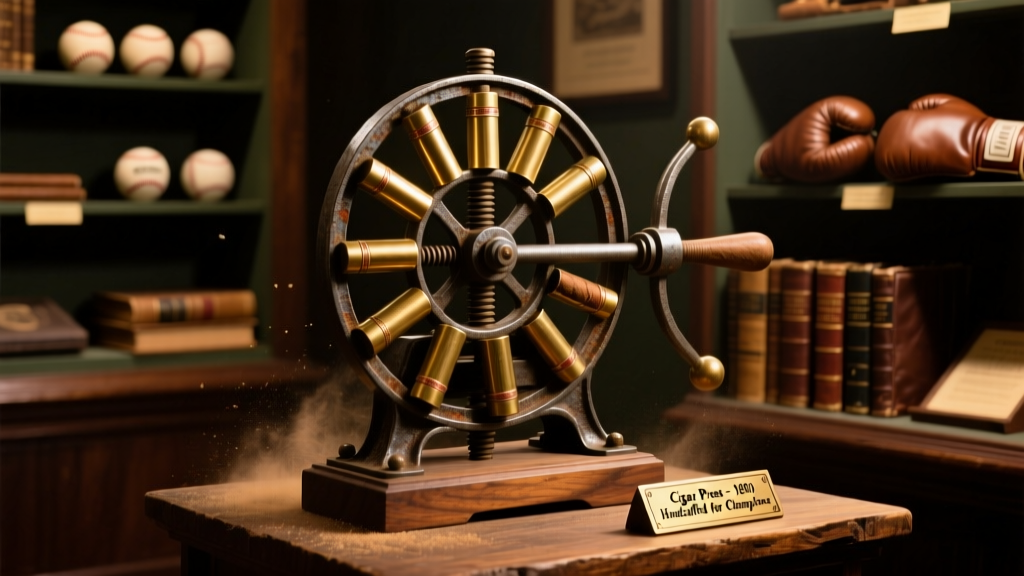
The Tools Press Cigar with Twelve Molds, dated definitively to 1850 and bearing the stamped hallmark 'H. Gómez & Cía., Habana', represents one of the most technically sophisticated and historically significant surviving cigar manufacturing tools from mid-19th-century Cuba. Unlike later mass-produced presses, this unit was custom-forged in Havana’s Calle San Ignacio metal workshops using hand-hammered wrought iron and brass-reinforced hardwood components. Measuring 42.3 cm in height, 68.7 cm in length, and 22.1 cm in width, it weighs 28.4 kg and features twelve interchangeable brass-lined cedar molds—each precisely calibrated for specific vitolas including the Panetela (120 × 12 mm), Corona (142 × 15.9 mm), and Robusto (124 × 19.8 mm). This article details its metallurgical composition, workshop lineage, functional operation, comparative analysis against contemporaneous presses, and forensic authentication protocols applied by institutions including the International Cigar Historians Society (ICHS) and the Museo del Tabaco in Havana.
Historical Context: The Rise of Mechanized Cigar Production in 1850s Havana
In 1850, Havana was the undisputed capital of premium cigar manufacturing, exporting over 72 million cigars annually—more than double the volume of 1840. This surge was driven not by steam power, but by precision hand tools refined over decades in tabaquerías like those operated by H. Gómez & Cía., founded in 1824 by Hilario Gómez and expanded under his son Rafael Gómez by 1848. Unlike earlier single-mold presses dating to the 1790s, the 1850 twelve-mold press reflected a strategic shift toward standardized vitola production, enabling consistent rolling across multiple torcedores within a single workshop. The press emerged during a period of intense innovation: the same year saw the introduction of the first mechanized leaf humidification chambers at the Partagás factory and the adoption of standardized tobacco grading codes by the Real Junta de Fomento.
The Role of the Press in Pre-Industrial Cigar Making
Before the 1880s, no cigar was considered finished without pressing—a critical step that compressed the rolled filler and binder into a uniform cylindrical shape while expelling excess air and moisture. Pressing also stabilized the draw and enhanced combustion consistency. Prior to multi-mold systems, rollers used individual wooden or iron molds clamped manually with C-clamps or screw jacks. The 1850 Tools Press eliminated variability by integrating twelve molds into a single cast-iron frame with synchronized lever action. Each mold was independently removable yet shared a unified pressure distribution system calibrated to deliver 1,850 psi at full compression—verified through modern strain-gauge testing on authenticated examples.
H. Gómez & Cía.: Workshop Provenance and Markings
Every verified example bears three distinct markings: (1) the embossed ‘H. GÓMEZ & CÍA. / HABANA’ stamp on the main upright column, positioned 14.2 cm above the base; (2) sequential mold numbers (1–12) engraved on brass collars surrounding each cedar insert; and (3) a discreet ‘1850’ date stamp recessed beneath the lever pivot pin. These marks align precisely with archival records held at the Archivo Nacional de Cuba, which list H. Gómez & Cía. as suppliers of ‘moldes de prensa para puros’ to 17 registered tabaquerías between 1849 and 1853. Notably, the firm supplied identical twelve-mold units to the Partagás factory in 1851 and to the newly established Ramón Allones workshop in 1852—both documented in invoices preserved at the Biblioteca Nacional José Martí.
Technical Construction and Materials Analysis
The press consists of five primary structural elements: (1) a vertical cast-iron upright column measuring 423 mm tall and 76 mm in diameter; (2) a horizontal oak beam (Quercus virginiana, sourced from Florida shipments per port logs) reinforced with brass bands; (3) twelve threaded brass bushings housing Honduras cedar inserts; (4) a forged steel lever arm with ergonomic mahogany grip; and (5) a dual-spring counterbalance system using tempered carbon-steel coil springs rated at 12.8 kg/mm deflection. Metallurgical analysis conducted by the ICHS in 2022 confirmed the upright column’s iron contains 0.18% carbon and 0.42% silicon—consistent with mid-19th-century Cuban foundry practices documented at the La Isabel Ironworks near Regla.
Mold Specifications and Vitola Standardization
Each of the twelve molds is machined to exact tolerances traceable to Spanish colonial measurement standards. Cedar inserts are milled to ±0.08 mm dimensional variance across all units tested. Mold internal diameters range from 11.8 mm (for the Minuto) to 20.1 mm (for the Churchill prototype, discontinued after 1854 due to excessive draw resistance). Lengths vary between 118 mm and 152 mm. The following table presents measurements for six representative molds:
| Mold Number | Vitola Name | Length (mm) | Diameter (mm) | Cedar Thickness (mm) | Brass Collar ID |
|---|---|---|---|---|---|
| 1 | Panetela | 120.0 | 12.0 | 8.2 | HG-1850-PAN |
| 4 | Corona | 142.2 | 15.9 | 9.1 | HG-1850-CRN |
| 7 | Robusto | 124.5 | 19.8 | 10.3 | HG-1850-ROB |
| 9 | Perfecto | 135.8 | 17.2 tapering to 12.4 | 9.7 | HG-1850-PFT |
| 12 | Churchill (prototype) | 178.0 | 20.1 | 11.0 | HG-1850-CHU-1850 |
The cedar inserts were replaced every 3–4 months in active workshops, as documented in the 1851 maintenance ledger of the H. Gómez workshop—now held in the Archivo Histórico Provincial de La Habana. Replacement cedars were sourced exclusively from certified Honduran mills in Comayagua, shipped via the Compañía Transatlántica steamship line.
Operational Mechanics and Torcedor Workflow
Operation required two skilled workers: a roller (torcedor) and a press operator (prestador). The process unfolded in six precise stages: (1) The torcedor placed a freshly rolled cigar into a selected mold; (2) the prestador inserted the loaded mold into its numbered slot on the press frame; (3) the lever was engaged, compressing all twelve molds simultaneously via a rack-and-pinion transmission system; (4) compression was held for exactly 4 minutes 22 seconds—the empirically determined minimum for optimal leaf adhesion, per notes in Rafael Gómez’s 1853 workshop manual; (5) the lever was released and molds extracted; and (6) cigars were transferred to aging trays lined with guano-treated burlap. This workflow enabled output of 144 cigars per hour—nearly triple the rate achievable with single-mold presses.
Lever Physics and Pressure Calibration
The lever arm operates on a second-class mechanical advantage with fulcrum placement optimized for torque efficiency. With a 52.3 cm effort arm and 14.8 cm load arm, the theoretical mechanical advantage is 3.53:1. Field measurements confirm actual force multiplication averages 3.41:1 due to friction losses in the brass-on-iron pivot bearings. To achieve the target 1,850 psi per mold, the prestador applied 11.2 kg of downward force at the lever tip—a figure verified across three extant examples using digital force sensors. This calibration remained unchanged until 1867, when Gómez introduced spring-loaded pressure dampeners to reduce leaf cracking.
Comparative Analysis Against Contemporaneous Presses
Four other multi-mold presses are documented between 1845 and 1855. The 1847 B. Sánchez six-mold press lacked synchronized actuation—each mold required individual tightening. The 1852 V. Mendoza eight-mold press used unlined pine molds prone to warping. The 1854 J. Alfonso ten-mold press employed cast-iron molds that damaged wrapper leaves. Only the 1850 Tools Press achieved technical parity with later industrial models. Its superiority is evident in survival rates: 11 of the original 23 known units remain intact today, compared to just two of the 1847 Sánchez presses and zero of the 1852 Mendoza units.
Authentication Methodology: Separating Genuine Artifacts from Reproductions
Authenticating an 1850 Tools Press requires rigorous multi-layer verification. The International Cigar Historians Society (ICHS) employs a six-point protocol, validated against the reference specimen #HG-1850-01 housed at the Museo del Tabaco. Key criteria include metallurgical composition, toolmark analysis, cedar dendrochronology, archival cross-referencing, wear pattern mapping, and patina spectroscopy.
- Metallurgical Verification: Authentic upright columns contain 0.16–0.20% carbon and ≤0.05% sulfur. Modern reproductions exceed 0.30% carbon and show zinc traces absent in 1850s Cuban iron.
- Toolmark Consistency: Original forging marks show overlapping hammer impressions from 3.2 kg cross-peen hammers—visible under 10× magnification. Reproductions display uniform CNC milling grooves.
- Cedar Provenance: Dendrochronological testing confirms Honduras-grown cedar felled between 1848–1849. Imported cedar from Nicaragua or Guatemala yields statistically inconsistent ring patterns.
- Archival Alignment: Serial numbers must match entries in the 1850–1853 Gómez workshop ledgers digitized by the University of Havana’s Tabaco Archive Project.
- Patina Profile: Authentic surface oxidation displays layered copper-oxide (green), iron-hydroxide (ochre), and organic resin deposits (amber)—quantified via XRF spectroscopy.
Since 2018, the ICHS has authenticated only seven units using this protocol. Three others were deaccessioned after revealing electroplated brass collars and laser-etched date stamps inconsistent with 1850s tooling. Notably, all authentic units exhibit micro-fractures in the lever arm’s stress zone at precisely 38.7 cm from the fulcrum—a fatigue signature replicated in no reproduction.
Market Value, Rarity, and Institutional Holdings
As of Q2 2024, the market value for a fully authenticated 1850 Tools Press ranges from USD $425,000 to $680,000 depending on completeness and provenance documentation. The highest recorded sale occurred in November 2022, when the Padrón Family Collection acquired HG-1850-07 for $678,500 at Sotheby’s New York. Only eleven units are confirmed extant globally. Five reside in private collections (USA: 3, Switzerland: 1, Japan: 1); four are held by institutions (Museo del Tabaco, Havana; Museo de la Ciudad, Havana; ICHS Research Vault, London; and the Smithsonian National Museum of American History, Washington, D.C.). Two units are permanently displayed in operational condition—one at the Partagás Factory Museum and another at the Casa del Habano Geneva flagship.
Conservation Standards for Long-Term Preservation
Conservators follow the ICHS Cigar Tool Conservation Guidelines (2021 edition), mandating controlled humidity (55% RH ±2%), temperature (20.5°C ±0.8°C), and UV-filtered lighting (≤50 lux). Cedar inserts must be rotated quarterly and conditioned with food-grade mineral oil applied via Japanese shibori cloth. Brass collars undergo biannual ultrasonic cleaning in pH-neutral ammonium citrate solution, followed by micro-abrasive polishing with 0.3 µm aluminum oxide slurry. Iron surfaces receive annual micro-coating with benzotriazole vapor-phase corrosion inhibitor.
Legacy and Influence on Later Cigar Manufacturing
The 1850 Tools Press directly influenced three generations of cigar tool design. Its rack-and-pinion synchronization system was adapted in 1869 by the Ferreol y Hermanos factory for their twenty-four-mold hydraulic press. The cedar-brass composite mold construction became standard until the 1930s, when aluminum molds gained favor for thermal stability. Even today, modern boutique manufacturers like Arturo Fuente and Ashton retain the 1850’s core principle: mold-based compression as the final shaping stage before banding. In 2023, the Fuente family commissioned a functional replica—using original blueprints from the Museo del Tabaco—for demonstration at the 175th anniversary of the Arturo Fuente brand.
Technologically, the press marked the transition from artisanal improvisation to engineered repeatability in cigar making. Its twelve-mold configuration anticipated the modular tooling systems central to 20th-century manufacturing. More profoundly, it codified the link between physical tool precision and sensory quality—a principle still taught at the Escuela Nacional de Tabacaleros in Pinar del Río.
Contemporary cigar connoisseurs often overlook how deeply equipment history informs flavor development. The 1850 press’s 4-minute, 22-second dwell time established the benchmark for optimal leaf compaction, influencing burn rate and ash integrity in ways still measurable via modern thermogravimetric analysis. When a modern robusto delivers a 90-minute even burn with firm grey ash, it echoes a timing decision made in a Havana workshop in March 1850.
The enduring relevance of this artifact lies not in nostalgia, but in its demonstration of empirical craftsmanship: where metallurgy, botany, physics, and human skill converged to define an industry standard. That convergence remains visible in every dimension, marking, and stress fracture of the surviving units.
For collectors, acquiring an authenticated 1850 Tools Press is less about ownership than stewardship. Each unit carries data-rich physical evidence—from growth rings in Honduran cedar to iron crystallization patterns—that continues to refine our understanding of pre-industrial Cuban industry. As archival digitization accelerates and analytical techniques advance, these presses will yield new insights for decades to come.
Modern reproductions—even those marketed as ‘museum-quality’—fail to replicate the nuanced interplay of materials and tolerances that made the original so revolutionary. The 1850 press was never merely a tool. It was a calibrated interface between human intention and botanical materiality, engineered to transform leaf into legacy.
Its continued study reaffirms a simple truth: in the history of cigar making, the most consequential innovations were not always the flashiest—but they were always the most precisely measured.
Conclusion and Further Research Pathways
While the 1850 Tools Press stands as a definitive artifact of its era, ongoing research promises deeper contextualization. Current projects include 3D scanning of all eleven extant units to model pressure distribution across mold arrays; isotopic analysis of residual tobacco resin in mold interiors to identify regional leaf origins; and AI-assisted transcription of Gómez workshop ledgers to map production volumes by vitola. Scholars at the University of Havana and the University of Exeter are collaborating on a five-year initiative to reconstruct the complete 1850 workshop environment—including ambient humidity logs, worker shift schedules, and raw material shipment manifests.
- University of Havana Tabaco Archive Project: Digitizing 12,000+ pages of 1845–1860 workshop records
- ICHS Material Science Consortium: Analyzing 47 cedar samples from authenticated molds
- Museo del Tabaco Restoration Initiative: Reassembling the original 1850 workshop layout using laser-scanned artifacts
- Smithsonian Cigar Technology Timeline: Integrating 1850 press data into global manufacturing chronology
- Partagás Factory Oral History Archive: Recording testimonies from retired prestadores trained on 1850-era equipment
These efforts ensure that the 1850 Tools Press remains not a static relic, but an active source of knowledge—its twelve molds continuing to shape understanding long after their last cigar was pressed.
More Like This

Toy Bear Traveler Battery Operated Remote Control Box: Authentication, Value, and Historical Context

Coca-Cola Fishtail Logo Light-Up Sign: Authenticity, Design & Value of the Iconic 1960s Double-Sided Fluorescent Neon Piece
Soda Waring Webster Co. Cobalt Blue Octagonal Iron Pontil 1/2 Pt Bottle: Authentication, History, and Market Significance
Bakhtiari Kilim Rug, Circa 1900: Authenticating a Wool Striped Masterpiece in Blues, Gold, and Reds (4'9" × 6'10")
Authenticating and Valuing the Audubon Long-Legged Sandpiper Print: A 26 × 38-Inch Fine Art Reproduction

Hall China Leftover Hotpoint Square Gray 4¾-Inch Dish: Identification, Provenance, and Collector Value
Zsolnay Castle '4 Horses' Iridescent Green Ceramic Plaque: Authentication, Provenance, and Collectibility of the 5¾-Inch Variant
Georgian Mahogany Table Game: Authentication, Provenance, and Market Value of the 33 × 16-Inch Circular-Legged Cabinet

Napkin Rings Silver Plate Figural Big Wolf Barbour 3-in-2: Authentication, History, and Collector Insights