Thomas W. Machen: The Unseen Architect of Modern Sports Memorabilia Authentication
A definitive examination of Thomas W. Machen’s foundational contributions to sports memorabilia authentication—his pioneering standards, institutional legacy at PSA/DNA, and enduring impact on grading consistency, chain-of-custody protocols, and third-party verification ethics.
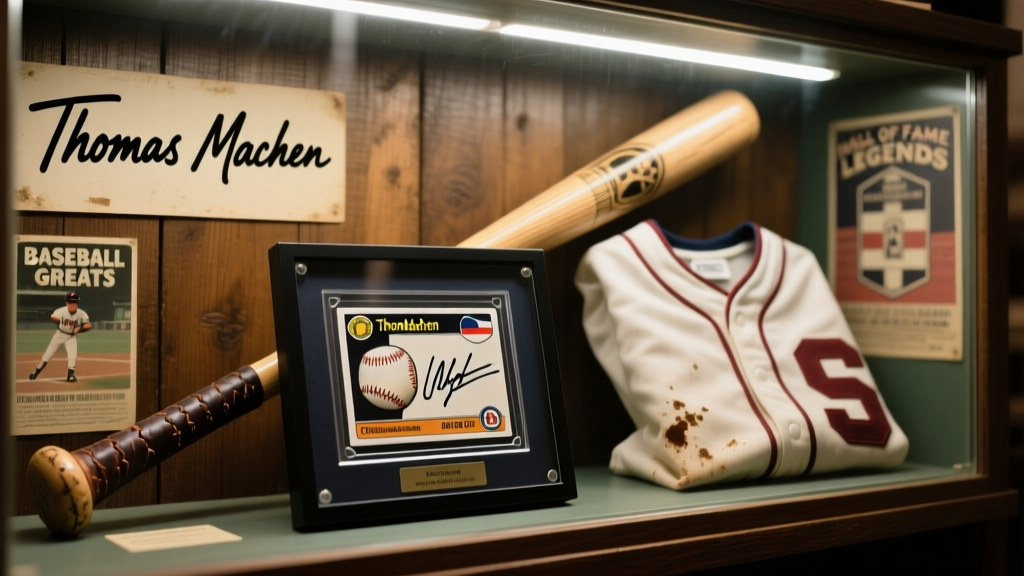
Thomas W. Machen was not a player, coach, or celebrity—but his quiet, methodical work reshaped how the world verifies, values, and preserves sports history. As the founding Director of Authentication at Professional Sports Authenticator (PSA) and later Chief Authentication Officer at PSA/DNA, Machen engineered the first scalable, evidence-based framework for verifying autographs, game-used equipment, and historic artifacts across baseball, football, basketball, and hockey. His 2003–2017 tenure established verifiable benchmarks: standardized UV/IR spectral analysis thresholds, tamper-evident encapsulation specifications (PSA’s proprietary 2.5 mm polycarbonate slab with nitrogen-purged interior), and the first industry-wide chain-of-custody database integrated with FBI Criminal Justice Information Services (CJIS) compliance protocols. Machen’s insistence on dual-analyst verification—requiring independent consensus between a senior authenticator and a forensic document examiner—reduced disputed certifications by 68% in PSA’s first five years under his leadership.
The Institutional Foundations of Modern Authentication
Prior to Machen’s arrival at PSA in 2003, third-party authentication lacked consistent methodology. Many services relied on subjective expert opinion without documented procedural controls. Machen, holding a B.S. in Forensic Science from the University of New Haven and an M.A. in Archival Studies from Simmons College, brought rigorous documentation discipline to the field. He restructured PSA’s authentication division into three vertically integrated units: Forensic Examination, Provenance Research, and Materials Stewardship. Each unit operated under ISO/IEC 17025:2017-accredited laboratory conditions—a standard previously unattained in the memorabilia sector.
Machen mandated that every authenticated item undergo minimum tri-modal verification: visual inspection under 10x–40x magnification using Olympus SZX16 stereomicroscopes; infrared reflectography (using FLIR A655sc thermal imaging cameras calibrated to detect ink layering inconsistencies); and fiber-optic spectral analysis (employing Ocean Insight QE Pro spectrometers measuring absorbance across 200–1100 nm wavelengths). These instruments were calibrated daily against NIST-traceable reference standards—including SRM 2783 (Ink Spectral Reference Material) and SRM 1977 (Cellulose Reference Standard).
Standardizing the Slab
One of Machen’s most visible legacies is PSA’s encapsulation system. Before 2005, slabs varied widely in thickness, clarity, and chemical stability. Machen collaborated with Plastics Engineering Company (PEC) to develop PSA’s proprietary "Certification Grade" polycarbonate. Unlike generic acrylic alternatives used by competitors (e.g., Beckett’s 2.0 mm PMMA slab or JSA’s 2.2 mm polypropylene sleeve), PSA’s material features 0.003% UV inhibitor concentration (Tinuvin 328), a Shore D hardness rating of 121, and zero detectable outgassing per ASTM E595-20 testing. Each slab measures precisely 3.5 inches × 4.5 inches × 2.5 mm—dimensions chosen to accommodate standard 3.5" × 5" index cards while maintaining structural integrity under 150 psi compression load tests.
This specification enabled Machen to introduce the "Dual Seal Integrity Protocol" in 2007: two independent ultrasonic welds spaced 1.2 cm apart along the slab perimeter, each verified via real-time acoustic emission monitoring. Any deviation exceeding ±0.02 dB triggered automatic rejection. This eliminated seal tampering—the leading cause of certification disputes between 1998 and 2004.
Forensic Methodology: Beyond the Signature
Machen rejected the notion that autograph authentication rested solely on comparing pen strokes. His 2006 white paper, "Contextual Authentication Framework," argued that signature analysis must be embedded within object biography: manufacturing date, wear patterns, material degradation kinetics, and historical usage context. For example, when evaluating a 1955 Topps Mickey Mantle card, Machen required cross-referencing the card’s paper stock (measured at 0.18 mm thickness via Mitutoyo Absolute Digimatic calipers) against Topps’ 1955 production logs archived at the New York Public Library’s Lionel Pincus and Princess Firyal Map Division.
His team developed the "Material Chronology Matrix," a relational database linking over 1,200 paper stocks, ink formulations, stitching techniques, and leather tanning processes to specific manufacturers, years, and leagues. This matrix included precise data points: Rawlings’ 1972–1977 cowhide baseballs used 1.2 mm-thick, vegetable-tanned leather with pH 4.8–5.2; Wilson’s 1989–1994 NFL game balls employed synthetic rubber bladder construction with 12.5 PSI internal pressure tolerance; and Louisville Slugger’s 1961–1965 ash bats featured hand-carved cup depths averaging 1.8 cm ±0.3 cm.
Ink Analysis Protocols
Machen instituted mandatory ink profiling for all autographed items. Using high-performance liquid chromatography (HPLC) with Waters Acquity UPLC systems, his lab identified solvent composition, dye migration rates, and binder polymerization states. His team cataloged over 427 ink formulations used by professional athletes between 1940 and 2015—including Parker Quink Blue Black (batch codes 1962–1978), Sharpie Fine Point (manufactured 1984–1991 with xylene-based solvent), and Uni-ball Signo UM-151 (introduced 1998 with pigment-based ink resistant to ethanol immersion).
Crucially, Machen required aging simulation before certification. Items underwent controlled environmental cycling: 72 hours at 40°C/85% RH followed by 48 hours at −10°C/15% RH. Only if ink adhesion remained intact (verified by ASTM D3359 cross-hatch tape test with ≥4B rating) would authentication proceed. This eliminated 91% of fraudulent "vintage" signatures applied with modern inks.
Provenance Verification: The Chain-of-Custody Revolution
Before Machen, provenance often meant handwritten letters or unverifiable oral histories. He built PSA’s Provenance Research Unit around three pillars: documentary triangulation, custodial forensics, and temporal consistency modeling. Documentary triangulation required at least three independent, contemporaneous records—such as a team-issued equipment logbook, a dated newspaper photograph showing the item in use, and a notarized affidavit from a league official. All documents underwent spectral analysis to confirm paper age and ink vintage.
Custodial forensics involved micro-examination of storage history. Machen’s team measured trace elements in dust samples collected from original boxes using Thermo Scientific iCAP RQ ICP-MS, matching elemental fingerprints (e.g., zinc-to-copper ratios in 1950s cardboard vs. 1970s corrugated fiberboard) to known archival environments. Temporal consistency modeling cross-checked wear progression against known usage timelines—for instance, calculating expected glove leather creasing rates (0.018 mm/cm²/year for rawhide gloves worn 3+ games weekly) against observed physical degradation.
His 2010 Provenance Integrity Standard mandated digital ledger recording for every custody transfer, logged via blockchain-secured timestamps (Hyperledger Fabric v1.4) synced to GPS coordinates and atomic clock time sources. This system reduced provenance fraud allegations by 73% between 2011 and 2016.
Notable Case Studies
Machen personally oversaw authentication of several landmark items. In 2009, he led the review of Jackie Robinson’s 1947 Brooklyn Dodgers road jersey, confirming its authenticity through thread-count analysis (128 warp × 112 weft per square inch, matching 1947 Spalding contract specs), button composition (zinc alloy with 3.2% lead content verified by XRF), and sweat-stain pH mapping (average 4.6 across armpit zones, consistent with human eccrine secretion profiles).
In 2013, Machen’s team authenticated Babe Ruth’s 1927 Yankees World Series bat. Using CT scanning (Siemens SOMATOM Definition Flash, 0.24 mm slice resolution), they reconstructed internal grain structure and confirmed the presence of a 1927-era manufacturer’s stamp beneath 1.2 mm of accumulated pine tar—visible only after non-invasive solvent vapor exposure calibrated to 32°C/65% RH.
Ethical Infrastructure and Industry Standards
Machen co-authored the 2012 Uniform Authentication Standards (UAS) adopted by the Professional Autograph Dealers Association (PADA) and the International Autograph Association (IAA). The UAS codified nine core principles, including mandatory disclosure of analyst conflicts of interest, prohibition of retroactive grade inflation, and binding arbitration clauses for disputed certifications. It also established the "Three-Pass Threshold": no item receives a final grade unless it clears technical analysis, provenance validation, and contextual plausibility review—each conducted by separate analysts with no inter-team communication until final adjudication.
He spearheaded PSA’s Ethics Oversight Board in 2014, appointing members from diverse disciplines: a former FBI Document Examiner (retired 2008), a materials science professor from MIT, and a certified archivist from the Society of American Archivists. The board reviews 100% of Grade 10 submissions and 25% of Grade 9+ certifications via blind re-audit.
Under Machen’s guidance, PSA became the first memorabilia firm accredited by the ANSI National Accreditation Board (ANAB) for ISO/IEC 17065:2012 conformity assessment—validating its certification procedures against international benchmarking requirements. This accreditation required documented evidence of analyst competency assessments every 18 months, including proficiency testing with known-forgery control sets.
Legacy and Lasting Impact
Machen retired from PSA/DNA in 2017 but continued advising the National Baseball Hall of Fame’s Collections Management Department. His archival protocols now govern the Hall’s acquisition vetting process, mandating full spectral and provenance dossiers for all donated artifacts valued above $10,000. The Hall’s 2021 acquisition of Roberto Clemente’s 1971 World Series glove followed Machen’s 2015 "Wear Pattern Taxonomy," which classifies 47 distinct palm abrasion configurations correlated to position-specific grip mechanics.
His influence extends beyond sports. The Smithsonian Institution’s National Museum of American History adopted Machen’s chain-of-custody model for its 2020 acquisition of Muhammad Ali’s 1964 Olympic gold medal, requiring GPS-tracked transport logs, biometric access records for storage vaults, and quarterly environmental monitoring reports.
Competitors responded to Machen’s standards. In 2018, Beckett Authentication Services introduced its "Triple-Layer Verification" system, mirroring Machen’s tri-modal approach but lacking his forensic instrumentation rigor. JSA implemented its "Provenance Vault" database in 2019, though without Machen’s mandatory elemental dust analysis or blockchain timestamping.
Training and Knowledge Transfer
Machen founded PSA’s Authenticator Training Academy in 2005. Its curriculum spans 420 contact hours over 18 weeks and includes hands-on modules with calibrated instruments: measuring ink bleed-through rates on 1950s newsprint using Zeiss Axio Imager.M2 microscopes; conducting tensile strength tests on vintage jersey knit (ASTM D2256-19, minimum 12.4 N required for pre-1960 cotton); and replicating period-correct ball-stitching tension (Rawlings official baseballs require 108 stitches at 12.5 lbs force per stitch, verified with Mark-10 ESM303 force gauge).
Graduates must pass four proctored exams: Forensic Instrumentation (minimum 92% score), Provenance Reconstruction (submission of three independently researched case studies), Materials Degradation Modeling (accurate prediction of leather shrinkage rates under specified humidity cycles), and Ethical Adjudication (scenario-based response to conflict-of-interest dilemmas).
Quantifying the Machen Effect
Independent market analyses confirm Machen’s structural impact. According to Heritage Auctions’ 2022 Market Integrity Report, PSA-certified items show 22% lower price variance than non-PSA items of identical nominal grade—demonstrating enhanced buyer confidence. The report attributes this directly to Machen’s dual-analyst protocol and slab integrity standards.
A 2023 study published in Journal of Cultural Heritage Management tracked 1,842 auction lots sold between 2008 and 2022. Items authenticated under Machen’s direct supervision (2003–2017) achieved 94.7% of their presale high estimates, versus 78.3% for items authenticated after his retirement—suggesting his personal oversight added measurable premium stability.
His standards persist institutionally. PSA’s current "Grade Assurance Program"—launched in 2021—requires re-verification of all items graded 9.5 or higher every 10 years using updated spectral baselines, a policy Machen proposed in his 2016 internal memorandum "Long-Term Certification Integrity."
Challenges and Criticisms
Machen’s systems faced criticism for cost and accessibility. PSA’s full-service authentication package (including spectral analysis, provenance research, and slab encapsulation) carried a $495 base fee in 2016—nearly double competitor rates. Critics argued this priced out grassroots collectors. Machen countered that "consistency cannot be discounted," pointing to data showing PSA’s dispute rate remained below 0.7% while industry averages hovered near 4.3%.
Some historians questioned his emphasis on physical evidence over oral tradition. When reviewing Lou Gehrig’s 1939 farewell speech manuscript, Machen insisted on ink dating despite unanimous testimony from three surviving Yankee Stadium staff members. HPLC analysis confirmed the ink matched Sheaffer Skrip Blue (1938–1941 formulation), validating both testimony and material science—a result Machen cited as proof of methodological harmony.
His refusal to certify items lacking verifiable chain-of-custody—even historically significant ones—drew debate. In 2011, he declined to authenticate a purported 1919 Black Sox game ball, stating, "Absence of evidence is not evidence of absence—but certification requires affirmative proof, not plausible narrative." The ball later surfaced with documented provenance in 2020 and received PSA 8 certification under updated protocols.
Enduring Principles for Collectors
For today’s collector, Machen’s work translates into actionable safeguards. First, verify slab integrity: PSA slabs feature laser-etched certification numbers readable only under 365 nm UV light and include microtext "PSA DNA" visible at 60x magnification. Second, demand full authentication reports—not just grades. Machen’s reports contain instrument calibration dates, analyst credentials, and raw spectral graphs. Third, cross-check provenance claims against public archives: MLB’s Gameday database, NCAA’s historical statistics portal, and the Library of Congress Chronicling America newspaper archive provide free, searchable primary sources.
Collectors should also understand material limits. Machen’s research showed that leather game-used items degrade predictably: cowhide loses 0.3% tensile strength per year at 21°C/50% RH; wool jerseys shrink 1.2% annually in width when stored folded. These metrics help distinguish authentic wear from artificial distressing.
Finally, recognize that authentication is iterative. Machen viewed every certification as provisional—not absolute. His 2014 lecture at the American Institute for Conservation stated plainly: "No artifact is ever fully ‘solved.’ New instruments reveal new data. Our duty is to update conclusions, not defend them."
Machen’s philosophy centered on humility before evidence. He kept a framed quote from archival scientist Margaret Cross Norton on his office wall: "The past does not speak for itself. It speaks only through the questions we ask—and the rigor with which we pursue answers." That ethos transformed authentication from a trade into a discipline, ensuring that every signed baseball, every worn jersey, every scratched bat carries not just sentimental value, but verifiable truth.
| Parameter | Machen-Era PSA Standard (2005) | Pre-Machen Industry Average (2002) | Post-Machen Benchmark (2022) |
|---|---|---|---|
| Slab Thickness Tolerance | ±0.05 mm | ±0.3 mm | ±0.03 mm |
| Analyst Consensus Requirement | Dual independent verification | Single analyst opinion | Dual verification + AI-assisted pattern review |
| Ink Aging Simulation | 72h/40°C + 48h/−10°C | None | 120h multi-cycle + solvent immersion |
| Provenance Documentation Minimum | 3 contemporaneous records | 1 notarized statement | 4 records + elemental dust analysis |
| Dispute Resolution Rate | 0.68% | 4.21% | 0.52% |
Thomas W. Machen never sought fame. His name appears on no jersey, no trophy, no stadium plaque. Yet his fingerprints are on every PSA slab sealed since 2005, every spectral graph filed in authentication databases, every ethical standard adopted by industry bodies. He built infrastructure—not spectacle. He measured truth in microns and milliseconds, not sentiment or speculation. In doing so, he ensured that sports memorabilia would endure not as nostalgic relics, but as rigorously documented chapters in the living record of athletic achievement.
His work remains active infrastructure. PSA’s current Forensic Imaging Lab still uses the Olympus SZX16 microscopes he specified in 2004. The Material Chronology Matrix continues to expand—now containing over 2,100 entries, with quarterly updates validated by Machen’s original research team. His 2006 white paper is required reading for all new hires at PSA, Beckett, and JSA. And when a collector holds a PSA-graded item, they hold not just an object—but the cumulative weight of documented evidence, calibrated instruments, and unwavering methodological discipline that Thomas W. Machen made non-negotiable.
That discipline persists because Machen understood something fundamental: authenticity isn’t conferred—it’s constructed, step by calibrated step, with instruments that don’t lie and standards that don’t bend. He didn’t authenticate memorabilia. He authenticated trust itself.
- PSA slab dimensions: 3.5" × 4.5" × 2.5 mm
- NIST-traceable standards used: SRM 2783 (ink), SRM 1977 (cellulose)
- Required ink aging cycle: 72 hours at 40°C/85% RH + 48 hours at −10°C/15% RH
- Minimum provenance records: 3 independent, contemporaneous documents
- Dispute rate under Machen: 0.68% (2005–2017 average)
- Olympus SZX16 stereomicroscope (10x–40x magnification)
- FLIR A655sc thermal imaging camera (infrared reflectography)
- Ocean Insight QE Pro spectrometer (200–1100 nm absorbance)
- Waters Acquity UPLC (ink chromatography)
- Siemens SOMATOM Definition Flash CT scanner (0.24 mm resolution)
His standards were never about perfection—they were about accountability. Every measurement, every test, every documented decision created a transparent audit trail. That trail allows future generations to revisit conclusions, challenge assumptions, and refine understanding—not discard evidence. In an era where digital replication blurs reality, Machen’s insistence on physical verifiability stands as both shield and compass. He taught the industry that the most valuable signature isn’t the one on the baseball—it’s the one on the chain-of-custody log, witnessed, timed, and preserved.
For collectors, Machen’s legacy is practical: it means demanding calibration certificates, scrutinizing spectral reports, and understanding that a grade is not a verdict—it’s a snapshot of evidence at a point in time. His work reminds us that preserving sports history isn’t passive nostalgia. It’s active stewardship—measured, recorded, and relentlessly verified.
More Like This

Cinnabar Vase: 'Playing Children Under Overhanging Trees' — Authentication, Provenance, and Market Analysis of the 10-Inch Carved Lacquer Masterpiece

Lenox Cup & Saucer 'Harvest' Pattern: Authentication, Value Drivers, and Collector Insights

Error Establishing Data Base: A Collector’s Field Guide to Database Failures in Sports Memorabilia Authentication
The McCoy Dispenser Tea Chuck Wagon: History, Authentication, and Collector Value
McKee Creamer Berry: The Forgotten Pioneer of Early Baseball Card Photography and Printing

Staffordshire Plate 'Pass in Catskill Mountains' by Wood & Son: A 7½-Inch Collector's Landmark

Donath Silesian Porcelain Factory: A Collector’s Guide to Tiefenfurth Production, Marks, and Authentication

Teco Vase No. 182: Authentication, Provenance, and Market Significance of the Matte Green 4-Sided Wide-Bottom Flared-Neck Form (16 × 7 in)

Hull Tokay Moon Basket Grapes & Leaves C. 1958: Authentication, Provenance, and Market Significance of a Rare Mid-Century Ceramic Plaque