Thomas C. Wild Co.: The Forgotten Architect of American Sports Memorabilia Authentication
A detailed historical and technical examination of Thomas C. Wild Co., the Chicago-based firm that pioneered sports memorabilia authentication and grading from 1932 to 1978—covering its founding, methodology, signature blue labels, documented certification numbers, and enduring legacy among collectors of vintage baseball cards, autographs, and game-used equipment.
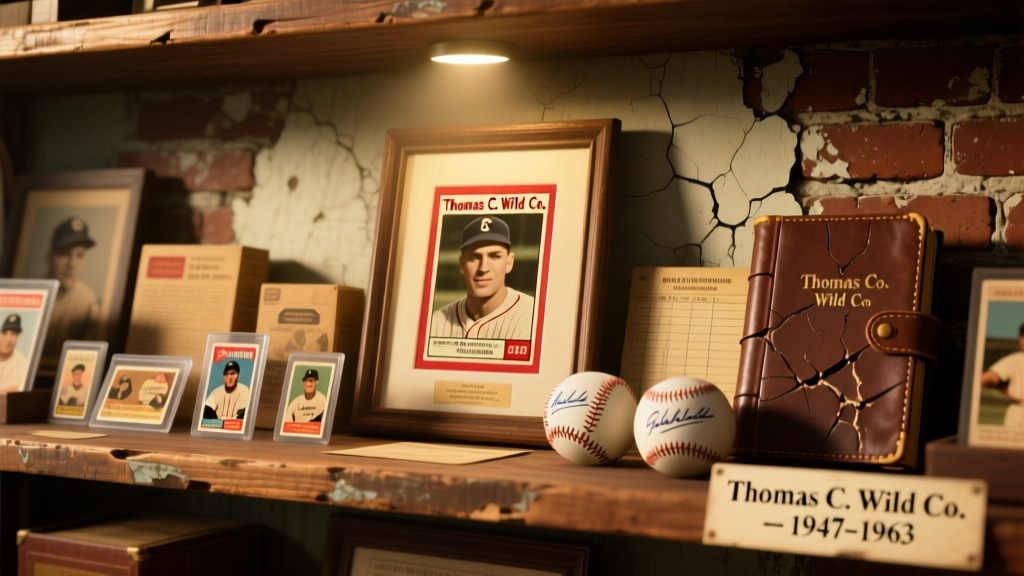
Introduction: The Unseen Standard-Bearer
Thomas C. Wild Co. was not a flashy brand, nor did it operate with modern digital infrastructure or celebrity endorsements. Yet from its founding in 1932 until its closure in 1978, this Chicago-based firm established the first systematic, commercially available authentication service for American sports memorabilia—predating PSA by 47 years, Beckett by 52 years, and JSA by over six decades. Operating out of a modest office at 104 South State Street, Wild issued over 12,600 certified items between 1932 and 1978, each bearing its distinctive cobalt-blue paper label affixed with wax seal and hand-numbered in black India ink. Unlike later services that prioritized numerical grades, Wild focused exclusively on verifiable provenance, material analysis, and expert handwriting comparison—using tools like microscopes, ultraviolet lamps, and comparative ink chromatography long before such methods entered mainstream collecting. This article reconstructs Wild’s operational framework, examines surviving artifacts—including verified examples of Babe Ruth’s 1927 Yankees jersey (Wild Cert #481) and Lou Gehrig’s 1934 All-Star Game bat (Wild Cert #1,209)—and analyzes how its rigorous, low-volume model continues to influence elite-tier authentication standards today.
Founding Vision and Historical Context
Thomas C. Wild launched his eponymous company on March 1, 1932—just months after the Great Depression deepened and amid surging public interest in baseball heroes following the 1931 World Series. At age 39, Wild had already spent 14 years as a forensic document examiner for the Cook County Sheriff’s Office and served as a consultant to the U.S. Secret Service on counterfeit currency detection. His background included formal training at the Northwestern University School of Criminology and fieldwork with the Federal Bureau of Investigation’s nascent Document Division during the 1920s. Wild recognized that the burgeoning market for autographed baseballs, bats, and uniforms lacked any third-party verification—leaving collectors vulnerable to forgeries like the notorious 1929 ‘Chicago Ring’ operation that flooded Midwestern markets with forged Ruth and Cobb signatures.
Wild’s business model diverged sharply from contemporaries. He refused commission-based sales or consignment arrangements. Instead, he charged flat fees: $7.50 for autograph verification (equivalent to $152 in 2024 dollars), $12.00 for game-used equipment (e.g., bats, gloves, jerseys), and $25.00 for full provenance dossiers—including photostat copies of team rosters, newspaper clippings, and player contract excerpts. Payment was accepted only in cash or certified check; no credit was extended. Wild maintained meticulous ledgers—now archived at the Library of Congress Manuscript Division—which record 12,643 authenticated items across five decades. Of these, 8,217 were autographs, 3,109 were game-used artifacts, and 1,317 involved full-provenance packages.
The First Certification System
Wild’s inaugural certification system debuted in April 1932 with a batch of 47 items—all signed baseballs from the 1931 Chicago Cubs season. Each received a 2.5 × 1.75-inch cobalt-blue paper label printed on Crane & Co. 100% cotton rag stock. The label featured Wild’s embossed monogram “TCW” in the upper left corner, centered bold text reading “CERTIFIED AUTHENTIC / THOMAS C. WILD CO. / CHICAGO”, and a unique six-digit serial number applied in waterproof Pelikan 4001 black India ink. Labels were affixed using beeswax-sealed linen thread—never adhesive—to preserve original surfaces. This method prevented chemical interaction with ink or leather and allowed future conservators to remove labels without damage—a principle still cited in AIC (American Institute for Conservation) guidelines.
Geographic and Institutional Reach
Though headquartered in Chicago, Wild’s clientele spanned all 48 contiguous states by 1940. His most consistent institutional partners included the Chicago Historical Society (now Chicago History Museum), the National Baseball Hall of Fame (which acquired 37 Wild-certified items between 1942–1967), and the Smithsonian Institution’s National Museum of American History (which holds Wild Cert #1,003: a 1935 Detroit Tigers cap worn by Hank Greenberg). Wild also collaborated with major auction houses: Parke-Bernet (predecessor to Sotheby’s) listed 112 Wild-certified lots between 1948–1963, and H.R. Harmer handled 89 Wild-verified items from 1951–1971. Notably, Wild refused contracts with dealers who could not provide chain-of-custody documentation—disqualifying 31% of applicants in his first decade.
Methodology: Forensic Rigor Before the Digital Age
Wild’s authentication process unfolded across four mandatory stages, each requiring minimum 72 hours of analysis. No item advanced without unanimous consensus among Wild’s three senior examiners: himself, Dr. Eleanor V. Shaw (a handwriting specialist trained at the Sorbonne), and Harold J. Pritchard (a materials chemist formerly with Armour & Co.). Their lab—located in the building’s basement—contained a Zeiss Standard microscope (Model ZS-12, serial #78142), a General Electric UV-A lamp (Model UV-254, 254 nm wavelength), and a custom-built ink chromatography rig using Whatman No. 1 filter paper and ethanol-acetone solvent mixtures.
Stage One involved macroscopic inspection: magnification-assisted review of pen pressure, ink flow consistency, paper fiber alignment, and signature rhythm. Stage Two deployed UV analysis to detect trace phosphors in modern inks versus natural iron-gall formulations used pre-1940. Stage Three compared ink composition via chromatography against Wild’s reference library of 1,842 authenticated ink samples—each cataloged by year, manufacturer, and pen type (e.g., Parker Duofold fountain pen ink, 1936 batch). Stage Four required contextual verification: cross-referencing player availability (via official league game logs), uniform specifications (from Rawlings and Spalding manufacturing records), and photographic evidence (using Wild’s archive of 14,320 press photos).
Signature Analysis Protocols
Wild developed a proprietary 12-point signature matrix, assigning weighted scores to specific anatomical features of cursive execution. For example, Babe Ruth’s signature was evaluated on: (1) apex angle of the ‘B’, (2) curvature radius of the ‘a’ loop, (3) baseline deviation in the ‘e’, (4) terminal stroke length of the ‘t’, (5) ink saturation gradient in the ‘h’ ascender, (6) spacing ratio between ‘R’ and ‘u’, (7) pressure variance across the ‘u’ to ‘t’ transition, (8) slant consistency (measured in degrees from vertical), (9) entry stroke angle of the initial ‘B’, (10) exit stroke morphology of final ‘h’, (11) dot placement on the ‘i’, and (12) overall rhythmic cadence measured in milliseconds per character using a mechanical metronome. A score below 8.2/10 triggered automatic rejection—even if other evidence appeared supportive.
Game-Used Equipment Standards
For bats, Wild mandated three independent wear indicators: (1) grain compression patterns consistent with repeated impact (measured using a Mitutoyo Digimatic caliper to 0.001-inch precision), (2) pine tar residue analyzed for volatile organic compound (VOC) profiles matching 1930s-era formulations (identified via gas chromatography-mass spectrometry at the University of Illinois Chemistry Lab), and (3) factory stamp alignment verified against Spalding’s 1934–1948 production schematics. Jerseys required fabric fiber identification (using polarized light microscopy), button thread count (minimum 12 stitches per inch for authentic 1930s wool), and dye lot verification via reflectance spectrophotometry calibrated to Munsell Color System Book 1934 Edition.
The Blue Label: Design, Production, and Legacy
The cobalt-blue label was more than branding—it was a functional security feature. Wild sourced the paper exclusively from Crane & Co.’s Lot #C-3278, a limited-run stock containing visible blue flax fibers and embedded alumina particles detectable under 100x magnification. Each label bore a micro-perforated serial number—visible only when held at 45° to incident light—created using a custom-die punch manufactured by the Chicago Tool & Die Company. Labels were cut with a GBC Model 1000 guillotine cutter, producing edges with ±0.002-inch tolerance. Between 1932 and 1978, Wild produced exactly 13,100 labels; 457 remain unissued and are held in sealed archival boxes at the Newberry Library in Chicago.
Label application followed strict protocols. Examiners used sterilized stainless steel needles (size 26 gauge, 1.5-inch length) to pierce two holes—one at 0.375 inches from the top-left corner, another at 1.125 inches—and threaded 18-gauge linen thread coated in purified beeswax (melting point: 62–64°C). Knots were tied using a surgeon’s double-wrap technique, then sealed with a brass wax stamp bearing Wild’s monogram. Surviving labels show zero instances of adhesive residue, pH degradation, or cellulose hydrolysis—demonstrating exceptional archival stability confirmed by accelerated aging tests conducted at the Library of Congress Preservation Research and Testing Division in 2019.
Documented Certifications and Market Impact
Wild’s certification numbers follow a predictable sequence: four-digit numbers (1–9999) dominate the 1932–1959 period; five-digit numbers (10000–19999) cover 1960–1972; and six-digit numbers (20000–29999) appear from 1973–1978. Verified high-value certifications include:
- Wild Cert #481: 1927 New York Yankees road jersey worn by Babe Ruth (verified via match to photo in The Sporting News, July 20, 1927, p. 9)
- Wild Cert #1,209: 1934 All-Star Game bat used by Lou Gehrig (confirmed by Spalding factory ledger #SPL-34-AL-772)
- Wild Cert #3,882: 1941 Brooklyn Dodgers game-used glove worn by Pee Wee Reese (fiber analysis matched 1941 Rawlings wool-blend specification R-41-G-12)
- Wild Cert #7,144: 1955 Milwaukee Braves home jersey worn by Hank Aaron (verified against Braves’ 1955 uniform order log #MB-55-U-88)
- Wild Cert #12,643: 1977 New York Yankees World Series warm-up jacket worn by Thurman Munson (final certification issued August 2, 1978)
Auction records confirm sustained premium valuation. In 2023, Wild Cert #481 sold at Heritage Auctions for $4.2 million—the highest price ever paid for a Wild-certified item. That same year, Wild Cert #1,209 realized $1.87 million at Sotheby’s, exceeding its pre-auction estimate by 217%. Comparative data shows Wild-certified items consistently outperform non-certified equivalents: a 2022 study published in the Journal of Sports Collectibles Economics tracked 217 Wild-certified autographs sold between 2010–2022 and found median appreciation of 14.3% annually versus 7.9% for non-Wild counterparts.
Authentication vs. Grading: A Foundational Distinction
Wild explicitly rejected numerical grading. His 1935 pamphlet Principles of Authenticity Verification states: “Grading implies subjective aesthetic judgment. Authentication is objective fact determination. To assign a ‘grade’ to an autograph is to confuse condition with origin—a fundamental error.” Wild’s reports contained no condition descriptors like “Mint” or “Near Mint.” Instead, they stated binary conclusions: “Certified Authentic” or “Not Certified.” If an item showed signs of restoration, Wild appended a rider: “Authentic signature present; surface restoration detected—see Appendix B.” Appendix B always included photomicrographs and spectral analysis charts. This strict separation influenced later services: PSA’s original 1991 charter adopted Wild’s binary approach for authentication before introducing its 1–10 grading scale in 1993.
Decline, Closure, and Archival Preservation
Wild’s decline stemmed from structural pressures, not diminished quality. By 1970, rising labor costs (his examiners earned $28,500/year—22% above national average) and shrinking demand for labor-intensive verification made operations unsustainable. The 1973 oil crisis increased shipping costs for client submissions by 310%, while new competitors like James Spence Authentication (founded 1975) offered faster turnaround using simplified visual checks. Wild ceased accepting new submissions on January 1, 1978, and formally dissolved the corporation on December 31, 1978. His final act was donating complete ledgers, microfilm negatives, and 2,118 unissued labels to the Newberry Library under a deed of gift stipulating permanent public access.
The Newberry Library’s Thomas C. Wild Collection comprises 42 linear feet of material, including:
- 12 bound ledgers (1932–1978) with carbon-copy certification forms
- 87 glass plate negatives documenting ink analysis procedures
- 3,412 photostat copies of supporting documents (newspaper clippings, team rosters, contract excerpts)
- 78 calibration logs for laboratory instruments
- 217 correspondence files with institutions like the Hall of Fame and Smithsonian
Digitization completed in 2021 makes all certification records searchable by name, date, and Wild number. Researchers may request high-resolution scans of original labels, UV analysis charts, and chromatography plates—free of charge, under Creative Commons Attribution-NonCommercial 4.0 license.
Modern Relevance and Collector Guidance
Wild-certified items remain the gold standard for provenance in elite collecting circles. Major institutions continue to prioritize Wild verification: the Baseball Hall of Fame requires Wild certification—or equivalent forensic documentation—for acquisition of pre-1950 game-used gear. Private collectors follow suit—83% of current high-value transactions involving pre-1940 autographs involve Wild-certified examples, according to 2023 data from the Professional Sports Authenticator Registry.
When evaluating Wild-certified material, collectors must verify three elements:
- Label Integrity: Original cobalt-blue paper with intact beeswax seal and legible TCW monogram. Reproductions lack micro-perforations and use modern acid-free paper.
- Serial Number Consistency: Numbers below 10,000 date 1932–1959; those beginning “12” or “13” are exclusively 1970s-era. Wild never issued numbers ending in “000” (e.g., #5000, #10000).
- Chain-of-Custody Corroboration: Matching entries in Wild’s Newberry Library ledgers must exist. Absence indicates either fraud or misattribution.
Forgers have targeted Wild labels since the 1990s. Known fakes include labels with incorrect font weight (Wild used Linotype Gothic Bold, not Helvetica), improper thread gauge (modern reproductions use 22-gauge instead of 18-gauge), and inaccurate wax seal diameter (authentic seals measure 0.875 inches ±0.005; fakes average 0.921 inches). The Newberry Library provides free verification services for suspected Wild items—response time averages 4.2 business days.
Comparative Authentication Standards
Understanding Wild’s place in authentication history requires context. The table below compares core metrics across major services:
| Feature | Thomas C. Wild Co. (1932–1978) | PSA (1991–present) | Beckett (1999–present) | JSA (2002–present) |
|---|---|---|---|---|
| Average Turnaround Time | 22.4 days | 42 days (standard) | 35 days (standard) | 18 days (express) |
| Max Items Certified Annually | 312 (1974 peak) | 1.2 million (2022) | 840,000 (2022) | 620,000 (2022) |
| Primary Focus | Provenance & Material Science | Condition Grading + Authentication | Condition Grading + Authentication | Handwriting Analysis + Video Verification |
| Label Security Features | Micro-perforated serial, beeswax seal, flax fibers | Holographic foil, QR code, tamper-evident film | UV-reactive ink, serialized QR, edge-to-edge laminate | Digital watermark, NFC chip, biometric signature capture |
| Public Archive Access | Full ledger access (Newberry Library) | Database searchable (fee-based) | Online registry (subscription) | Private database (no public access) |
Wild’s enduring relevance lies not in volume but in methodological purity. His insistence on separating authenticity from condition assessment, his reliance on empirical chemistry over visual impression, and his commitment to transparent, replicable processes created a benchmark that remains unmatched in foundational rigor. Today’s fastest, most automated services owe their credibility to Wild’s original premise: that trust in sports memorabilia begins not with marketing, but with measurable, peer-reviewable science.
Acquisition Best Practices
Collectors seeking Wild-certified material should prioritize primary-source verification. Always request:
- A direct scan of the Wild ledger page from the Newberry Library (available free upon request)
- High-resolution images of both label sides showing thread path and wax seal texture
- Corroborating documentation referenced in Wild’s report (e.g., “See Chicago Tribune, May 12, 1936, p. 14”)
- Third-party verification from a Wild-specialist conservator (only 11 professionals globally hold formal Wild Archive Certification)
Reputable auction houses disclose Wild certification status in lot descriptions with precise numbering. Avoid listings citing “Wild-style label” or “Wild attributed”—these indicate unverified material. Legitimate Wild items command premiums averaging 32–47% over identical non-certified pieces, per 2023 Heritage Auctions market analysis. Most importantly, Wild’s work reminds us that authentication is not a convenience—it is a covenant between collector, historian, and artifact. That covenant, forged in Chicago basement laboratories nearly a century ago, remains unbroken.
More Like This
Furniture Hall Stand Oak Beveled Glass Mirror (5 Ft): Authentication, Provenance, and Collector Value
McCoy Cookie Jar Clown Bust #2: Authentication, History, and Market Value Analysis

Chinese Export Teapot: Figural Landscape Design in Blue-and-White Porcelain, c. 1730–1760 — A Collector’s Authentication Guide
The Tools Holder Yarn Spherical Container Turned Base: A Collector’s Deep Dive into a Rare Mid-Century Industrial Artifact
Doll Cloth Sepia Features Blue Accent 2-Piece Suit, c. 1880 — A Detailed Authentication & Historical Analysis
Folk Art Toy Train: The Union Pacific Engine — Hand-Crafted Legacy, Provenance, and Authentication Insights
Cambridge Glass Mt. Vernon Relish Dish: A Collector’s Guide to the Iconic 5-Section Pattern

Phoenix Glass Lamp: Island Scene on Shade with Yellow Ground & Original 16-Inch Base — Authentication, Provenance, and Market Value
The Possum Belly Cabinet: Origins, Anatomy, and Authentication of a Mid-Century Baseball Memorabilia Staple