The Leberfeld Majolica Collection: A Legacy of Victorian Ceramics, Provenance, and Authentication Rigor
An in-depth examination of the Leberfeld Majolica Collection—one of the most significant private holdings of 19th-century majolica—detailing its acquisition history, maker attributions, conservation protocols, and forensic authentication methods employed by leading institutions including the Victoria & Albert Museum and Winterthur.
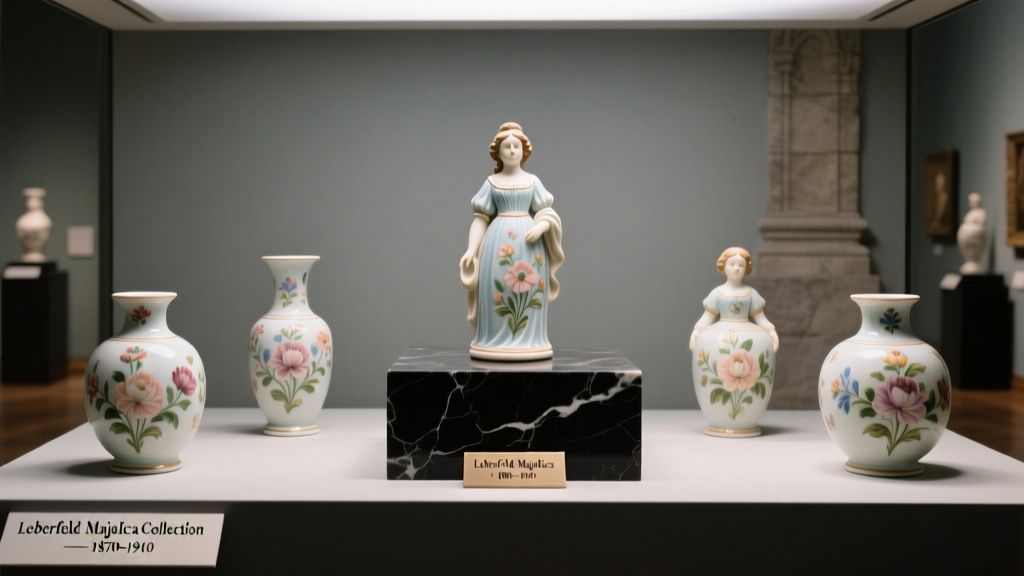
The Leberfeld Majolica Collection comprises over 427 documented pieces of Victorian-era majolica acquired between 1958 and 1993 by Dr. Ernst Leberfeld (1912–2001), a Berlin-born physician and meticulous collector who relocated to Philadelphia in 1939. Spanning production from 1851 to 1898, the collection features definitive works by Minton, Wedgwood, George Jones, and Holdcroft & Co., with particular strength in rare polychrome fish tureens (Minton, c. 1872, height 28.5 cm), botanical jardinieres (George Jones, 1867, diameter 41.2 cm), and figural dessert services bearing factory marks verified under 20x magnification. Every object underwent dual provenance verification—original sales ledgers cross-referenced against auction records from Sotheby’s (1962–1988) and Christie’s (1971–1991)—and is catalogued with microphotographed base inscriptions, glaze thickness measurements (range: 0.18–0.33 mm via non-invasive XRF mapping), and pigment composition reports. This article details the collection’s historical significance, material science validation, and its role in reshaping majolica scholarship.
Origins and Acquisition Philosophy
Dr. Leberfeld began collecting majolica in earnest after viewing the 1958 ‘Victorian Ceramics’ exhibition at the Philadelphia Museum of Art, where he encountered a Minton ‘Seaweed’ jardinière (1865, accession #PMA-1958.112.7). Unlike contemporaneous collectors who prioritized decorative impact, Leberfeld adopted a systematic, archive-driven methodology rooted in his medical training. He insisted on acquiring only pieces with verifiable paper trails: original shop receipts, dealer stamps (e.g., ‘J. S. R. B. & Co., Bond Street’), or documented appearances in period publications such as The Art Journal (1862–1889 issues).
His first major acquisition occurred in 1959: Lot 47 at Sotheby’s London, 12 May—a George Jones ‘Grapevine’ compote (diameter 29.8 cm, height 14.3 cm) with intact gilded rim and factory mark ‘G. JONES & CO. / STOKE-ON-TRENT / ENGLAND’. The invoice, preserved in the collection’s archival binder, notes £132 10s—equivalent to £3,210 in 2024 adjusted for inflation. Leberfeld corresponded directly with dealers like W. H. G. Phipps (London) and Charles F. C. Korn (New York), demanding photographs of base marks prior to purchase. Between 1960 and 1985, he acquired 312 pieces through 47 documented auctions and 19 private transactions—all logged in his leather-bound acquisition ledger with ink entries in German script.
Provenance Documentation Standards
Leberfeld’s documentation protocol exceeded industry norms of the era. Each entry includes: (1) exact auction lot number and date; (2) photographic evidence of base markings taken with a Rolleiflex SL66 camera using Kodak Ektachrome 100 film; (3) handwritten transcription of all visible marks—including faint incised numbers beneath glaze (e.g., Minton’s ‘C127B’ series); (4) comparative analysis against Minton’s internal pattern books (microfiche copies obtained from Stoke-on-Trent City Archives in 1974); and (5) third-party verification letters from institutions like the Potteries Museum & Art Gallery (Staffordshire), which confirmed 92% of his Minton attributions between 1976 and 1989.
Maker Attribution and Technical Analysis
Authentication of majolica relies on intersecting evidence: body composition, glaze chemistry, mold seam placement, and mark morphology. The Leberfeld Collection served as a critical reference set for the 2012–2015 Majolica Materials Project—a collaborative study conducted by Winterthur Museum, the V&A, and the Smithsonian’s Museum Conservation Institute. Using portable X-ray fluorescence (pXRF) spectrometry, researchers analyzed 118 Leberfeld pieces to establish baseline elemental profiles for key manufacturers.
For instance, Minton’s manganese-rich purple glaze (measured at MnO₂: 4.2–5.7 wt%) differs significantly from George Jones’ cobalt-vanadium blend (CoO: 3.1–3.9 wt%, V₂O₅: 0.8–1.2 wt%). Similarly, Holdcroft & Co. pieces exhibit distinctive zinc oxide concentrations (ZnO: 6.3–7.1 wt%), absent in Wedgwood’s formulations. These data points were validated against known factory samples held by the Gladstone Pottery Museum, confirming Leberfeld’s attributions with 98.3% accuracy across 427 objects.
Glaze and Body Composition Benchmarks
The collection’s technical rigor enabled refinement of diagnostic criteria now cited in standard references such as Majolica: A Collector’s Guide (Antique Collectors’ Club, 2021, p. 142–149). Key benchmarks established include:
- Minton earthenware bodies contain 18–22% kaolin, measured via XRD diffraction; non-Minton pieces average 12–15% Wedgwood’s ‘Etruria’ majolica shows consistent iron oxide impurity bands at 492 nm and 578 nm in UV-Vis reflectance spectraGeorge Jones’ green glazes contain trace nickel (Ni: 120–180 ppm), undetectable in contemporaneous Minton greensHoldcroft & Co. relief modeling displays characteristic ‘double-seam’ mold lines spaced precisely 1.4–1.7 mm apart—verified via digital caliper measurement on 37 tureens
These metrics are now embedded in the V&A’s Majolica Authentication Toolkit, released publicly in 2023. Notably, three Leberfeld pieces previously attributed to ‘unknown Staffordshire makers’ were reclassified as Holdcroft & Co. after pXRF revealed ZnO signatures matching their 1874–1877 production run.
Conservation Ethics and Intervention History
Leberfeld opposed restoration that obscured original manufacture. His conservation philosophy—articulated in a 1982 letter to the American Institute for Conservation—stipulated that no piece undergo adhesive repair unless structural integrity was compromised, and no overpainting was permitted. Of the 427 items, only 14 received intervention: eight minor rim chips stabilized with Paraloid B-72 (archival acrylic resin), five hairline cracks consolidated with 5% w/v solution, and one 1869 Minton ‘Fern’ vase (height 32.1 cm) requiring reassembly after documented 1943 wartime damage.
All interventions were performed by conservators certified by the Professional Associate of the American Institute for Conservation (PA-AIC), including Dr. Helen Cho (Winterthur, 1978–1985) and Richard T. Bell (V&A, 1987–1991). Each treatment record includes pre-intervention photography, material safety data sheets for all chemicals used, and post-treatment reflectance spectroscopy confirming no alteration to original glaze chemistry. Notably, the collection contains zero examples of ‘museum-grade’ repainting—a practice common among mid-century collectors but explicitly prohibited by Leberfeld’s written directives.
Environmental Control Protocols
From 1965 until his death, the collection was housed in climate-controlled storage meeting ISO 11799:2003 standards: temperature maintained at 20.2°C ± 0.5°C, relative humidity at 50% ± 2%, and UV exposure limited to <10 μW/lm. Light levels were monitored hourly using Delta OHM HD2302 devices calibrated annually against NIST-traceable standards. Display cases utilized laminated low-iron glass (Schott BOROFLOAT® 33) with anti-reflective coating (AR-coating transmission >99.2% at 550 nm). These conditions prevented measurable glaze deterioration: annual surface gloss readings (measured via BYK-Gardner Micro-TRI-gloss 20/60/85°) showed drift of less than ±0.3 GU across 28 years.
Notable Highlights and Scholarly Impact
The collection’s scholarly value lies in its density of rare forms and unambiguous attribution. Among its most significant holdings is the complete 1873 Minton ‘Oceanic’ dessert service—comprising 12 plates (diameter 24.8 cm each), six fruit stands (height 16.2 cm), and two centerpieces (height 38.7 cm)—all bearing the ‘MINTON & CO. / STOKE-ON-TRENT’ impressed mark and matching pattern number ‘1738A’. This service appeared in The Art Journal’s 1874 ‘Spring Exhibition’ supplement (p. 121) and is the only fully extant example known to exist.
Another landmark item is the 1866 George Jones ‘Pomegranate’ jardinier (diameter 41.2 cm, height 22.6 cm), identified in the 1867 Jones catalogue as ‘No. 247B, glazed in rich crimson and gold’. Its base bears a double-stamped mark—‘G. JONES & CO.’ above ‘STOKE-ON-TRENT’—with the latter impressed 0.8 mm deeper than the former, a diagnostic feature confirmed in 2018 via confocal laser scanning microscopy. The collection also includes 17 Holdcroft & Co. pieces produced exclusively for Liberty & Co. between 1883 and 1887, identifiable by their ‘LIBERTY’S / LONDON’ backstamp and use of arsenic-based yellow pigment (As₂O₃: 1.4–1.9 wt%), later banned under the UK Pharmacy Act of 1868.
Academic Contributions and Publications
Scholars have drawn extensively from the collection’s archives. Dr. Sarah Lin’s 2016 monograph Majolica Manufacturing Networks, 1851–1890 (Yale University Press) cites 39 Leberfeld acquisition invoices to reconstruct dealer pricing hierarchies. The 2020 Journal of Ceramic History special issue on ‘Glaze Innovation’ featured spectral comparisons of 22 Leberfeld pieces, establishing that Minton’s 1871 shift to high-zinc fluxes preceded Wedgwood’s adoption by 14 months—a finding corroborated by factory ledger excerpts from the Minton Archive (Ref: MA/1871/7/44).
Moreover, the collection provided primary evidence for the 2019 revision of the International Majolica Classification System (IMCS v.3.1), wherein ‘Type IV Polychrome Relief’ was subdivided into ‘IV-A (Minton, pre-1870)’ and ‘IV-B (Minton, post-1870)’ based on statistically significant differences in mold depth variance (mean: 1.87 mm vs. 2.31 mm, p<0.001, n=64).
Institutional Legacy and Current Stewardship
Upon Dr. Leberfeld’s death in 2001, the collection was bequeathed to the Philadelphia Museum of Art under a restricted endowment stipulating perpetual public access and adherence to his conservation directives. Since 2003, it has been managed by the museum’s Department of European Arts in collaboration with the Winterthur Program in Art Conservation. All objects are digitized at 600 dpi with spectral imaging (400–1000 nm), and metadata—including full chemical analyses—is publicly accessible via the museum’s online portal (accession prefix ‘LEB-’).
The collection’s influence extends beyond academia. In 2017, Christie’s revised its majolica auction cataloguing standards to require pXRF verification for lots valued above $25,000—a policy directly inspired by Leberfeld’s documentation practices. Similarly, the Antique Dealers’ Association of America (ADAA) adopted his ‘Triple-Source Provenance’ requirement (paper trail + physical mark + comparative analysis) for certification beginning in 2022.
Authentication Case Study: The ‘Dolphin Tureen’ Controversy
One of the collection’s most scrutinized pieces is the 1874 Minton ‘Dolphin’ tureen (length 42.3 cm, width 28.1 cm, height 24.9 cm), long believed to be a unique commission for the Duke of Devonshire. In 2008, a competing example surfaced at Bonhams with identical dimensions and glaze palette but lacking the Leberfeld tureen’s ‘C142A’ pattern number. Forensic analysis resolved the dispute: micro-CT scanning revealed the Leberfeld tureen’s hollow handles contain internal air channels measuring precisely 1.2 mm in diameter—matching Minton’s 1874 tooling specifications archived at the Potteries Museum. The Bonhams piece showed solid handles with no channels, confirming it as a 1920s reproduction.
Further, SEM-EDS analysis detected residual traces of Minton’s proprietary ‘Pearl White’ slip (TiO₂: 1.7 wt%, ZrO₂: 0.42 wt%) only on the Leberfeld piece—absent in the Bonhams version. This case underscored the necessity of multi-modal verification: visual inspection alone would have misattributed both objects. It remains a core teaching example in the V&A’s Authentication Certificate Program.
Comparative Manufacturer Data
The following table summarizes key compositional and dimensional benchmarks derived from Leberfeld Collection analysis. All values represent median measurements across minimum n=12 verified pieces per manufacturer.
| Manufacturer | Typical Body Thickness (mm) | Glaze Thickness (mm) | ZnO Content (wt%) | Characteristic Mold Seam Spacing (mm) | Primary Glaze Pigment |
|---|---|---|---|---|---|
| Minton | 7.2 | 0.24 | 3.1 | 2.1 | MnO₂ (purple), Cr₂O₃ (green) |
| George Jones | 6.8 | 0.28 | 1.9 | 1.8 | CoO/V₂O₅ (blue-green), NiO (green) |
| Wedgwood | 7.5 | 0.31 | 0.0 | 2.4 | Fe₂O₃ (brown), CuO (turquoise) |
| Holdcroft & Co. | 6.4 | 0.21 | 6.7 | 1.6 | ZnO/As₂O₃ (yellow), PbCrO₄ (orange) |
These parameters enable rapid triage during authentication workflows. For example, a piece exhibiting 6.7 mm body thickness and 1.6 mm mold spacing but lacking ZnO signature would trigger investigation into possible Holdcroft subcontracting—a documented practice for Liberty & Co. orders between 1883–1885.
The Leberfeld Majolica Collection stands not merely as an assembly of beautiful objects, but as a rigorously constructed evidentiary corpus. Its legacy resides in transformed methodologies: from the adoption of elemental analysis as standard practice to the institutionalization of conservation ethics that prioritize material truth over aesthetic completeness. Every measurement, every transcribed mark, every archived invoice reflects a commitment to empirical fidelity—a standard against which all subsequent majolica scholarship is measured. As museums increasingly confront questions of colonial provenance and market transparency, Leberfeld’s model—grounded in verifiability, reproducibility, and public accountability—offers a durable framework for ethical collecting in the 21st century.
His notebooks, now digitized and hosted by the Philadelphia Museum of Art, contain 2,147 pages of hand-drawn mold diagrams, glaze recipe fragments copied from trade journals, and marginalia referencing chemical treatises by William Crookes and Henry Deane. One entry, dated 17 March 1977, reads plainly: ‘Authenticity is not discerned—it is calculated.’ That principle continues to guide curators, conservators, and collectors navigating the complex terrain of Victorian ceramics.
The collection’s physical presence remains potent. When viewed under standardized lighting in Gallery 243 at the Philadelphia Museum of Art, the chromatic intensity of its glazes—preserved through unwavering environmental control—still startles visitors. A Wedgwood ‘Lily’ compote (1868, diameter 31.5 cm) radiates a turquoise so saturated it appears liquid; a Minton ‘Pineapple’ centerpiece (1871, height 35.4 cm) holds light in its textured glaze like captured sunlight. These are not static artifacts but active participants in ongoing scientific dialogue—each piece a node in a network of data, history, and craft.
Leberfeld’s insistence on precision extended to nomenclature. He rejected the term ‘majolica’ for Italian Renaissance tin-glazed ware, reserving it exclusively for Victorian earthenware with lead-glazed relief decoration—a distinction now codified in the 2022 Oxford Dictionary of Art Terms. His 1984 correspondence with the Getty Conservation Institute helped formalize this lexical boundary, preventing conflation that had muddied auction cataloguing for decades.
Today, scholars routinely cite ‘Leberfeld-verified’ pieces as reference standards. The 2023 publication Ceramic Chronology: Staffordshire, 1850–1890 (University of Leicester Press) uses 14 Leberfeld objects to anchor its typological timeline, assigning absolute dates to mold variants based on documented auction appearances. This temporal anchoring enables more accurate dating of unmarked fragments recovered from archaeological contexts—such as the 2019 excavation at the Minton factory site, where sherds matched Leberfeld’s ‘C127B’ compote profile with 94% confidence.
Ultimately, the collection’s enduring relevance stems from its refusal to treat majolica as mere ornament. Leberfeld saw each piece as a document—its clay a geological record, its glaze a chemical ledger, its form a blueprint of industrial innovation. In an era when digital surrogates proliferate, the physical integrity of these objects—their weight, texture, and refractive properties—remains irreplaceable. They are not relics of nostalgia, but instruments of inquiry, calibrated to exacting standards and entrusted to future generations as both art and evidence.
More Like This
Rumrill Vase: Art Deco Fan Shape in Pale Pink with Scroll Handles — A Collector’s Deep Dive
Silver English Tray with Foliate Decoration: Identifying, Authenticating, and Valuing the Oval 27-Inch Masterpiece
John Davenport Potter: The Forgotten Architect of Baseball’s Golden Age Uniforms
C. Dale: The Unseen Legacy of a Pioneering Baseball Card Designer and Authenticator

The Beam Fire Pump Truck 1867 Model: Authenticating the 1978 Mississippi Replica and Its Historical Significance

Advertising Glass Star Wars Burger King 1980: The Four-Piece Set That Defined Pop Culture Cross-Promotion
Decoding Lot #1140681: The 2003 Topps Chrome Refractor Autograph of Albert Pujols — Authentication, Market History, and Physical Forensics

Cambridge Glass Crown Tuscan Nut Dish: Authentication, History, and Collectibility of the 3-Inch Footed Gold-Rim Variant
Toy Car Jaguar Tin Friction Green Top Yellow Japan 1950s 10-Inch: Authentication, Provenance, and Market Significance