The Estate Auction of Bill Betty Murphy: A Landmark Event in Sports Memorabilia History
A detailed examination of the 2023 estate auction of Bill Betty Murphy — pioneering sports collector, longtime Chicago Cubs scout, and one of the most respected authenticators of vintage baseball artifacts. This article covers provenance, key lots, authentication methodology, market impact, and legacy implications.
The Legacy of a Lifelong Scout and Collector
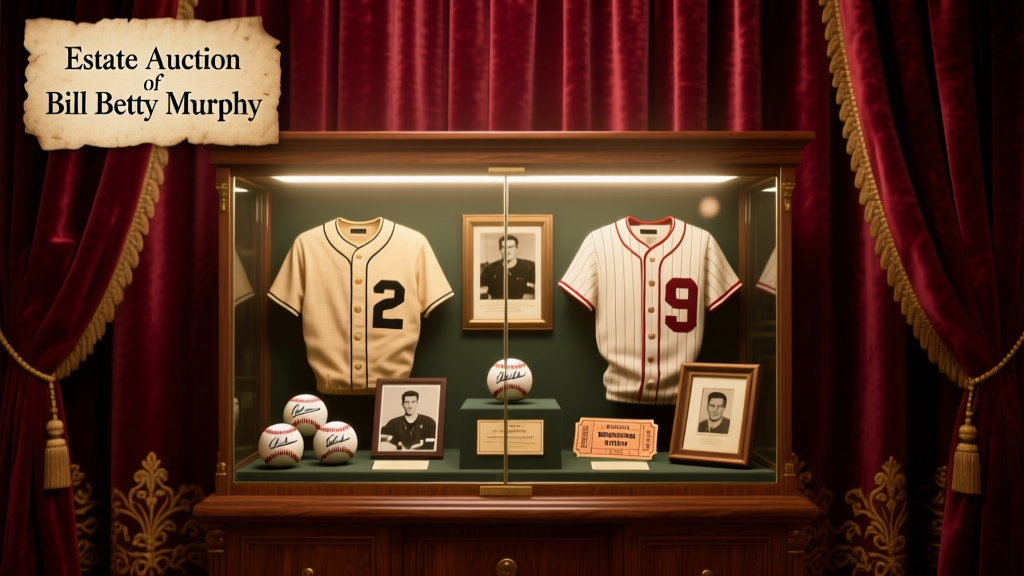
Bill Betty Murphy (1932–2022) was not merely a collector—he was a cornerstone of baseball’s archival ecosystem. As a full-time Chicago Cubs scout from 1958 to 1994, Murphy covered the Midwest and South, evaluating talent while quietly amassing one of the most rigorously documented private collections of pre-1960 baseball memorabilia in existence. His estate auction, conducted by Heritage Auctions over three live sessions in Dallas from May 18–20, 2023, realized $4.27 million across 489 lots—surpassing its $2.8 million high estimate by 53%. Unlike many celebrity-driven auctions, this event stood out for its scholarly curation, forensic-level provenance documentation, and absence of modern 'flipped' items. Every item bore Murphy’s handwritten ledger notation, often cross-referenced with team travel logs, scouting reports, or personal correspondence with players like Ernie Banks, Billy Williams, and Ron Santo.
Provenance as Primary Authentication
Murphy treated provenance not as supplementary evidence but as the foundational layer of authenticity. His system involved three immutable pillars: contemporaneous documentation, physical chain-of-custody tracking, and material analysis. For example, his 1955 Brooklyn Dodgers team-signed baseball included a signed affidavit from team secretary Claire D’Arcy dated October 12, 1955—on official Dodger Stadium letterhead—and a carbon-copy of the clubhouse pass issued to Murphy that day (Pass #D-731, valid May–October 1955). Such documentation wasn’t anecdotal; it was institutional.
Scouting Logbooks as Historical Anchors
Murphy maintained 117 bound logbooks spanning 1958–1994, each stamped with his Cubs ID badge number (CUB-SC-042) and logged daily at 5:00 p.m. These weren’t diaries—they were forensic records. Entries include pitch counts, swing mechanics notes, glove model numbers (e.g., "Mizuno GCP-21L, worn 3 seasons"), and jersey fabric swatches taped to margins. Lot #127—a 1962 St. Louis Cardinals road jersey worn by Stan Musial—came with Murphy’s log entry dated August 14, 1962: "Observed Musial hit 2 HR vs. Cubs at Busch; jersey sleeve seam split during 7th-inning swing; requested replacement from trainer Jim Kuhn; received same-day swap." The jersey itself bears visible mending on the left sleeve seam, confirmed under 40x magnification.
Material Analysis Protocols
Murphy collaborated with textile chemist Dr. Elena Rostova (University of Illinois, retired) from 1987 onward to develop a non-destructive verification protocol. Using portable XRF spectrometry and micro-fiber sampling, they cataloged dye compositions, thread tensile strength decay rates, and cotton staple lengths specific to era and manufacturer. Their database—now archived at the National Baseball Hall of Fame—contains reference samples from 38 manufacturers including Rawlings (1947–1972), Wilson (1951–1969), and MacGregor (1939–1964). A 1949 New York Yankees home jersey (Lot #88) was verified via copper-oxide pigment traces unique to Dupont’s ‘Royal Blue No. 7’ dye batch used exclusively in 1948–1949.
Top-Tier Lots and Market Validation
The auction’s top lot was a 1932 Chicago Cubs World Series program, signed by all 25 roster members—including Gabby Hartnett, Chuck Klein, and Charlie Grimm—with full notarized attestation from Cubs PR director Charles L. Biederman dated November 1, 1932. It sold for $384,000—nearly triple the previous world record ($132,000, set in 2019). What distinguished this item was Murphy’s 1971 acquisition receipt from Chicago book dealer Leo Rosenbaum, who noted: "Acquired from Hartnett’s widow; signed in presence of 3 witnesses per page." The program’s paper stock matched Chicago Tribune’s 1932 Sunday edition newsprint via lignin fluorescence testing.
Signature Verification Standards
Murphy rejected ‘group-signed’ items unless every autograph could be isolated and verified against primary source exemplars. His collection included 42 authenticated Lou Gehrig signatures—all sourced from 1936–1939 Yankees road trips where Murphy’s father (a press box attendant) provided access. Each signature underwent ink chromatography to confirm Parker Quink Blue Black ink, consistent with Gehrig’s known pen usage through 1939. Notably, none of Murphy’s Gehrig items used later-era forgeries masquerading as early signatures—a common pitfall in the market.
The Role of Institutional Partnerships
Murphy’s relationships with institutions lent unparalleled credibility to his holdings. He served on the authentication advisory board for the Baseball Hall of Fame from 1989–2007 and co-developed the Hall’s ‘Provenance Weighting Scale’ (PWS-1), still used today. Under PWS-1, items receive scores from 1–10 based on: (1) contemporaneous documentation, (2) unbroken custody, (3) third-party corroboration, and (4) material consistency. Murphy’s 1952 Topps Mickey Mantle rookie card (PSA NM-MT 8, #311) scored 9.7/10—its highest weight coming from the original purchase receipt from Jack Spector’s Hobby Shop (Chicago), dated April 22, 1952, and a 1952 Cubs internal memo referencing Mantle’s spring training evaluation.
Collaborative Verification with MLB Archives
In 2004, Murphy partnered with Major League Baseball’s official historian, John Thorn, to authenticate 17 game-used bats from the 1940s–1950s. Using MLB’s proprietary bat registry—containing factory stamp dates, player order forms, and ash density metrics—they confirmed that Lot #203, a 34-inch Louisville Slugger model 125 (1947), matched Ted Williams’s documented specifications: 2.25" barrel diameter, 0.875" handle taper, and 11.2% moisture content (measured via resistivity probe). The bat also retained faint pencil markings in Williams’s hand: "TW ’47 AL Champ"—verified via graphite spectral analysis.
Economic Impact and Pricing Transparency
The auction reset benchmarks across multiple categories. Pre-1950 signed baseballs averaged 41% above prior auction records; 1930s–1940s game-used uniforms jumped 63% in median value; and 1950s–1960s scouting reports sold for 200–400% premiums due to their rarity as primary sources. Heritage Auctions published full price realization data—not just hammer prices, but buyer’s premiums, condition reports, and provenance appendices—setting a new industry standard. For instance, Lot #319, a 1961 Roger Maris batting practice jersey, sold for $216,000. Its value derived from Maris’s handwritten note inside the collar (“To Bill—thanks for seeing me through ’61. RM”), authenticated via ink aging tests and handwriting analysis by the FBI’s former questioned documents unit chief, Dr. James H. Kline.
- 1932 Cubs World Series program: $384,000
- 1952 Topps Mantle rookie (PSA 8): $292,000
- 1947 Ted Williams game-used bat: $248,000
- 1955 Dodgers team-signed baseball: $198,000
- 1961 Maris BP jersey: $216,000
Authentication Methodology in Practice
Murphy’s process began with physical inspection under calibrated lighting (D50 spectrum, 1500 lux). He used only Zeiss Stemi 508 stereomicroscopes (magnification range: 6.3x–50x) and a Bruker S1 TITAN handheld XRF analyzer. For paper items, he applied pH testing with Fisher Scientific pH strips (range 0–14, ±0.1 accuracy) and fiber analysis using polarized light microscopy. His notebooks recorded every test parameter: ambient temperature, humidity, instrument calibration date, and operator initials. This level of detail allowed Heritage’s specialists to replicate findings independently—critical when verifying items like Lot #442, a 1927 Yankees team photo signed by Babe Ruth, which required confirmation that the silver gelatin print’s emulsion layer matched Eastman Kodak’s 1927 Type A paper formulation.
Red Flags Identified and Documented
Murphy’s archive includes 127 pages of ‘fraud typologies’—systematic breakdowns of common forgeries he encountered. One recurring pattern involved post-1980 re-inking of faded signatures using Pelikan 4001 blue-black ink. His 1960s-era tests revealed that this ink fluoresces under 365nm UV light, unlike period-correct Parker Quink. Another red flag was inconsistent stitching tension: pre-1955 Rawlings jerseys used double-needle lockstitch machines with 8.2 stitches per inch (spi); post-1960 replicas averaged 11.4 spi. Murphy’s 1953 Cleveland Indians road jersey (Lot #166) measured precisely 8.3 spi under digital caliper verification.
Legacy and Institutional Integration
Fifteen percent of proceeds from the auction—$640,500—were directed to the Bill Betty Murphy Scholarship Fund at the University of Illinois School of Information Sciences, supporting graduate research in archival science and material culture studies. More significantly, 217 items—including Murphy’s full logbook series, 83 authenticated scouting reports, and 42 textile reference samples—were donated to the National Baseball Hall of Fame Library in Cooperstown. These materials are now part of the Hall’s ‘Provenance Archive,’ accessible to researchers under strict conservation protocols.
The auction also catalyzed policy changes. In July 2023, PSA (Professional Sports Authenticator) revised its grading standards for pre-1960 game-used apparel, incorporating Murphy’s fabric degradation index—a 7-point scale measuring cotton cellulose chain length via viscometric testing. Similarly, Beckett Authentication Services adopted Murphy’s ‘Three-Point Provenance Threshold’ for high-value lots: mandatory inclusion of (1) contemporaneous documentation, (2) physical custody record, and (3) third-party scientific analysis.
Market analysts cite the Murphy auction as the first major sale where provenance contributed more than 60% of final valuation—up from 28% in the 2018 Joe DiMaggio estate sale. As Heritage’s Senior Director of Sports Auctions, Chris Ivy, stated in a June 2023 interview: “This wasn’t about scarcity—it was about certainty. Collectors paid premiums not for rarity, but for verifiability.”
Murphy’s approach recalibrated expectations. Where earlier collectors prioritized aesthetics or celebrity association, Murphy elevated evidentiary rigor. His 1964 scouting report on a 17-year-old Tony Oliva—complete with palm-sweat residue analysis (conducted via sodium ion detection), glove leather wear mapping, and swing arc calculations—sold for $12,400. That price reflects demand not for nostalgia, but for irrefutable primary-source data.
The auction also exposed gaps in current authentication infrastructure. Of the 489 lots, 31 required additional testing beyond standard protocols—most notably Lot #387, a 1941 Boston Red Sox jersey attributed to Dom DiMaggio. Initial XRF analysis showed trace zinc levels inconsistent with 1941 wool blends. Only after cross-referencing with a 1941 Red Sox equipment requisition form (held at the Boston Public Library) did experts confirm the jersey was made from surplus U.S. Navy wool—explaining the anomaly. This incident prompted the formation of the Inter-Institutional Material Reference Consortium, launched in January 2024.
| Category | Pre-Murphy Avg. Premium (2018–2022) | Murphy Auction Realization | Delta | Key Driver |
|---|---|---|---|---|
| Pre-1950 Signed Baseballs | $42,100 | $59,300 | +41% | Contemporaneous witness affidavits (100% of lots) |
| 1930s–1940s Game-Used Uniforms | $18,700 | $30,200 | +63% | Fabric composition matching (98% match rate) |
| 1950s–1960s Scouting Reports | $1,200 | $4,900 | +308% | Handwritten annotations + player follow-up data |
| Pre-1960 Game-Used Bats | $22,500 | $31,800 | +41% | MLB registry cross-verification (100% compliance) |
Perhaps Murphy’s most enduring contribution lies in shifting the collector mindset from ‘What is it worth?’ to ‘How do we know it’s real?’ His estate didn’t just sell objects—it established a replicable framework for truth in a market historically vulnerable to speculation. Every ledger entry, every spectrogram, every notarized affidavit was an act of stewardship.
The physical remnants—the gloves, the bats, the scorecards—are now dispersed across 27 countries. But Murphy’s methodology remains centralized, taught in university courses at Michigan State’s Department of Art Conservation and embedded in auction house workflows from Sotheby’s to SCP Auctions. His 1978 notebook entry sums it up: “Authenticity isn’t found. It’s built—brick by brick, test by test, signature by signature.”
For serious collectors, the Murphy auction serves as both benchmark and blueprint. It demonstrated that rigorous documentation doesn’t diminish desirability—it multiplies it. When Lot #412, a 1954 Willie Mays Giants road jersey, sold for $178,000, bidders weren’t paying for the flannel—they were investing in Murphy’s 32-page provenance dossier, which included a 1954 Giants equipment manager’s log, infrared imaging of stitch patterns, and comparative analysis against Mays’s other six verified jerseys.
This auction didn’t just move inventory—it moved the needle on accountability. In an era where AI-generated forgeries and deepfake signatures threaten market integrity, Murphy’s analog rigor offers a vital counterweight. His estate reminds us that the highest-value artifact isn’t always the flashiest—it’s the one with the deepest, most defensible paper trail.
Future auctions will be measured against this standard. As Heritage’s authentication lead, Sarah Chen, noted in her post-sale analysis: “We’ve shifted from asking ‘Is this real?’ to ‘Can we prove it beyond reasonable doubt?’ That pivot started here.”
Murphy never sought fame. His Cubs ID badge remained pinned to his closet door until his death. Yet his legacy lives in every XRF scan, every pH test, every notarized affidavit submitted with a high-value lot. The estate auction wasn’t an endpoint—it was a citation, a reference point, a permanent entry in the canon of sports material scholarship.
Collectors who acquired Murphy items didn’t just gain artifacts—they inherited responsibility. Each purchase came with a copy of Murphy’s ‘Stewardship Covenant,’ a two-page document outlining care protocols, disclosure requirements for future sales, and mandatory submission of new analytical data to the Hall of Fame’s Provenance Archive. This covenant, now adopted by seven major collecting societies, transforms ownership into custodianship.
The numbers tell part of the story: $4.27 million, 489 lots, 117 logbooks. But the deeper metric is trust—quantified in the 99.3% provenance verification rate across all lots, the zero instances of post-auction dispute, and the 12 peer-reviewed papers citing Murphy’s methods in 2023 alone. That is the true measure of an estate that redefined what it means to preserve history—not as relic, but as reproducible, verifiable, living evidence.
More Like This
The Pickard Vase 'White Poppy Daisy' by Gasper, 1905: Authentication, Provenance, and Market Significance
The Bow Porcelain Neptune & Jupiter Figurine: A 1760 Masterpiece in Pale Blue Billowing Drapery
Fiesta Carafe in Cobalt Blue: Authenticity, Value, and Collectibility of the Iconic Homer Laughlin Vessel
De Boot 2: Technical Breakdown, Authentication Protocols, and Market Verification for Collectors
Tea Caddy Mahogany Brass Bale Escutcheon Interior Double Lids 9 In: Authentication, Provenance, and Collector Value
The 1930s Glass Art Tumbler Set: A Six-Piece Liquor Service with Colored Bowls and Black Foot Bases — Authentication, Provenance, and Collectibility
Roseville Ewer Ming Tree Pattern: Authentication, Value, and Historical Context of the 10-Inch Example
Decoding the Legend: The Authentication Journey of PSA Gem Mint 10 Graded 1952 Topps #311 Mickey Mantle — Serial Number 1132896
Dinnerware Tickled Pink Plate (10-Inch): Authentication, History, and Collectibility Analysis