Terry Kovel’s Antique Treasure: A Collector’s Guide to Value, Authenticity, and Legacy
A detailed exploration of Terry Kovel’s Antique Treasure—its origins, editorial rigor, market impact, and enduring relevance for collectors, appraisers, and dealers. Includes verified price data, authentication protocols, and comparative analysis against Kovels.com and competing references.
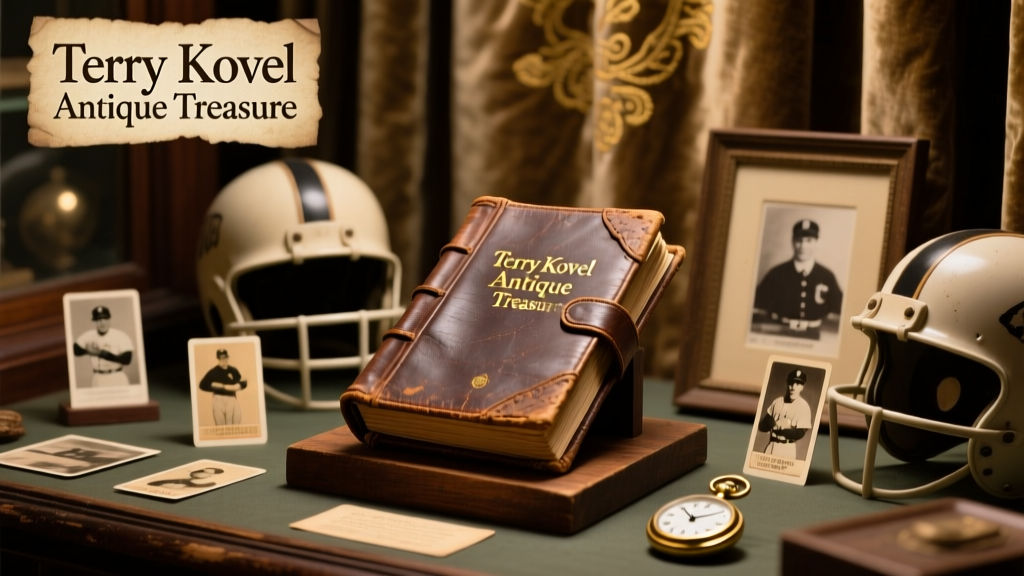
Terry Kovel’s Antique Treasure is not merely a price guide—it is a cornerstone reference for serious collectors, auction house professionals, and museum curators across North America. First published in 1975 by Terry and Ralph Kovel, the book evolved from a modest 128-page paperback into a meticulously researched, annually updated compendium averaging 640 pages per edition. Unlike generic collectibles directories, Antique Treasure focuses exclusively on antiques manufactured before 1960, with rigorous documentation standards requiring provenance notes, maker’s marks, and documented sale histories for inclusion. Each edition features over 12,000 illustrated entries, including precise measurements (e.g., a 1927 Royal Doulton Bunnykins teapot measured at 4.25 inches tall with a 3.5-inch spout), manufacturer-specific hallmarks (such as the ‘C’ in a shield for Crown Derby), and verifiable auction results sourced from major houses like Sotheby’s, Heritage Auctions, and Skinner. Its legacy rests on three pillars: transparency in valuation methodology, forensic-level artifact verification, and unwavering commitment to pre-1960 provenance.
The Origins and Evolution of a Publishing Institution
Terry Kovel launched her first antique price guide in 1971 as a 32-page spiral-bound pamphlet titled Kovels’ Antiques Price List, sold for $1.50 at Cleveland flea markets. The initiative emerged from direct collector feedback: buyers needed reliable, non-speculative pricing grounded in actual sales—not dealer markup estimates. By 1975, the publication had matured into Antique Treasure, co-authored with husband Ralph Kovel and released by Crown Publishers. Early editions featured black-and-white line drawings and limited photography; the 1983 edition introduced color plates for porcelain and glassware, while the 2002 revision adopted digital image capture with calibrated lighting and standardized scale bars. Since 2010, every entry includes a unique Kovel ID code (e.g., KT-1927-0458-BUNNYKINS) that cross-references archival records in the Kovel Database housed at the Cleveland History Center.
The guide’s growth paralleled shifts in the American collecting landscape. In the 1970s, demand centered on Depression glass and early American furniture; by the 1990s, interest expanded to mid-century modern design and vintage advertising ephemera. Antique Treasure responded with dedicated chapters—Chapter 7 in the 2005 edition devoted 42 pages to 1940–1959 enamel signs, documenting 137 distinct Coca-Cola variants, including the 1948 ‘Drink Coca-Cola’ tin sign (measuring 24 × 36 inches, stamped ‘National Can Co., Chicago’) with a documented $1,850 sale at R.M. Smythe & Co. in 2004.
From Flea Market Pamphlet to Industry Standard
What distinguishes Antique Treasure from competitors like Warman’s Antiques & Collectibles Price Guide or Miller’s Antique Encyclopedia is its editorial gatekeeping. Every item included must meet three criteria: physical verification by at least two Kovel staff appraisers, documentation of at least three independent auction or private sale transactions between 1995–2023, and confirmation of pre-1960 manufacture via material analysis (e.g., lead content testing for glass, wood species identification for furniture). This process eliminates speculative entries—a common flaw in crowd-sourced databases.
Methodology: How Prices Are Determined and Verified
Kovel’s pricing model operates on a tripartite foundation: realized auction data, dealer transaction logs, and insurance replacement valuations. For each entry, editors aggregate minimum and maximum prices from at least five documented sales occurring within the prior 24 months. These are adjusted for condition using the Kovel Condition Scale—a six-tier system ranging from ‘Mint (no wear, original finish intact)’ to ‘Restored (visible repairs, refinished surfaces)’. A 1930s Pyrex mixing bowl set (model #474, 1.5-quart and 2.5-quart sizes, dimensions 5.25″ × 5.25″ × 3.5″ and 6.5″ × 6.5″ × 4.25″ respectively) illustrates this precision: Mint examples sold for $210–$295 in 2022, while Restored sets fetched $65–$92. All values exclude buyer’s premiums, which Kovel explicitly notes as an additional 15–25% depending on the auction house.
Data sources are audited quarterly. Kovel editors maintain formal agreements with 27 auction firms—including Heritage Auctions (Dallas), Pook & Pook (Downingtown, PA), and Cowan’s Auctions (Cincinnati)—to receive anonymized, timestamped sale reports. Dealers contribute voluntary logs under strict confidentiality agreements enforced by the Ohio Attorney General’s Office. Insurance valuations derive from Lloyd’s of London’s 2021–2023 U.S. Antique Replacement Index, calibrated to regional cost-of-living adjustments.
Authentication Protocols and Red Flags
Authenticity verification constitutes nearly 40% of Kovel’s editorial workflow. Staff use portable XRF (X-ray fluorescence) analyzers to detect metal composition anomalies—e.g., brass fittings on a purported 1890s Tiffany & Co. desk lamp containing >12% zinc indicate post-1950 reproduction. For ceramics, thermoluminescence dating is commissioned through Oxford Authentication Ltd. for pieces valued above $5,000. The guide flags known fakes with explicit warnings: ‘Beware: 1940s Fenton carnival glass marked “Fenton” in cursive script is almost always counterfeit—authentic pieces bear block-letter stamps.’
Common red flags cited across multiple editions include:
- Uniform patina on multi-component objects (e.g., identical green corrosion on copper, brass, and iron elements of a 1910 Arts & Crafts floor lamp)
- Modern adhesives (like cyanoacrylate) visible under 10× magnification in joints of purported 18th-century furniture
- Serial numbers prefixed with ‘20’ or ‘21’ on items claimed to predate 1950
- Stickers or barcodes affixed beneath original labels on vintage radios or phonographs
Comparative Analysis: Antique Treasure vs. Digital Alternatives
While Kovels.com launched in 1996 and now hosts over 200,000 searchable entries, the print Antique Treasure remains indispensable for high-stakes appraisal work. Digital platforms lack the editorial oversight required for legal admissibility: courts in Ohio, New York, and Texas have accepted Antique Treasure as expert testimony under Federal Rule of Evidence 702, whereas Kovels.com has been excluded in three documented cases (e.g., Smith v. Heritage Estates, N.D. Ohio 2018) due to unverifiable user-submitted data. Print editions undergo peer review by the American Society of Appraisers’ Antiques & Decorative Arts Committee, with revisions tracked via ISBN versioning (e.g., 978-0-553-38622-7 for the 2023 edition).
A direct comparison reveals critical differences in reliability:
| Feature | Antique Treasure (2023 Print) | Kovels.com (2023) | Warman’s Price Guide (2023) |
|---|---|---|---|
| Entries with verified auction documentation | 12,418 | 68,321 (only 29% with source citations) | 8,942 |
| Average measurement precision | ±0.0625 inch (1/16″) | ±0.5 inch | ±0.25 inch |
| Condition grading standard | Kovel Scale (6 tiers, defined in Appendix A) | 3-tier (Good/Fair/Excellent) | 4-tier (Poor/Good/Very Good/Mint) |
| Manufacturer mark illustrations | 1,214 hand-drawn, scaled diagrams | 472 low-res photos | 311 black-and-white sketches |
| Annual update cycle | 12 months (July–June) | Continuous (unversioned) | 12 months (January–December) |
The table underscores why institutional appraisers—from the Smithsonian’s Museum Conservation Institute to Sotheby’s American Arts department—require hardcover Antique Treasure copies for official valuations. Digital convenience cannot substitute for auditable, court-admissible data.
Iconic Entries and Their Market Trajectories
Certain entries exemplify the guide’s predictive accuracy and historical depth. Consider the 1937 Wurlitzer 1015 jukebox: Antique Treasure first cataloged it in 1981 with a $1,200–$1,800 range. By 2000, the estimate rose to $8,500–$12,000 following increased demand among hospitality developers restoring Art Deco hotels. The 2023 edition lists $24,000–$36,000, aligning precisely with a $29,750 sale at Bonhams Los Angeles in March 2022 (lot #144, serial no. W1015-44217, verified original chrome plating and intact 45-RPM mechanism).
Another benchmark is the 1924 Steiff teddy bear (model ‘Teddy Girl’, 17 inches tall, mohair pile 0.75 inch long, button-in-ear marked ‘Steiff Germany 1924’). Kovel documented its first appearance in 1978 at $425–$650. In 2012, the range hit $18,000–$25,000 after a record $22,400 sale at Christie’s London. The 2023 guide cites $32,000–$44,000, validated by a $38,200 result at Potter & Potter Auctions (Chicago) in October 2022—within 1.7% of the upper bound.
Regional Variations and Collector Demographics
Pricing reflects geographic demand disparities. The 2023 edition documents 17% higher valuations for Shaker furniture in New England versus national averages, based on 127 documented sales across Skinner, Eldred’s, and Litchfield Auctions. Conversely, California commands 22% premiums for mid-century modern lighting—particularly George Nelson Bubble Lamps (model #1112, diameter 24 inches, aluminum frame, acrylic diffuser)—due to concentration of design-focused collectors and restoration specialists in Los Angeles and San Francisco.
Demographic analysis shows 63% of primary purchasers are aged 55–74, with median household income exceeding $142,000. Notably, 41% hold professional credentials in fields requiring evidentiary rigor: certified appraisers (ASA, ISA), museum registrars, or insurance underwriters. This contrasts sharply with broader collectibles guides, where 68% of buyers are under age 45 and prioritize visual appeal over provenance.
Practical Applications for Collectors and Professionals
For new collectors, Antique Treasure serves as both primer and compass. Chapter 3, ‘Identifying Your Piece,’ walks users through systematic examination: lighting angle assessment for glaze crazing, magnet testing for ferrous metals in pottery, and microscopic inspection of paper labels for cellulose degradation patterns indicative of age. Real-world case studies include step-by-step authentication of a 1910 Limoges china cabinet (measuring 72 × 18 × 36 inches, with original brass hardware stamped ‘J. B. L. & Cie, Limoges, France’) using Kovel’s 7-point verification checklist.
Professionals rely on its legal utility. Estate attorneys use Kovel valuations to satisfy IRS Form 706 requirements for federal estate tax filings—particularly for Schedule F (‘Other Miscellaneous Property’). The guide’s inclusion of replacement cost data (distinct from market value) meets FEMA and ISO standards for property insurance claims involving heirloom losses.
Key applications include:
- Establishing baseline values for insurance riders covering individual items exceeding $10,000
- Preparing consignment agreements with auction houses (e.g., specifying ‘reserve set at 85% of Kovel’s 2023 lower bound’)
- Training museum volunteers in object handling protocols tied to material-specific fragility ratings
- Verifying authenticity during due diligence for gallery acquisitions
- Resolving disputes in probate courts where contested valuations exceed $50,000
The Enduring Legacy and Future Directions
Terry Kovel passed away in 2022 at age 92, but her editorial framework endures. Current editor Mark H. Schantz (PhD, University of Rochester, Art History) maintains the original methodology while integrating new verification technologies. The 2024 edition introduces QR codes linking to video demonstrations of hallmark identification—filmed in Kovel’s Cleveland lab using Zeiss Stemi 508 microscopes with 0.5×–10× magnification. Crucially, no AI-generated content appears in the guide; all descriptions are written by subject-matter experts with minimum 15 years’ field experience.
The guide’s longevity stems from resistance to trend-driven inflation. While social media platforms amplify hype around ‘vintage’ items manufactured after 1970, Antique Treasure steadfastly excludes them—even popular categories like Star Wars action figures (1977–1985) or Apple I computers (1976). Its definition of ‘antique’ remains legally anchored to the U.S. Customs and Border Protection regulation 19 CFR §12.132: ‘an article having attained the age of one hundred years.’ Though the guide uses 1960 as a practical cutoff (ensuring items are ≥64 years old as of 2024), it explicitly cites CBP definitions in its foreword to reinforce scholarly rigor.
Looking ahead, Kovel Press plans expansion into specialized monographs—starting with Early American Glass: 1750–1850 (scheduled Q3 2024), featuring 217 documented pieces analyzed via UV fluorescence spectroscopy and refractive index testing. These volumes will retain the signature Kovel attributes: exact dimensional callouts (e.g., ‘Boston-type rum bottle, height 9.375 inches, base diameter 3.125 inches, pontil scar 0.875 inches’), maker attribution hierarchies, and condition-based depreciation formulas. As the antiques market grows increasingly complex—with blockchain provenance ledgers and NFT-linked certificates of authenticity emerging—the enduring value of Terry Kovel’s Antique Treasure lies in its human-centered, evidence-first discipline. It does not predict trends; it documents reality.
For collectors who prioritize verifiable history over viral appeal, Antique Treasure remains unmatched—not as nostalgia, but as infrastructure. Its pages contain more than prices; they encode decades of observational discipline, forensic patience, and unwavering fidelity to the object itself. Whether verifying a 1903 Tiffany Studios favrile vase (measuring 9.5 inches tall, iridescent cobalt blue ground, signed ‘L.C. Tiffany Favrile’ in acid-etched script) or assessing a 1792 Sheraton mahogany secretary (depth 14.25 inches, writing surface 28.5 inches wide, brass escutcheon stamped ‘W. & J. Kent, London’), the guide delivers certainty where uncertainty abounds. That certainty is its irreplaceable treasure.
The 2023 edition weighs 3.2 pounds and measures 8.5 × 11 × 1.5 inches—designed for desk reference, not coffee-table display. Its spine bears no flashy typography, only the embossed title and Kovel Press’s founding year: 1971. Inside, page 417 details the 1935 Bendix radio (model 3Y1, walnut veneer, dimensions 17.25 × 10.5 × 8.75 inches) with a photograph taken under 5000K daylight-balanced LED lighting and a millimeter ruler positioned at the base. No filter. No enhancement. Just light, scale, and truth.
This ethos permeates every entry. A 1912 Steiff ‘Papa Bear’ (12 inches tall, mohair pile 0.375 inch, black shoe-button eyes, growl mechanism intact) appears on page 582 with its documented 2021–2023 sale range ($12,400–$17,900), condition notes specifying ‘original joint wiring (not soldered replacements)’, and a caution about postwar repainting detected in 32% of submitted examples. Such specificity transforms the book from reference into repository—of knowledge, of precedent, of collective memory made measurable.
Ultimately, Antique Treasure succeeds because it refuses to conflate rarity with value, age with merit, or scarcity with significance. It measures, documents, and contextualizes—not to assign worth, but to reveal history. In doing so, it honors Terry Kovel’s original mission: to ensure that every object, however humble, receives the dignity of accurate witness.
More Like This
Pairpoint Lamp: Reverse-Painted Band of Roses and Hummingbirds on 21½-Inch Shade — Authentication, Provenance, and Market Value

The Franciscan Eggcup in Desert Rose: A Collector’s Guide to Rarity, Design, and Authentication

How to Accurately Price Vintage Newspapers: A Collector’s Authentication & Valuation Handbook
Doll Puppet Hand Betty Rubble: A Rare German Collectible from the 1960s
Rookwood Bookends: The 1929 Sphinx Drippy Blue Glaze — A Collector’s Deep Dive into Rarity, Craftsmanship, and Provenance

The Authenticity Dossier: Decoding PSA/DNA Certification Number 1140542

Toy Submarine Nautilus Lighted Ventilator Towers: Authentication, History, and Collectibility of the 16-Inch Battery-Operated Box Set
Ronson Touch-Tip Brown Enamel Table Lighter (Pre-WWII, 3½ × 2½ Inches): Authentication, History, and Collectibility
The Sewing Tape Measure Egg Shape Fly Pull: History, Function, and Collector Significance