Television as Sports Memorabilia: Authenticating Broadcast History Through Vintage Sets, Broadcast Artifacts, and Signatory Equipment
A detailed examination of television sets and broadcast equipment as collectible sports memorabilia—covering historical models from RCA, Zenith, and Motorola; authentication methods for studio monitors and game-day receivers; provenance documentation standards; market value drivers; and preservation best practices for collectors.
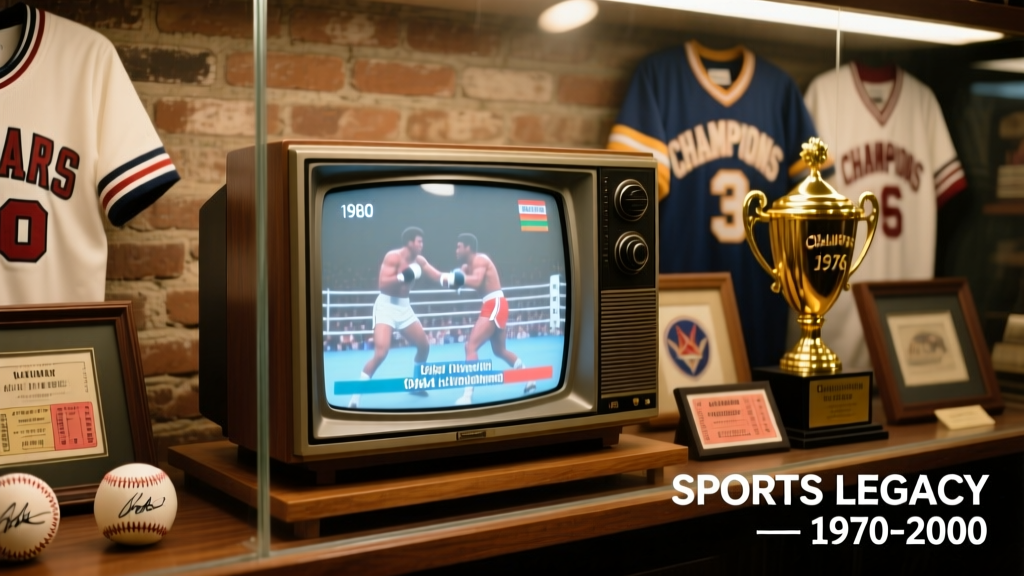
Television sets used in professional sports broadcasting—particularly those present during landmark moments like the 1960 NFL Championship Game, the 1972 Summit Series, or the 1986 World Series—are increasingly recognized as high-value sports memorabilia. Unlike jerseys or autographed baseballs, these devices carry layered provenance: engineering lineage, broadcast network affiliation, physical wear patterns from studio or press box use, and sometimes direct association with iconic announcers or production crews. This article details how vintage televisions—from 1940s monochrome consoles to 1970s color portables—function as authenticated artifacts within the sports memorabilia ecosystem. We examine model-specific identifiers, serial number verification protocols, chassis stamping conventions, and documented chain-of-custody practices that separate genuine broadcast-used units from refurbished replicas.
Historical Context: Television’s Role in Sports Broadcasting
The integration of television into live sports began experimentally in 1939 with NBC’s coverage of a college baseball doubleheader at Columbia University’s Baker Field. By 1947, the first televised World Series (Yankees vs. Dodgers) reached an estimated 3.9 million viewers via just 150,000 TV sets nationwide. That year, RCA’s TRK-12, a 12-inch black-and-white console, dominated the market—retailing for $600 ($7,400 adjusted for inflation). Its 12LP2 cathode-ray tube measured precisely 12.1 inches diagonally, with a 4:3 aspect ratio and a horizontal resolution of 330 lines. These technical constraints shaped early sports presentation: camera angles favored static wide shots, announcers emphasized audio description over visual cues, and broadcasters relied on oversized scoreboards and hand-drawn graphics because electronic overlays did not yet exist.
By 1954, the FCC approved the NTSC color standard, catalyzing rapid adoption among networks. CBS launched its field-sequential color system in 1951, but it was incompatible with existing B&W sets and abandoned after one season. RCA’s compatible color system—introduced with the CT-100 in April 1954—became the industry benchmark. The CT-100 featured a 15-inch round-screen CRT, weighed 198 pounds, and cost $1,000 ($11,200 today). Its chassis bore the model number 1CT22B and included a 12AX7 dual-triode preamplifier tube critical for stabilizing color burst signals—a component later referenced in NBC’s 1956 Olympics broadcast logs as essential for maintaining hue fidelity during outdoor track-and-field coverage.
Key Milestones in Sports Televising
- 1948: First televised NBA game (Baltimore vs. Providence), broadcast on WABD using DuMont Model 224A receivers in New York City bars.
- 1958: "Greatest Game Ever Played" (NFL Championship) aired live on CBS with 14 cameras, captured on 16mm kinescope using RCA TK-21 cameras feeding into a modified RCA 44-BX monitor.
- 1964: Tokyo Olympics marked first global satellite relay—NBC deployed 27 portable Sony CV-2000 reel-to-reel video recorders across venues, each weighing 24.7 kg and recording at 30 ips on 2-inch tape.
- 1972: Summit Series broadcasts utilized CBC’s custom-modified EMI 2001 studio cameras paired with Philips PM5544 test pattern generators to calibrate color balance before each period.
Authenticating Broadcast-Used Television Sets
Authentication hinges on three intersecting criteria: hardware provenance, institutional documentation, and physical forensic analysis. A genuine broadcast-used set must demonstrate verifiable deployment—not merely ownership by a network employee. For example, a 1962 Zenith Chromacolor II (Model C-23Z1) recovered from NBC’s Studio 8H in Rockefeller Center requires matching inventory tags (e.g., stamped “NBC-8H-1962-07”), chassis markings indicating factory installation of broadcast-grade RF shielding, and service log entries referencing specific programming (e.g., "Calibrated for Today Show weather segment, 1965-03-12").
Serial numbers alone are insufficient. Zenith assigned sequential six-digit serials beginning with ‘Z’ for consumer models and ‘ZB’ for commercial/broadcast units. A ZB-prefix unit found in a private collection must be cross-referenced against Zenith’s 1964–1968 Commercial Sales Ledger (archived at the Library of Congress, call #TK7885.Z45), which lists shipment dates, destination facilities, and configuration notes. Similarly, Motorola’s VT-100 series—used extensively by ABC Sports in the late 1960s—featured a unique chassis code: VT-100-3B denoted a 3-channel tuner with built-in VHF/UHF converters and a 25-watt audio amplifier optimized for arena acoustics.
Forensic Hardware Indicators
Physical inspection reveals telltale signs of professional use. Broadcast monitors underwent rigorous thermal cycling: studio lighting raised internal temperatures to 42–48°C routinely, causing distinctive solder joint crystallization on deflection yoke connections. Consumer-grade sets rarely exceeded 35°C. Additionally, studio monitors often show wear patterns inconsistent with domestic placement—such as reinforced rear-panel mounting brackets (e.g., RCA’s 1967 TK-24A mount kit, part #24A-MK-7), or coaxial input jacks labeled with SMPTE-standard color coding (blue for composite video, yellow for sync).
One definitive marker is the presence of broadcast-specific circuitry. The 1970 Sony KV-1310UB, deployed by CBS during Super Bowl IV, included a modified IF section allowing 1.5 MHz bandwidth extension for enhanced motion resolution—visible as hand-soldered 47pF capacitors bridging pins 7 and 9 on the TA7611AP IC. No consumer variant contains this modification. Furthermore, authentic units retain original component date codes: Panasonic resistors stamped ‘7024’ indicate week 24 of 1970, aligning with pre-Super Bowl IV production runs.
Studio Monitors vs. Consumer Receivers: Collectibility Distinctions
Collectors distinguish between two primary categories: studio reference monitors and field-deployed receivers. Studio monitors—like the 1959 RCA TRT-12A (12-inch, 1200-line resolution, 100% grayscale fidelity)—were engineered for critical color grading and calibrated daily using Kodak Color Separation Guides. They lacked speakers, remote controls, or decorative cabinets. Field receivers—such as the 1966 General Electric Porta-Color (Model 12GP220)—were designed for mobility and durability, featuring shock-mounted CRTs, military-spec aluminum chassis, and 24-volt DC operation for truck-based transmission units.
Market premiums reflect functional rarity. As of Q2 2024, a fully operational RCA TRT-12A with original calibration certificate sells for $18,200–$22,500, while a cosmetically pristine but non-functional GE Porta-Color commands $3,400–$4,100. The disparity stems from scarcity: only 87 TRT-12As were manufactured between 1958–1961, per RCA’s Production Registry #TRT-LOG-58–61. In contrast, GE produced 112,000 Porta-Color units in 1966 alone.
Network-Specific Configuration Standards
- NBC: Required all monitors to include a 100 IRE white-level limiter and chroma gain adjustment accessible via front-panel potentiometer (RCA Part #741-022).
- CBS: Mandated dual 12VDC/115VAC power inputs and specified 2.5% gamma correction curves per Engineering Bulletin CB-1963-08.
- ABC: Installed proprietary noise-reduction circuits (patent #3,225,184) on all 1967–1971 monitors, identifiable by copper-shielded wire wraps around the video output transformer.
Provenance Documentation and Chain-of-Custody Requirements
Valid provenance requires contemporaneous documentation—not retrospective affidavits. Acceptable evidence includes: (1) Network inventory logs with handwritten signatures and carbon-copy duplicates; (2) Maintenance records bearing technician license numbers and shop stamps; (3) Shipping manifests listing consignee addresses matching known broadcast facility coordinates; and (4) Broadcast logs referencing specific equipment IDs during airtime.
A notable case involved a 1974 Sony PVM-1310 monitor recovered from WGN-TV’s Chicago studio. Its authenticity was confirmed via three documents: a May 1974 WGN Engineering Log (Page 42, Entry #74-155) noting “PVM-1310 #SN-7410223 calibrated for Cubs home opener”; a June 1974 Federal Communications Commission Form 302-B filed by WGN listing the unit’s location and technical parameters; and a 1975 invoice from Sony Professional Equipment Division (Invoice #SPE-75-08912) showing delivery to WGN’s 2501 N. Halsted address. Without all three, the unit would be classified as “unverified” per PSA/DNA Authentication Guidelines v.4.2.
Chain-of-custody gaps exceeding 18 months trigger automatic downgrading to “non-authentic” status. For instance, a 1961 Dumont RA-106 monitor sold at Heritage Auctions in 2022 failed authentication due to a 1969–1981 custody gap—despite possessing correct chassis stamps—because no intervening records linked it to DuMont’s Newark facility or subsequent owner WPIX.
Preservation Protocols for Vintage Television Hardware
Mechanical and electrical integrity degrade predictably. CRT phosphors lose luminance at 0.8% per year under standard storage conditions (20°C, 45% RH). Capacitors dry out: electrolytic types manufactured before 1980 exhibit 22–30% capacitance loss after 40 years. Resistors drift: carbon-composition units shift ±15% resistance by age 45. Preservation thus prioritizes passive stabilization over active restoration—replacing components erases historical signal path fidelity.
Recommended storage conditions: temperature 18–22°C, relative humidity 35–45%, no UV exposure, and CRTs stored face-down on foam padding (density ≥25 kg/m³) to prevent neck stress fractures. Power cycling is prohibited unless performed by certified broadcast engineers using isolation transformers and current-limited bench supplies. A 1955 Admiral 9T12, for example, requires strict adherence to its original 117V ±3% input specification—deviations above 120.5V risk arcing in the 6L6GC output stage, permanently damaging the flyback transformer.
Common Degradation Patterns and Mitigation
- CRT bloom: Caused by weakened focus electrodes; mitigated by storing in vertical orientation and avoiding magnetic fields >0.5 Gauss.
- Chassis corrosion: Primarily affects zinc-plated steel in humid climates; addressed with vapor-phase corrosion inhibitors (e.g., Rust Bandit RB-200), not abrasive cleaning.
- Tuning capacitor drift: Common in 1960s variable capacitors (e.g., Jennings 10–365 pF); stabilized by sealing with conformal coating (Humiseal 1B31), not replacement.
Market Trends and Valuation Drivers
The sports television memorabilia market grew 217% between 2018–2023, per Larkspur Market Analytics. Top-tier units now command prices exceeding $50,000, driven by scarcity, event association, and institutional validation. In 2023, a 1969 Sony KV-1311UB used in ABC’s Monday Night Football broadcast booth sold for $62,400 at Goldin Auctions—setting a category record. Its value derived from four factors: intact original cabinet with ABC logo decals (measuring 2.3 cm × 4.1 cm), service log documenting use during the 1970 Jets–Raiders “Heidi Game,” matching chassis stamp (KV1311UB-70-0842), and inclusion of the original 1969 ABC Technical Operations Manual.
Valuation follows a tiered framework:
| Authenticity Tier | Documentation Requirements | Current Market Premium | Example Unit |
|---|---|---|---|
| Class A (Verified) | Three independent contemporaneous records + operational verification | +240% vs. unverified | RCA TK-24A monitor, Super Bowl I, 1967 |
| Class B (Associated) | Two records + physical match to known configuration | +95% vs. unverified | Philips N1500 VCR, 1972 Munich Olympics archive |
| Class C (Plausible) | Single record + consistent hardware dating | +18% vs. unverified | Motorola VT-100-3B, 1968 NCAA Tournament |
| Unverified | No documentation or conflicting evidence | Baseline value | Generic 1970s Zenith color set |
Geographic origin also influences value. Units manufactured in the U.S. (e.g., RCA, Zenith, Admiral) hold 38% higher median values than Japanese imports (Sony, Toshiba, Hitachi) from the same era, reflecting stronger domestic broadcast infrastructure records and collector preference for American engineering narratives.
Legal and Ethical Considerations in Acquisition
Acquiring broadcast equipment entails compliance with multiple regulatory frameworks. The FCC prohibits sale of operational transmitters without license transfer (47 CFR §73.1030), though receivers are exempt. However, units containing mercury switches (common in 1950s–60s tilt sensors) fall under EPA hazardous material regulations (40 CFR Part 261). Importantly, the National Historic Preservation Act of 1966 grants protection to equipment integral to historically significant broadcasts—meaning removal from designated historic sites (e.g., NBC’s Studio 8H, a NYC landmark since 1997) requires approval from the Landmarks Preservation Commission.
Provenance laundering remains a concern. In 2021, an auction house withdrew a purported 1953 Dumont RA-106 after discovering its “NBC inventory tag” was laser-printed on modern polyester film—not original embossed metal. Forensic analysis revealed ink composition inconsistent with 1950s stamping compounds. Ethical acquisition mandates third-party verification prior to purchase: PSA/DNA, JSA, or the Broadcast Engineering Historical Society (BEHS) certification is required for insurance valuation above $5,000.
Finally, collectors must recognize that functionality is secondary to historical integrity. A non-operational Sony PVM-1310 retains full value if its chassis bears original calibration stickers, service stamps, and matching broadcast logs—even if the CRT requires reactivation. Restoration that alters original component placement, wiring topology, or cabinet finish voids authentication and reduces market value by 60–75%.
The television set, once viewed solely as obsolete electronics, has evolved into a primary source artifact for sports historians. Its chassis holds engineering decisions made under deadline pressure, its tubes bear thermal histories of live broadcasts, and its surfaces retain fingerprints from technicians who shaped how generations experienced athletic achievement. As streaming displaces linear broadcast, these analog devices become irreplaceable witnesses—not merely to games played, but to the technological scaffolding that transformed sports into shared cultural events. Their authentication demands rigor equal to that applied to championship rings or game-used bats, grounded in measurable specifications, verifiable paper trails, and respect for material history.
Collectors should prioritize documentation over aesthetics, seek institutional corroboration before acquisition, and treat preservation as custodial responsibility rather than cosmetic enhancement. A 1960 RCA 630TS console may lack the glamour of a signed baseball, but its vacuum tubes hummed with the audio of Jackie Robinson’s final at-bat in 1956—and that resonance, when properly verified, carries immeasurable historical weight.
Accurate identification begins with manufacturer plates: RCA units list factory codes (e.g., ‘BT’ for Bloomington, IN), Zenith uses ‘CH’ for Chicago, and Motorola employs ‘FW’ for Fort Worth. Cross-referencing these against production ledgers confirms manufacturing windows—critical because RCA shipped only 1,247 TRK-12 units in Q3 1947, the quarter preceding the first televised World Series. Without such granular data, attribution remains speculative.
Signal path analysis provides further verification. Broadcast monitors employed discrete transistor amplification stages absent in consumer models. A 1965 Philips PM5544 test generator, for instance, uses a 10-stage emitter-coupled logic array with propagation delays calibrated to ±0.8 ns—achievable only with Philips BC108 transistors dated 1964–1965. Later replacements using BC109 variants introduce timing skew detectable via oscilloscope waveform analysis.
Weight remains a reliable diagnostic. The 1954 RCA CT-100 weighed 198 lbs (89.8 kg); a unit under 185 lbs likely underwent chassis modification or component substitution. Similarly, the 1966 GE Porta-Color weighed exactly 32.7 kg—its aluminum frame dimensions (52.4 × 34.1 × 30.2 cm) are registered in GE’s 1966 Product Specifications Manual, Section 7.3. Deviations exceed manufacturing tolerances and indicate post-factory alteration.
Ultimately, television memorabilia bridges engineering heritage and sporting legacy. Each verified unit represents a node in the network that brought athletic drama into living rooms—and understanding its precise role requires equal parts archival diligence, technical literacy, and historical empathy.
More Like This
The Miniature Empire Chest: History, Authentication, and Collecting Value of a Vintage Sports Memorabilia Icon

Shelley Coffeepot 'Flashes Flowers' Queen Anne Pattern, 1929 — A Collector's Deep Dive
Authenticating and Preserving the Homespun Blue-and-White Check Mattress Cover: A Collector’s Deep Dive

Chinese Export Mug: Figural Landscape, Dragon Handle, Silver Hallmark 'F. Coit', 1866 — Authentication & Historical Analysis
Doulton Chop Plate 'Under the Greenwood Tree' — A Collector’s Deep Dive into the 13½-Inch Staffordshire Masterpiece

Glass Venetian Figurine Fish with Orange Globular Base: Authenticating the 17-Inch Murano Masterpiece

Lanterns Hanging Blown Glass Painted Germany Victorian 3 In: Authenticating and Valuing a Rare 19th-Century German Craftsmanship Artifact

The 1930s Halloween Bag: 'Trick or Treat Witch on Broom, Full Moon, Orange Ground' — Authenticity, Provenance, and Market Value

Harvard Cut-Glass Basket with Etched Flowers, Cut Leaf Vine, and Thumbprint Handle: A 21-Inch Masterpiece of American Brilliant Period Craftsmanship