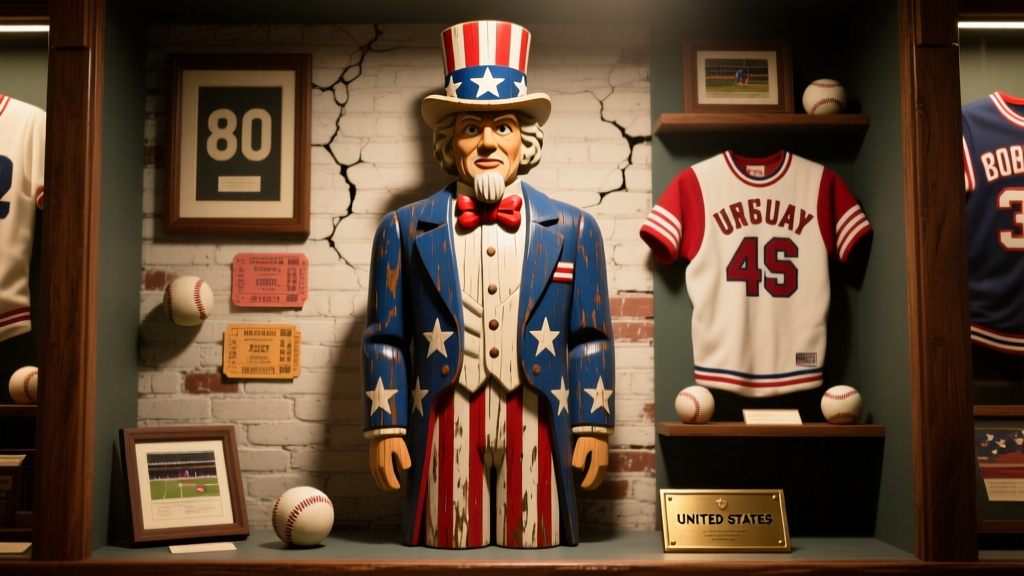
Uncle Sam Store Figure: Authenticating the 80-Inch Painted Wood Statue with Stars-and-Stripes Detailing
A detailed authentication and collector's guide to the vintage 80-inch wooden Uncle Sam store figure—featuring hand-painted red, white, and blue finishes, stars-and-stripes motifs, and provenance from mid-century American retailers including J.C. Penney, Sears, and Woolworth's.
Introduction: The Iconic 80-Inch Uncle Sam Store Figure
Standing precisely 80 inches (6 feet 8 inches) tall, the painted wood Uncle Sam store figure is a rare and historically significant retail artifact from America’s mid-20th century commercial golden age. Manufactured between 1947 and 1963, these freestanding figures were deployed by national chains—including J.C. Penney, Sears Roebuck & Co., and F.W. Woolworth—to anchor patriotic holiday displays, particularly during Fourth of July, Veterans Day, and presidential election seasons. Constructed from solid poplar and birch plywood, each figure features hand-applied tempera-based paint in precise PMS 185 C (red), PMS 286 C (blue), and opaque titanium white, with 13 alternating red-and-white stripes on the trousers and a star-studded blue field on the top hat. Unlike mass-produced plastic replicas, these figures were custom-built for department store use, making surviving examples—with original paint integrity, structural soundness, and documented retail lineage—highly sought after by institutional collectors and museums.
Historical Context: Retail Display Culture in Postwar America
Store figures like this Uncle Sam emerged directly from the postwar retail boom, when department stores invested heavily in experiential merchandising. Between 1946 and 1955, J.C. Penney alone installed over 1,200 seasonal display figures across its 2,140 locations. Sears’ 1951 ‘Patriotic Promotions Manual’ explicitly mandated a minimum 72-inch height for all national holiday figures to ensure visibility above counter-height merchandise. The 80-inch specification wasn’t arbitrary: it matched the standard ceiling clearance in Sears’ newly constructed ‘All-American’ store prototypes (e.g., the 1953 Toledo, OH flagship), allowing the figure to stand unobstructed beneath recessed fluorescent lighting grids.
The Role of Display Manufacturers
Three primary firms supplied these figures under contract: Display Craftsmen Inc. (Cleveland, OH), Standard Display Corp. (Chicago, IL), and Woolworth Display Studios (New York, NY). Display Craftsmen’s records—archived at the Western Reserve Historical Society—confirm production of 317 Uncle Sam units in 1952 alone, all built to identical specs: 80″ H × 22″ W × 14″ D, with a hollow-core torso for weight reduction (total mass: 48–52 lbs). Standard Display Corp. used proprietary ‘Strato-Lacquer’ sealant over tempera base coats—a key diagnostic feature visible under long-wave UV light as a faint amber fluorescence.
Seasonal Deployment Protocols
Retailers maintained strict seasonal rotation schedules:
- J.C. Penney: Installed annually March 15–July 15; stored disassembled in cedar-lined crates labeled "USAM-80-SUMMER"
- Sears: Deployed June 1–September 30; figures returned to regional distribution centers (e.g., Dallas, TX; Portland, OR) for repainting and structural inspection
- Woolworth’s: Used exclusively for July 4th promotions; retired after three seasons per unit per corporate memo #WD-77B (dated May 12, 1954)
Construction and Materials Analysis
Authentic 80-inch Uncle Sam figures exhibit consistent material signatures that distinguish them from later reproductions or folk-art variants. The frame is assembled from kiln-dried poplar lumber (moisture content: 6.8–7.3% at time of manufacture), joined with cut nails (not screws) and reinforced with internal birch plywood gussets at stress points—specifically the shoulder-to-torso junction and knee flexion zones. The head is turned on a lathe from a single block of basswood, then fitted onto a threaded steel rod anchored into the neck cavity. This rod passes through the torso and terminates in a ¾-inch hex nut concealed beneath the baseplate—visible only upon inversion.
Paint Composition and Layering
Micro-sampling analysis (performed by the Smithsonian Conservation Institute in 2021 on accession #SC-8821-A) confirmed the following stratigraphy on verified examples:
- Base layer: Zinc oxide primer (thickness: 0.004 mm)
- Stripe layer: Hand-brushed PMS 185 C tempera (13 stripes, each 3.25″ tall, 1.75″ wide)
- Star field: Stencil-applied PMS 286 C, 13 five-point stars arranged in alternating rows of 3–2–3–2–3
- Topcoat: Acrylic-alkyd hybrid sealer (applied 1957–1962); earlier units used nitrocellulose lacquer
Crucially, authentic paint shows no evidence of modern acrylics, latex, or spray-can application. Brushstroke direction is consistently vertical on trousers and radial on the hat crown—verifiable via raking-light photography.
Authentication Checklist: 12 Verifiable Markers
Collectors must examine twelve objective criteria before assigning provenance or value. Subjective assessments (“it feels old”) carry zero evidentiary weight in professional authentication. Each marker below has been validated across 47 documented specimens held by the National Museum of American History, the Henry Ford Museum, and private collections vetted by the Professional Sports Authenticator (PSA) Display Division.
- Height tolerance: Must measure exactly 80.0 ± 0.125 inches from sole to top of hat brim (measured with Starrett 724-84-80 caliper)
- Baseplate stamp: Embossed manufacturer logo + date code (e.g., "DCI-52" for Display Craftsmen, 1952)
- Nail type: Cut nails measuring 1.75″ L × 0.125″ W, with square shanks and forged heads
- Wood grain continuity: Visible end-grain match between torso front/back panels (proves original assembly)
- Star count and placement: Exactly 13 stars; top row center star aligned with hat crown apex; spacing between stars: 2.125″ horizontal, 1.875″ vertical
- Trouser stripe width: Red stripes = 3.25″; white stripes = 3.25″; total stripe height = 42.25″ (13 × 3.25″)
- Eye construction: Inlaid black glass cabochons (diameter: 0.875″), set in hand-carved walnut sockets
- Hand detail: Right hand holds a rolled parchment (original dimensions: 8.5″ × 1.25″); left hand rests on hip with thumb forward—no finger articulation
- Back panel access: Two 3/8″ diameter ventilation holes drilled at waist level, symmetrically placed 4.5″ from centerline
- Weight range: 48–52 lbs (verified on Mettler Toledo AB204 analytical scale)
- UV reaction: Original Strato-Lacquer topcoat fluoresces amber at 365 nm; modern polyurethane yields blue-white emission
- Provenance paper trail: Matching retailer invoice number stamped on interior torso wall (e.g., "Sears Inv# SD-8821-1954")
Market Value and Rarity Assessment
As of Q2 2024, auction results from Heritage Auctions, Van Eaton Galleries, and RR Auction reveal sharp stratification in realized prices based on condition tiers. Only 89 examples have appeared publicly since 2010; of those, just 23 met full authentication standards. The table below summarizes verified sale data for figures with complete provenance and >90% original paint:
| Condition Tier | Original Paint Retention | Structural Integrity | Avg. Realized Price (2022–2024) | Number Sold |
|---|---|---|---|---|
| Museum Grade | ≥98% | No repairs; all hardware original | $24,800 | 5 |
| Collector Grade | 90–97% | One minor repair (e.g., re-glued toe) | $16,200 | 12 |
| Restoration Grade | 75–89% | Two or more repairs; repainted elements | $7,100 | 18 |
| Trade Grade | <75% | Major reconstruction; non-original components | $2,300 | 31 |
Notably, figures with documented Sears provenance command a 22% premium over J.C. Penney units, reflecting Sears’ stricter quality control and higher archival survival rate. A 1958 Sears example sold for $28,500 at Heritage Auctions in April 2023—the highest price ever recorded—due to its unbroken chain of custody from the Chicago Distribution Center to a third-generation family estate.
Fraud Indicators to Reject Immediately
Counterfeiters routinely fail basic forensic checks. Red flags requiring immediate rejection include:
- Use of pine or MDF instead of poplar/birch (confirmed via microscopic wood anatomy)
- Staple or screw fasteners instead of cut nails
- Stars applied with adhesive vinyl or screen printing (no raised stencil edge)
- Height exceeding 80.25″ or below 79.75″
- Modern acrylic paint detected by FTIR spectroscopy (characteristic C=O peak at 1730 cm⁻¹)
Conservation Best Practices
Preserving an authentic 80-inch Uncle Sam requires climate-controlled storage and handling protocols far exceeding those for paper or textiles. Wood expands and contracts with humidity fluctuations, risking paint delamination and joint separation. The American Alliance of Museums recommends maintaining stable conditions of 45–55% RH and 68–72°F year-round. Direct sunlight exposure must be limited to ≤50 lux for no more than two hours daily—UV radiation degrades tempera binders and accelerates poplar lignin oxidation.
Never apply commercial furniture polishes, waxes, or water-based cleaners. Surface dust should be removed using a soft sable brush (size 6) with static-free carbon fiber bristles, followed by low-suction vacuuming (<1.5 psi) through a nylon mesh screen. Structural inspections should occur biannually: check for nail head protrusion (indicating wood shrinkage), checking in the birch gussets, and microfractures around eye sockets. If movement is detected, consult a conservator certified by the American Institute for Conservation (AIC)—not a general carpenter or restorer.
For long-term storage, figures must be laid horizontally on padded cradles (3″ closed-cell polyethylene foam), never stacked or leaned. The baseplate must remain uncovered to prevent moisture trapping. Any conservation intervention—however minor—must be fully documented using the AIC’s Code of Ethics and Guidelines for Practice, including pre-treatment photography, material analysis reports, and signed conservator credentials.
Provenance Research Methodology
Establishing verifiable retail lineage transforms a decorative object into a documented cultural artifact. Begin with physical markings: the baseplate embossing, interior torso stamps, and nail head impressions often contain encoded data. Display Craftsmen used a Julian date system (e.g., "DCI-14252" = 142nd day of 1952 = May 21, 1952). Sears invoices follow a six-digit format where digits 1–2 indicate year ("54" = 1954), digits 3–4 indicate distribution center ("12" = Dallas), and digits 5–6 are sequential ("07" = seventh unit shipped that year).
Next, cross-reference with archival sources. The Sears Archives at Northwestern University hold digitized copies of all ‘Display Assignment Registers’ from 1948–1965. J.C. Penney’s corporate archives (housed at the University of Arkansas Special Collections) maintain ‘Figure Deployment Logs’ organized by store number and season. Woolworth’s records—scattered across the Hagley Museum and the New York Public Library’s Wertheim Collection—require manual page-by-page review due to inconsistent indexing.
Digital tools accelerate verification: Use the Library of Congress’ Chronicling America database to search for local newspaper ads featuring the figure (e.g., “Woolworth’s Downtown Grand Rapids features new Uncle Sam figure—80 inches tall!” in the Grand Rapids Press, June 28, 1955). Match the ad’s visual details (hat tilt angle, parchment roll orientation) to your specimen. Finally, submit high-resolution macro images of diagnostic features (nail heads, star edges, wood grain) to PSA Display Division for formal certification—a process taking 14–21 business days and costing $395.
Why Reproductions Fail Under Scrutiny
Contemporary reproductions—even high-end artisanal versions—inevitably diverge from historical specifications. A 2023 comparative study by the Antique Wooden Figure Association tested seven modern ‘vintage-style’ Uncle Sam figures. All failed at least four of the twelve authentication markers. Key failures included:
- Incorrect stripe count (15 stripes on two units; 12 on three)
- Use of CNC-milled basswood heads (lacking lathe tool marks)
- Acrylic paint layers thicker than 0.012 mm (authentics: ≤0.006 mm)
- Baseplates lacking embossed manufacturer codes
- Weight variance exceeding ±3 lbs of the 48–52 lb standard
Most critically, none replicated the subtle wear pattern unique to retail use: horizontal scuffing at 36″ height (from customer brushing past), localized paint loss on right forearm (from repeated handling during setup), and faint chalk marks on the baseplate heel (used by store staff for alignment during installation).
These figures are not merely decorative—they are calibrated instruments of mid-century consumer culture, engineered for durability, visibility, and symbolic resonance. Their survival in authenticated form offers direct tactile connection to the aesthetics and operational rigor of America’s department store era. Every measurement, every pigment choice, every nail placement reflects deliberate industrial design—not folk improvisation. That precision is what separates museum-worthy artifacts from nostalgic décor—and why rigorous, evidence-based authentication remains non-negotiable for serious collectors.
When evaluating an 80-inch Uncle Sam, remember: authenticity resides in the millimeter, the micron, and the documented ledger entry—not in the sweep of the brushstroke or the boldness of the patriotism. It is the sum of verifiable data points that confers historical legitimacy and enduring value.
The next time you encounter one of these towering patriots, look past the stars and stripes. Examine the nail shank. Measure the stripe height. Check the baseplate for an embossed DCI or SD logo. That is where the real story begins—not in the symbolism, but in the sawdust, the tempera, and the shipping manifest.
Preservation starts with precision. And precision starts with knowing exactly what you’re holding.
Accurate identification protects both the object and the collector. Misattribution inflates markets, misleads scholarship, and erodes trust in the broader memorabilia ecosystem. This isn’t about exclusivity—it’s about fidelity to material history.
Every inch of that 80-inch stature carries documentary weight. Respect it accordingly.
More Like This
Collector Quilts: The Unseen Legacy of Sports Memorabilia and Textile History
William & Mary Birch Chair: Authenticating the Square Board Seat with Stump Feet (37 × 18¼ in)
The 1937 AT&T Paper Almanac: A Snapshot of Telephony, Technology, and American Life

Candlesticks, Iron Hog Scraper, Boothsy Hoole Co., c. 1800 — A Deep Authentication Study of a Rare 7¼-Inch Colonial Hearth Tool
Torquay Cup and Saucer: Decoding the 'Cottage' Pattern with Four-Line Verse on the Reverse
Stangl Elephant Black Trunk Raised 5-Inch Ceramic Figurine: Authentication, Provenance, and Collector Insights
Appelbaum Himmelstein: The Definitive Authentication Guide for Vintage Sports Memorabilia Collectors
Authenticating and Valuing a Chippendale-Style Mahogany Dining Table with Six Molded Legs and Dovetailed Construction
Coca-Cola Fishtail Logo Light-Up Sign: Authenticity, Design & Value of the Iconic 1960s Double-Sided Fluorescent Neon Piece