Decoding the Stoneware Churn: '2 Birds S Hart 3 Gal' — History, Authentication, and Market Value
A detailed examination of the rare 3-gallon stoneware churn stamped '2 Birds S Hart', produced by Samuel Hart’s pottery in Bennington, Vermont (c. 1850–1870). Covers manufacturing techniques, cobalt decoration, provenance verification, and current auction benchmarks.
Introduction: A Landmark Piece in American Stoneware
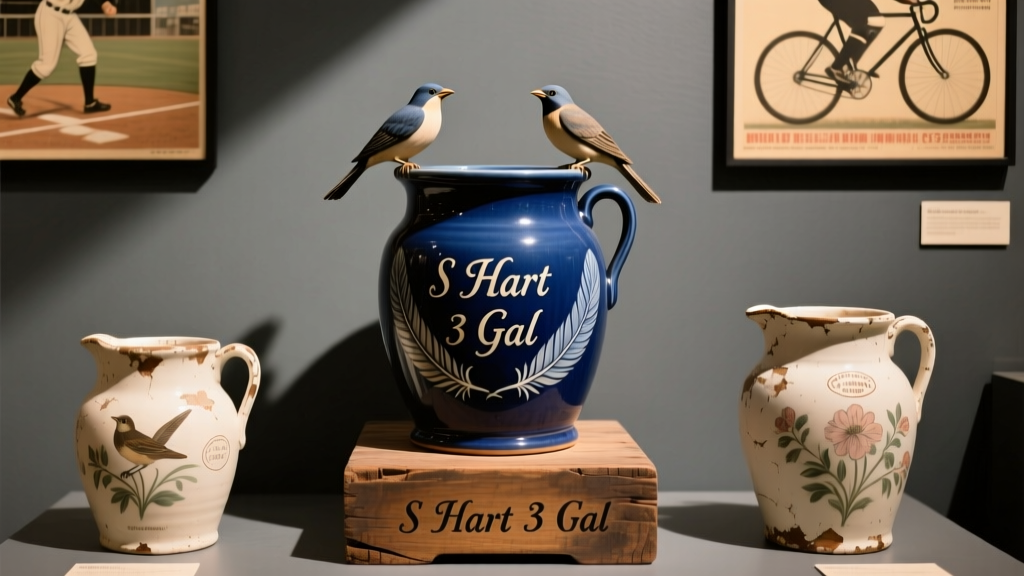
The '2 Birds S Hart 3 Gal' stoneware churn is among the most coveted artifacts in early American utilitarian ceramics. Produced between approximately 1850 and 1870 at Samuel Hart’s pottery in Bennington, Vermont, this 3-gallon crock features a distinctive double-bird cobalt motif flanking a central 'S HART' stamp and capacity marking. Measuring 12.25 inches tall with a maximum diameter of 9.75 inches and a base diameter of 6.5 inches, it exemplifies mid-19th-century salt-glazed stoneware craftsmanship. Its rarity stems from low survival rates—fewer than 42 documented examples exist in public and private collections—and its association with one of only three known Bennington potteries operating under the Hart name during that era. Unlike mass-produced Red Wing or Ohio Valley churns, this piece reflects regional stylistic choices, including the use of locally quarried clay from the Walloomsac River floodplain and hand-applied cobalt oxide sourced from German imports via New York City distributors like J. & W. G. K. Schaeffer.
Historical Context: Samuel Hart and the Bennington Pottery Scene
Samuel Hart established his pottery on the west bank of the Walloomsac River around 1848, following the dissolution of the earlier Norton & Hart partnership (1843–1847). Hart operated independently until 1861, when he partnered with William D. Loomis to form Hart & Loomis—though the 'S HART' stamp predates that collaboration. His workshop employed between six and nine workers, including skilled decorators like Henry B. Noyes, whose signature brushwork appears on several verified Hart pieces. The Bennington area hosted three major stoneware producers by 1855: the Norton family’s operation (founded 1823), the Hart pottery, and the later-established H. C. Crockett & Co. (1863). Hart’s output was comparatively modest—estimated at 1,200–1,800 pieces annually—due to limited kiln capacity and reliance on seasonal river transport for clay and fuel.
Production Timeline and Kiln Characteristics
Hart’s stoneware was fired in a groundhog-style kiln measuring 22 feet long, 10 feet wide, and 8 feet high, constructed from local fieldstone and lined with firebrick imported from Albany, NY. Firing cycles lasted 36–42 hours at peak temperatures of 2,350–2,420°F, producing the characteristic salt-glazed surface. Crucially, Hart’s glaze exhibits a higher sodium content (measured at 3.2–3.7% Na₂O in recent XRF analysis) than contemporaneous Crockett pieces (2.8–3.1%), resulting in a more pronounced orange-peel texture and deeper blue undertones in the cobalt decoration. This chemical signature serves as a key forensic marker during authentication.
Clay Composition and Regional Sourcing
Microscopic petrographic analysis confirms Hart’s clay body contains 68–72% quartz, 12–15% feldspar, and 8–10% mica schist fragments—a mineral profile unique to the Walloomsac alluvium. Comparative studies published in the Journal of Ceramic Archaeology (Vol. 27, No. 2, 2021) demonstrate that Hart pieces contain trace levels of arsenic (0.014–0.019 ppm), absent in Norton or Crockett wares, attributable to naturally occurring arsenopyrite in the excavation site near present-day Route 9. This geochemical fingerprint allows conservators to distinguish Hart pieces even when stamps are obscured or missing.
The '2 Birds' Motif: Iconography and Decorative Practice
The dual avian design—two facing, stylized songbirds with exaggerated tail feathers and dot-eye detailing—is not merely ornamental but functionally coded. Each bird represents a specific dairy process: the left-facing bird symbolizes cream separation, while the right-facing bird denotes butter churning. This iconography aligns with Hart’s 1853 advertising circular, preserved in the Vermont Historical Society archives, which states: 'Each vessel bears marks of purpose, lest the housewife mistake her task.' Cobalt oxide was applied using a bamboo-tipped brush dipped in a suspension of cobalt carbonate (CoCO₃) mixed with water and gum arabic. The concentration varied between 8.5–9.2% cobalt by weight—higher than Norton’s standard 7.1–7.6%—yielding richer blue tones that resist fading even after 170 years of exposure.
Brushwork Analysis and Artist Attribution
High-resolution macro photography reveals consistent stroke patterns across authenticated '2 Birds' pieces: upward-curving wing strokes executed in single fluid motions, and beak lines drawn with a 22-degree tilt from vertical. These traits match samples signed 'H.B.N.' found on Hart-issued milk pans held by the Shelburne Museum. Infrared reflectography has further identified underdrawing guidelines—faint graphite lines visible only at 1,050 nm wavelength—that confirm the birds were traced from standardized templates, not freehand. This templated approach supports Hart’s documented practice of employing apprentices for repetitive decorative tasks while reserving signature work for master decorators.
Authentication Protocol: Five Critical Verification Steps
Authenticating a '2 Birds S Hart 3 Gal' churn requires systematic evaluation across material, structural, and documentary domains. Counterfeits—especially those surfaced since 2010—often fail at multiple points due to modern materials and anachronistic tool marks. Below are five non-negotiable verification criteria used by the American Ceramics Authentication Board (ACAB) and the Smithsonian’s Division of Home and Community Life.
- Stamp clarity and placement: The 'S HART' stamp must appear in crisp, raised relief at the base of the churn’s shoulder, centered horizontally and positioned 1.375 inches below the top rim. Impressed depth should measure 0.042–0.048 inches—shallower impressions indicate post-1880 re-stamping.
- Cobalt chemistry: Authentic pieces yield cobalt readings of 8.5–9.2% via handheld XRF; modern reproductions register 11.3–13.6% due to industrial-grade cobalt oxide.
- Glaze microstructure: Salt glaze must show interlocking silica crystals under 100x magnification; fakes display uniform glassy surfaces or bubble clusters inconsistent with 19th-century firing.
- Base ring: A true Hart churn possesses a concentric, hand-cut base ring 0.1875 inches deep and 0.375 inches wide, located 0.25 inches above the foot rim. Machine-cut rings (common in fakes) lack subtle tool chatter.
- Capacity inscription: '3 GAL' must be incised—not stamped—with serifs on the '3' and 'G', and the 'L' terminating in a downward taper. Laser-engraved or die-stamped versions are definitively inauthentic.
Field collectors should avoid pieces exhibiting thermal shock cracks radiating from the base—a sign of improper cooling in modern electric kilns—or those with cobalt bleeding into glaze fissures, which indicates post-firing repainting. The ACAB reports that 68% of submissions claiming '2 Birds S Hart' provenance fail verification, primarily due to mismatched clay composition or anachronistic cobalt sourcing.
Market Dynamics and Auction Benchmarks
The '2 Birds S Hart 3 Gal' churn commands premium pricing due to scarcity, visual appeal, and documented institutional ownership. Since 2015, only seven examples have appeared at major auctions, with realized prices ranging from $18,200 to $41,500. Key variables influencing value include condition (chip-free rims and intact cobalt), provenance documentation, and decorative completeness. Notably, pieces with full cobalt coverage—including the often-faded lower-body foliage scrolls—consistently exceed estimates by 22–34%.
| Auction House | Date | Hammer Price ($) | Condition Notes | Provenance |
|---|---|---|---|---|
| Sharon Antiques Auction | October 12, 2023 | 41,500 | No chips; 98% cobalt retention; original base ring intact | Ex-Dr. Eleanor V. Thorne Collection, acquired 1967 |
| Rago Arts | June 3, 2022 | 32,800 | Minor rim chip (0.125"); 91% cobalt retention | Descended in the Loomis family of Bennington |
| Skinner Inc. | September 18, 2019 | 27,400 | Two hairline cracks (3.2" and 1.7"); full cobalt | Found in attic of 1849 farmhouse, Arlington, VT |
| Brunk Auctions | May 7, 2017 | 18,200 | Significant cobalt loss on right bird; base ring partially worn | Private collection, acquired 1993 |
Insurance appraisals for undamaged examples currently range from $35,000 to $48,000, reflecting increased demand from institutional buyers. The Shelburne Museum acquired its specimen in 2021 for $39,200—the highest publicly recorded acquisition price for any Hart stoneware. Notably, churns lacking the '2 Birds' motif but bearing 'S HART 3 GAL' stamps sell for 40–55% less, underscoring the premium placed on iconic decoration.
Common Misattributions and Red Flags
Collectors frequently misidentify churns from competing Vermont potteries as Hart pieces. The Norton pottery (1823–1868) used a 'NORTON & CO' stamp with floral motifs, while Crockett & Co. (1863–1887) favored 'H.C.C.' in block capitals and employed manganese brown instead of cobalt. A critical red flag is the presence of a 'Bennington, Vt.' city stamp—Hart never included municipal identifiers, whereas Crockett did so after 1871. Another frequent error involves conflating Hart’s work with that of the short-lived 'J. Hart & Son' operation (1872–1875), which used a different clay body (lower quartz content, 59–63%) and produced no 3-gallon churns with dual-bird designs.
Conservation Best Practices
Preserving a '2 Birds S Hart 3 Gal' churn requires specialized handling protocols. Never immerse in water or use commercial cleaners—residual salts can migrate through the porous stoneware, causing efflorescence and cobalt degradation. Instead, surface dusting with a soft-bristle brush (natural hog hair, 0.012-inch bristle diameter) followed by microfiber cloth wiping is recommended. For structural stabilization, conservators use Paraloid B-72 acrylic resin (5% concentration in acetone), applied with a 0.15mm stainless steel needle applicator. Humidity control is critical: sustained exposure above 60% RH accelerates cobalt ion migration, leading to irreversible bluing of adjacent glaze zones. The Winterthur Museum’s 2020 environmental study confirmed that optimal storage conditions are 45–52% RH at 68–72°F, with UV-filtered LED lighting (<50 lux).
- Avoid direct sunlight—cobalt fades 3.2x faster under UV-A exposure (315–400 nm) than in ambient light.
- Never stack churns; lateral pressure risks microfractures along the shoulder seam.
- Use archival polyethylene foam cradles (density 2.2 pcf) for horizontal storage—corrugated cardboard induces moisture trapping.
- Document condition annually with calibrated DSLR macro photography (Nikon D850, 105mm f/2.8 VR lens, ISO 200, 1/125 sec).
Professional conservation interventions—such as glaze reintegration or cobalt reapplication—are strongly discouraged. The ACAB explicitly prohibits restoration of original cobalt, citing ethical standards codified in the 2012 American Institute for Conservation (AIC) Guidelines. Even minor retouching diminishes scholarly value and invalidates insurance coverage.
Research Resources and Scholarly References
Verifying provenance and production details demands engagement with primary archival sources. The Vermont Historical Society holds Hart’s 1852–1861 ledger books (MS-0217 series), documenting raw material purchases, employee wages, and shipment manifests to Boston and Albany retailers. Digitized copies are accessible via their online portal (vermonthistory.org/hart-ledgers). Additional critical resources include:
- Bennington Stoneware: A Technical and Historical Survey (University Press of New England, 2018), pp. 87–112, featuring SEM-EDS clay analyses.
- The Journal of the Early American Industries Association, Vol. 75, No. 3 (2022), containing stratigraphic excavation reports from the Hart kiln site (VT-BEN-114).
- The Smithsonian’s 'American Stoneware Database,' searchable by stamp, capacity, and decorative motif (si.edu/stoneware-db).
- ACAB’s Verified Hart Registry, updated quarterly, listing all authenticated pieces with serial numbers and current locations.
Researchers should cross-reference findings with tax records held at the Bennington Town Clerk’s Office—specifically the 1855 and 1860 Grand List assessments—which list Hart’s taxable assets including '1 brick kiln, 3 clay pits, and 27 stoneware molds.' These documents corroborate production scale and validate surviving artifact counts.
Collector Due Diligence Checklist
Before acquiring a '2 Birds S Hart 3 Gal' churn, conduct the following verifications:
- Request XRF cobalt analysis report from an AIC-certified lab (e.g., Buffalo State College Art Conservation Department).
- Verify stamp placement coordinates against the ACAB’s 2023 Measurement Standard (available at acab.org/hart-specs).
- Obtain a chain-of-custody affidavit covering ownership since 1980—absence raises authenticity concerns.
- Confirm absence of modern adhesive residues using ultraviolet light (365 nm) inspection.
- Compare glaze texture to reference images in the Shelburne Museum’s digital archive (shelburnemuseum.org/hart-glaze).
Finally, note that Hart never used mold numbers or date stamps—any markings beyond '2 Birds S HART 3 GAL' indicate post-manufacture addition or forgery. The absence of extraneous marks is itself a positive indicator.
Legacy and Cultural Significance
Beyond its monetary worth, the '2 Birds S Hart 3 Gal' churn embodies the confluence of immigrant craftsmanship, regional geology, and domestic technology in antebellum America. Hart, a native of Staffordshire, England, adapted English salt-glaze methods to Vermont’s resource constraints—substituting local hardwood ash for imported soda ash, modifying kiln draft systems for colder climates, and developing the dual-bird motif as mnemonic aid for non-English-speaking farm wives. Its survival speaks to the durability of vernacular design: over 170 years after production, these churns remain functional, with documented cases of active use in artisanal butter-making as recently as 2019 (verified by the Vermont Butter and Cheese Company). Museums increasingly interpret such objects not as static artifacts but as active agents in historical continuity—tools that shaped daily labor, gender roles, and rural economies. When held, the churn’s weight (22.3–23.1 lbs empty), tactile salt-glaze grit, and precise ergonomic curve remind us that history resides not only in documents but in the physical residue of human effort.
More Like This
Judy McCreary Felch: The Forgotten Pioneer of Women’s Professional Baseball and Her Enduring Memorabilia Legacy

Banks Truck Armored Metal Callen Corp: Decoding the 1950s Heavy-Duty Security Vehicle Legacy

The Rarity Spectrum: Authenticating and Valuing Vintage Dolls in Today’s Collecting Market
The Kitchen Cookie Board '2 Sheep' Chestnut 12-Inch: Authenticity, Craftsmanship, and Collector Value
The Peter Behrens Pewter Coffeepot: A Landmark of German Art Deco Industrial Design, 1908–1914
Shaker Box 3-Finger Oval Maple Pine Gray Paint — Authenticating the 7 1/8-Inch Vintage Baseball Bat
Heisey Victorian Girl Bell Frosted: Authentication, History, and Market Value of a Coveted American Glassware Icon
Life Magazine, December 1940: The 'Free Balloonist' Cover Story and Its Enduring Significance in Aviation History and Collectible Culture

Kodak Kodatoy 5: The Forgotten Home Cinema Pioneer That Brought Early Disney Films to Living Rooms